Thank you for visiting SNEWPapers!
Sign up free
The Virginia Gazette
Williamsburg, Virginia
What is this article about?
Extract of a letter from an American army officer near Princeton, dated Jan 7, 1777, describing the Jan 2 battle at Trenton where U.S. forces under Washington repelled British advance led by Cornwallis, then marched to Princeton on Jan 3, defeating enemy troops, capturing prisoners, artillery, and forcing British retreat toward New York. American losses: ~40 killed, ~80 wounded; British heavier.
Merged-components note: These two components are a direct continuation of the same letter extract detailing the battles at Trenton and Princeton, forming a single coherent domestic news report on American Revolutionary War events.
Clippings
1 of 2
OCR Quality
Full Text
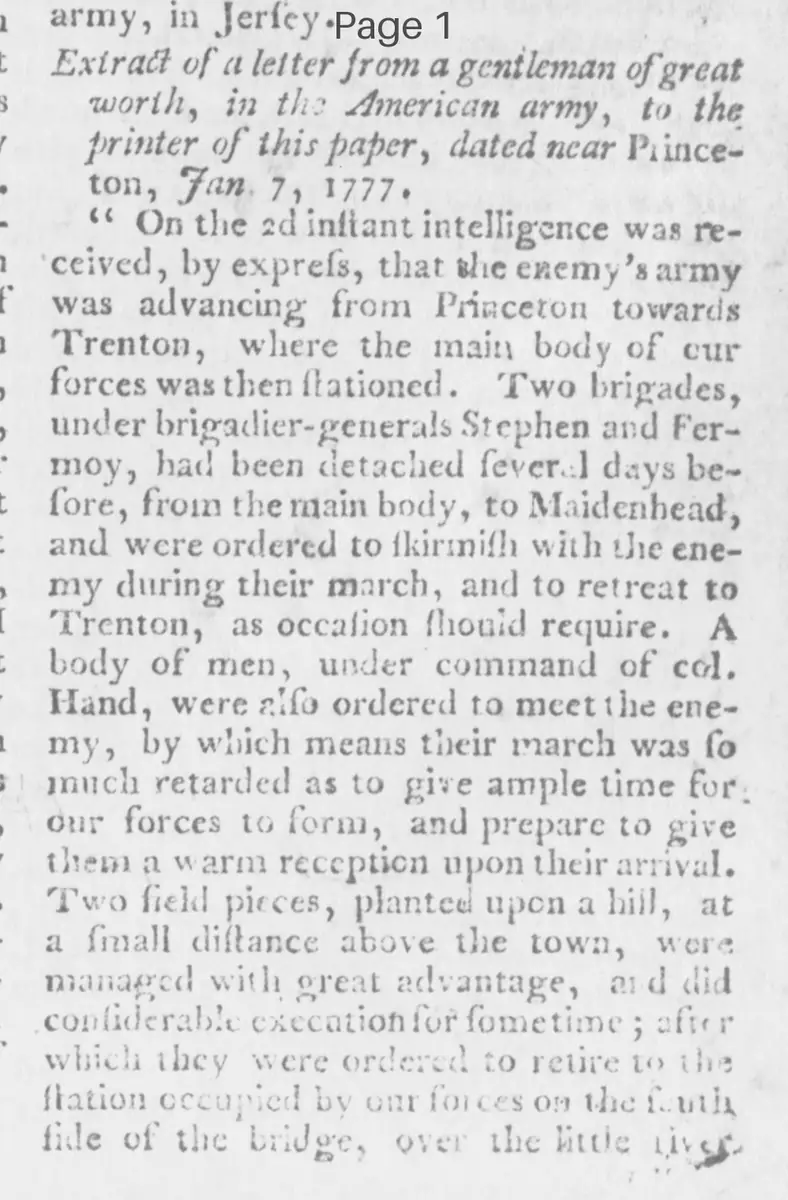
"On the 2d instant intelligence was received, by express, that the enemy's army was advancing from Princeton towards Trenton, where the main body of our forces was then stationed. Two brigades, under brigadier-generals Stephen and Ferguson, had been detached several days before, from the main body, to Maidenhead, and were ordered to skirmish with the enemy during their march, and to retreat to Trenton, as occasion should require. A body of men, under command of col. Hand, were also ordered to meet the enemy, by which means their march was so much retarded as to give ample time for our forces to form, and prepare to give them a warm reception upon their arrival. Two field pieces, planted upon a hill, at a small distance above the town, were managed with great advantage, and did considerable execution for some time; after which they were ordered to retire to the station occupied by our forces on the south side of the bridge, over the Assunpink river."
which divides the town into two parts, and opens at right angles into the Delaware. In their way through the town the enemy suffered much by an incessant fire of musketry, from behind the houses and barns. Their army had now arrived at the northern side of the bridge, whilst our army was drawn up, in order of battle, on the southern side. Our cannon played very briskly from this eminence, and were returned as briskly by the enemy. In a few minutes after the cannonade began a very heavy discharge of musketry ensued, and continued for 10 or 15 minutes. During the action a party of men were detached from our right wing, to secure a part of the river, which it was imagined, from the motions of the enemy, they intended to ford. This detachment arrived at the pass very opportunely, and effected their purpose. After this, the enemy made a feeble and unsupported attempt to pass the bridge, but this likewise proved abortive. It was now near 6 o'clock in the evening, and night coming on, closed the engagement. Our fires were built in due season, and very numerous, and whilst the enemy were amused by these appearances, and preparing for a general attack the ensuing morning, our army marched, about 1 in the morning, from Trenton, on the south side of the creek, to Princeton. When they arrived near the hill, about one mile from Princeton, they found a body of the enemy formed upon it, and ready to receive them; upon which a spirited attack was made upon them, both with field pieces and musketry, and after an obstinate resistance, and losing a considerable number of their men upon the field, those of them who could not make their escape surrendered prisoners of war. We immediately marched on to the centre of the town, and there took another party of the enemy, near the college. After tarrying a short time in the town, general Washington marched his army from thence towards Rocky Hill, and they are now at Morris town, in high spirits, and in expectation of a junction with the rest of our forces, sufficiently seasonable to make a general attack upon the enemy, and prevent, at least, a considerable part of them from reaching their asylum in New York. It is difficult, precisely, to ascertain the loss we have sustained in the two engagements; but, as near as I can judge, I think we have lost about 40 men killed, and had near double the number wounded. In the list of the former are the brave col. Haslet, capt. Shippen, and capt. Neal, who fell in the engagement upon the hill near Princeton; amongst the latter was brigadier-general Mercer, who received seven wounds, five in his body, and two in his head, and was much bruised by the breech of a musket. His life was yesterday almost despaired of, but this morning I find him much relieved, and some of the most dangerous complaints removed, so that I still have hopes of his recovery, and of his being again restored to the arms of his grateful country. He is now a prisoner upon parole. The loss sustained by the enemy was much greater than ours, as was easily discovered by viewing the dead upon the field, after the action. We have near 100 of their wounded prisoners in the town, which, together with those who surrendered, and were taken in small parties, endeavouring to make their escape, I think must amount nearly to the number of 400, chiefly British troops. Six brass pieces of cannon have fallen into our hands, a quantity of ammunition, and several waggons of baggage. A capt. Lt. Lie was found amongst the enemy's dead, and was this day buried with the honours of war. And number of other officers were also found on the field, but they were not known, and were buried with the other dead. According to information from the inhabitants of Princeton, the number which marched out of it to attack our army amounted to 1300 men, under command of general Cornwallis. This body, as soon as they discovered that they were out-generalled by the march of general Washington, being much chagrined at their disappointment (as it seems they intended to have cut our army to pieces, crossed the Delaware, and marched immediately, without any farther delay, to Philadelphia) pushed, with the greatest precipitation, towards Princeton, where they arrived about an hour after general Washington had left it; and imagining he would attempt to take Brunswick in the same manner, proceeded directly for that place. Our soldiers were much fatigued, the greatest part of them having been deprived of their rest the two preceding nights, otherwise, we might, perhaps, have possessed ourselves of Brunswick. The enemy appear to be preparing to decamp, and retire to New York, as they are much disgusted with their late treatment in New Jersey, and have a great inclination to rest themselves a little in some secure winter quarters."
What sub-type of article is it?
What keywords are associated?
What entities or persons were involved?
Where did it happen?
Domestic News Details
Primary Location
Trenton And Princeton, New Jersey
Event Date
Jan 2 3, 1777
Key Persons
Outcome
american losses: about 40 killed (including col. haslet, capt. shippen, capt. neal) and near 80 wounded (including brigadier-general mercer with seven wounds). enemy losses greater: near 100 wounded prisoners, total ~400 prisoners (chiefly british), considerable dead on field; 6 brass cannon, ammunition, baggage wagons captured. enemy retreated toward new york.
Event Details
On Jan 2, 1777, British army under Cornwallis advanced from Princeton toward Trenton; American brigades under Stephen and Ferguson skirmished to delay them, allowing forces to prepare. Artillery and musketry repelled enemy at Assunpink bridge; after dark, Washington marched army to Princeton, attacking and defeating enemy brigade on hill near town, capturing prisoners and another party near college. Army then moved toward Rocky Hill, now at Morristown expecting junction with other forces.