Thank you for visiting SNEWPapers!
Sign up free
The State Guard
Wetumpka, Elmore County, Alabama
What is this article about?
The Democratic Party convention in Montgomery, Alabama, on May 3-4, 1847, organized proceedings, nominated Reuben Chapman for governor after multiple ballots, and adopted resolutions on state debt, Mexican War, tariff policy, slavery in territories, and other political issues.
Merged-components note: Merge the Democratic Convention journal (page 1), delegate/voter table (page 1), and continuation of resolutions (page 2) as they form a single coherent report on the convention proceedings. Resulting label 'domestic_news' best describes the political content; differs from original 'story' and 'table' labels.
Clippings
1 of 2
OCR Quality
Full Text
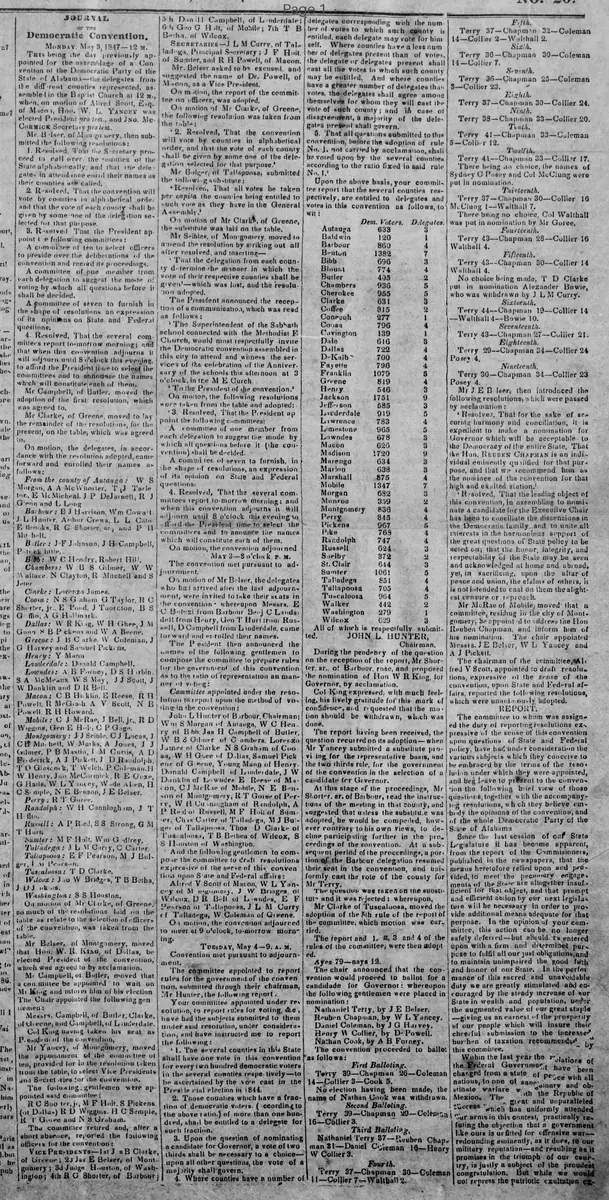
Monday. May 3. 1847-12 M.
This being the day previously appointed for the assemblage of a Convention of the Democratic Party of the State of Alabama—the delegates from the different counties represented, assembled in the Baptist Church at 12 M. when, on motion of Alfred Scott, Esq. of Macon, Hon. W. L. Yancey was elected President pro tem., and Jno. McCormick Secretary pro tem.
Mr. J. E. Belser, of Montgomery, then submitted the following resolutions:
1. Resolved, That the Secretary proceed to call over the counties of the State alphabetically, and that the delegates in attendance enrol their names as their counties are called.
2. Resolved. That the convention will vote by counties in alphabetical order and that the vote of each county shall be given by some one of the delegation selected for that purpose.
3. Resolved That the President appoint the following committees:
A committee of ten to select officers to preside over the deliberations of the convention and record its proceedings.
A committee of one member from each delegation to suggest the mode of voting by which all questions before it shall be decided.
A committee of seven to furnish in the shape of resolutions an expression of its opinions on State and Federal questions:
4. Resolved. That the several committees report to-morrow morning; and that when this convention adjourns it will adjourn until 8 o'clock this evening. to afford the President time to select the committees and to announce the names which will constitute each of them.
Mr Campbell, of Butler, moved the adoption of the first resolution, which was agreed to.
Mr Clarke, of Greene. moved to lay the remainder of the resolutions, for the present, on the table, which was agreed to.
On motion, the delegates, in accordance with the resolution adopted, came forward and enrolled their names as follows:
From the county of Autauga: W S Morgan, A A McWhorter, TJ Tarleton. E McMichael. J P DeJarnett, R J Glenn and L Long
Barbour ; B J Harrison. Wm Cowan J L Hunter. Arthur Crews. L L Cato E Brooks, R C Shorter, sr. and P H Mitchell.
Butler : J.F Johnson, J H Campbell, Patrick Little.
Bibb: W C Hendry, Robert Hill.
Chambers: W B S Gilmer, W W Wallace. N Clayton, R Mitchell and S Jeter
Clarke: Lorenzo James.
Coosa: N S Graham G Taylor. R C Shorter, jr.. E Pound, J Thornton, B S Gwin. A G Harnack.
Dallas: W R King, W H Ghee, JM Gunn S B Pickens and W A Beene.
Greene: J B Clarke. W Coleman, J G Harvey and Samuel Pickens.
Henry: Y Mann
Lauderdale: Donald Campbell.
Lowndes: A B Forney, D S Harbin. S A McMeans. W S May, JJ Scott, J W Dunklin and D R Bell.
Macon: CB H. Akin, E Reese. RH Powell. R McGaha A V Scott, N B Powell. R H Howard.
Mobile: C J McRae, J Bell. jr. R D Wiggins, Geo E Hull, C P Gage.
Montgomery: J J Seible, C J Lucas, J CB Mitchell, W Marks, A Jones, J J Gilmer, P B Mastin, I M Curtis, A D Frederick, A J Pickett, JD Randolph, T O Glascoek, T Welch, P Coleman.H W Henry, Jno McCormick, R E Coxe, G Hails, W L Yancey, Wade Allen, H C Semple, N E Benson, J E Belser.
Perry: RT Goree.
Randolph: W H Cunningham, J T Hilto.
Russell: A P Reed, S S Strong, G M T Hurt.
Sumter: M F Holt, Wm G direy.
Talladega: J L M Garry, C Carter.
Tallapoosa: E F Pearson, M J Bulger, I M Pearson.
Tuscaloosa: T D Clarke.
Wilcox : Jno W Bridges, T B Bethea, Jukes.
Washington: S S Houston.
On motion of Mr Clarke, of Greene. so much of the resolutions laid on the table as relate to the selection of officers of the convention, was taken from the table.
Mr Belser, of Montgomery, moved that Hon. W. R. King, of Dallas, be elected President of the convention, which was agreed to by acclamation.
Mr Campbell, of Butler, moved that a committee be appointed to wait on Col King and inform him of his election The Chair appointed the following gentlemen:
Messrs. Campbell, of Butler, Clarke, of Greene, and Campbell, of Lauderdale.
Col King having taken his Seat as President of the convention,
Mr Yancey, of Montgomery, moved the appointment of the committee of ten, provided for in the resolution taken from the table, to select Vice Presidents and Secretaries for the convention.
The following gentlemen were appointed said committee:
R C Shorter, jr, M F Holt. S Pickens. (of Dallas) R D Wiggins. H C Semple, R T Goree and N S Graham.
The committee retired and, after a short absence, reported the following officers for the convention:
Vice Presidents—1st J B Clarke of Greene; 2nd Jas E Belser, of Montgomery; 3d Judge Houston, of Washington; 4th R C Shorter, of Barbour 5th DonII Campbell, of Lauderdale; 6th Geo C Hull, of Mobile; 7th T B Betha, of Wilcox.
Secretaries—J L M Curry, of Talladega, Principal Secretary; J F Holt. of Sumter, and R H Powell, of Macon.
Mr. Belser asked to be excused. and suggested the name of Dr. Powell, of Macon, as a Vice President.
On motion, the report of the committee on officers, was adopted.
On motion of Mr Clarke, of Greene the following resolution was taken from the table:
'2. Resolved, That the convention will vote by counties in alphabetical order, and that the vote of each county shall be given by some one of the delegation selected for that purpose.'
Mr Bulger, of Tallapoosa, submitted the following substitute:
Resolved, That all votes be taken per capita the counties being entitled to such vote as they have in the General Assembly.
On motion of Mr Clarke, of Greene, the substitute was laid on the table.
Mr Seibles, of Montgomery. moved to amend the resolution by striking out all after resolved, and inserting—
That the delegation from each county determine the manner in which the vote of their respective counties shall be given'—which was lost, and the resolution adopted.
The President announced the reception of a communication, which was read as follows:
The Superintendent of the Sabbath school connected with the Methodist E Church, would most respectfully invite the Democratic convention assembled in this city to attend and witness the services of the celebration of the Anniversary of the schools this afternoon at 3 o'clock.in the M E Church
To the President of the convention.'
On motion, the following resolutions were taken from the table and adopted:
3. Resolved, 'That the President appoint the following committees:
A committee of one member from each delegation to suggest the mode by which all questions before it (the convention)shall be decided.
A committee of seven to furnish, in the shape of resolutions, an expression of its opinion on State and Federal questions.
4. Resolved, That the several committees report to-morrow morning; and when this convention adjourns It will adjourn until 8 o'clock this evening so as to afford the President time to select the committees and to announce the names which will constitute each of them.
On motion, the convention adjourned May 3-8 o'clock. P. M.
The convention met pursuant to adjournment.
On motion of Mr Belser, the delegates who had arrived after the last adjournment, were invited to take their seats in the convention whereupon Messrs. E C Bolen from Barbour Benj C Lamsdell from Henry, Geo T Hurt from Russell, D Campbell from Lauderdale. came forward and enrolled their names.
The President then announced the names of the following gentlemen to compose the committee to prepare rules for the government of this convention as to the ratio of representation an manner of voting:
Committee appointed under the resolution to report upon the method of voting in the convention
John L Hunter of Barbour, Chairman;
Wm S Morgan of Autauga, W C Henry of Bibb. Jas H Campbell of Butler, W B S Gilmer of Chambers. Lorenzo James of Clarke N S Graham of Coosa, W H Ghee of Dallas, Samuel Pickens of Greene, Young Mann of Henry. Donald Campbell of Lauderdale, J W Dunklin of Lowndes E Reese of Macon. CJ McRae of Mobile. N E Benson of Montgomery, R T Goree of Perry. W H Cunningham of Randolph, A P Reed of Russell, M F Holt of Sumter. Chis Carter of Talladega, M J Bulger of Tallapoosa. Thos D Clarke of Tuscaloosa, T B Bethea of Wilcox, S S Houston of Washington.
And the following gentlemen to compose the committee to draft resolutions expressive of the sense of this convention upon State and Federal affairs:
Alfred V. Scott of Macon, W L Yancey of Montgomery. J W Bridges. of Wilcox, D R Bell of Lowndes, E F Pearson of Tallapoosa, J L M Curry of Talladega, W Coleman of Greene.
On motion, the convention adjourned to meet at 9 o'clock, to-morrow morning
Tuesday, May 4-9, A. M.
Convention met pursuant to adjournment.
The committee appointed to report rules for the government of the convention, submitted through their chairman, Mr Hunter, the following report.
Your committee appointed under resolution, to report rules for voting, &c., have had the subjects submitted to them under said resolution, under consideration, and have instructed me to report the following:
I. The several counties in this State shall have one vote in this convention for every two hundred democratic voters in the several counties respectively—to be ascertained by the vote cast in the Presidential election in 1844.
2. Those counties which have a fraction of democratic voters.(according to the above ratio,) of more than one hundred, shall be entitled to a delegate for such fraction.
3. Upon the question of nominating a candidate for Governor, a vote of two thirds shall be necessary to a choice upon all other questions, the vote of a majority shall govern.
4. Where counties have a number of delegates corresponding with the number of votes to which such county is entitled, each delegate may vote for himself. Where counties have a less number of delegates present than of votes. the delegate or delegates present shall cast all the votes to which such county may be entitled. And where counties have a greater number of delegates than votes. the delegates shall agree among themselves for whom they will cast the vote of such county: and in case of disagreement, a majority of the delegates present shall govern.
5. That all questions submitted to this convention,before the adoption of rule No. l, not carried by acclamation, shall be voted upon by the several counties according to the ratio fixed in said rule No. I.'
Upon the above basis, your committee report that the several counties respectively, are entitled to delegates and votes in this convention as follows, to wit :
All of which is. respectfully submitted.
JOHN L. HUNTER,
Chairman.
During the pendency of the question on the reception of the report, Mr Shorter. sr.. of Barbour. rose, and proposed the nomination of Hon W R King, for Governor, by acclamation.
Col King expressed, with much feeling, his lively gratitude for this mark of confidence, and requested that the motion should be withdrawn, which was done.
The report having been received, the question recurred on its adoption—when Mr Yancey submitted a substitute providing for the representative basis, and the two thirds rule, for the government of the convention in the selection of a candidate for Governor.
At this stage of the proceedings. Mr Shorter, sr. of Barbour, read the instructions of the meeting in that county, and suggested that unless the substitute was adopted, he would be compelled, however contrary to his own views. to decline participating further in the proceedings of the convention. At a subsequent period of the proceedings, a portion of the Barbour delegation resumed their seat in the convention, and uniformly cast the vote of the county for Mr Terry.
The question was taken on the substitute and it was rejected: whereupon.
Mr Clarke of Tuscaloosa, moved the adoption of the 5th rule of the report of the committee; which motion was carried.
The report and 1, 2, 3 and 4 of the rules of the committee; were then adopted.
The chair announced that the convention would proceed to ballot for a candidate for Governor: whereupon the following gentlemen were placed in nomination:
Nathaniel Terry, by J E Belser.
Reuben Chapman, by W L Yancey.
Daniel Coleman, by J G Harvey.
Henry W Collier, by D. Powell.
Nathan Cook, by A B Forney.
The convention proceeded to ballot as follows:
First Balloting.
Terry 39—Chapman 26—Coleman 14—Collier 3—Cook 5.
No election having been made, the name of Nathan Cook was withdrawn.
Second Balloting.
Terry 39 Chapman 29—Coleman 16—Collier 3.
Third Balloting.
Nathaniel Terry 37—Reuben Chapman 31—Daniel Coleman 16—Henry W Collier 3.
Fourth.
Terry 37 —Chapman 30 Coleman 11—Collier 7—Walthall 2.
Fifth,
Terry 37—Chapman 32—Coleman 14—Collier 2—Walthall 2
Sixth.
Terry 36—Chapman 30—Coleman 14—Collier 7.
Seventh.
Terry 36—Chapman 25—Coleman 3—Collier 23.
Eighth.
Terry 37—Chapman 30—Collier 24.
Ninth.
Terry 38—Chapman 33—Collier 20.
Tenth.
Terry 41—Chapman 33—Coleman 5—Collier 12.
Twelfth.
Terry 41—Chapman 33—Collier 17.
There being no choice, the names of Sydney C Posey and Col McClung were put in nomination.
Thirteenth.
Terry 37—Chapman 30—Collier 16 MeClung 1—Walthall 7.
There being no choice, Col Walthall was put in nomination by Mr Goree.
Fourteenth.
Terry 43—Chapman 28—Collier 16 Walthall 4.
Fifteenth.
Terry 43—Chapman 30—Collier 14 Walthall 4.
No choice being made. T D Clarke put in nomination Alexander Bowie, who was withdrawn by J L M Curry.
Sixteenth.
Terry 44—Chapman 19—Collier 14 —Walthall 4—Bowie 10.
Seventeenth.
Terry 43—Chapman 27—Collier 21.
Eighteenth.
Terry 29—Chapman 34—Collier 24 Posey 4.
Nineteenth.
Terry 30—Chapman 34—Collier 23 Posey 4.
Mr J E Belser, then introduced the following resolutions, which were passed by acclamation:
Resolved. That for the sake of securing harmony and conciliation, it is expedient to make a nomination for Governor which will be acceptable to the Democracy of the entire State, That the Hon, Reuben Chapman is an individual eminently qualified for that purpose, and that we recommend him as the nominee of the convention for that high and exalted station.
Resolved. That the leading object of this convention. in assembling to nominate a candidate for the Executive Chair has been to conciliate the dissensions in the Democratic family. and to unite all interests in the harmonious support of the great questions of State policy to be acted on; that the honor, integrity, and respectability of the State may be seen and acknowledged at home and abroad, yet, in sacrificing, upon the altar of peace and union, the claims of others, it is not intended to cast on them the slightest censure or reproach.
Mr McRae of Mobile: moved that a committee, residing in the city of Montgomery, be appointed to address the Hon Reuben Chapman, and inform him of his nomination. The chair appointed Messrs. J E Belser, W L Yancey and A J Pickett.
The chairman of the committee, Alfred V Scott, appointed to draft resolutions, expressive of the sense of the convention, upon State and Federal affairs. reported the following resolutions, which were unanimously adopted.
REPORT.
The committee to whom was assigned the duty of reporting resolutions expressive of the sense of this convention upon questions of State and Federal policy, have had under consideration the various subjects which they conceive to be embraced by the terms of the resolution under which they were appointed, and beg leave to present to the convention the following brief view of those questions, together with the accompanying resolutions, which they believe embody the opinions of the convention, and of the whole Democratic Party of the State of Alabama
Since the last session of our State Legislature it has become apparent, from the report of the Commissioners, published in the newspapers, that the means heretofore relied upon and provided, to meet the pecuniary engagements of the State are altogether insufficient for that object, and that prompt and efficient action by our next legislature will be necessary in order to provide additional means adequate for that purpose. In the opinion of your committee, this action can be no longer safely deferred—but should be entered upon with a firm and determined purpose to fulfil all our just obligations,and to maintain unimpaired the good faith and honor of our State. In the performance of this sacred and unavoidable duty we are greatly stimulated and encouraged by the steady increase of our State in wealth and population, under the augmented value of our great staple -giving us an earnest of the prosperity of our people which will insure their cheerful submission to the increased burthen of taxation recommended by this committee.
Within the last year the "relations of the Federal Government have been changed from a state of peace with all nations, to one of sanguinary and obstinate warfare with the Republic of Mexico.
The great and unparalleled success which has uniformly attended our arms in this contest, practically refuting the objection that a government like ours is unfitted for offensive war redounding eminently, as it does, to our military reputation—and resulting as it promises in the triumph of our country, is justly a subject of the proudest congratulation. But while we would not repress the patriotic exultation easily awakened in every American bosom by these brilliant achievements, we cannot disguise from ourselves the fact, that this war has been forced upon the country by the perfidy and faithlessness of Mexico, and the imbecility and folly of her rulers; and that it has been unnecessarily protracted and embarrassed by the factious opposition of a portion of our countrymen to the measures of the Executive for its vigorous prosecution. We believe that the war will be prosecuted until a just, honorable and permanent peace shall be secured; and that the terms of that peace should be such as to secure to our citizens the enjoyment of all the rights guaranteed to them by the treaty of 1842, and to indemnify them for the injuries and losses they have sustained from the wanton and unprovoked aggressions of Mexico. We are opposed to any attempt to conquer Mexico, or to dismember it, or to erect any portion of it into a monarchical government, or to interfere in any way with its domestic concerns. We desire no territory which is not necessary to the security of our western frontier, and the protection of the trade and commerce of the Gulf of Mexico; but we are inflexible in the demand that ample security shall be given for the future observance of treaties, and full redress for the past.
In the conduct of this war, we have the fullest confidence in the patriotism, wisdom and firmness of the President of the United States, and we tender to the brave officers and men who have periled their lives in its defence, our warmest thanks and highest admiration.
We are in favor of the annexation of Oregon to this Union, and of its admission into the Federal family as a State; and we are opposed to its occupation by Great Britain, or to the extension over it of British laws and jurisdiction.
We are opposed to the exercise of veto power by the President of the United States, except in cases of clear and palpable violation of the Constitution.
We are in favor of the immediate construction of a National Railroad from the Mississippi River to the Pacific Ocean, and we believe that the General Government has the constitutional power to make such appropriations of money and grants of land as may be necessary to secure its completion.
We are opposed to the Sub-Treasury system, and in favor of a National Bank, with such checks and guards as will secure it from abuse, and make it subservient to the public good.
We are in favor of the distribution of the proceeds of the public lands among the States, according to their Federal ratio.
We are opposed to the admission of any new State into the Union, the Constitution of which shall tolerate or permit the institution of African Slavery.
We are in favor of the annexation of Texas to this Union, upon terms proposed by the joint resolution of Congress of 1845.
We are in favor of the protective policy, and believe that the tariff of 1842 should be restored, with such modifications as will secure to the manufacturers of the North and West a fair remuneration for their labor, without imposing unequal burdens upon the agricultural and planting interests of the South.
We are in favor of the independence of Texas, and believe that the United States should recognize her as an independent power.
We are opposed to the repeal of the Ordinance of 1787, or to any interference with the rights of the States in regard to the institution of domestic slavery.
We are in favor of the election of Electors of President and Vice President by the people, and of the election of United States Senators by the State Legislatures.
We are opposed to all secret political associations, and believe that the purity and efficiency of our political institutions can only be preserved by the free and open discussion of men and measures in the light of day.
We are in favor of the reform of the Naturalization Laws, so as to secure a longer probation to foreigners before they are admitted to the rights of citizenship.
We are opposed to the increase of the Executive patronage, and believe that the veto power should be restricted to cases of clear constitutional violation.
We are in favor of the annexation of California to this Union, and believe that the United States has a clear title to the whole of Oregon.
We are opposed to the doctrine of secession, or the right of a State to nullify the laws of the United States, or to withdraw from the Union at its pleasure.
We believe that the Union of these States is perpetual, and that any attempt to dissolve it by force, or to obstruct the execution of the laws, is treason against the sovereignty of the people, and a violation of the Constitution.
We are in favor of the Common School system, and believe that the State should make ample provision for the education of all her children.
We are opposed to the grant of special privileges to banks or corporations, and believe that all such associations should be subject to the control of the Legislature.
We are in favor of the improvement of our rivers and harbors, and believe that the General Government should make liberal appropriations for that purpose.
We are opposed to the doctrine of instructions to members of Congress, and believe that representatives should be left free to exercise their judgment upon all questions.
We are in favor of the reform of the Judiciary system, so as to secure a more speedy and cheap administration of justice.
We believe that the State should provide for the support of the poor, the insane, and the deaf and dumb, and that the General Government should make liberal appropriations for the improvement of the navigation of the Mississippi River.
We are opposed to the increase of the salary of the President, or of the members of Congress, and believe that the compensation of all public officers should be fixed by law, and not subject to change during their term of office.
We are in favor of the abolition of imprisonment for debt, and believe that the laws should be reformed so as to secure to the honest debtor the means of paying his debts.
We are opposed to the system of internal improvements by the General Government, except for national objects, such as the defence of the country, or the facilitation of commerce between the States.
We believe that the State should encourage education, agriculture, and manufactures, by all reasonable means, and that the General Government should protect the rights of the States, and secure to the people the blessings of liberty and the pursuit of happiness.
All of which is respectfully submitted.
ALFRED V. SCOTT, Chairman.
| Dem. Voters. | Delegates |
| Autuga | 3 |
| Baldwin | 1 |
| Barbour | 860 |
| Benton | 1382 |
| Bibb | 696 |
| Blount | 774 |
| Butler | 405 |
| Chambers | 936 |
| Cherokee | 955 |
| Clarke | 631 |
| Coffee | 315 |
| Conecuh | 277 |
| Coosa | 796 |
| Covington | 139 |
| Dale | 616 |
| Dallas | 722 |
| D-Kalb | 700 |
| Fayette | 796 |
| Franklin | 1079 |
| Greene | 819 |
| Henry | 546 |
| Jackson | 1751 |
| Jefferson | 585 |
| Larderdale | 919 |
| Lawrence | 783 |
| Limestone | 965 |
| Lowndes | 678 |
| Macon | 626 |
| Madison | 1720 |
| Marengo | 634 |
| Marion | 638 |
| Marshall | 875 |
| Mobile | 1347 |
| Morgan | 682 |
| Monroe | 359 |
| Montgomery | 836 |
| Perry | 845 |
| Pickens | 967 |
| Pike | 765 |
| Racdolph | 747 |
| Russell | 624 |
| Suelby | 372 |
| St. Clair | 614 |
| Sumter | 1061 |
| Talladega | 851 |
| Tallapoosa | 705 |
| Tuscaloosa | 964 |
| Walker | 442 |
| Washington | 279 |
| Wilcox | 629 |
Cited by these considerations, it is deeply
to be regretted that a measure proscriptive of the South has been proposed in
connection with the acquisition of territory by the war, and fraught with danger
to the internal peace and union of
the States. This danger, your committee
believe, can be averted only by the
wise and united action of the slaveholding
States and a resolute and determined
resistance to all aggressions on their
equal rights.
In the opinion of your committee, the
national debt contracted for the prosecution of the war, the amount of which
in money, it is idle to expect to recover
from Mexico, can be discharged only
by a steady perseverance in the Revenue
policy of the tariff of 1846—and
will afford no excuse for a return to the
odious Protective system, which they
believe has contributed more to produce
discontent in large sections of the Union
and the present state of embittered sectional feeling, than all other measures
of the Federal Government.
In conformity with these opinions
your committee unanimously recommend
to the convention, the adoption of the
following resolutions:
1. Resolved, That considerations of
expediency, probity, and honor, imperiously demand that some efficient system
of finance and taxation, looking to
the reduction and gradual extinguishment of the State debt and the punctual
payment of the accruing interest, should
be established by the General Assembly
of the State at its next session; and, as
a basis of such system, this convention
recommends that the assets of the
Banks should be applied to the reduction of the principal, while the interest
should be provided for by levying a tax
sufficient for that purpose.
2. Resolved, That this convention
has entire confidence in the salutary
operations of the Independent Treasury
system, recently adopted for the collection, safe-keeping, and disbursement of
the public revenue. Believing that while
it perfectly subserves those purposes,
it exerts an influence, in the highest degree beneficial, upon the general fiscal
condition of the country, by restraining
in some degree the paper issues of the
Banks—widening the basis of specie
upon which alone such issues can safely subsist, and throwing a greatly increased amount of coin into the general
circulation of the country.
3. Resolved, That while this convention believes a Bank of the United States
to be unconstitutional, and it has been
shown by experience to be corrupting
in its tendency, and dangerous to our
political Institutions, it believes also that
the utter inexpediency, and uselessness,
of such an institution will be conclusively demonstrated by the greater certainty and efficiency with which all the
beneficial functions, heretofore ascribed
to it, may be performed under the action
of the Independent Treasury.
4. Resolved, That the Democratic
party of Alabama are in favor of a tariff for the purpose only of raising revenue for the support of the General Government—that they believe the Constitution recognizes no power to exist in
the General Government to lay taxes
for the purpose of protecting, or favoring, any particular portion of the industry or capital of its citizens. That in
laying a tariff for purposes of revenue,
the lowest rate of duty adequate to the
support of the General Government,
economically administered, should be
the one imposed, and that all articles of
import should be subject to a rate of duty which will best secure the object of
revenue.
5. Resolved, That while we oppose
a tariff for protection directly, we equally oppose one having for its object protection incidental. That we believe all
taxes in the shape of duties upon imports afford a certain degree of benefit
to manufacturers or producers, of like
articles at home, while they are a burden upon the consumer, and we cannot
consent to secure to the former any
greater benefits by the imposition of a
greater burden upon the latter, in the
shape of discriminating duties.
6. Resolved, That entertaining these
views this convention highly approves
the great principles so ably and successfully advocated in the annual Report of
Hon. Robert J. Walker, Secretary of
the Treasury, to the first session of the
29th Congress, and that the tariff of
1846, though not strictly according to
all the principles upon which we believe a tariff should be formed yet in its
general action, has proven to be eminently wise and conducive to the best,
and general, interest of the whole country. That under its influence the great
shipping interest has enjoyed a degree
of prosperity unexampled in our history. That the great agricultural interest has received an impetus under which it is rapidly recovering from the baneful
effects of past legislation for the protection of manufacturers—while the
manufacturing interest itself, instead of
suffering has already under the invigorating and healthful influence of comparative Free Trade started upon a career
of honorable and independent success.
7. Resolved, That, in the existing war
between the United States and Mexico
every consideration of patriotism and duty imperiously requires of every portion of the Union and of all its citizens a zeal
and hearty and determined support of the
Government, in order, that by its vigorous prosecution, it may be brought to a
speedy and honorable issue—adding to
the reputation of our arms securing the
respect of foreign nations and attaining
the only legitimate end of all war—lasting peace based upon "indemnity for the
past and security for the future."
8. Resolved, That while this convention would earnestly deprecate a war
for conquest, as equally repugnant to
the genius of our Government, and to
the enlightened spirit of the age in which
we live, it is convinced that in adjusting
the terms of a treaty with Mexico, no
other mode of obtaining indemnity for
the expenses of the war, and for past
injuries and aggressions, will be available to the United States except that of
receiving from Mexico a portion of her
territory contiguous to our own.
9. Resolved, That any territory which
may be so acquired, will become the
common property of all the States of
the Union, and will be held by the General Government as their joint agent and
representative, and having no right to
make laws or do any acts, whatever
which shall directly, or by their effects
make any discrimination between the
States of this Union, by which any of
them shall be deprived of its full and
equal right in such territory.
10. Resolved, That the amendment
to the Three Million Bill, authorizing
the appropriation of that sum for negotiating a peace with Mexico, which provides as "a fundamental condition" to
the acquisition of any territory from the
Republic of Mexico, "that slavery shall
be forever excluded" does make such
discrimination, by depriving citizens of
the slaveholding States of the right of
emigrating with their property into such
territory, and if the same should become a law, would, therefore, be a violation of
the constitution, and of the rights of
those States—in derogation of their perfect equality as members of the Union
and tend directly to subvert the Union
itself.
11. Resolved, That this convention
concurs with entire unanimity in the resolutions, recently adopted by the legislature of Virginia, and adopts them as
expressing not only the sense of this convention, but it believes of the State
of Alabama and of the whole South—which resolutions are as follows:
Be it resolved unanimously by the
General Assembly of Virginia, That the
Government of the United States has no
control, directly or indirectly mediately
or immediately, over the institution of
slavery; and that, in taking any such
control, it transcends the limits of its legitimate functions by destroying the internal organization of the sovereignties
who created it.
2. Resolved unanimously, That under no circumstances will this body recognize as binding any enactment of the
Federal Government which has for its
objects the prohibition of slavery in any
territory to be acquired either by conquest or treaty; holding it to be the natural and indefeasible right of each
and every citizen of each and every
State of the Confederacy, to reside with
his property, of whatever description, in
any territory which may be acquired
by the arms of the United States, or
yielded by treaty with any foreign power.
3. Resolved, That this General Assembly holds it to be the duty of every
man, in every section of this confederacy, if the Union is dear to him, to oppose the passage of any law, for whatever purpose, by which territory to be
acquired may be subject to such a restriction.
4. Resolved unanimously, That the
passage of the above mentioned proviso
makes it the duty of every slaveholding
State, and all the citizens thereof, as they
value their dearest privileges, their sovereignty, their independence, their rights
of property, to take firm, united and concerted action in this emergency.
12. Resolved, That as one of the
most effective modes of "firm, united
and concerted action," recommended by
the above resolutions of resisting the
Interference by the General Government
with a view to establish a discrimination
as degrading as it is injurious, to the
slaveholding States—the members of
this convention solemnly pledge themselves to each other, and recommend to
their fellow citizens, in those States, to
withhold their votes for the choice of
President of the United States from any
citizen who shall not previously to the
election distinctly unequivocally, and
publicly avow his opposition to all such
interference.
The President having vacated his seat
J. B. Clarke in the chair,
Mr. W. L. Yancey submitted the following resolutions, which were adopted:
Resolved, That the thanks of this
convention be unanimously tendered to
the Hon. W. R. King, for the able, impartial and dignified manner in which
he has presided over its deliberations.
Resolved, That the thanks of this
body be tendered to the Vice Presidents
and Secretaries for the efficient and
prompt discharge of the various duties
appertaining to their stations.
Resolved, That the thanks of this
body be tendered to the Baptist congregation for the use of their church so liberally tendered to this convention.
The President having resumed his
seat, a motion was made, that the convention adjourned sine die.
Before putting the vote, the President
addressed the convention, in a felicitous
manner; highly recommending the nominee, and encouraging unity and harmony of action.
Wm. R. KING, President,
J. L. M. CURRY,
M. F. HOLT,
Secretaries.
R. H. POWELL,
What sub-type of article is it?
What keywords are associated?
What entities or persons were involved?
Where did it happen?
Domestic News Details
Primary Location
Montgomery, Alabama
Event Date
May 3 4, 1847
Key Persons
Outcome
reuben chapman nominated for governor by acclamation after multiple ballots failed to achieve two-thirds majority; resolutions adopted on state finances, mexican war, tariff, slavery in territories, and other issues; convention adjourned sine die.
Event Details
The Democratic Party convention assembled in the Baptist Church in Montgomery, elected temporary and permanent officers including W. R. King as President, enrolled delegates from various counties, adopted voting rules based on 1844 election returns, balloted repeatedly for governor nominee without achieving two-thirds until switching to Chapman by acclamation for unity, and unanimously passed a comprehensive platform of resolutions.