Thank you for visiting SNEWPapers!
Sign up free
The Caledonian
Saint Johnsbury, Caledonia County, Vermont
What is this article about?
In a speech at the Vermont Whig State Convention, Hon. Wm. Slade argues that the Texas annexation movement is driven by Southern interests to perpetuate and expand slavery, citing historical evidence from Mexican abolition, Benton's essays, constitutional provisions, and statements by Southern figures like Upshur, Wise, and Gilmer.
Merged-components note: This is a continuation of the speech by Hon. Wm. Slade on the Texas annexation and slavery, split across pages due to page boundary; merging into a single coherent editorial component.
Clippings
1 of 2
OCR Quality
Full Text
At the Whig State Convention of Vermont in
October last.
Continued.
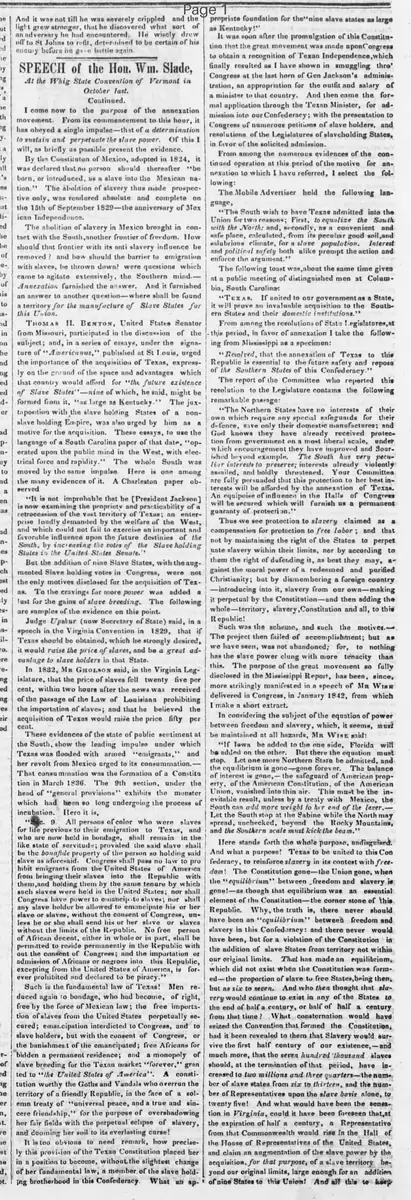
I come now to the purpose of the annexation movement. From its commencement to this hour, it has obeyed a single impulse—that of a determination to sustain and perpetuate the slave power. Of this I will, as briefly as possible present the evidence.
By the Constitution of Mexico, adopted in 1824, it was declared that no person should thereafter "be born, or introduced, as a slave into the Mexican nation." The abolition of slavery thus made prospective only, was rendered absolute and complete on the 15th of September 1829—the anniversary of Mexican Independence.
The abolition of slavery in Mexico brought in contact with the South, another frontier of freedom. How should that frontier with its anti-slavery influence be removed? and how should the barrier to emigration with slaves, be thrown down? were questions which came to agitate extensively, the Southern mind.—Annexation furnished the answer. And it furnished an answer to another question—where shall be found a territory for the manufacture of Slave States for this Union.
Thomas H. Benton, United States Senator from Missouri, participated in the discussion of the subject; and, in a series of essays, under the signature of "Americanus," published at St. Louis, urged the importance of the acquisition of Texas, expressly on the ground of the space and advantages which that country would afford for "the future existence of Slave States"—nine of which, he said, might be formed from it, "as large as Kentucky." The juxtaposition with the slave holding States of a non-slave holding Empire, was also urged by him as a motive for the acquisition. These essays, to use the language of a South Carolina paper of that date, "operated upon the public mind in the West, with electrical force and rapidity." The whole South was moved by the same impulse. Here is one among the many evidences of it. A Charleston paper observed
"It is not improbable that he [President Jackson] is now examining the propriety and practicability of a retrocession of the vast territory of Texas; an enterprise loudly demanded by the welfare of the West, and which could not fail to exercise an important and favorable influence upon the future destinies of the South, by increasing the votes of the Slave holding States in the United States Senate."
But the addition of nine Slave States, with the augmented Slave holding votes in Congress, were not the only motives disclosed for the acquisition of Texas. To the cravings for more power was added a lust for the gains of slave breeding. The following are samples of the evidence on this point.
Judge Upshur (now Secretary of State) said, in a speech in the Virginia Convention in 1829, that if Texas should be obtained, which he strongly desired, it would raise the price of slaves, and be a great advantage to slave holders in that State.
In 1832, Mr. Goode said, in the Virginia Legislature, that the price of slaves fell twenty five per cent, within two hours after the news was received of the passage of the Law of Louisiana prohibiting the importation of slaves; and that he believed the acquisition of Texas would raise the price fifty per cent.
These evidences of the state of public sentiment at the South, show the leading impulse under which Texas was flooded with armed "emigrants," and her revolt from Mexico urged to its consummation.—That consummation was the formation of a Constitution in March 1836. The 9th section, under the head of "general provisions" exhibits the monster which had been so long undergoing the process of incubation. Here it is,
9. All persons of color who were slaves for life previous to their emigration to Texas, and who are now held in bondage, shall remain in the like state of servitude; provided the said slave shall be the bona fide property of the person so holding said slave as aforesaid. Congress shall pass no law to prohibit emigrants from the United States of America from bringing their slaves into the Republic with them, and holding them by the same tenure by which such slaves were held in the United States; nor shall Congress have power to emancipate slaves; nor shall any slave holder be allowed to emancipate his or her slave or slaves, without the consent of Congress, unless he or she shall send his or her slave or slaves without the limits of the Republic. No free person of African descent, either in whole or in part, shall be permitted to reside permanently in the Republic without the consent of Congress; and the importation or admission of Africans or negroes into this Republic, excepting from the United States of America, is forever prohibited and declared to be piracy."
Such is the fundamental law of Texas! Men reduced again to bondage, who had become, of right, free by the force of Mexican law; the free importation of slaves from the United States perpetually secured; emancipation interdicted to Congress, and to slave holders, but with the consent of Congress, or the banishment of the emancipated; free Africans forbidden a permanent residence; and a monopoly of slave breeding for the Texan market: "forever," granted to "the United States of America". A constitution worthy the Goths and Vandals who overran the territory of a friendly Republic, in the face of a solemn treaty of "universal peace, and a true and sincere friendship," for the purpose of overshadowing her fair fields with the perpetual eclipse of slavery, and dooming her soil to its everlasting curse!
It is too obvious to need remark, how precisely this provision of the Texan Constitution placed her in a position to become, without the slightest change of her fundamental law, a member of the slave holding brotherhood in this Confederacy. What an appropriate foundation for the "nine slave states as large as Kentucky!"
It was soon after the promulgation of this Constitution that the great movement was made upon Congress to obtain a recognition of Texan Independence, which finally resulted as I have shown in smuggling thro' Congress at the last hour of Gen Jackson's administration, an appropriation for the outfit and salary of a minister to that country. And then came the formal application through the Texan Minister, for admission into our Confederacy; with the presentation to Congress of numerous petitions of slave holders, and resolutions of the Legislatures of slaveholding States, in favor of the solicited admission.
From among the numerous evidences of the continued operation at this period of the motive for annexation to which I have referred, I select the following:
The Mobile Advertiser held the following language,
"The South wish to have Texas admitted into the Union for two reasons; First, to equalize the South with the North: and, secondly, as a convenient and safe place, calculated, from its peculiar good soil, and salubrious climate, for a slave population. Interest and political safety both alike prompt the action and enforce the argument."
The following toast was, about the same time given at a public meeting of distinguished men at Columbia, South Carolina:
"Texas. If united to our government as a State, it will prove an invaluable acquisition to the Southern States and their domestic institutions."
From among the resolutions of State Legislatures, at this period, in favor of annexation I take the following from Mississippi as a specimen:
"Resolved, that the annexation of Texas to this Republic is essential to the future safety and repose of the Southern States of this Confederacy."
The report of the Committee who reported this resolution to the Legislature contains the following remarkable passage:
"The Northern States have no interests of their own which require any special safeguards for their defence, save only their domestic manufactures; and God knows they have already received protection from government on a most liberal scale, under which encouragement they have improved and flourished beyond example. The South has very peculiar interests to preserve; interests already violently assailed, and boldly threatened. Your Committee are fully persuaded that this protection to her best interests will be afforded by the annexation of Texas. An equipoise of influence in the Halls of Congress will be secured which will furnish us a permanent guaranty of protection.'"
Thus we see protection to slavery claimed as a compensation for protection to free labor: and that not by maintaining the right of the States to perpetuate slavery within their limits, nor by according to them the right of defending it, as best they may, against the moral power of a redeemed and purified Christianity; but by dismembering a foreign country—introducing into it, slavery from our own—making it perpetual by the Constitution—and then adding the whole territory, slavery, Constitution and all, to this Republic!
Such was the scheme, and such the motives.—The project then failed of accomplishment; but as we have seen, was not abandoned; for, to nothing has the slave power clung with more tenacity than this. The purpose of the great movement so fully disclosed in the Mississippi Report, has been, since, more strikingly manifested in a speech of Mr. Wise delivered in Congress, in January 1842, from which I make a short extract.
In considering the subject of the equation of power between freedom and slavery, which, it seems, must be maintained at all hazards, Mr. Wise said:
"If Iowa be added to the one side, Florida will be added on the other. But there the equation must stop. Let one more Northern State be admitted, and the equilibrium is gone—gone forever. The balance of interest is gone,—the safeguard of American property, of the American Constitution, of the American Union, vanished into thin air. This must be the inevitable result, unless by a treaty with Mexico, the South can add more weight to her end of the lever.—Let the South stop at the Sabine while the North may spread, unchecked, beyond the Rocky Mountains, and the Southern scale must kick the beam."
Here stands forth the whole purpose, undisguised. And what a purpose! Texas to be united to this Confederacy, to reinforce slavery in its contest with freedom! The Constitution gone—the Union gone, when the "equilibrium" between freedom and slavery is gone!—as though that equilibrium was an essential element of the Constitution—the corner stone of this Republic. Why, the truth is, there never should have been an "equilibrium" between freedom and slavery in this Confederacy: and there never would have been, but for a violation of the Constitution in the addition of slave States from territory not within our original limits. That has made an equilibrium, which did not exist when the Constitution was formed—the proportion of slave to free States, being then, but as six to seven. And who then thought that slavery would continue to exist in any of the States to the end of half a century, or half of half a century from that time? What consternation would have seized the Convention that formed the Constitution, had it been revealed to them that Slavery would survive the first half century of our existence,—and much more, that the seven hundred thousand slaves should, at the termination of that period, have increased to two millions and three quarters—the number of slave states from six to thirteen, and the number of Representatives upon the slave basis alone, to twenty five! And what would have been the sensation in Virginia, could it have been foreseen that, at the expiration of half a century, a Representative from that Commonwealth would rise in the Hall of the House of Representatives of the United States, and claim an augmentation of the slave power by the acquisition, for that purpose, of a slave territory, beyond our original limits, large enough for an addition of nine States to this Union! And all this to keep
up an "equilibrium" between slavery and freedom,—to keep slavery from "kicking the beam"—to save the Constitution—to preserve the Union from "vanishing into thin air!" Freedom may, "unchecked," spread beyond the Rocky Mountains; and therefore, Slavery must be permitted to cross the Sabine, and move onward to the Pacific Ocean!
But I forbear, and proceed to another, and later evidence of the continued aim of annexation, and the motive by which it is guided and governed. It is the letter of Gov. Gilmer to which I have already referred, dated at Washington on the 10th of January, 1843.
The importance of the letter of Gov. Gilmer as well as the speech of Mr. Wise, is enhanced by their well known relation to the administration, as well as by their general standing as Southern men. The letter was written to a private individual, who, according to the annunciation of the Baltimore Republican, in publishing it, regarded it as "placing the policy of the annexation of Texas to the United States in a very striking and imposing point of view," & therefore communicated it, with the leave of Gov. Gilmer, for publication.
A few extracts will suffice to show its character. On the subject of strengthening the slave power, it is less bold than Mr. Wise. It was evidently written for publication, and sugars over the deadly dose, in a manner to make it as inoffensive as possible to the people of the North,
"You ask," says the letter, "if I have expressed the opinion that Texas would be annexed to the United States. I answer, yes; and this opinion has not been adopted without reflection or without a careful observation of causes which, I believe, are rapidly bringing about this result. I do not know how far these causes have made the same impression on others; but I am persuaded that the time is not distant when they will be felt in all their force. The excitement which you apprehend, may arise; but it will be temporary, and, in the end salutary.
"I assume what no one will deny, that, under the jurisdiction of the United States, the large and unusually fertile territory of Texas will be rapidly peopled; and that an immense accession will be made to our strength and productive energies. [The strength and productive energies of slavery!] The settlement of Texas under these auspices will open a market at home for the manufactures, and agricultural products of all the non-slaveholding States—a market which, otherwise, can only avail them, under the restrictions and disadvantages of foreign competition.—The means of supply for those States will be increased in the same manner."
How ready is Mr. Gilmer to urge the great argument for the protective policy, when it can be used to favor the protection and extension of slavery. The annexation of Texas will "open a home market for the manufactures and agricultural products of the non-slave holding States!" And here is the bait that is to be thrown out to Northern cupidity! A home market for manufactures!" And how much does this anti-tariff nullifier care for the encouragement and protection of the "manufactures of the non-slave holding States?" Not a straw, unless it be connected with additional security to a market for another species of manufacture—of which he does not speak—that manufacture, the price of which it was asserted, as I have shown, in the Virginia Legislature, eleven years ago, would be raised fifty per cent. upon the acquisition of Texas. It is true the Constitution of Texas gives to the slave breeding States of this Union a monopoly of its market for this kind of manufacture; but annexation, alone, can give permanent security to this monopoly.
"But," continues Gov. Gilmer, "you anticipate objections with regard to the subject of slavery. This is, indeed, a subject of extreme delicacy, but it is one on which the annexation of Texas will have the most salutary influence. Some have thought that the proposition would endanger our Union. I am of a different opinion. I believe it will bring about a better understanding of our relative rights and obligations. Slavery is one of those subjects which the people of the slave holding States are content to leave where the Constitution of our Union left it. They ask for no new concessions to their rights, guaranteed by that instrument."
The Constitution of the Union, Gov. Gilmer ought to know, left slavery to live as long as it could, and to die, as it must, in the original States of this Union. But there the friends of annexation are not "content" to leave it; but would extend it over "the large and unusually fertile territory of Texas," and then add the extension to this already slave ridden Union. And this asking "no new concessions to their rights guaranteed by" the Constitution!
I would gladly make further extracts from this letter; and indeed give it entire,—but I must forbear. It is an artful attempt to give to annexation the character of a national measure—important, even, to give permanence to the Union!—It may be regarded as a sample of the manner in which the North is to be addressed to secure its support to the measure.
To be Continued.
What sub-type of article is it?
What keywords are associated?
What entities or persons were involved?
Editorial Details
Primary Topic
Opposition To Texas Annexation As A Means To Extend Slavery
Stance / Tone
Strongly Anti Annexation And Anti Slavery
Key Figures
Key Arguments