Thank you for visiting SNEWPapers!
Sign up free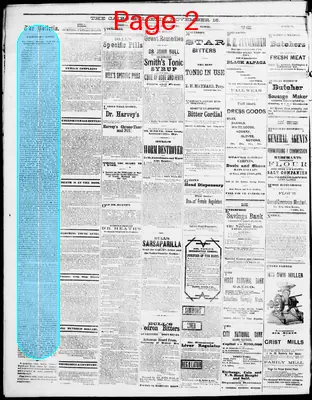
The Cairo Daily Bulletin
Cairo, Alexander County, Illinois
What is this article about?
The Chicago Tribune editorial discusses the disintegration of traditional parties post-slavery era, advocating reorganization around free trade vs. protectionism. It notes free trade gains in recent elections in states like Missouri and Illinois, predicting a shift toward revenue reform in Congress. (248 characters)
Clipping

OCR Quality
Full Text
A REMARKABLE ARTICLE.
The Chicago Tribune Formally Renounces the Republican Party.
[From the Chicago Tribune.]
THE REORGANIZATION OF PARTIES.
The general result of the recent elections indicate that the issues growing out of slavery, and the great pro-slavery rebellion, are settled; that the mere platform of 'economy and reform,' without specifying by what measures these glittering generalities are to be put in practice, is as available to one party as another, and, consequently, is not available as the special platform of any party; and that, on the present living issues, as to the proper mode of laying taxes and tariffs for the support of the government, the two old party organizations can no longer be relied upon for their full party vote. Both parties are, to some extent, disintegrated and disorganized by this change of issues, as might naturally be expected. But the Democratic party enters into the fight everywhere with the advantage of having an issue in which it believes, and for which it is prepared to vote, viz: Free Trade. The Republican party, as such, for four years past, has had no issue on this question, except within its own ranks. A large number of its leading statesmen and organs, as well as of its voters, are as heartily committed to free trade or a revenue tariff as any portion of the Democratic party. Upon this question there must be, and, indeed, to a great extent, has been, a union of the homogeneous element such as will enable those who think alike in the two old political parties to work together in future political organizations. The same necessity which, in 1856, induced William C. Bryant and his journal, the New York Evening Post, to abandon the Democratic party, with which they agreed on all other questions, to co-operate with the Free Soil (afterwards Republican) party, on the main question, now induces such leaders in the late revolution in favor of human liberty as the same Bryant, Wendell Phillips, Wm. Lloyd Garrison, Henry Ward Beecher, Lyman Trumbull, Carl Schurz, David A. Wells, Charles Sumner, B. Gratz Brown, John A. Logan, Governor Palmer, Frederick Douglass, etc., etc., and such journals as the New York Evening Post, Cincinnati Commercial and Gazette, and St. Louis Democrat, to effect a reconstruction and reorganization of political parties as will enable them to vote squarely for such a revenue policy and civil service system as they can conscientiously support, without becoming responsible for, or identifying themselves with, the past errors of the Democratic party on the slavery question. The election in Missouri is the result of such a reorganization of political parties, and is a triumph of the distinctively free trade party over the protectionists, though the free suffrage question aided in effecting the result. In Illinois the two parties adopted in convention substantially the same platform, the Republican platform opposing protection, and the Democratic demanding free trade. Yet, in going before the people on these platforms, the Republican candidates were met by the point, that in Congress they would be compelled, by party affiliations on other questions, to come under the lead of protectionist caucuses, to vote for a protectionist Speaker, to see their business referred to protectionist committees and a general protectionist inclination given to their votes, whatever might be their personal predilections. This might have been met by the assurance that the candidates would vote and act with free traders in all matters involving this question, irrespective of their previous associations. In the absence of this assurance, many Republicans who desired to sustain the free trade policy, either did not vote, or believed their votes could be cast most effectively for the Democratic candidate. This fact has had its potency in changing the Congressional delegation in Illinois from eleven Republicans and three Democrats to seven Republicans and seven Democrats. The same influences have had an effect in Indiana, Missouri, Michigan and Wisconsin. Had it been clearly understood, beforehand, that the next Congress would organize, elect its Speaker, appoint its committees, and hold its caucuses upon a division of parties based on new and living issues, the people would have voted in accordance with that understanding. But, so long as that is doubtful, the party whose position is uncertain must continue to give place to the candidates whose position is declared. In Schenck's district, D. J. Morrell's, and McCarthy's of Syracuse, the issue was made up mainly on the question of protection and free trade, the friends of free trade voting, in some degree, without regard to past political affiliations, and carrying McCarthy's district for a Republican free trader in the convention, and the other two districts for a free trader at the polls. The time has now come when the two real parties of the country, the free traders and protectionists, must cast their votes where they will tell most effectively for their principles both in Congress and out of it. It is impossible that we shall continue voting on dead issues, and dodging the living and vital ones. As our New York dispatch intimated yesterday, the Revenue Reform party will enter the next Congress prepared to claim the Speaker, the organization of the House, and the appointment of committees, so that the business before Congress may be presented in a manner to carry out the views of the majority of the people, as indicated in the recent elections. If the protectionists of the country desire to carry this issue to a general election, or to form a national party on their own basis, we shall, at all times, stand ready to meet them. If not, it is pretty clear that, so long as the Democratic party elects none but free traders, Republicans vote for none but free traders, while the protectionists rely on the prestige of the Republican organization and shirk the issue, the complexion of Congress will rapidly change into one for revenue reform, and possibly, Democratic. On the whole, in the recent elections, the Democracy have made gains. But their gain has been very slight compared with the heavy gain over the high tariff party, in the prestige of success, in organization, confidence, and power. All these will make themselves felt at the outset in the meeting of next Congress.
What sub-type of article is it?
What themes does it cover?
What keywords are associated?
What entities or persons were involved?
Where did it happen?
Story Details
Key Persons
Location
United States
Event Date
Recent Elections
Story Details
The Chicago Tribune argues for reorganization of political parties around new issues like free trade and revenue tariffs, following the settlement of slavery questions. It highlights shifts in voter alignments, gains for free traders in elections in Missouri, Illinois, Indiana, Michigan, and Wisconsin, and predicts a Revenue Reform party influence in the next Congress.