Thank you for visiting SNEWPapers!
Sign up free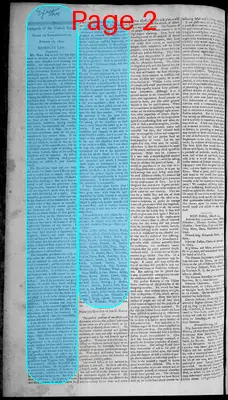
Alexandria Advertiser And Commercial Intelligencer
Alexandria, Virginia
What is this article about?
On February 18, 1803, the U.S. House of Representatives debated the Bankrupt Law. Mr. Dana supported amendments for judicial oversight. Mr. Bayard defended the law against objections on common law consistency, rigor, and republicanism. Mr. Griswold's motion to postpone until the next session passed 50-39.
Clipping
OCR Quality
Full Text
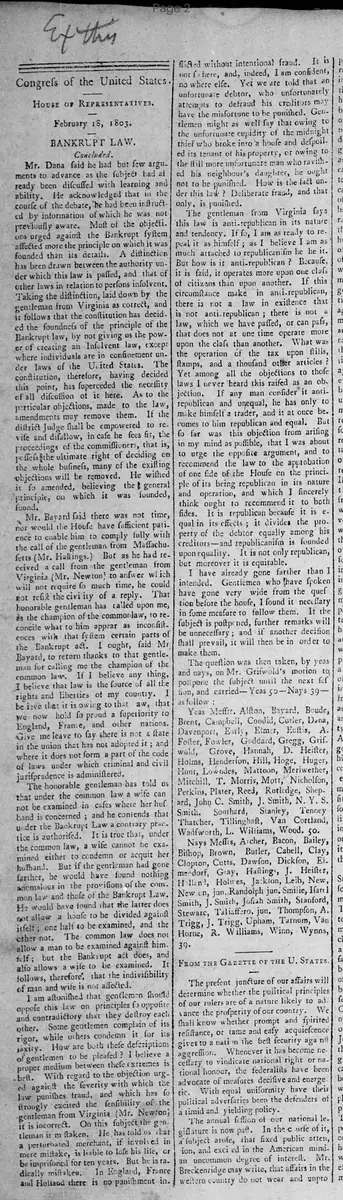
House of Representatives.
February 18, 1803.
BANKRUPT LAW.
Concluded.
Mr. Dana said he had but few arguments to advance as the subject had already been discussed with learning and ability. He acknowledged that in the course of the debate he had been instructed by information of which he was not previously aware. Most of the objections urged against the Bankrupt system affected more the principle on which it was founded than its details. A distinction has been drawn between the authority under which this law is passed, and that of other laws in relation to persons insolvent. Taking the distinction, laid down by the gentleman from Virginia as correct, and it follows that the constitution has decided the soundness of the principle of the Bankrupt law, by not giving us the power of creating an Insolvent law, except where individuals are in confinement under laws of the United States. The constitution, therefore, having decided this point, has superseded the necessity of all discussion of it here. As to the particular objections, made to the law, amendments may remove them. If the district Judge shall be empowered to revise and disallow, in case he sees fit, the proceedings of the commissioners, that is, possess the ultimate right of deciding on the whole business, many of the existing objections will be removed. He wished it so amended, believing the general principle, on which it was founded, found.
Mr. Bayard said there was not time, nor would the House have sufficient patience to enable him to comply fully with the call of the gentleman from Massachusetts (Mr. Hastings.) But as he had received a call from the gentleman from Virginia (Mr. Newton,) to answer which will not require so much time, he could not resist the civility of a reply. That honorable gentleman has called upon me, as the champion of the common law, to reconcile what to him appear as inconsistencies with that system certain parts of the Bankrupt act. I ought, said Mr. Bayard, to return thanks to that gentleman for calling me the champion of the common law. If I believe any thing, I believe that law is the source of all the rights and liberties of my country. I believe that it is owing to that law, that we now hold so proud a superiority to England, France, and other nations. Give me leave to say there is not a state in the union that has not adopted it; and where it does not form a part of the code of laws under which criminal and civil jurisprudence is administered.
The honorable gentleman has told us that under the common law a wife can not be examined in cases where her husband is concerned; and he contends that under the Bankrupt Law a contrary practice is authorized. It is true that, under the common law, a wife cannot be examined either to condemn or acquit her husband. But if the gentleman had gone farther, he would have found nothing anomalous in the provisions of the common law and those of the Bankrupt Law. He would have found that the latter does not allow a house to be divided against itself; one half to be examined, and the other not. The common law does not allow a man to be examined against himself; but the Bankrupt act does, and also allows a wife to be examined. It follows, therefore, that the indivisibility of man and wife is not affected.
I am astonished that gentlemen should oppose this law on principles so opposite and contradictory that they destroy each other. Some gentlemen complain of its rigor, while others condemn it for its laxity. How are both these descriptions of gentlemen to be pleased? I believe a proper medium between these extremes is found. With regard to the objection urged against the severity with which the law punishes fraud, and which has so strongly excited the sensibility of the gentleman from Virginia (Mr. Newton) it is incorrect. On this subject the gentleman is mistaken. He has told us that a perturbed merchant, if involved in mere mistake, is liable to lose his life, or be imprisoned for ten years. But he is radically mistaken. In England, France and Holland there is no punishment inflicted without intentional fraud. It is not here, and, indeed, I am confident, no where else. Yet we are told that an unfortunate debtor, who unfortunately attempts to defraud his creditors may have the misfortune to be punished. Gentlemen might as well say that owing to the unfortunate cupidity of the midnight thief who broke into a house and despoiled its tenant of his property, or owing to the still more unfortunate man who ravished his neighbour's daughter, he ought not to be punished. How is the fact under this law? Deliberate fraud, and that only, is punished.
The gentleman from Virginia says this law is anti-republican in its nature and tendency. If so, I am as ready to repeal it as himself: as I believe I am as much attached to republicanism he is it. But how is it anti-republican? Because, it is said, it operates more upon one class of citizens than upon another. If this circumstance make it anti-republican, there is not a law in existence that is not anti-republican; there is not a law, which we have passed, or can pass, that does not at one time operate more upon the class than another. What was the operation of the tax upon stills, stamps, and a thousand other articles? Yet among all the objections to those laws I never heard this raised as an objection. If any man consider it anti-republican and unequal, he has only to make himself a trader, and it at once becomes to him republican and equal. But so far was this objection from arising in my mind as possible, that I was about to urge the opposite argument, and to recommend the law to the approbation of one side of the House on the principle of its being republican in its nature and operation, and which I sincerely think ought to recommend it to both sides. It is republican because it is equal in its effects: it divides the property of the debtor equally among his creditors—and republicanism is founded upon equality. It is not only republican, but moreover it is equitable.
I have already gone farther than I intended. Gentlemen who have spoken have gone very wide from the question before the house, I found it necessary in some measure to follow them. If the subject is postponed, further remarks will be unnecessary; and if another decision shall prevail, it will then be in order to make them.
The question was then taken, by yeas and nays, on Mr. Griswold's motion to postpone the subject until the next session, and carried—Yeas 50—Nays 39—as follow:
Yeas Messrs. Alston, Bayard, Boudinot, Brent, Campbell, Condict, Cutler, Dana, Davenport, Early, Elmer, Eustis, A. Foster, Fowler, Goddard, Gregg, Griswold, Grove, Hannah, D. Hiester, Holmes, Henderson, Hill, Hoge, Huger, Hunt, Lowndes, Mattoon, Meriwether, Mitchill, T. Morris, Mott, Nicholson, Perkins, Plater, Reed, Rutledge, Shepard, John C. Smith, J. Smith, N. Y. S. Smith, Southard, Stanley, Tenney, Thatcher, Tillinghast, Van Cortlandt, Wadsworth, L. Williams, Wood. 50.
Nays Messrs. Archer, Bacon, Bailey, Bishop, Brown, Butler, Cabell, Clay, Clopton, Cutts, Dawson, Dickson, Elmendorf, Gray, Hastings, J. Hiester, Hillhouse, Holmes, Jackson, Leib, New, Newton, jun. Randolph jun. Smilie, Israel Smith, J. Smith, Josiah Smith, Stanford, Stewart, Taliaferro, jun. Thompson, A. Trigg, J. Trigg, Upham, Varnum, Van Horne, R. Williams, Winn, Wynns, 39.
What sub-type of article is it?
What keywords are associated?
What entities or persons were involved?
Domestic News Details
Event Date
1803 02 18
Key Persons
Outcome
motion to postpone the bankrupt law until the next session passed by yeas 50, nays 39.
Event Details
Debate in the House of Representatives on the Bankrupt Law, with Mr. Dana advocating for amendments allowing district judges to oversee commissioners' proceedings. Mr. Bayard defended the law against claims of inconsistency with common law, excessive rigor or laxity, and anti-republican nature, emphasizing its equity and equality in dividing debtors' property among creditors. The vote on Mr. Griswold's postponement motion succeeded.