Thank you for visiting SNEWPapers!
Sign up free
Editorial
October 10, 1867
The Home Journal
Winchester, Franklin County, Tennessee
What is this article about?
Ex-Gov. Perry's letter argues against granting political rights to Southern negroes, warning of inevitable racial conflict, and proposes segregating them in separate states or gradually colonizing to Liberia, deeming them unfit for productive citizenship based on historical precedents in Jamaica, the North, and Africa.
Clipping
OCR Quality
95%
Excellent
Full Text
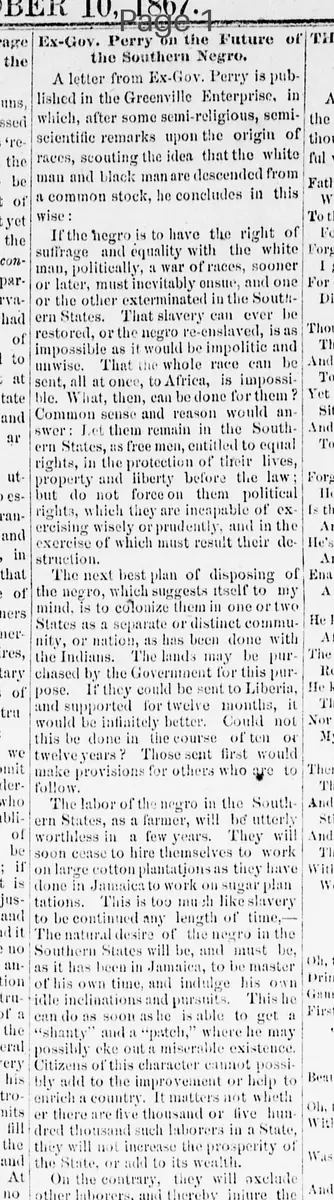
Ex-Gov. Perry on the Future of the Southern Negro.
A letter from Ex-Gov. Perry is published in the Greenville Enterprise, in which, after some semi-religious, semi-scientific remarks upon the origin of races, scouting the idea that the white man and black man are descended from a common stock, he concludes in this wise:
If the negro is to have the right of suffrage and equality with the white man, politically, a war of races, sooner or later, must inevitably ensue, and one or the other exterminated in the Southern States. That slavery can ever be restored, or the negro re-enslaved, is as impossible as it would be impolitic and unwise. That the whole race can be sent, all at once, to Africa, is impossible. What, then, can be done for them? Common sense and reason would answer: Let them remain in the Southern States, as free men, entitled to equal rights, in the protection of their lives, property and liberty before the law, but do not force on them political rights, which they are incapable of exercising wisely or prudently, and in the exercise of which must result their destruction.
The next best plan of disposing of the negro, which suggests itself to my mind, is to colonize them in one or two States as a separate or distinct community, or nation, as has been done with the Indians. The lands may be purchased by the Government for this purpose. If they could be sent to Liberia and supported for twelve months, it would be infinitely better. Could not this be done in the course of ten or twelve years? Those sent first would make provisions for others who are to follow.
The labor of the negro in the Southern States, as a farmer, will be utterly worthless in a few years. They will soon cease to hire themselves to work on large cotton plantations as they have done in Jamaica to work on sugar plantations. This is too much like slavery to be continued any length of time.—
The natural desire of the negro in the Southern States will be, and must be as it has been in Jamaica, to be master of his own time, and indulge his own idle inclinations and pursuits. This he can do as soon as he is able to get a "shanty" and a "patch," where he may possibly eke out a miserable existence.
Citizens of this character cannot possibly add to the improvement or help to enrich a country. It matters not whether there are five thousand or five hundred thousand such laborers in a State, they will not increase the prosperity of the State, or add to its wealth.
On the contrary, they will exclude other laborers, and thereby injure the State. What we now want in the Southern States is an industrious, intelligent and thrifty population, who will build comfortable houses, plant orchards, erect machinery and develop the hidden resources of the country. This the negro will never do. There may be a few exceptions, but so few as not to be worth considering. Whilst the negro continues to hire himself as a laborer to the cotton planters, he may add to the wealth of the State, if he does not to his own: others will be benefitted by his labor if he himself is not. But this will not continue, as I have already said. The experience of Jamaica and all the other West India Islands, where the negro has been set free, proves this fact.
The history of the negro in the Northern States where he has been free for more than half a century, shows that he will only work enough to obtain a bare subsistence. He does not grow rich there or accumulate property. Is it at all likely that he will do better in the Southern States: The history of the negro in Africa, where he has always been free, proves the same thing I do not believe, therefore, that the three or four millions of negroes in the Southern States will, in the course of a few years, make more than a bare subsistence And if that contingency to the exclusion of other labor, the Southern States are destined to poverty and misery. I am, etc.,
B. F. Perry
A letter from Ex-Gov. Perry is published in the Greenville Enterprise, in which, after some semi-religious, semi-scientific remarks upon the origin of races, scouting the idea that the white man and black man are descended from a common stock, he concludes in this wise:
If the negro is to have the right of suffrage and equality with the white man, politically, a war of races, sooner or later, must inevitably ensue, and one or the other exterminated in the Southern States. That slavery can ever be restored, or the negro re-enslaved, is as impossible as it would be impolitic and unwise. That the whole race can be sent, all at once, to Africa, is impossible. What, then, can be done for them? Common sense and reason would answer: Let them remain in the Southern States, as free men, entitled to equal rights, in the protection of their lives, property and liberty before the law, but do not force on them political rights, which they are incapable of exercising wisely or prudently, and in the exercise of which must result their destruction.
The next best plan of disposing of the negro, which suggests itself to my mind, is to colonize them in one or two States as a separate or distinct community, or nation, as has been done with the Indians. The lands may be purchased by the Government for this purpose. If they could be sent to Liberia and supported for twelve months, it would be infinitely better. Could not this be done in the course of ten or twelve years? Those sent first would make provisions for others who are to follow.
The labor of the negro in the Southern States, as a farmer, will be utterly worthless in a few years. They will soon cease to hire themselves to work on large cotton plantations as they have done in Jamaica to work on sugar plantations. This is too much like slavery to be continued any length of time.—
The natural desire of the negro in the Southern States will be, and must be as it has been in Jamaica, to be master of his own time, and indulge his own idle inclinations and pursuits. This he can do as soon as he is able to get a "shanty" and a "patch," where he may possibly eke out a miserable existence.
Citizens of this character cannot possibly add to the improvement or help to enrich a country. It matters not whether there are five thousand or five hundred thousand such laborers in a State, they will not increase the prosperity of the State, or add to its wealth.
On the contrary, they will exclude other laborers, and thereby injure the State. What we now want in the Southern States is an industrious, intelligent and thrifty population, who will build comfortable houses, plant orchards, erect machinery and develop the hidden resources of the country. This the negro will never do. There may be a few exceptions, but so few as not to be worth considering. Whilst the negro continues to hire himself as a laborer to the cotton planters, he may add to the wealth of the State, if he does not to his own: others will be benefitted by his labor if he himself is not. But this will not continue, as I have already said. The experience of Jamaica and all the other West India Islands, where the negro has been set free, proves this fact.
The history of the negro in the Northern States where he has been free for more than half a century, shows that he will only work enough to obtain a bare subsistence. He does not grow rich there or accumulate property. Is it at all likely that he will do better in the Southern States: The history of the negro in Africa, where he has always been free, proves the same thing I do not believe, therefore, that the three or four millions of negroes in the Southern States will, in the course of a few years, make more than a bare subsistence And if that contingency to the exclusion of other labor, the Southern States are destined to poverty and misery. I am, etc.,
B. F. Perry
What sub-type of article is it?
Slavery Abolition
Suffrage
What keywords are associated?
Southern Negro
Suffrage
Colonization
Racial War
Liberia
Jamaica
Negro Labor
What entities or persons were involved?
Ex Gov. Perry
Negro
Southern States
Indians
Jamaica
Liberia
Africa
Editorial Details
Primary Topic
Future Of The Southern Negro
Stance / Tone
Opposed To Negro Suffrage And Political Equality, Advocates Colonization
Key Figures
Ex Gov. Perry
Negro
Southern States
Indians
Jamaica
Liberia
Africa
Key Arguments
If Negroes Gain Suffrage And Political Equality, A War Of Races Will Ensue Leading To Extermination Of One Race
Slavery Cannot Be Restored Or All Negroes Sent To Africa At Once
Negroes Should Remain Free With Equal Legal Protections But Without Political Rights
Colonize Negroes In Separate Southern States Like Indians, With Government Purchased Lands
Gradually Send Negroes To Liberia Over 10 12 Years
Negro Farm Labor In South Will Become Worthless As They Avoid Plantation Work Resembling Slavery
Negroes Prefer Idleness And Minimal Subsistence Over Productive Labor
Such Negro Laborers Hinder State Prosperity By Excluding Better Workers
Southern States Need Industrious Population To Develop Resources, Which Negroes Will Not Provide
Historical Examples From Jamaica, Northern States, And Africa Show Negroes Do Not Accumulate Wealth Or Improve Economies