Thank you for visiting SNEWPapers!
Sign up free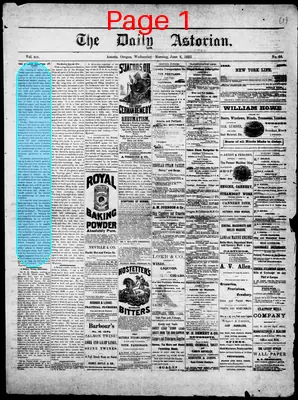
The Daily Astorian
Astoria, Clatsop County, Oregon
What is this article about?
The salmon canning industry on the Pacific coast, led by Columbia River producers, faces growing competition from new canneries in British Columbia and Alaska where fish are cheaper. Past success has waned; calls for artificial propagation and protective legislation to maintain market position against extinction risks.
Clipping

OCR Quality
Full Text
The canning of salmon on the Pacific coast has already reached a magnitude that places this food product on the list of staple quotations in the world's markets, especially in the British isles, where it holds relation next to the cereal and animal elements that enter into trade and public consumption. For a decade or more, the Columbia-river product, both in quantity and quality, has held the line of trade to an extent that placed its export and brands everywhere in the front rank. Yielding to canning enterprises results that have made financial princes of more than a score of our pioneers who initiated that special industry.
To-day, there are changed conditions in the business and trade from past years, in which the Columbia-river canning investments (composed of about forty plants) have an earnest interest, and cannot afford to drift with the tide of events till more northwestern competition may place Columbia product before the central markets at a disadvantage at least in cost of production, with consequent minimum quotations in accordance.
At present, canneries are sprouting up as fast as Jonah's gourd at every inlet and river between the Columbia and Yukon, where fish are obtained for cents, in lieu of what costs Columbia-river canning the extent of dollars! At the price paid on the Columbia (90c to $1 each salmon for raw material), canners assure us costs not less than 5 per case, or $1.25 per dozen, which with freights, commission, insurance, etc., places Columbia product on the market at a disadvantage for cheap consumption.
It is time for those interested in local canning to look the situation square in the face, if they desire to hold the present status of brands and prices abroad. The inquiries should provide for keeping the river supplied with stock by artificial production on an extended scale through some public or private supervision, to be supplemented by protection adequate to the conditions of required results. This is feasible if canning interests and legislation will pull together intelligently; otherwise, this literally home industry is to meet this British Columbia and Alaskan competition at great disadvantage where salmon is classed among the European cheap food staples, with the diminished scale of future supply, imminent from the precedent of salmon extinction in many rivers of both the Old and New World.-Portland Commercial Reporter.
What sub-type of article is it?
What keywords are associated?
Where did it happen?
Story Details
Location
Pacific Coast, Columbia River, British Columbia, Alaska, Yukon
Event Date
For A Decade Or More To To Day
Story Details
The Columbia River salmon canning industry, once dominant and profitable, now faces competition from cheaper production in northern areas, leading to higher costs and market disadvantages; recommends artificial propagation and legislative protection to sustain supply and status.