Thank you for visiting SNEWPapers!
Sign up free
Literary
August 27, 1857
The Westerly Echo, & Pawcatuck Advertiser
Westerly, Washington County, Rhode Island
What is this article about?
In Bavaria, Major Loffen, separated from his wife Charlotte due to his temper, attends daughter Dorothea's wedding on St. Sylvester's Day, when children rule. Dorothea brings Charlotte incognito, reviving memories through music and customs, leading to family reconciliation.
Merged-components note: Continuation of the story 'Saint Sylvester's Day' from page 1 to page 2, forming a single coherent literary piece.
Clippings
1 of 2
OCR Quality
92%
Excellent
Full Text
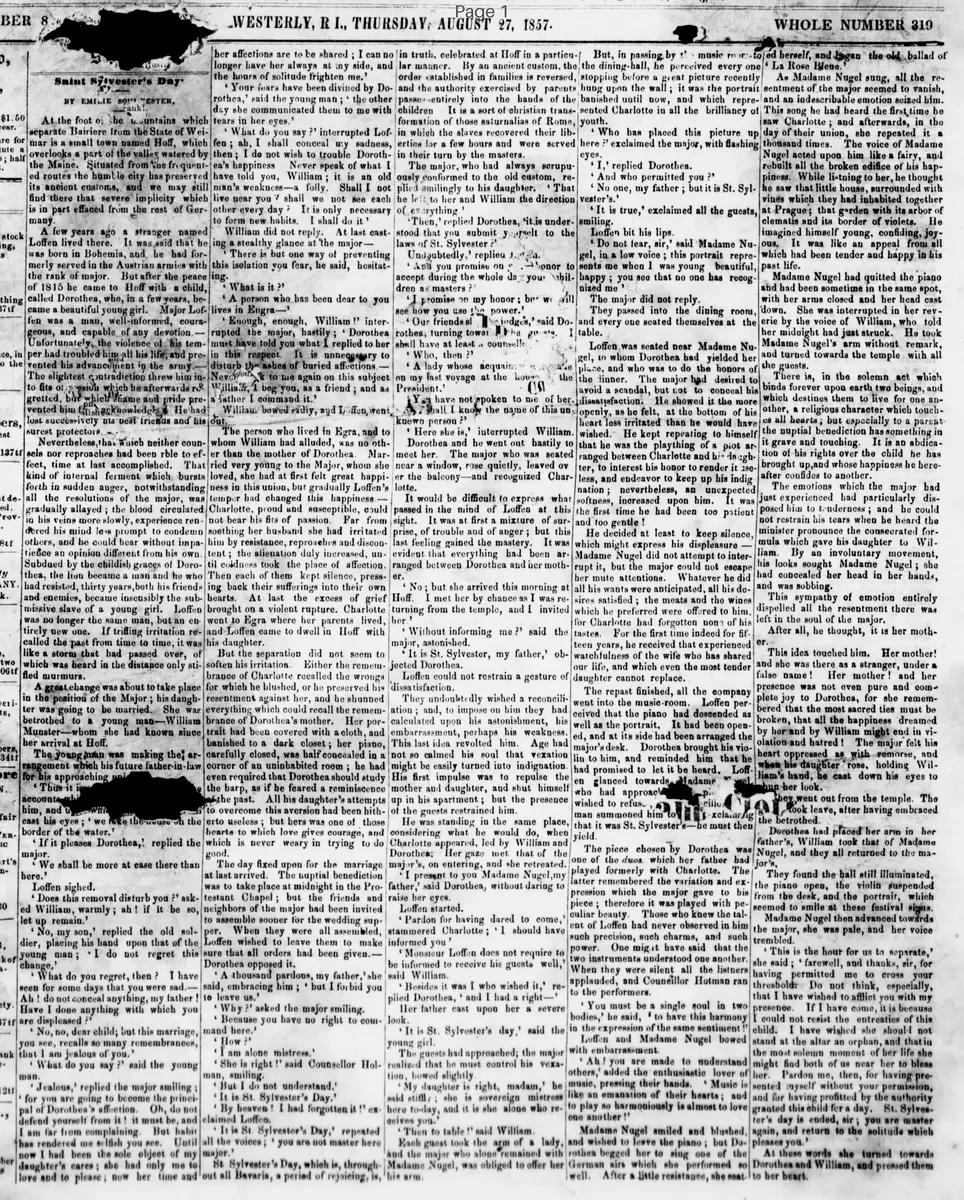
Saint Sylvester's Day
BY EMILIE SYLVESTER.
At the foot of the mountains which separate Bavaria from the State of Weimar is a small town named Hoff, which overlooks a part of the valley watered by the Main. Situated from the frequented routes the humble city has preserved its ancient customs, and we may still find there that severe simplicity which is in part effaced from the rest of Germany.
A few years ago a stranger named Loffen lived there. It was said that he was born in Bohemia, and he had formerly served in the Austrian armies with the rank of major. But after the peace of 1815 he came to Hoff with a child, called Dorothea, who, in a few years, became a beautiful young girl. Major Loffen was a man, well-informed, courageous, and capable of any devotion. Unfortunately, the violence of his temper had troubled him all his life, and prevented his advancement in the army. The slightest contradiction threw him into fits of passion which he afterwards regretted, but which shame and pride prevented him from acknowledging. He had lost successively his best friends and his surest protectors.
Nevertheless, that which neither counsels nor reproaches had been able to effect, time at last accomplished. That kind of internal ferment which bursts forth in sudden anger, notwithstanding all the resolutions of the major, was gradually allayed; the blood circulated in his veins more slowly, experience rendered his mind less prompt to condemn others, and he could hear without impatience an opinion different from his own. Subdued by the childish graces of Dorothea, the lion became a man and he who had resisted, thirty years, both his friends and enemies, became insensibly the submissive slave of a young girl. Loffen was no longer the same man, but an entirely new one. If trifling irritation recalled the past from time to time, it was like a storm that had passed over, of which was heard in the distance only stifled murmurs.
A great change was about to take place in the position of the Major; his daughter was going to be married. She was betrothed to a young man—William Munster—whom she had known since her arrival at Hoff.
The young man was making the arrangements with his future father-in-law for his approaching union. Thus it was agreed, and William cast his eyes on the house on the border of the water.
'If it pleases Dorothea,' replied the major.
'We shall be more at ease there than here.'
Loffen sighed.
'Does this removal disturb you?' asked William, warmly; 'ah! if it be so, let us remain.'
'No, my son,' replied the old soldier, placing his hand upon that of the young man; 'I do not regret this change.'
'What do you regret, then? I have seen for some days that you were sad. Ah! do not conceal anything, my father. Have I done anything with which you are displeased?'
'No, no, dear child; but this marriage, you see, recalls so many remembrances, that I am jealous of you.'
'What do you say?' said the young man.
'Jealous,' replied the major smiling; 'for you are going to become the principal of Dorothea's affection. Oh, do not defend yourself from it! it must be, and I am far from complaining. But habit has rendered me selfish you see. Until now I had been the sole object of my daughter's cares; she had only me to love and to please; now her time and her affections are to be shared; I can no longer have her always at my side, and the hours of solitude frighten me.'
'Your fears have been divined by Dorothea,' said the young man; 'the other day she communicated them to me with tears in her eyes.'
'What do you say?' interrupted Loffen; 'ah, I shall conceal my sadness, then: I do not wish to trouble Dorothea's happiness. Never speak of what I have told you, William; it is an old man's weakness—a folly. Shall I not live near you? shall we not see each other every day? It is only necessary to form new habits. I shall do it.'
William did not reply. At last casting a stealthy glance at the major—
'There is but one way of preventing this isolation you fear,' he said, hesitating.
'What is it?'
'A person who has been dear to you lives in Egra—
'Enough, enough, William!' interrupted the major hastily; 'Dorothea must have told you what I replied to her in this respect. It is unnecessary to disturb the ashes of buried affections. Never speak to me again on this subject, William, I beg you, as a friend; and as a father I command it.'
William bowed sadly, and Loffen went out.
The person who lived in Egra, and to whom William had alluded, was no other than the mother of Dorothea. Married very young to the Major, whom she loved, she had at first felt great happiness in this union, but gradually Loffen's temper had changed this happiness. Charlotte, proud and susceptible, could not bear his fits of passion. Far from soothing her husband she had irritated him by resistance, reproaches and discontent; the alienation duly increased, until coldness took the place of affection. Then each of them kept silence, pressing back their sufferings into their own hearts. At last the excess of grief brought on a violent rupture. Charlotte went to Egra where her parents lived, and Loffen came to dwell in Hoff with his daughter.
But the separation did not seem to soften his irritation. Either the remembrance of Charlotte recalled the wrongs for which he blushed, or he preserved his resentment against her, and he shunned everything which could recall the remembrance of Dorothea's mother. Her portrait had been covered with a cloth, and banished to a dark closet; her piano, carefully closed, was half concealed in a corner of an uninhabited room; he had even required that Dorothea should study the harp, as if he feared a reminiscence of the past. All his daughter's attempts to overcome this aversion had been hitherto useless; but hers was one of those hearts to which love gives courage, and which is never weary in trying to do good.
The day fixed upon for the marriage at last arrived. The nuptial benediction was to take place at midnight in the Protestant Chapel; but the friends and neighbors of the major had been invited to assemble sooner for the wedding supper. When they were all assembled, Loffen wished to leave them to make sure that all orders had been given. Dorothea opposed it.
'A thousand pardons, my father,' she said, embracing him; 'but I forbid you to leave us.'
'Why?' asked the major smiling.
'Because you have no right to command here.'
'How?'
'I am alone mistress.'
'She is right!' said Counsellor Holman, smiling.
'But I do not understand.'
'It is St. Sylvester's Day.'
'By heaven! I had forgotten it!' exclaimed Loffen.
'It is St. Sylvester's Day,' repeated all the voices; 'you are not master here, major.'
St. Sylvester's Day, which is, throughout all Bavaria, a period of rejoicing, is, in truth, celebrated at Hoff in a particular manner.
By an ancient custom, the order established in families is reversed, and the authority exercised by parents passes entirely into the hands of the children. It is a sort of Christian transformation of those saturnalias of Rome, in which the slaves recovered their liberties for a few hours and were served in their turn by the masters.
The major, who had always scrupulously conformed to the old custom, replied smilingly to his daughter. That he left to her and William the direction of everything.
'Then,' replied Dorothea, 'it is understood that you submit yourself to the laws of St. Sylvester?'
'Undoubtedly,' replied the major.
'And you promise on honor to accept during the whole day your children as masters?'
'I promise on my honor; but we will see how you use the power.'
'Our friends shall judge,' said Dorothea, turning towards them.
'She shall have at least a counsellor.'
'Who, then?'
'A lady whose acquaintance I made on my last visit at the house of the President.'
'You have not spoken to me of her.'
'Shall I know the name of this unknown person?'
'Here she is,' interrupted William.
Dorothea and he went out hastily to meet her. The major who was seated near a window, rose quietly, leaned over the balcony—and recognized Charlotte.
It would be difficult to express what passed in the mind of Loffen at this sight. It was at first a mixture of surprise, of trouble and of anger; but this last feeling gained the mastery. It was evident that everything had been arranged between Dorothea and her mother.
'No; but she arrived this morning at Hoff. I met her by chance as I was returning from the temple, and I invited her'
'Without informing me?' said the major, astonished.
'It is St. Sylvester, my father,' objected Dorothea.
Loffen could not restrain a gesture of dissatisfaction.
They undoubtedly wished a reconciliation; and, to impose on him they had calculated upon his astonishment, his embarrassment, perhaps his weakness. This last idea revolted him. Age had not so calmed his soul that vexation might be easily turned into indignation. His first impulse was to repulse the mother and daughter, and shut himself up in his apartment; but the presence of the guests restrained him.
He was standing in the same place considering what he would do, when Charlotte appeared, led by William and Dorothea; Her gaze met that of the major's, on entering, and she retreated.
'I present to you Madame Nugel, my father,' said Dorothea, without daring to raise her eyes.
Loffen started.
'Pardon for having dared to come,' stammered Charlotte; 'I should have
'Monsieur Loffen does not require to be informed to receive his guests well,' said William.
'Besides it was I who wished it,' replied Dorothea, 'and I had a right—'
Her father cast upon her a severe look.
'It is St. Sylvester's day,' said the young girl.
The guests had approached; the major realized that he must control his vexation, bowed slightly
'My daughter is right, madam,' he said stiffly; 'she is sovereign mistress here to-day, and it is she alone who receives you.'
'Then to table!' said William.
Each guest took the arm of a lady, and the major who alone remained with Madame Nugel, was obliged to offer her his arm.
But, in passing by the music room to the dining-hall, he perceived every one stopping before a great picture recently hung upon the wall; it was the portrait banished until now, and which represented Charlotte in all the brilliancy of youth.
'Who has placed this picture up here?' exclaimed the major, with flashing eyes.
'I,' replied Dorothea.
'And who permitted you?'
'No one, my father; but it is St. Sylvester's.'
'It is true,' exclaimed all the guests, smiling.
Loffen bit his lips.
'Do not fear, sir,' said Madame Nugel, in a low voice; 'this portrait represents me when I was young, beautiful, happy; you see that no one has recognized me.'
The major did not reply.
They passed into the dining room, and every one seated themselves at the table.
Loffen was seated near Madame Nugel, to whom Dorothea had yielded her place, and who was to do the honors of the dinner. The major had desired to avoid a scandal, but not to conceal his dissatisfaction. He showed it the more openly, as he felt, at the bottom of his heart less irritated than he would have wished. He kept repeating to himself that he was the plaything of a plot arranged between Charlotte and his daughter, to interest his honor to render it useless, and endeavor to keep up his indignation; nevertheless, an unexpected softness, increased upon him. It was the first time he had been too patient and too gentle!
He decided at least to keep silence which might express his displeasure.
Madame Nugel did not attempt to interrupt it, but the major could not escape her mute attentions. Whatever he did all his wants were anticipated, all his desires satisfied; the meats and the wines which he preferred were offered to him, for Charlotte had forgotten none of his tastes.
For the first time indeed for fifteen years, he received that experienced watchfulness of the wife who has shared our life, and which even the most tender daughter cannot replace.
The repast finished, all the company went into the music-room. Loffen perceived that the piano had descended as well as the portrait, It had been opened, and at its side had been arranged the major's desk. Dorothea brought his violin to him, and reminded him that he had promised to let it be heard, Loffen glanced towards Madame who had approached
He wished to refuse, but the counsellor summoned him to the
Exclaiming that it was St. Sylvester's—he must then yield.
The piece chosen by Dorothea was one of the duos which her father had played formerly with Charlotte. The latter remembered the variation and expression which the major gave to his piece; therefore it was played with peculiar beauty. Those who knew the talent of Loffen had never observed in him such precision, such charms, and such power.
One might have said that the two instruments understood one another.
When they were silent all the listeners applauded, and Councillor Holman ran to the performers.
'You must be a single soul in two bodies,' he said, 'to have this harmony in the expression of the same sentiment!'
Loffen and Madame Nugel bowed with embarrassment.
'Ah! you are made to understand others,' added the enthusiastic lover of music, pressing their hands.
'Music is like an emanation of their hearts; and to play so harmoniously is almost to love one another!'
Madame Nugel smiled and blushed, and wished to leave the piano; but Dorothea begged her to sing one of the German airs which she performed so well.
After a little resistance, she consented.
WHOLE NUMBER 319
She adjusted herself, and began the old ballad of 'La Rose Bleue.'
As Madame Nugel sung, all the resentment of the major seemed to vanish, and an indescribable emotion seized him.
This song he had heard the first time he saw Charlotte; and afterwards, in the day of their union, she repeated it a thousand times. The voice of Madame Nugel acted upon him like a fairy, and rebuilt all the broken edifice of his happiness. While listening to her, he thought he saw that little house, surrounded with vines which they had inhabited together at Prague; that garden with its arbor of clematis and its border of violets. He imagined himself young, confiding, joyous. It was like an appeal from all which had been tender and happy in his past life.
Madame Nugel had quitted the piano and had been some time in the same spot, with her arms crossed and her head cast down. She was interrupted in her reverie by the voice of William, who told her midnight had just struck. He took Madame Nugel's arm without remark, and turned towards the temple with all the guests.
There is, in the solemn act which binds forever upon earth two beings, and which destines them to live for one another, a religious character which touches all hearts; but especially to a parent the nuptial benediction has something in it grave and touching. It is an abdication of his rights over the child he has brought up, and whose happiness he hereafter confides to another.
The emotions which the major had just experienced had particularly disposed him to tenderness; and he could not restrain his tears when he heard the minister pronounce the consecrated formula which gave his daughter to William. By an involuntary movement, his looks sought Madame Nugel; she had concealed her head in her hands, and was sobbing.
This sympathy of emotion entirely dispelled all the resentment there was left in the soul of the major.
After all, he thought, it is her mother.
This idea touched him. Her mother! and she was there as a stranger, under a false name! Her mother! and her presence was not even pure and complete joy to Dorothea, for she remembered that the most sacred ties must be broken, that all the happiness dreamed by her and by William might end in violation and hatred! The major felt his heart oppressed as with remorse, and when his daughter rose, holding William's hand, he cast down his eyes to avoid her look.
They went out from the temple. The guests took leave, after having embraced the betrothed.
Dorothea had placed her arm in her father's, William took that of Madame Nugel, and they all returned to the major's.
They found the ball still illuminated, the piano open, the violin suspended from the desk, and the portrait, which seemed to smile at these festival scenes.
Madame Nugel then advanced towards the major, she was pale, and her voice trembled.
'This is the hour for us to separate,' she said; 'farewell, and thanks, sir, for having permitted me to cross your threshold: Do not think, especially, that I have wished to afflict you with my presence. If I have come, it is because I could not resist the entreaties of this child. I have wished she should not stand at the altar an orphan, and that in the most solemn moment of her life she might find both of us near her to bless her. Pardon me, then, for having presented myself without your permission, and for having profited by the authority granted this child for a day. St. Sylvester's day is ended, sir; you are master again, and return to the solitude which pleases you.'
At these words she turned towards Dorothea and William, and pressed them to her heart.
'Farewell,' she said, 'you who love me still, and whom I shall see no more. I carry with me the remembrance of this day as a consolation for my future life; but you must endeavor to forget it. Close this piano, which has not been opened for a long time; cover this portrait and all the past with it; or St. Sylvester's Day is finished.'
At these words she tore herself from the arms of her children, and advanced tremblingly towards the door; but the major, who had just closed it, remained standing upon the threshold pale and trembling. Their eyes met and a lifetime of anger and sorrow was pardoned in the look.
'Charlotte,' murmured Loffen, opening his arms.
'Lucian,' replied Madame Nugel.
At last after a long embrace the major suddenly disengaged himself, and, placing both his hands upon the foreheads of his children, who had fallen on their knees near him—
'Blessed be the children,' he said gratefully, 'for they have been wiser than their parents! Remain here as mistress, Dorothea; you have restored us to happiness, and I wish that henceforth it may be always St. Sylvester's Day.'
BY EMILIE SYLVESTER.
At the foot of the mountains which separate Bavaria from the State of Weimar is a small town named Hoff, which overlooks a part of the valley watered by the Main. Situated from the frequented routes the humble city has preserved its ancient customs, and we may still find there that severe simplicity which is in part effaced from the rest of Germany.
A few years ago a stranger named Loffen lived there. It was said that he was born in Bohemia, and he had formerly served in the Austrian armies with the rank of major. But after the peace of 1815 he came to Hoff with a child, called Dorothea, who, in a few years, became a beautiful young girl. Major Loffen was a man, well-informed, courageous, and capable of any devotion. Unfortunately, the violence of his temper had troubled him all his life, and prevented his advancement in the army. The slightest contradiction threw him into fits of passion which he afterwards regretted, but which shame and pride prevented him from acknowledging. He had lost successively his best friends and his surest protectors.
Nevertheless, that which neither counsels nor reproaches had been able to effect, time at last accomplished. That kind of internal ferment which bursts forth in sudden anger, notwithstanding all the resolutions of the major, was gradually allayed; the blood circulated in his veins more slowly, experience rendered his mind less prompt to condemn others, and he could hear without impatience an opinion different from his own. Subdued by the childish graces of Dorothea, the lion became a man and he who had resisted, thirty years, both his friends and enemies, became insensibly the submissive slave of a young girl. Loffen was no longer the same man, but an entirely new one. If trifling irritation recalled the past from time to time, it was like a storm that had passed over, of which was heard in the distance only stifled murmurs.
A great change was about to take place in the position of the Major; his daughter was going to be married. She was betrothed to a young man—William Munster—whom she had known since her arrival at Hoff.
The young man was making the arrangements with his future father-in-law for his approaching union. Thus it was agreed, and William cast his eyes on the house on the border of the water.
'If it pleases Dorothea,' replied the major.
'We shall be more at ease there than here.'
Loffen sighed.
'Does this removal disturb you?' asked William, warmly; 'ah! if it be so, let us remain.'
'No, my son,' replied the old soldier, placing his hand upon that of the young man; 'I do not regret this change.'
'What do you regret, then? I have seen for some days that you were sad. Ah! do not conceal anything, my father. Have I done anything with which you are displeased?'
'No, no, dear child; but this marriage, you see, recalls so many remembrances, that I am jealous of you.'
'What do you say?' said the young man.
'Jealous,' replied the major smiling; 'for you are going to become the principal of Dorothea's affection. Oh, do not defend yourself from it! it must be, and I am far from complaining. But habit has rendered me selfish you see. Until now I had been the sole object of my daughter's cares; she had only me to love and to please; now her time and her affections are to be shared; I can no longer have her always at my side, and the hours of solitude frighten me.'
'Your fears have been divined by Dorothea,' said the young man; 'the other day she communicated them to me with tears in her eyes.'
'What do you say?' interrupted Loffen; 'ah, I shall conceal my sadness, then: I do not wish to trouble Dorothea's happiness. Never speak of what I have told you, William; it is an old man's weakness—a folly. Shall I not live near you? shall we not see each other every day? It is only necessary to form new habits. I shall do it.'
William did not reply. At last casting a stealthy glance at the major—
'There is but one way of preventing this isolation you fear,' he said, hesitating.
'What is it?'
'A person who has been dear to you lives in Egra—
'Enough, enough, William!' interrupted the major hastily; 'Dorothea must have told you what I replied to her in this respect. It is unnecessary to disturb the ashes of buried affections. Never speak to me again on this subject, William, I beg you, as a friend; and as a father I command it.'
William bowed sadly, and Loffen went out.
The person who lived in Egra, and to whom William had alluded, was no other than the mother of Dorothea. Married very young to the Major, whom she loved, she had at first felt great happiness in this union, but gradually Loffen's temper had changed this happiness. Charlotte, proud and susceptible, could not bear his fits of passion. Far from soothing her husband she had irritated him by resistance, reproaches and discontent; the alienation duly increased, until coldness took the place of affection. Then each of them kept silence, pressing back their sufferings into their own hearts. At last the excess of grief brought on a violent rupture. Charlotte went to Egra where her parents lived, and Loffen came to dwell in Hoff with his daughter.
But the separation did not seem to soften his irritation. Either the remembrance of Charlotte recalled the wrongs for which he blushed, or he preserved his resentment against her, and he shunned everything which could recall the remembrance of Dorothea's mother. Her portrait had been covered with a cloth, and banished to a dark closet; her piano, carefully closed, was half concealed in a corner of an uninhabited room; he had even required that Dorothea should study the harp, as if he feared a reminiscence of the past. All his daughter's attempts to overcome this aversion had been hitherto useless; but hers was one of those hearts to which love gives courage, and which is never weary in trying to do good.
The day fixed upon for the marriage at last arrived. The nuptial benediction was to take place at midnight in the Protestant Chapel; but the friends and neighbors of the major had been invited to assemble sooner for the wedding supper. When they were all assembled, Loffen wished to leave them to make sure that all orders had been given. Dorothea opposed it.
'A thousand pardons, my father,' she said, embracing him; 'but I forbid you to leave us.'
'Why?' asked the major smiling.
'Because you have no right to command here.'
'How?'
'I am alone mistress.'
'She is right!' said Counsellor Holman, smiling.
'But I do not understand.'
'It is St. Sylvester's Day.'
'By heaven! I had forgotten it!' exclaimed Loffen.
'It is St. Sylvester's Day,' repeated all the voices; 'you are not master here, major.'
St. Sylvester's Day, which is, throughout all Bavaria, a period of rejoicing, is, in truth, celebrated at Hoff in a particular manner.
By an ancient custom, the order established in families is reversed, and the authority exercised by parents passes entirely into the hands of the children. It is a sort of Christian transformation of those saturnalias of Rome, in which the slaves recovered their liberties for a few hours and were served in their turn by the masters.
The major, who had always scrupulously conformed to the old custom, replied smilingly to his daughter. That he left to her and William the direction of everything.
'Then,' replied Dorothea, 'it is understood that you submit yourself to the laws of St. Sylvester?'
'Undoubtedly,' replied the major.
'And you promise on honor to accept during the whole day your children as masters?'
'I promise on my honor; but we will see how you use the power.'
'Our friends shall judge,' said Dorothea, turning towards them.
'She shall have at least a counsellor.'
'Who, then?'
'A lady whose acquaintance I made on my last visit at the house of the President.'
'You have not spoken to me of her.'
'Shall I know the name of this unknown person?'
'Here she is,' interrupted William.
Dorothea and he went out hastily to meet her. The major who was seated near a window, rose quietly, leaned over the balcony—and recognized Charlotte.
It would be difficult to express what passed in the mind of Loffen at this sight. It was at first a mixture of surprise, of trouble and of anger; but this last feeling gained the mastery. It was evident that everything had been arranged between Dorothea and her mother.
'No; but she arrived this morning at Hoff. I met her by chance as I was returning from the temple, and I invited her'
'Without informing me?' said the major, astonished.
'It is St. Sylvester, my father,' objected Dorothea.
Loffen could not restrain a gesture of dissatisfaction.
They undoubtedly wished a reconciliation; and, to impose on him they had calculated upon his astonishment, his embarrassment, perhaps his weakness. This last idea revolted him. Age had not so calmed his soul that vexation might be easily turned into indignation. His first impulse was to repulse the mother and daughter, and shut himself up in his apartment; but the presence of the guests restrained him.
He was standing in the same place considering what he would do, when Charlotte appeared, led by William and Dorothea; Her gaze met that of the major's, on entering, and she retreated.
'I present to you Madame Nugel, my father,' said Dorothea, without daring to raise her eyes.
Loffen started.
'Pardon for having dared to come,' stammered Charlotte; 'I should have
'Monsieur Loffen does not require to be informed to receive his guests well,' said William.
'Besides it was I who wished it,' replied Dorothea, 'and I had a right—'
Her father cast upon her a severe look.
'It is St. Sylvester's day,' said the young girl.
The guests had approached; the major realized that he must control his vexation, bowed slightly
'My daughter is right, madam,' he said stiffly; 'she is sovereign mistress here to-day, and it is she alone who receives you.'
'Then to table!' said William.
Each guest took the arm of a lady, and the major who alone remained with Madame Nugel, was obliged to offer her his arm.
But, in passing by the music room to the dining-hall, he perceived every one stopping before a great picture recently hung upon the wall; it was the portrait banished until now, and which represented Charlotte in all the brilliancy of youth.
'Who has placed this picture up here?' exclaimed the major, with flashing eyes.
'I,' replied Dorothea.
'And who permitted you?'
'No one, my father; but it is St. Sylvester's.'
'It is true,' exclaimed all the guests, smiling.
Loffen bit his lips.
'Do not fear, sir,' said Madame Nugel, in a low voice; 'this portrait represents me when I was young, beautiful, happy; you see that no one has recognized me.'
The major did not reply.
They passed into the dining room, and every one seated themselves at the table.
Loffen was seated near Madame Nugel, to whom Dorothea had yielded her place, and who was to do the honors of the dinner. The major had desired to avoid a scandal, but not to conceal his dissatisfaction. He showed it the more openly, as he felt, at the bottom of his heart less irritated than he would have wished. He kept repeating to himself that he was the plaything of a plot arranged between Charlotte and his daughter, to interest his honor to render it useless, and endeavor to keep up his indignation; nevertheless, an unexpected softness, increased upon him. It was the first time he had been too patient and too gentle!
He decided at least to keep silence which might express his displeasure.
Madame Nugel did not attempt to interrupt it, but the major could not escape her mute attentions. Whatever he did all his wants were anticipated, all his desires satisfied; the meats and the wines which he preferred were offered to him, for Charlotte had forgotten none of his tastes.
For the first time indeed for fifteen years, he received that experienced watchfulness of the wife who has shared our life, and which even the most tender daughter cannot replace.
The repast finished, all the company went into the music-room. Loffen perceived that the piano had descended as well as the portrait, It had been opened, and at its side had been arranged the major's desk. Dorothea brought his violin to him, and reminded him that he had promised to let it be heard, Loffen glanced towards Madame who had approached
He wished to refuse, but the counsellor summoned him to the
Exclaiming that it was St. Sylvester's—he must then yield.
The piece chosen by Dorothea was one of the duos which her father had played formerly with Charlotte. The latter remembered the variation and expression which the major gave to his piece; therefore it was played with peculiar beauty. Those who knew the talent of Loffen had never observed in him such precision, such charms, and such power.
One might have said that the two instruments understood one another.
When they were silent all the listeners applauded, and Councillor Holman ran to the performers.
'You must be a single soul in two bodies,' he said, 'to have this harmony in the expression of the same sentiment!'
Loffen and Madame Nugel bowed with embarrassment.
'Ah! you are made to understand others,' added the enthusiastic lover of music, pressing their hands.
'Music is like an emanation of their hearts; and to play so harmoniously is almost to love one another!'
Madame Nugel smiled and blushed, and wished to leave the piano; but Dorothea begged her to sing one of the German airs which she performed so well.
After a little resistance, she consented.
WHOLE NUMBER 319
She adjusted herself, and began the old ballad of 'La Rose Bleue.'
As Madame Nugel sung, all the resentment of the major seemed to vanish, and an indescribable emotion seized him.
This song he had heard the first time he saw Charlotte; and afterwards, in the day of their union, she repeated it a thousand times. The voice of Madame Nugel acted upon him like a fairy, and rebuilt all the broken edifice of his happiness. While listening to her, he thought he saw that little house, surrounded with vines which they had inhabited together at Prague; that garden with its arbor of clematis and its border of violets. He imagined himself young, confiding, joyous. It was like an appeal from all which had been tender and happy in his past life.
Madame Nugel had quitted the piano and had been some time in the same spot, with her arms crossed and her head cast down. She was interrupted in her reverie by the voice of William, who told her midnight had just struck. He took Madame Nugel's arm without remark, and turned towards the temple with all the guests.
There is, in the solemn act which binds forever upon earth two beings, and which destines them to live for one another, a religious character which touches all hearts; but especially to a parent the nuptial benediction has something in it grave and touching. It is an abdication of his rights over the child he has brought up, and whose happiness he hereafter confides to another.
The emotions which the major had just experienced had particularly disposed him to tenderness; and he could not restrain his tears when he heard the minister pronounce the consecrated formula which gave his daughter to William. By an involuntary movement, his looks sought Madame Nugel; she had concealed her head in her hands, and was sobbing.
This sympathy of emotion entirely dispelled all the resentment there was left in the soul of the major.
After all, he thought, it is her mother.
This idea touched him. Her mother! and she was there as a stranger, under a false name! Her mother! and her presence was not even pure and complete joy to Dorothea, for she remembered that the most sacred ties must be broken, that all the happiness dreamed by her and by William might end in violation and hatred! The major felt his heart oppressed as with remorse, and when his daughter rose, holding William's hand, he cast down his eyes to avoid her look.
They went out from the temple. The guests took leave, after having embraced the betrothed.
Dorothea had placed her arm in her father's, William took that of Madame Nugel, and they all returned to the major's.
They found the ball still illuminated, the piano open, the violin suspended from the desk, and the portrait, which seemed to smile at these festival scenes.
Madame Nugel then advanced towards the major, she was pale, and her voice trembled.
'This is the hour for us to separate,' she said; 'farewell, and thanks, sir, for having permitted me to cross your threshold: Do not think, especially, that I have wished to afflict you with my presence. If I have come, it is because I could not resist the entreaties of this child. I have wished she should not stand at the altar an orphan, and that in the most solemn moment of her life she might find both of us near her to bless her. Pardon me, then, for having presented myself without your permission, and for having profited by the authority granted this child for a day. St. Sylvester's day is ended, sir; you are master again, and return to the solitude which pleases you.'
At these words she turned towards Dorothea and William, and pressed them to her heart.
'Farewell,' she said, 'you who love me still, and whom I shall see no more. I carry with me the remembrance of this day as a consolation for my future life; but you must endeavor to forget it. Close this piano, which has not been opened for a long time; cover this portrait and all the past with it; or St. Sylvester's Day is finished.'
At these words she tore herself from the arms of her children, and advanced tremblingly towards the door; but the major, who had just closed it, remained standing upon the threshold pale and trembling. Their eyes met and a lifetime of anger and sorrow was pardoned in the look.
'Charlotte,' murmured Loffen, opening his arms.
'Lucian,' replied Madame Nugel.
At last after a long embrace the major suddenly disengaged himself, and, placing both his hands upon the foreheads of his children, who had fallen on their knees near him—
'Blessed be the children,' he said gratefully, 'for they have been wiser than their parents! Remain here as mistress, Dorothea; you have restored us to happiness, and I wish that henceforth it may be always St. Sylvester's Day.'
What sub-type of article is it?
Prose Fiction
What themes does it cover?
Moral Virtue
Social Manners
Love Romance
What keywords are associated?
Reconciliation
Family
Marriage
St Sylvesters Day
Bavaria
Temper
Custom
What entities or persons were involved?
By Emilie Sylvester.
Literary Details
Title
Saint Sylvester's Day
Author
By Emilie Sylvester.
Subject
Reconciliation On St. Sylvester's Day During A Wedding
Form / Style
Short Story In Prose With Dialogue
Key Lines
'Blessed Be The Children,' He Said Gratefully, 'For They Have Been Wiser Than Their Parents! Remain Here As Mistress, Dorothea; You Have Restored Us To Happiness, And I Wish That Henceforth It May Be Always St. Sylvester's Day.'
'Music Is Like An Emanation Of Their Hearts; And To Play So Harmoniously Is Almost To Love One Another!'
'It Is St. Sylvester's Day,' Repeated All The Voices; 'You Are Not Master Here, Major.'