Thank you for visiting SNEWPapers!
Sign up free
Editorial
August 25, 1864
Weekly National Intelligencer
Washington, District Of Columbia
What is this article about?
The editorial critiques the New York Tribune's inconsistent views on peace during the Civil War, highlighting its past support for Southern secession and current reluctance to propose specific peace terms, while defending the Union and criticizing Republican tactics in the 1861 Peace Conference.
Merged-components note: Direct continuation of the editorial 'PEACE-BREAKING AND PEACE-MAKING' across adjacent columns on the page.
Clipping
OCR Quality
98%
Excellent
Full Text
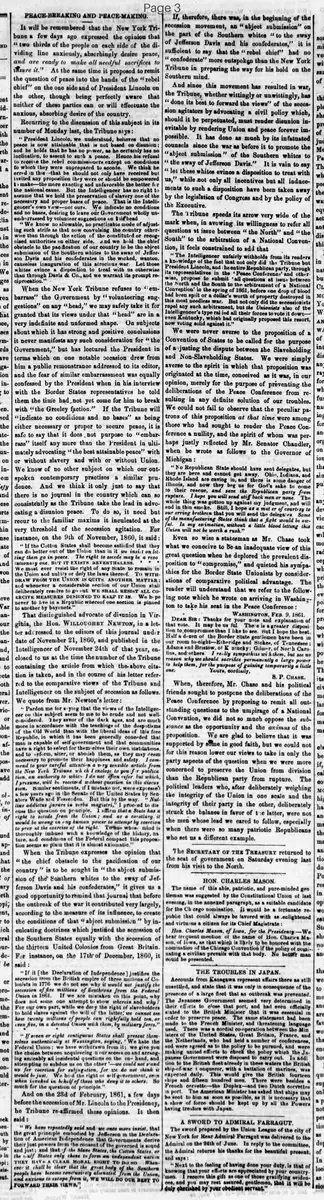
PEACE-BREAKING AND PEACE-MAKING.
It will be remembered that the New York Tribune a few days ago expressed the opinion that "two thirds of the people on each side of the dividing line anxiously, absorbingly desire peace, and are ready to make all needful sacrifices to insure it." At the same time it proposed to remit the question of peace into the hands of the "rebel chief" on the one side and of President Lincoln on the other, though being perfectly aware that neither of these parties can or will effectuate the anxious, absorbing desire of the country.
Recurring to the discussion of this subject in its number of Monday last, the Tribune says:
"President Lincoln, we understand, believes that no peace is now attainable that is not based on disunion; and he holds that he has no power, as he certainly has no inclination, to assent to such a peace. Hence his refusal to receive the rebel commissioners except on conditions to which they were unprepared to accede. We think he erred in this—that he should not only have received but invited any proposition they were or should be empowered to make—the more exacting and unfavorable the better for the national cause. But the Intelligencer has no right to assume that we hold the preservation of slavery one of the necessary and proper bases of peace. That is the Intelligencer's own view—not ours. We indicate no conditions and no bases, desiring to leave our Government wholly unembarrassed by volunteer suggestions on our head.
"We know no allowable, no practicable mode of adjusting such strife as that now convulsing the country other than through the action of the constituted or recognized authorities on either side, and we hold the chief obstacle to the pacification of our country to be the abject submission of the Southern whites to the sway of Jefferson Davis and his confederates in the wicked, wanton, causeless inauguration of this atrocious war. Let those whites evince a disposition to treat with us otherwise than through Davis & Co., and we warrant its prompt reciprocation."
When the New York Tribune refuses to "embarrass" the Government by "volunteering suggestions" on any "head," we may safely take it for granted that its views under that "head" are in a very indefinite and unformed shape. On subjects about which it has strong and positive conclusions it never manifests any such consideration for "the Government," but has lectured the President in terms which on one notable occasion drew from him a public remonstrance addressed to its editor. And the fear of similar embarrassment was equally confessed by the President when in his interview with the Border States representatives he told them the time had not yet come for him to break with "the Greeley faction." If the Tribune will "indicate no conditions and no bases" as being either necessary or proper to secure peace, it is safe to say that it does not purpose to "embarrass" itself any more than the President in ultimately advocating "the best attainable peace" with or without slavery and with or without Union.
We know of no other subject on which our outspoken contemporary practises a similar prudence. And we think it only just to say that there is no journal in the country which can so consistently as the Tribune take the lead in advocating a disunion peace. To do so, it need but recur to the familiar maxims it inculcated at the very threshold of the secession agitation. For instance, on the 9th of November, 1860, it said:
"If the Cotton States shall become satisfied that they can do better out of the Union than in it we insist on letting them go in peace. The right to secede may be a revolutionary one, but it exists nevertheless. We must ever resist the right of any State to remain in the Union and nullify or defy the laws thereof. To WITHDRAW FROM THE UNION IS QUITE ANOTHER MATTER; and whenever a considerable section of our Union shall deliberately resolve to go out, WE SHALL RESIST ALL COERCIVE MEASURES DESIGNED TO KEEP IT IN. We hope never to live in a Republic whereof one section is pinned to another by bayonets."
That distinguished advocate of disunion in Virginia, the Hon. WILLOUGHBY NEWTON, in a letter addressed to the editors of this journal under date of November 21, 1860, and published in the Intelligencer of November 24th of that year, enclosed to us at the time the number of the Tribune containing the article from which the above citation is taken, and in the course of his letter referred to the comparative views of the Tribune and Intelligencer on the subject of secession as follows.
We quote from Mr. Newton's letter:
"Pardon me for saying that the views of the Intelligencer on this subject seem to me to be crude and not well considered. They savor of the dark ages, and are much more in accordance with the teachings of the despotisms of the Old World than with the liberal ideas of this free Republic, in which it has been generally conceded that man is capable of self government and that communities have a right to select for themselves their own institutions, and to form, alter, or abolish them, as they may deem necessary to promote their happiness and safety. I commend to your careful attention a very sensible article from the New York Tribune which I enclose to you for publication, an authority to which I do not often refer but which, I presume, will be received without question in this discussion. Similar sentiments, if I mistake not, were expressed a few years ago in the Senate of the United States by Senators Wade and Fessenden. But this by the way. 'Nullius addictus jurare in verba magistri,' I proceed to discuss the question on principle. I affirm that a State has a right to secede from the Union; and as a corollary, it would be wrong in any human power to attempt by coercion to prevent the exercise of the right. To one whose mind is thoroughly imbued with a knowledge of the history, nature, and conditions of the Federal compact this proposition seems so plain that it is almost axiomatic."
When the Tribune expresses the opinion that "the chief obstacle to the pacification of our country" is to be sought in "the abject submission of the Southern whites to the sway of Jefferson Davis and his confederates," it gives us a good opportunity to remind that journal that before the outbreak of the war it contributed very largely, according to the measure of its influence, to create the conditions of that "abject submission" by inculcating doctrines which justified the secession of the Southern States equally with the secession of the thirteen United Colonies from Great Britain.
For instance, on the 17th of December, 1860, it said:
"If it [the Declaration of Independence] justifies the secession from the British empire of three millions of colonists in 1776 we do not see why it would not justify the secession of five millions of Southrons from the Federal Union in 1861. If we are mistaken on this point, why does not some one attempt to show wherein and why? For our own part, while we deny the right of slaveholders to hold slaves against the will of the latter; we cannot see how twenty millions of people can rightfully hold ten, or even five, in a detested Union with them, by military force."
"If seven or eight contiguous States shall present themselves authentically at Washington, saying, 'We hate the Federal Union; we have withdrawn from it; we give you the choice between acquiescing in our secession and arranging amicably all incidental questions on the one hand, and attempting to subdue us on the other'—we could not stand up for coercion or subjugation, for we do not think it would be just. We hold the right of self-government, even when invoked in behalf of those who deny it to others. So much for the question of principle."
And on the 23d of February, 1861, a few days before the accession of Mr. Lincoln to the Presidency, the Tribune re-affirmed these opinions. It then said:
"We have repeatedly said and here once more insist, that the great principle embodied by Jefferson in the Declaration of American Independence—that Governments derive their just powers from the consent of the governed is sound and just; and that if the Slave States, the Cotton States, or the Gulf States only chose to form an independent nation THEY HAVE A CLEAR MORAL RIGHT TO DO SO Whenever it shall be clear that the great body of the Southern people have become conclusively alienated from the Union, and anxious to escape from it, WE WILL DO OUR BEST TO FORWARD THEIR VIEWS."
If, therefore, there was, in the beginning of the secession movement, an "abject submission" on the part of the Southern whites "to the sway of Jefferson Davis and his confederates," it is sufficient to say that the "rebel chief" had no "confederate" more outspoken than the New York Tribune in preparing the way for his hold on the Southern mind.
And since this movement has resulted in war, the Tribune, whether wittingly or unwittingly, has "done its best to forward the views" of the secession agitators by advocating a civil policy which, should it be perpetuated, must render disunion inevitable by rendering Union and peace forever impossible. It has done as much by its infatuated counsels since the war as before it to promote the "abject submission" of the Southern whites to "the sway of Jefferson Davis." It is vain to say "let these whites evince a disposition to treat with us," while not only all incentives but all inducements to such a disposition have been taken away by the legislation of Congress and by the policy of the Executive.
The Tribune speeds its arrow very wide of the mark when, in avowing its willingness to refer all questions at issue between "the North" and "the South" to the arbitration of a National Convention, it feels constrained to add that
"The Intelligencer unfairly withholds from its readers a knowledge of the fact that not only did the Tribune but President Lincoln, and the entire Republican party, through its representatives in the 'Peace Conference' and otherwise, propose to submit all questions at issue between the North and the South to the arbitrament of a National Convention in the spring of 1861, before one drop of blood had been spilt or a dollar's worth of property destroyed in this most needless war. But not only did the secessionists repel any such arbitrament, but the Unionists also of the Intelligencer's type rallied all their forces to vote it down—even Kentucky, which had originally proposed this resort, now voting solid against it."
We were never averse to the proposition of a Convention of States to be called for the purpose of adjusting the dispute between the Slaveholding and Non-Slaveholding States. We were simply averse to the spirit in which that proposition was originated at the time, conceived as it was, in our opinion, merely for the purpose of preventing the deliberations of the Peace Conference from resulting in any definite solution of our troubles.
We could not fail to observe that the peculiar patrons of this proposition at that time were among those who had sought to render the Peace Conference a nullity, and the spirit of whom was perhaps justly reflected by Mr. Senator Chandler, when he wrote as follows to the Governor of Michigan:
"No Republican State should have sent delegates, but they are here and cannot get away. Ohio, Indiana, and Rhode Island are caving in, and there is some danger of Illinois, and now they beg us for God's sake to come to their rescue, and save the Republican party from rupture. I hope you will send stiff back men or none. The whole thing was gotten up against my judgment, and will end in thin smoke. Still, I hope as a matter of courtesy to our erring brethren that you will send the delegates. Some of the manufacturing States think that a fight would be awful. In my estimation, without a little blood-letting this Union will not be worth a rush."
Even so wise a statesman as Mr. Chase took what we conceive to be an inadequate view of this great question when he deplored the prevalent disposition to "compromise," and quieted his sympathies for the Border State Unionists by considerations of comparative political advantage. The reader will understand that we refer to the following note which he wrote on arriving in Washington to take his seat in the Peace Conference:
Washington, Feb. 9, 1861.
Dear Sir: Thanks for your note and explanation of that vote. It may be useful. There is a greater disposition to compromise than I like to see. But I hope the best. Half a dozen of the Border State gentlemen have been in our room to-night—Etheridge and Stokes, of Tennessee; Adams and Bristow, of Kentucky; Gilmer, of North Carolina, and others. I really sympathize with them, but see no reason why we should sacrifice permanently a large power to help them, for the purpose of gaining temporarily a little one.
Yours, cordially,
S. P. CHASE.
When, therefore, Mr. Chase and his political friends sought to postpone the deliberations of the Peace Conference by proposing to remit all outstanding questions to the umpirage of a National Convention, we did not so much oppose the substance as the opportunity and the animus of the proposition. We are glad to believe that it was supported by some in good faith, but we could not for this reason lower our views to take in only the party aspects of the question when we were more concerned to preserve the Union from division than the Republican party from rupture. The political leaders who, after deliberately weighing the integrity of the Union in one scale and the integrity of their party in the other, deliberately struck the balance in favor of the latter, were not the men whose lead we cared to follow, especially when there were so many patriotic Republicans who set us a different example.
It will be remembered that the New York Tribune a few days ago expressed the opinion that "two thirds of the people on each side of the dividing line anxiously, absorbingly desire peace, and are ready to make all needful sacrifices to insure it." At the same time it proposed to remit the question of peace into the hands of the "rebel chief" on the one side and of President Lincoln on the other, though being perfectly aware that neither of these parties can or will effectuate the anxious, absorbing desire of the country.
Recurring to the discussion of this subject in its number of Monday last, the Tribune says:
"President Lincoln, we understand, believes that no peace is now attainable that is not based on disunion; and he holds that he has no power, as he certainly has no inclination, to assent to such a peace. Hence his refusal to receive the rebel commissioners except on conditions to which they were unprepared to accede. We think he erred in this—that he should not only have received but invited any proposition they were or should be empowered to make—the more exacting and unfavorable the better for the national cause. But the Intelligencer has no right to assume that we hold the preservation of slavery one of the necessary and proper bases of peace. That is the Intelligencer's own view—not ours. We indicate no conditions and no bases, desiring to leave our Government wholly unembarrassed by volunteer suggestions on our head.
"We know no allowable, no practicable mode of adjusting such strife as that now convulsing the country other than through the action of the constituted or recognized authorities on either side, and we hold the chief obstacle to the pacification of our country to be the abject submission of the Southern whites to the sway of Jefferson Davis and his confederates in the wicked, wanton, causeless inauguration of this atrocious war. Let those whites evince a disposition to treat with us otherwise than through Davis & Co., and we warrant its prompt reciprocation."
When the New York Tribune refuses to "embarrass" the Government by "volunteering suggestions" on any "head," we may safely take it for granted that its views under that "head" are in a very indefinite and unformed shape. On subjects about which it has strong and positive conclusions it never manifests any such consideration for "the Government," but has lectured the President in terms which on one notable occasion drew from him a public remonstrance addressed to its editor. And the fear of similar embarrassment was equally confessed by the President when in his interview with the Border States representatives he told them the time had not yet come for him to break with "the Greeley faction." If the Tribune will "indicate no conditions and no bases" as being either necessary or proper to secure peace, it is safe to say that it does not purpose to "embarrass" itself any more than the President in ultimately advocating "the best attainable peace" with or without slavery and with or without Union.
We know of no other subject on which our outspoken contemporary practises a similar prudence. And we think it only just to say that there is no journal in the country which can so consistently as the Tribune take the lead in advocating a disunion peace. To do so, it need but recur to the familiar maxims it inculcated at the very threshold of the secession agitation. For instance, on the 9th of November, 1860, it said:
"If the Cotton States shall become satisfied that they can do better out of the Union than in it we insist on letting them go in peace. The right to secede may be a revolutionary one, but it exists nevertheless. We must ever resist the right of any State to remain in the Union and nullify or defy the laws thereof. To WITHDRAW FROM THE UNION IS QUITE ANOTHER MATTER; and whenever a considerable section of our Union shall deliberately resolve to go out, WE SHALL RESIST ALL COERCIVE MEASURES DESIGNED TO KEEP IT IN. We hope never to live in a Republic whereof one section is pinned to another by bayonets."
That distinguished advocate of disunion in Virginia, the Hon. WILLOUGHBY NEWTON, in a letter addressed to the editors of this journal under date of November 21, 1860, and published in the Intelligencer of November 24th of that year, enclosed to us at the time the number of the Tribune containing the article from which the above citation is taken, and in the course of his letter referred to the comparative views of the Tribune and Intelligencer on the subject of secession as follows.
We quote from Mr. Newton's letter:
"Pardon me for saying that the views of the Intelligencer on this subject seem to me to be crude and not well considered. They savor of the dark ages, and are much more in accordance with the teachings of the despotisms of the Old World than with the liberal ideas of this free Republic, in which it has been generally conceded that man is capable of self government and that communities have a right to select for themselves their own institutions, and to form, alter, or abolish them, as they may deem necessary to promote their happiness and safety. I commend to your careful attention a very sensible article from the New York Tribune which I enclose to you for publication, an authority to which I do not often refer but which, I presume, will be received without question in this discussion. Similar sentiments, if I mistake not, were expressed a few years ago in the Senate of the United States by Senators Wade and Fessenden. But this by the way. 'Nullius addictus jurare in verba magistri,' I proceed to discuss the question on principle. I affirm that a State has a right to secede from the Union; and as a corollary, it would be wrong in any human power to attempt by coercion to prevent the exercise of the right. To one whose mind is thoroughly imbued with a knowledge of the history, nature, and conditions of the Federal compact this proposition seems so plain that it is almost axiomatic."
When the Tribune expresses the opinion that "the chief obstacle to the pacification of our country" is to be sought in "the abject submission of the Southern whites to the sway of Jefferson Davis and his confederates," it gives us a good opportunity to remind that journal that before the outbreak of the war it contributed very largely, according to the measure of its influence, to create the conditions of that "abject submission" by inculcating doctrines which justified the secession of the Southern States equally with the secession of the thirteen United Colonies from Great Britain.
For instance, on the 17th of December, 1860, it said:
"If it [the Declaration of Independence] justifies the secession from the British empire of three millions of colonists in 1776 we do not see why it would not justify the secession of five millions of Southrons from the Federal Union in 1861. If we are mistaken on this point, why does not some one attempt to show wherein and why? For our own part, while we deny the right of slaveholders to hold slaves against the will of the latter; we cannot see how twenty millions of people can rightfully hold ten, or even five, in a detested Union with them, by military force."
"If seven or eight contiguous States shall present themselves authentically at Washington, saying, 'We hate the Federal Union; we have withdrawn from it; we give you the choice between acquiescing in our secession and arranging amicably all incidental questions on the one hand, and attempting to subdue us on the other'—we could not stand up for coercion or subjugation, for we do not think it would be just. We hold the right of self-government, even when invoked in behalf of those who deny it to others. So much for the question of principle."
And on the 23d of February, 1861, a few days before the accession of Mr. Lincoln to the Presidency, the Tribune re-affirmed these opinions. It then said:
"We have repeatedly said and here once more insist, that the great principle embodied by Jefferson in the Declaration of American Independence—that Governments derive their just powers from the consent of the governed is sound and just; and that if the Slave States, the Cotton States, or the Gulf States only chose to form an independent nation THEY HAVE A CLEAR MORAL RIGHT TO DO SO Whenever it shall be clear that the great body of the Southern people have become conclusively alienated from the Union, and anxious to escape from it, WE WILL DO OUR BEST TO FORWARD THEIR VIEWS."
If, therefore, there was, in the beginning of the secession movement, an "abject submission" on the part of the Southern whites "to the sway of Jefferson Davis and his confederates," it is sufficient to say that the "rebel chief" had no "confederate" more outspoken than the New York Tribune in preparing the way for his hold on the Southern mind.
And since this movement has resulted in war, the Tribune, whether wittingly or unwittingly, has "done its best to forward the views" of the secession agitators by advocating a civil policy which, should it be perpetuated, must render disunion inevitable by rendering Union and peace forever impossible. It has done as much by its infatuated counsels since the war as before it to promote the "abject submission" of the Southern whites to "the sway of Jefferson Davis." It is vain to say "let these whites evince a disposition to treat with us," while not only all incentives but all inducements to such a disposition have been taken away by the legislation of Congress and by the policy of the Executive.
The Tribune speeds its arrow very wide of the mark when, in avowing its willingness to refer all questions at issue between "the North" and "the South" to the arbitration of a National Convention, it feels constrained to add that
"The Intelligencer unfairly withholds from its readers a knowledge of the fact that not only did the Tribune but President Lincoln, and the entire Republican party, through its representatives in the 'Peace Conference' and otherwise, propose to submit all questions at issue between the North and the South to the arbitrament of a National Convention in the spring of 1861, before one drop of blood had been spilt or a dollar's worth of property destroyed in this most needless war. But not only did the secessionists repel any such arbitrament, but the Unionists also of the Intelligencer's type rallied all their forces to vote it down—even Kentucky, which had originally proposed this resort, now voting solid against it."
We were never averse to the proposition of a Convention of States to be called for the purpose of adjusting the dispute between the Slaveholding and Non-Slaveholding States. We were simply averse to the spirit in which that proposition was originated at the time, conceived as it was, in our opinion, merely for the purpose of preventing the deliberations of the Peace Conference from resulting in any definite solution of our troubles.
We could not fail to observe that the peculiar patrons of this proposition at that time were among those who had sought to render the Peace Conference a nullity, and the spirit of whom was perhaps justly reflected by Mr. Senator Chandler, when he wrote as follows to the Governor of Michigan:
"No Republican State should have sent delegates, but they are here and cannot get away. Ohio, Indiana, and Rhode Island are caving in, and there is some danger of Illinois, and now they beg us for God's sake to come to their rescue, and save the Republican party from rupture. I hope you will send stiff back men or none. The whole thing was gotten up against my judgment, and will end in thin smoke. Still, I hope as a matter of courtesy to our erring brethren that you will send the delegates. Some of the manufacturing States think that a fight would be awful. In my estimation, without a little blood-letting this Union will not be worth a rush."
Even so wise a statesman as Mr. Chase took what we conceive to be an inadequate view of this great question when he deplored the prevalent disposition to "compromise," and quieted his sympathies for the Border State Unionists by considerations of comparative political advantage. The reader will understand that we refer to the following note which he wrote on arriving in Washington to take his seat in the Peace Conference:
Washington, Feb. 9, 1861.
Dear Sir: Thanks for your note and explanation of that vote. It may be useful. There is a greater disposition to compromise than I like to see. But I hope the best. Half a dozen of the Border State gentlemen have been in our room to-night—Etheridge and Stokes, of Tennessee; Adams and Bristow, of Kentucky; Gilmer, of North Carolina, and others. I really sympathize with them, but see no reason why we should sacrifice permanently a large power to help them, for the purpose of gaining temporarily a little one.
Yours, cordially,
S. P. CHASE.
When, therefore, Mr. Chase and his political friends sought to postpone the deliberations of the Peace Conference by proposing to remit all outstanding questions to the umpirage of a National Convention, we did not so much oppose the substance as the opportunity and the animus of the proposition. We are glad to believe that it was supported by some in good faith, but we could not for this reason lower our views to take in only the party aspects of the question when we were more concerned to preserve the Union from division than the Republican party from rupture. The political leaders who, after deliberately weighing the integrity of the Union in one scale and the integrity of their party in the other, deliberately struck the balance in favor of the latter, were not the men whose lead we cared to follow, especially when there were so many patriotic Republicans who set us a different example.
What sub-type of article is it?
War Or Peace
Partisan Politics
Constitutional
What keywords are associated?
Peace Negotiations
Secession Rights
Disunion Advocacy
New York Tribune
Civil War Policy
Republican Party
Peace Conference
Union Preservation
What entities or persons were involved?
New York Tribune
President Lincoln
Jefferson Davis
Willoughby Newton
S. P. Chase
Senator Chandler
Horace Greeley
Republican Party
Peace Conference
Editorial Details
Primary Topic
Critique Of New York Tribune's Stance On Peace And Secession
Stance / Tone
Critical Of Tribune's Inconsistency And Republican Tactics, Supportive Of Union Preservation
Key Figures
New York Tribune
President Lincoln
Jefferson Davis
Willoughby Newton
S. P. Chase
Senator Chandler
Horace Greeley
Republican Party
Peace Conference
Key Arguments
Tribune's Past Advocacy For Secession Contributed To Southern Submission To Davis
Tribune's Current Vagueness On Peace Conditions Avoids Embarrassing The Government But Reveals Indefinite Views
Tribune's Policies Since War Promote Disunion By Making Peace Impossible
Opposition To 1861 National Convention Stemmed From Republican Animus, Not Substance
Prioritizing Party Integrity Over Union Preservation Is Misguided
Tribune Hypocritically Blames Southern Whites For War Obstacles While Aiding Secession Initially