Thank you for visiting SNEWPapers!
Sign up free
Vandalia Whig And Illinois Intelligencer
Vandalia, Fayette County, Illinois
What is this article about?
Detailed report on U.S. House and Senate proceedings in May 1832, covering the Apportionment Bill disagreement, Tariff discussion scheduling, Pension Bill amendments, steam boat safety report, and debates on Internal Improvements appropriations for 1832 including Savannah River, Cumberland Road, and military road in Maine.
Clipping
OCR Quality
Full Text
From the Globe.
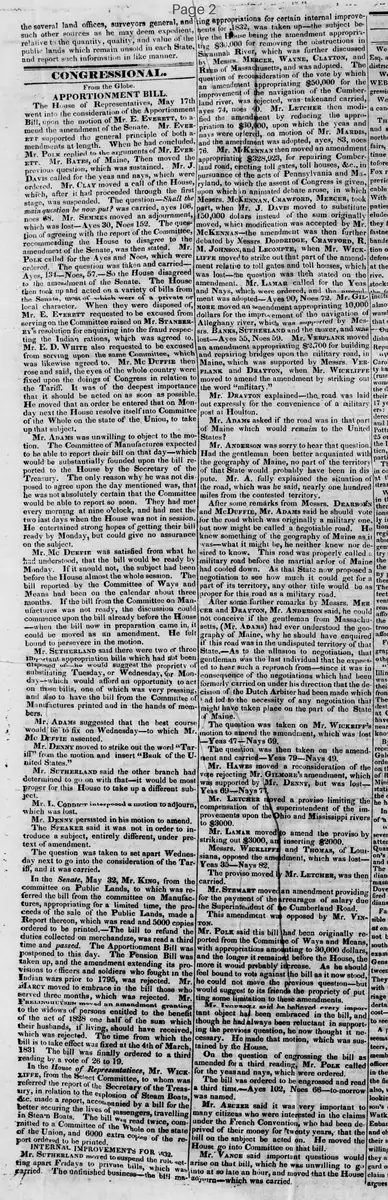
The House of Representatives, May 17th, went into the consideration of the Apportionment Bill, upon the motion of Mr. E. Everett, to amend the amendment of the Senate. Mr. Everett supported the general principle of both amendments at length. When he had concluded, Mr. Polk replied to the arguments of Mr. Everett. Mr. Bates, of Maine, then moved the previous question, which was sustained. Mr. J. Davis called for the yeas and nays, which were ordered. Mr. Clay moved a call of the House, which, after it had proceeded through the first stage, was suspended. The question—Shall the main question be now put? was carried, ayes 106, noes 08. Mr. Semmes moved an adjournment, which was lost—Ayes 30, Noes 152. The question of agreeing with the report of the Committee, recommending the House to disagree to the amendment of the Senate, was then stated. Mr. Polk called for the Ayes and Noes, which were ordered. The question was taken and carried—Ayes, 134—Noes, 57. So the House disagreed to the amendment of the Senate. The House then took up and acted on a variety of bills from the Senate, most of which were of a private or local character. When they were disposed of, Mr. E. Everett requested to be excused from serving on the Committee raised on Mr. Stanbery's resolution for enquiring into the fraud respecting the Indian rations, which was agreed to. Mr. E. D. White also requested to be excused from serving upon the same Committee, which was likewise agreed to. Mr. McDuffie then rose and said, the eyes of the whole country were fixed upon the doings of Congress in relation to the Tariff. It was of the deepest importance that it should be acted on as soon as possible. He moved that an order be entered that on Monday next the House resolve itself into Committee of the Whole on the state of the Union, to take up that subject. Mr. Adams was unwilling to object to the motion. The Committee of Manufactures expected to be able to report their bill on that day—which would be substantially founded upon the bill reported to the House by the Secretary of the Treasury. The only reason why he was not disposed to agree upon the day mentioned was, that he was not absolutely certain that the Committee would be able to report so soon. They had met every morning at nine o'clock, and had met the two last days when the House was not in session. He entertained strong hopes of getting their bill ready by Monday, but could give no assurance on the subject. Mr. McDuffie was satisfied from what he had understood, that the bill would be ready by Monday. If it should not, the subject had been before the House almost the whole session. The bill reported by the Committee of Ways and Means had been on the calendar about three months. If the bill from the Committee on Manufactures was not ready, the discussion could commence upon the bill already before the House—when the bill now in preparation came in, it could be moved as an amendment. He felt bound to persevere in the motion. Mr. Sutherland said there were two or three important appropriation bills which had not been disposed of. He would suggest the propriety of substituting Tuesday, or Wednesday, or Monday—which would afford an opportunity to act on those bills, one of which was very pressing, and also to have the bill from the Committee of Manufactures printed and in the hands of members. Mr. Adams suggested that the best course would be to fix on Wednesday—to which Mr. McDuffie assented. Mr. Denny moved to strike out the word "Tariff" from the motion and insert "Bank of the United States." Mr. Sutherland said the other branch had determined to go on with that; it would be most proper for this House to take up a different subject. Mr. L. Condict introduced a motion to adjourn, which was lost. Mr. Denny persisted in his motion to amend. The Speaker said it was not in order to introduce a subject, entirely different, under pretext of amendment. The question was taken to set apart Wednesday next to go into the consideration of the Tariff, and it was carried. In the Senate, May 22. Mr. King, from the committee on Public Lands, to which was referred the bill from the committee on Manufactures, appropriating for a limited time, the proceeds of the sale of the Public Lands, made a Report thereon, which was read and 5000 copies ordered to be printed.—The bill to refund the duties collected on merchandize, was read a third time and passed. The Apportionment Bill was postponed to this day. The Pension Bill was taken up, and the amendment extending its provisions to officers and soldiers who fought in the Indian wars prior to 1795, was rejected. Mr. Marcy moved to embrace in the bill those who served three months, which was rejected. Mr. Frelinghuysen moved an amendment granting to the widows of persons entitled to the benefit of the act of 1828 one half of the sum which their husbands, if living, should have received, which was rejected. The time from which the bill is to take effect was fixed at the 4th of March, 1831. The bill was finally ordered to a third reading by a vote of 26 to 19. In the House of Representatives, Mr. Wickliffe, from the Select Committee, to whom was referred the report of the Secretary of the Treasury, in relation to the explosion of Steam Boats, &c: made a report, accompanied by a bill for the better securing the lives of passengers, travelling in Steam Boats. The bill was read twice, committed to a Committee of the Whole on the state of the Union, and 6000 extra copies of the report ordered to be printed.
INTERNAL IMPROVEMENTS FOR 1832.
Mr. Sutherland moved to suspend the rule setting apart Fridays to private bills, which was carried. The unfinished business—the bill making appropriations for certain internal improvements for 1832, was taken up—the subject before the House being the amendment appropriating $30,000 for removing the obstructions in Savannah River, which was further discussed by Messrs. Mercer, Wayne, Clayton, and Reed of Massachusetts, and was adopted. The question of reconsideration of the vote by which an amendment appropriating $50,000 for the improvement of the navigation of the Cumberland land river, was rejected, was taken and carried, ayes 74, noes 40. Mr. Letcher then modified the amendment by reducing the appropriation to $30,000, upon which the yeas and nays were ordered, on motion of Mr. Mardis, and the amendment was adopted, ayes, 83, noes 76. Mr. McKennan then moved an amendment appropriating $328,923, for repairing Cumberland road, erecting toll gates, toll houses, &c., in pursuance of the acts of Pennsylvania and Maryland, to which the assent of Congress is given, upon which an animated debate arose, in which Messrs. McKennan, Crawford, Mercer, took part, when Mr. J. Davis moved to substitute 150,000 dollars instead of the sum originally moved, which modification was accepted by Mr. McKennan—the amendment was then further debated by Messrs. Doldridge, Crawford, R. M. Johnson, and Lecomte, when Mr. Wickliffe moved to strike out that part of the amendment relative to toll gates and toll houses, which was lost—the question was then stated on the amendment. Mr. Lamar called for the Yeas and Nays, which were ordered, and the amendment was adopted—Ayes 90. Noes 72. Mr. Gilmore moved an amendment appropriating 10,000 dollars for the improvement of the navigation of Alleghany river, which was supported by Messrs. Banks, Sutherland and the mover, and was lost—Ayes 55, Noes 59. Mr. Verplanck moved an amendment appropriating $2,700 for building and repairing bridges upon the military road, in Maine, which was supported by Messrs. Verplanck and Drayton, when Mr. Wickliffe moved to amend the amendment by striking out the word "military." Mr. Drayton explained—the road was laid out expressly for the convenience of a military post at Houlton. Mr. Adams asked if the road was in that part of Maine which would remain to the United States? Mr. Anderson was sorry to hear that question. Had the gentleman been better acquainted with the geography of Maine, no part of the territory of that State would probably have been in dispute. Mr. A. fully explained the situation of the road, which was he said, nearly one hundred miles from the contested territory. After some remarks from Messrs. Dearborn and McDuffie, Mr. Adams said he should vote for the road which was originally a military one, but now might be called a negotiable road. He knew something of the geography of Maine as it was—what it might be, he neither knew nor desired to know. This road was properly called a military road before the martial ardor of Maine had cooled down. As that State now proposed a negotiation to see how much it could get for a part of its territory, any other title would be as proper for this road as a military road. After some further remarks by Messrs. Mercer and Drayton, Mr. Anderson said, he could not conceive if the gentleman from Massachusetts, (Mr. Adams) had ever understood the geography of Maine, why he should have enquired if this road was in the undisputed territory of that State. As to the allusion to negotiation, that gentleman was the last individual that he expected to hear such a reproach from—since it was in consequence of the negotiations which had been formerly carried on under his direction that the decision of the Dutch Arbiter had been made which had led to the necessity of any negotiation that might have taken place on the part of the State of Maine. The question was taken on Mr. Wickliffe's motion to amend the amendment, which was lost. Yeas 47—Nays 69. The question was then taken on the amendment and carried—Yeas 79—Nays 49. Mr. Hawes moved a reconsideration of the vote rejecting Mr. Gilmore's amendment, which was supported by Mr. Denny, but was lost—Yeas 69—Nays 77. Mr. Letcher moved a proviso limiting the compensation of the superintendent of the improvements upon the Ohio and Mississippi rivers to $3000. Mr. Lamar moved to amend the proviso by striking out $3000, and inserting $2000. Messrs. Wickliffe and Thomas, of Louisiana, opposed the amendment, which was lost—Yeas 35—Nays 82. The proviso moved by Mr. Letcher, was then carried. Mr. Stewart moved an amendment providing for the payment of the arrearages of salary due the Superintendent of Cumberland Road. This amendment was opposed by Mr. Vinton. Mr. Polk said this bill had been originally reported from the Committee of Ways and Means, with appropriations amounting to $300,000 dollars, and the longer it remained before the House, the more it would probably increase. As he should feel bound to vote against the bill as it now stood, he could not move the previous question—but would suggest to its friends the propriety of putting some limitation to these amendments. Mr. Vansant said he believed every important object had been embraced in the bill, and though he had always been reluctant in supporting the previous question, he now thought it necessary. He made that motion, which was sustained by the House. On the question of engrossing the bill as amended for a third reading, Mr. Polk called for the yeas and nays, which were ordered. The bill was ordered to be engrossed and read a third time—Ayes 102, Noes 66—to-morrow was named. Mr. Archer said it was very important to many citizens who were interested in the claims under the French Convention, who had been deprived of their money for twenty years, that the bill on the subject be acted on. He moved the House go into Committee on that bill. Mr. Vance said important questions would arise on that bill, which he was unwilling to go into at so late an hour, and moved that the House adjourn—which was carried.
What sub-type of article is it?
What keywords are associated?
What entities or persons were involved?
Where did it happen?
Story Details
Key Persons
Location
House Of Representatives, Senate
Event Date
May 17th, May 22, 1832
Story Details
The House debated and disagreed to the Senate's amendment on the Apportionment Bill. Discussion scheduled the Tariff bill for Wednesday. Senate handled Public Lands report, refunded duties, postponed Apportionment, and advanced Pension Bill with rejections of amendments. House received steam boat safety report. Internal Improvements bill for 1832 saw amendments adopted for Savannah River ($30,000), Cumberland River ($30,000), Cumberland Road ($150,000), and Maine military road ($2,700), with rejections for Alleghany River and others; bill engrossed for third reading.