Thank you for visiting SNEWPapers!
Sign up free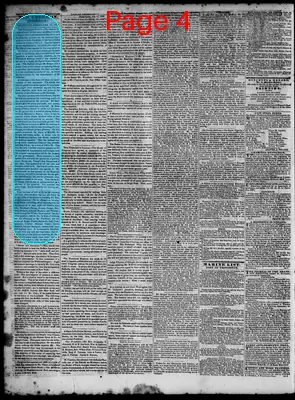
Rhode Island American And Gazette
Providence, Providence County, Rhode Island
What is this article about?
The American newspaper critiques a misrepresentation in Jackson-supporting papers about a congressional vote on the $18,000 appropriation for John Randolph's mission to Russia. It explains that the vote was evaded, and the final 115-3 tally on the general bill does not reflect true opposition to the item.
Clipping
OCR Quality
Full Text
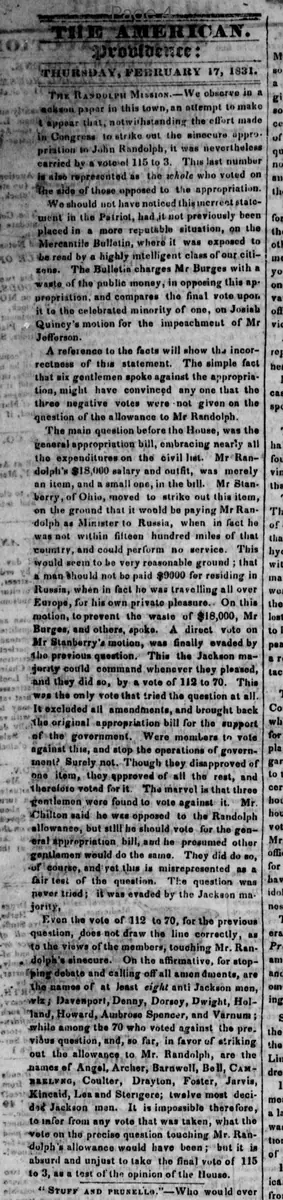
THURSDAY, FEBRUARY 17, 1831.
The Randolph Mission.—We observe in a Jackson paper in this town, an attempt to make it appear that, notwithstanding the effort made in Congress to strike out the sinecure appropriation to John Randolph, it was nevertheless carried by a vote of 115 to 3. This last number is also represented as the whole who voted on the side of those opposed to the appropriation.
We should not have noticed this incorrect statement in the Patriot, had it not previously been placed in a more reputable situation, on the Mercantile Bulletin, where it was exposed to be read by a highly intelligent class of our citizens. The Bulletin charges Mr. Burgess with a waste of the public money, in opposing this appropriation, and compares the final vote upon it to the celebrated minority of one, on Josiah Quincy's motion for the impeachment of Mr. Jefferson.
A reference to the facts will show the incorrectness of this statement. The simple act that six gentlemen spoke against the appropriation, might have convinced any one that the three negative votes were not given on the question of the allowance to Mr. Randolph.
The main question before the House, was the general appropriation bill, embracing nearly all the expenditures on the civil list. Mr. Randolph's $18,000 salary and outfit, was merely an item, and a small one, in the bill. Mr. Stanberry, of Ohio, moved to strike out this item, on the ground that it would be paying Mr. Randolph as Minister to Russia, when in fact he was not within fifteen hundred miles of that country, and could perform no service. This would seem to be very reasonable ground; that a man should not be paid $9000 for residing in Russia, when in fact he was travelling all over Europe, for his own private pleasure. On this motion, to prevent the waste of 18,000, Mr. Burgess, and others, spoke. A direct vote on Mr. Stanberry's motion, was finally evaded by the previous question. This the Jackson majority could command whenever they pleased, and they did so, by a vote of 112 to 70. This was the only vote that tried the question at all. It excluded all amendments, and brought back the original appropriation bill for the support of the government. Were members to vote against this, and stop the operations of government? Surely not. Though they disapproved of one item, they approved of all the rest, and therefore voted for it. The marvel is that three gentlemen were found to vote against it. Mr. Chilton said he was opposed to the Randolph allowance, but still he should vote for the general appropriation bill, and he presumed other gentlemen would do the same. They did do so, of course, and yet this is misrepresented as a fair test of the question. The question was never tried; it was evaded by the Jackson majority.
Even the vote of 112 to 70, on the previous question, does not draw the line correctly, as to the views of the members, touching Mr. Randolph's sinecure. On the affirmative, or stopping debate and calling off all amendments, are the names of at least eight anti-Jackson men, viz: Davenport, Denny, Dorsey, Dwight, Holland, Howard, Ambrose Spencer, and Varnum; while among the 70 who voted against the previous question, and, so far, in favor of striking out the allowance to Mr. Randolph, are the names of Angel, Archer, Barnwell, Bell, Cambreleng, Coulter, Drayton, Foster, Jarvis, Kincaid, Lea and Sterigere; twelve most decided Jackson men. It is impossible therefore, to infer from any vote that was taken, what the vote on the precise question touching Mr. Randolph's allowance would have been; but it is absurd and unjust to take the final vote of 115 to 3, as a test of the opinion of the House.
What sub-type of article is it?
What keywords are associated?
What entities or persons were involved?
Where did it happen?
Domestic News Details
Primary Location
U.S. Congress
Key Persons
Outcome
the appropriation for john randolph passed as part of the general bill by 115 to 3, but the direct motion to strike it was evaded by a 112 to 70 vote on the previous question.
Event Details
Debate in the House over striking the $18,000 item for John Randolph's salary and outfit as Minister to Russia from the general appropriation bill, on grounds he was not performing duties; motion evaded, leading to misrepresentation in Jackson papers.