Thank you for visiting SNEWPapers!
Sign up free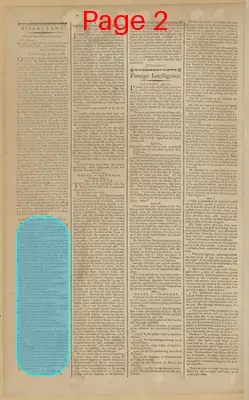
Literary
July 7, 1788
The New York Journal, And Daily Patriotic Register
New York, New York County, New York
What is this article about?
A satirical letter to the printer of the St. James Chronicle, where the writer expresses disdain for long political speeches and newspaper content, explaining they only read first lines. Examples include opening phrases from MPs' speeches, news items, and advertisements, signed heartily to Mr. Baldwin.
Clipping
OCR Quality
95%
Excellent
Full Text
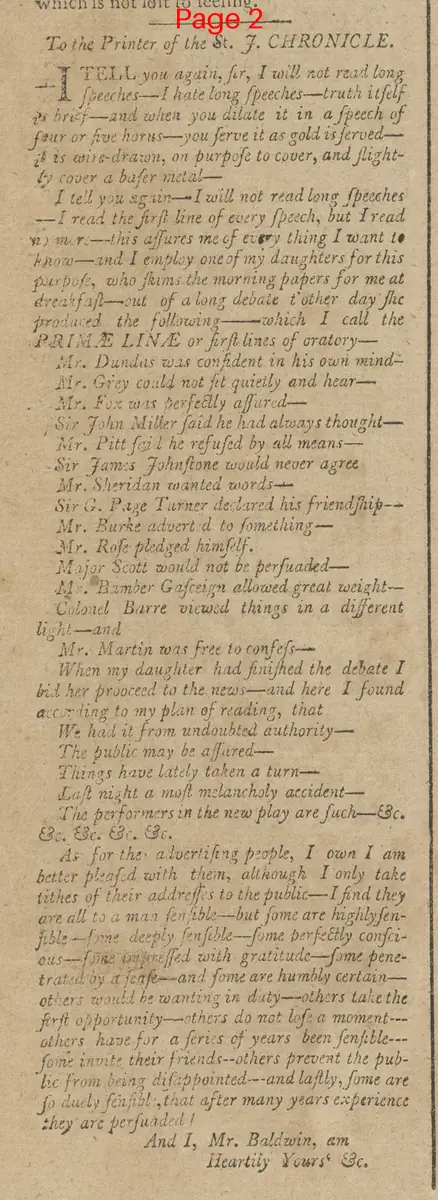
To the Printer of the St. J. CHRONICLE.
I TELL you again, sir, I will not read long speeches—I hate long speeches—truth itself is brief—and when you dilate it in a speech of four or five hours—you serve it as gold is served—it is wire-drawn, on purpose to cover, and lightly cover a baser metal.
I tell you again—I will not read long speeches—I read the first line of every speech, but I read no more—this assures me of every thing I want to know—and I employ one of my daughters for this purpose, who skims the morning papers for me at breakfast—out of a long debate t'other day she produced the following—which I call the PRIME LINE or first lines of oratory—
Mr. Dundas was confident in his own mind—
Mr. Grey could not sit quietly and hear
Mr. Fox was perfectly assured—
Sir John Miller said he had always thought—
Mr. Pitt said he refused by all means—
Sir James Johnstone would never agree
Mr. Sheridan wanted words—
Sir G. Page Turner declared his friendship—
Mr. Burke adverted to something—
Mr. Roe pledged himself.
Major Scott would not be persuaded—
Lord Amber Grey allowed great weight—
Colonel Barre viewed things in a different light—and
Mr. Martin was free to confess—
When my daughter had finished the debate I bid her proceed to the news—and here I found according to my plan of reading, that
We had it from undoubted authority—
The public may be assured
Things have lately taken a turn—
Last night a most melancholy accident—
The performers in the new play are such &c. &c. &c. &c.
As for the advertising people, I own I am better pleased with them, although I only take tithes of their addresses to the public—I find they are all to a man sensible—but some are highly sensible—some deeply sensible—some perfectly conscious—some injured with gratitude—some penetrated by a sense—and some are humbly certain—others would be wanting in duty—others take the first opportunity—others do not lose a moment—others have for a series of years been sensible—some invite their friends—others prevent the public from being disappointed—and lastly, some are so duly sensible, that after many years experience they are persuaded
And I, Mr. Baldwin, am
Heartily Yours' &c.
I TELL you again, sir, I will not read long speeches—I hate long speeches—truth itself is brief—and when you dilate it in a speech of four or five hours—you serve it as gold is served—it is wire-drawn, on purpose to cover, and lightly cover a baser metal.
I tell you again—I will not read long speeches—I read the first line of every speech, but I read no more—this assures me of every thing I want to know—and I employ one of my daughters for this purpose, who skims the morning papers for me at breakfast—out of a long debate t'other day she produced the following—which I call the PRIME LINE or first lines of oratory—
Mr. Dundas was confident in his own mind—
Mr. Grey could not sit quietly and hear
Mr. Fox was perfectly assured—
Sir John Miller said he had always thought—
Mr. Pitt said he refused by all means—
Sir James Johnstone would never agree
Mr. Sheridan wanted words—
Sir G. Page Turner declared his friendship—
Mr. Burke adverted to something—
Mr. Roe pledged himself.
Major Scott would not be persuaded—
Lord Amber Grey allowed great weight—
Colonel Barre viewed things in a different light—and
Mr. Martin was free to confess—
When my daughter had finished the debate I bid her proceed to the news—and here I found according to my plan of reading, that
We had it from undoubted authority—
The public may be assured
Things have lately taken a turn—
Last night a most melancholy accident—
The performers in the new play are such &c. &c. &c. &c.
As for the advertising people, I own I am better pleased with them, although I only take tithes of their addresses to the public—I find they are all to a man sensible—but some are highly sensible—some deeply sensible—some perfectly conscious—some injured with gratitude—some penetrated by a sense—and some are humbly certain—others would be wanting in duty—others take the first opportunity—others do not lose a moment—others have for a series of years been sensible—some invite their friends—others prevent the public from being disappointed—and lastly, some are so duly sensible, that after many years experience they are persuaded
And I, Mr. Baldwin, am
Heartily Yours' &c.
What sub-type of article is it?
Satire
Essay
What themes does it cover?
Political
Social Manners
What keywords are associated?
Satirical Letter
Parliamentary Speeches
Newspaper Satire
First Lines
Oratory Mockery
Advertisements
Political Debate
Literary Details
Subject
Complaint Against Long Speeches And Verbose Newspaper Content
Form / Style
Satirical Letter In Prose
Key Lines
I Tell You Again, Sir, I Will Not Read Long Speeches—I Hate Long Speeches—Truth Itself Is Brief—
Mr. Dundas Was Confident In His Own Mind—
Mr. Grey Could Not Sit Quietly And Hear
Mr. Fox Was Perfectly Assured—
We Had It From Undoubted Authority—
The Public May Be Assured
Things Have Lately Taken A Turn—