Thank you for visiting SNEWPapers!
Sign up free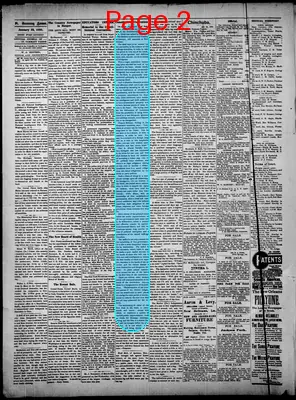
Editorial
January 29, 1898
St. Tammany Farmer
Covington, Saint Tammany County, Louisiana
What is this article about?
Editorial discusses the upcoming Louisiana Constitutional Convention on February 8, focusing on revising suffrage to exclude ignorant (primarily Black) voters and foreigners, reorganizing judiciary, and authorizing city bonds for public improvements like drainage and sewerage.
Clipping

OCR Quality
98%
Excellent
Full Text
On the second Tuesday of February, which will be the 8th of that month, the Constitutional Convention, which was called by the people at the election on the second Tuesday of January, will assemble in New Orleans.
The chief topic to be treated by the convention is the revision of the suffrage franchise, in order to take the power to vote out of the hands, first, of the ignorant and shiftless class, and, second, out of the hands of foreigners.
With a negro population embracing quite one-half the total of the people in the State, almost wholly ignorant and as shiftless as mentally benighted, but armed with the ballot, the State is perpetually overshadowed politically by a black and menacing cloud.
Such a situation demands prompt and effectual relief, and it can only be secured by imposing on all voters an intellectual or educational qualification, with the alternative of a property requirement for those who, while unlettered, have exhibited intelligence and thrift sufficient to have accumulated property and to have become payers of taxes direct to the State.
The crying need for the deliverance of Louisiana from the possibility of being dominated by a vast depraved, ignorant and shiftless element, is too imperative to be disregarded.
Francis Bellamy, writing in the Illustrated American, says: "Louisiana at present has the loosest suffrage laws in the Union. You do not have to be a citizen, or even a resident, in order to vote. You may be a subject of a foreign king and on a visit to this hospitable State; you can vote without naturalization and then return home."
This is almost literally true. Any foreigner who has sojourned in the State for one year and who shall declare in form his intention of becoming a citizen may vote in all political State elections, and there is no legal obligation resting on him ever to become a citizen. Doubtless there is a moral obligation, but moral obligations do not count in party politics.
Such a state of things is a monstrous outrage upon all citizenship, for foreigners, with no interest in the State, are placed above natives, who, in order to acquire the rights of citizens, must have lived for twenty-one years under free institutions; while aliens, with no knowledge of free constitutional government, after a brief and temporary residence, may vote without absolving their allegiance to the kings, emperors and other foreign potentates whose subjects they may be.
Such abuses of the principle upon which the entire superstructure of all free government rests must end in its destruction, unless a prompt and effective remedy be applied. Constitutional liberty and free institutions cannot long survive excess of political corruption and a prostitution of the sacred suffrage franchise.
The ballot is not only a means for the upbuilding of free government. It is also a most dangerous weapon for its destruction. The ballot is like dynamite, which, while it may be made a most useful servant in the hands of those who will use it with care and intelligence to secure the best results of which it is capable, becomes in the hands of the ignorant and the vicious classes a most destructive and dangerous element. To place proper restrictions around the use of the ballot is the first duty of the convention.
There are various other matters which will command attention at the hands of the convention. Among these is a reorganization of the judiciary. The abrogation of the present system of the district judges, and the substitution in their places of a judge for each parish or county, seems to embody the best view that has yet been presented for the reform.
The authorizing of cities of the first class in the State to issue bonds and borrow money with which to construct a system of needed public improvements, such as works for drainage, sewerage, paving and the like, is a matter that will also be brought before the convention. It is one which, when adopted, will bring results of the utmost importance to the city.
There are other matters of moment which will be considered by the convention and which will be treated later; but those mentioned are of the first and most imperative urgency, and they demand the first care.-Picayune.
The chief topic to be treated by the convention is the revision of the suffrage franchise, in order to take the power to vote out of the hands, first, of the ignorant and shiftless class, and, second, out of the hands of foreigners.
With a negro population embracing quite one-half the total of the people in the State, almost wholly ignorant and as shiftless as mentally benighted, but armed with the ballot, the State is perpetually overshadowed politically by a black and menacing cloud.
Such a situation demands prompt and effectual relief, and it can only be secured by imposing on all voters an intellectual or educational qualification, with the alternative of a property requirement for those who, while unlettered, have exhibited intelligence and thrift sufficient to have accumulated property and to have become payers of taxes direct to the State.
The crying need for the deliverance of Louisiana from the possibility of being dominated by a vast depraved, ignorant and shiftless element, is too imperative to be disregarded.
Francis Bellamy, writing in the Illustrated American, says: "Louisiana at present has the loosest suffrage laws in the Union. You do not have to be a citizen, or even a resident, in order to vote. You may be a subject of a foreign king and on a visit to this hospitable State; you can vote without naturalization and then return home."
This is almost literally true. Any foreigner who has sojourned in the State for one year and who shall declare in form his intention of becoming a citizen may vote in all political State elections, and there is no legal obligation resting on him ever to become a citizen. Doubtless there is a moral obligation, but moral obligations do not count in party politics.
Such a state of things is a monstrous outrage upon all citizenship, for foreigners, with no interest in the State, are placed above natives, who, in order to acquire the rights of citizens, must have lived for twenty-one years under free institutions; while aliens, with no knowledge of free constitutional government, after a brief and temporary residence, may vote without absolving their allegiance to the kings, emperors and other foreign potentates whose subjects they may be.
Such abuses of the principle upon which the entire superstructure of all free government rests must end in its destruction, unless a prompt and effective remedy be applied. Constitutional liberty and free institutions cannot long survive excess of political corruption and a prostitution of the sacred suffrage franchise.
The ballot is not only a means for the upbuilding of free government. It is also a most dangerous weapon for its destruction. The ballot is like dynamite, which, while it may be made a most useful servant in the hands of those who will use it with care and intelligence to secure the best results of which it is capable, becomes in the hands of the ignorant and the vicious classes a most destructive and dangerous element. To place proper restrictions around the use of the ballot is the first duty of the convention.
There are various other matters which will command attention at the hands of the convention. Among these is a reorganization of the judiciary. The abrogation of the present system of the district judges, and the substitution in their places of a judge for each parish or county, seems to embody the best view that has yet been presented for the reform.
The authorizing of cities of the first class in the State to issue bonds and borrow money with which to construct a system of needed public improvements, such as works for drainage, sewerage, paving and the like, is a matter that will also be brought before the convention. It is one which, when adopted, will bring results of the utmost importance to the city.
There are other matters of moment which will be considered by the convention and which will be treated later; but those mentioned are of the first and most imperative urgency, and they demand the first care.-Picayune.
What sub-type of article is it?
Suffrage
Immigration
Legal Reform
What keywords are associated?
Suffrage Revision
Voting Restrictions
Louisiana Convention
Educational Qualification
Foreign Voters
Judiciary Reform
Public Improvements
What entities or persons were involved?
Constitutional Convention
Negro Population
Foreigners
Francis Bellamy
Illustrated American
Picayune
Editorial Details
Primary Topic
Revision Of Suffrage Franchise To Exclude Ignorant And Foreigners
Stance / Tone
Strongly Supportive Of Voting Restrictions For Education Or Property
Key Figures
Constitutional Convention
Negro Population
Foreigners
Francis Bellamy
Illustrated American
Picayune
Key Arguments
Impose Educational Or Property Qualifications On Voters To Exclude Ignorant And Shiftless Classes
Restrict Foreign Voting After Only One Year Residence Without Citizenship
Reorganize Judiciary By Replacing District Judges With Parish Judges
Authorize Cities To Issue Bonds For Public Improvements Like Drainage And Sewerage
Ballot In Wrong Hands Is Destructive Like Dynamite