Thank you for visiting SNEWPapers!
Sign up free
Vermont Phœnix
Brattleboro, Bellows Falls, Ludlow, Windham County, Windsor County, Vermont
What is this article about?
Riots erupted in Philadelphia on May 5, 1844, between Irish immigrants and Native American supporters, escalating from attacks on tents and a church to deadly clashes with military forces. At least seven civilians and several soldiers were killed, with peace restored by Monday after troop withdrawals.
Clipping
OCR Quality
Full Text
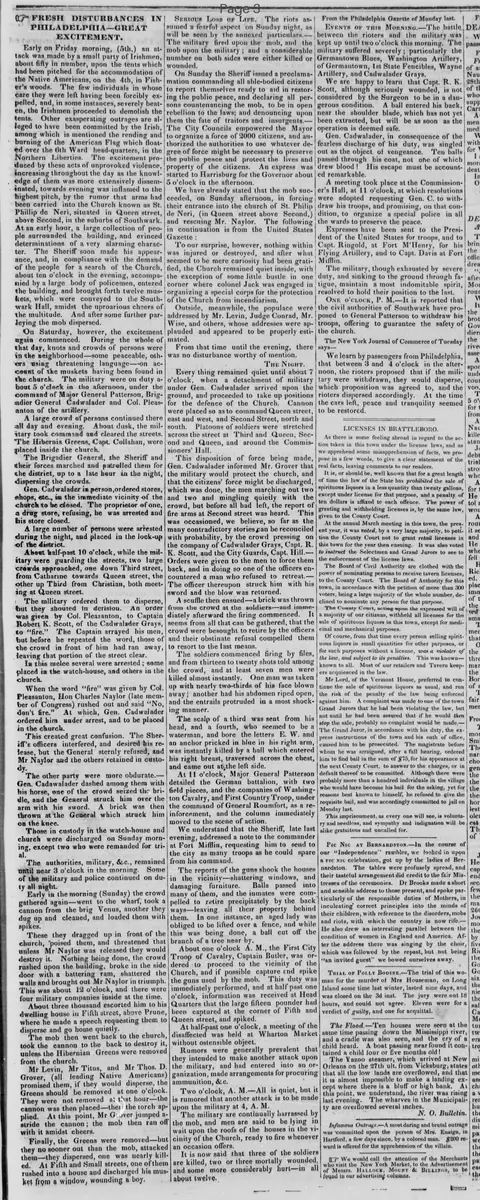
Early on Friday morning, (5th,) an attack was made by a small party of Irishmen, about fifty in number, upon the tents which had been pitched for the accommodation of the Native Americans, on the 4th, in Fisher's woods. The few individuals in whose care they were left having been forcibly expelled, and, in some instances, severely beaten, the Irishmen proceeded to demolish the tents. Other exasperating outrages are alleged to have been committed by the Irish, among which is mentioned the rending and burning of the American Flag which floated over the 6th Ward head-quarters, in the Northern Liberties. The excitement produced by these acts of unprovoked violence, increasing throughout the day as the knowledge of them was more extensively disseminated, towards evening was inflamed to the highest pitch, by the rumor that arms had been carried into the Church known as St. Phillip de Neri, situated in Queen street, above Second, in the suburbs of Southwark. At an early hour, a large collection of people surrounded the building, and evinced determinations of a very alarming character. The Sheriff soon made his appearance, and, in compliance with the demand of the people for a search of the Church, about ten o'clock in the evening, accompanied by a large body of policemen, entered the building, and brought forth twelve muskets, which were conveyed to the Southwark Hall, amidst the uproarious cheers of the multitude. And after some further parleying the mob dispersed.
On Saturday, however, the excitement again commenced. During the whole of that day, knots and crowds of persons were in the neighborhood—some peaceable, others using threatening language—on account of the muskets having been found in the church. The military were on duty about 5 o'clock in the afternoon, under the command of Major General Patterson, Brigadier General Cadwalader and Col. Pleasanton of the artillery. A large crowd of persons continued there all day and evening. About dusk, the military took command and cleared the streets. The Hibernia Greens, Capt. Collahan, were placed inside the church. The Brigadier General, the Sheriff and their forces marched and patrolled them for the district, up to a late hour in the night dispersing the crowds. Gen. Cadwalader in person, ordered stores, shops, etc. in the immediate vicinity of the church to be closed. The proprietor of one, a drug store, refusing, he was arrested and his store closed. A large number of persons were arrested during the night, and placed in the lock-up of the district. About half-past 10 o'clock, while the military were guarding the streets, two large crowds approached, one down Third street from Catharine towards Queen street, the other up Third from Christian, both meeting at Queen street. The military ordered them to disperse, but they shouted in derision. An order was given by Col. Pleasanton, to Captain Robert K. Scott, of the Cadwalader Grays, to "fire." The Captain arrayed his men, but before he repeated the word, those of the crowd in front of him had ran away, leaving that portion of the street clear. In this melee several were arrested; some placed in the watch-house, and others in the church. When the word "fire" was given by Col. Pleasanton, Hon. Charles Naylor (late member of Congress) rushed out and said "No, don't fire." At which, Gen. Cadwalader ordered him under arrest, and to be placed in the church. This created great confusion. The Sheriff's officers interfered, and desired his release, but the General sternly refused, and Mr. Naylor and the others retained in custody. The other party were more obdurate. Gen. Cadwalader dashed among them with his horse. One of the crowd seized the bridle, and the General struck him over the arm with his sword. A brick was then thrown at the General which struck him on the knee. Those in custody in the watch-house and church were discharged on Sunday morning, except two who were remanded for trial. The authorities, military, &c., remained until near 3 o'clock in the morning. Some of the military and police continued on duty all night. Early in the morning (Sunday) the crowd gathered again—went to the wharf, took a cannon from the brig Venus, another they dug up and cleaned, and loaded them with spikes. These they dragged up in front of the church, poised them, and threatened that unless Mr. Naylor was released they would destroy it. Nothing being done, the crowd rushed upon the building, broke in the side door with a battering ram, shattered the walls and brought out Mr. Naylor in triumph. This was about 12 o'clock, and there were four military companies inside at the time. About three thousand escorted him to his dwelling house in Fifth street, above Prune, where he made a speech requesting them to disperse and go home quietly. The mob then went back to the church, took the cannon to the back to destroy it, unless the Hibernian Greens were removed from the church. Mr. Levin, Mr. Titus, and Mr. Thos. D. Grover, (all leading Native Americans) promised them, if they would disperse, the Greens should be removed at one o'clock. They were not removed at that hour—the cannon was then placed—the torch applied. At this point, Mr. Grover jumped astride the cannon; the mob then ran off with it amidst cheers. Finally, the Greens were removed—but they no sooner out than the mob attacked them—they dispersed, one was nearly killed. At Fifth and Small streets, one of them rushed into a house and discharged his musket from a window, wounding a boy.
Serious Loss of Life. The riots assumed a fearful aspect on Sunday night, as will be seen by the annexed particulars. The military fired upon the mob, and the mob upon the military: and a considerable number on both sides were either killed or wounded.
On Sunday the Sheriff issued a proclamation commanding all able-bodied citizens to report themselves ready to aid in restoring the public peace, and declaring all persons countenancing the mob, to be in open rebellion to the laws; and denouncing upon them the fate of traitors and insurgents. The City Councils empowered the Mayor to organize a force of 2000 citizens, and authorized the authorities to use whatever degree of force might be necessary to preserve the public peace and protect the lives and property of the citizens. An express was started to Harrisburg for the Governor about 5 o'clock in the afternoon.
We have already stated that the mob succeeded, on Sunday afternoon, in forcing their entrance into the church of St. Philip de Neri, (in Queen street above Second,) and rescuing Mr. Naylor. The following in continuation is from the United States Gazette:
To our surprise, however, nothing within was injured or destroyed, and after what seemed to be mere curiosity had been gratified, the Church remained quiet inside, with the exception of some little bustle in one corner where colonel Jack was engaged in organizing a special corps for the protection of the Church from incendiarism.
Outside, meanwhile, the populace were addressed by Mr. Levin, Judge Conrad, Mr. Wise, and others, whose addresses were applauded and appeared to be properly estimated. From that time until the evening, there was no disturbance worthy of mention.
THE NIGHT.
Every thing remained quiet until about 7 o'clock, when a detachment of military under Gen. Cadwalader arrived upon the ground, and proceeded to take up positions for the defence of the Church. Cannon were placed so as to command Queen street, east and west, and Second Street, north and south. Platoons of soldiers were stretched across the street at Third and Queen, Second and Queen, and around the Commissioners' Hall. This disposition of force being made, Gen. Cadwalader informed Mr. Grover that the military would protect the church, and that the citizens' force might be discharged, which was done, the men marching out two and two and mingling quietly with the crowd, but before all had left, the report of fire arms at Second street was heard. This was occasioned, we believe, so far as the many contradictory stories can be reconciled with probability, by the crowd pressing on the company of Cadwalader Grays, Capt. R. K. Scott, and the City Guards, Capt. Hill. Orders were given to the men to force them back, and in doing so one of the officers encountered a man who refused to retreat. The officer thereupon struck him with his sword and the blow was returned. A scuffle then ensued—a brick was thrown from the crowd at the soldiers—and immediately afterward the firing commenced. It seems from all that can be gathered, that the crowd were besought to retire by the officers and their obstinate refusal compelled them to resort to the last means. The soldiers commenced firing by files, and from thirteen to twenty shots told among the crowd, and at least seven men were killed almost instantly. One man was taken up with nearly two-thirds of his face blown away; another had his abdomen ripped open, and the entrails protruded in a most shocking manner. The scalp of a third was sent from his head, and a fourth, who seemed to be a waterman, and bore the letters E. W. and an anchor pricked in blue in his right arm, was instantly killed by a ball which entered his right breast, traversed across the chest, and came out at the left side. At 11 o'clock, Major General Patterson detailed the German battalion, with two field pieces, and the companies of Washington Cavalry, and First Country Troop, under the command of General Roumfort, as a reinforcement, and the column immediately moved to the scene of action. We understand that the Sheriff, late last evening, addressed a note to the commander at Fort Mifflin, requesting him to send to the city as many troops as he could spare from his command. The reports of the guns shook the houses in the vicinity—shattering windows, and damaging furniture. Balls passed into many of them, and the inmates were compelled to retire precipitately by the back ways—leaving all their property behind them. In one instance, an aged lady was obliged to be lifted over a fence, and while this was being done, a ball cut off the branch of a tree near by.
About one o'clock A. M., the First City Troop of Cavalry, Captain Butler, was ordered to proceed to the vicinity of the Church, and if possible capture and spike the guns used by the mob. This duty was immediately performed, and at half past one o'clock, information was received at Head Quarters that the large fifteen pounder had been captured at the corner of Fifth and Queen street, and spiked. At half-past one o'clock, a meeting of the disaffected was held at Wharton Market without ostensible object. Rumors were generally prevalent that they intended to make another attack upon the military, and had entered into an organization, made arrangements for procuring ammunition, &c. Two o'clock, A. M.—All is quiet, but it is rumored that another attack is to be made upon the military at 4, A. M. The military are continually harassed by the mob, and men are said to be lying in wait upon the roofs of the houses in the vicinity of the Church, ready to fire whenever an occasion offers. It is now said that three of the soldiers are killed, two or three mortally wounded, and some more considerably hurt—in all about twelve.
From the Philadelphia Gazette of Monday last.
Events of This Morning.—The battle between the rioters and the military was kept up until two o'clock this morning. The military suffered severely; particularly the Germantown Blues, Washington Artillery, of Germantown, 1st State Fencibles, Wayne Artillery, and Cadwalader Grays. We are happy to learn that Capt. R. K. Scott, although seriously wounded, is not considered by the Surgeon to be in a dangerous condition. A ball entered his back, near the shoulder blade, which has not yet been extracted, but will be as soon as the operation is deemed safe.
Gen. Cadwalader, in consequence of the fearless discharge of his duty, was singled out as the object of vengeance. Ten balls passed through his coat, not one of which drew blood! His escape must be accounted remarkable.
A meeting took place at the Commissioners' Hall, at 11 o'clock, at which resolutions were adopted requesting Gen. C. to withdraw his troops, and promising, on that condition, to organize a special police in all the wards to preserve the peace.
Expresses have been sent to the President of the United States for troops, and to Capt. Ringgold, at Fort M'Henry, for his Flying Artillery, and to Capt. Davis at Fort Mifflin.
The military, though exhausted by severe duty, and sinking to the ground through fatigue, maintain a most indomitable spirit, resolved to hold their position to the last.
One o'clock, P. M.—It is reported that the civil authorities of Southwark have proposed to General Patterson to withdraw his troops, offering to guarantee the safety of the church.
The New York Journal of Commerce of Tuesday says—
We learn by passengers from Philadelphia, that between 3 and 4 o'clock in the afternoon, the rioters proposed that if the military were withdrawn, they would disperse, which proposition was agreed to, and the rioters dispersed accordingly. At the time the cars left, peace and tranquility seemed to be restored.
What sub-type of article is it?
What keywords are associated?
What entities or persons were involved?
Where did it happen?
Domestic News Details
Primary Location
Philadelphia
Event Date
Friday, 5th To Monday
Key Persons
Outcome
at least seven civilians killed in military firing, including graphic injuries; three soldiers killed, two or three mortally wounded, about twelve total military casualties; capt. r. k. scott seriously wounded but not dangerously; one boy wounded; multiple arrests; riots end with military withdrawal and peace restored.
Event Details
Irishmen attacked Native American tents in Fisher's woods on Friday, May 5, demolishing them and burning a flag. Rumors of arms in St. Philip de Neri Church led to searches finding muskets. Crowds gathered, military deployed under Generals Patterson and Cadwalader. Clashes on Saturday and Sunday involved arrests, near-firings, and rescue of Charles Naylor from church custody. Sunday night saw mob attacks, cannon seizures, and deadly military firing on crowds, with return fire. Authorities issued proclamations, sought reinforcements; peace restored Monday after troop withdrawal.