Thank you for visiting SNEWPapers!
Sign up free
Literary
December 9, 1785
Fowle's New Hampshire Gazette And General Advertiser
Portsmouth, Rockingham County, New Hampshire
What is this article about?
Mr. Varlo recounts his 1764 experiments using a new sowing machine to test optimal wheat seed density (10 and 20 pounds per acre) on a 15-acre field with varied soils, observing growth, spacing up to 18 inches, and plant behavior in thin sowing versus traditional methods.
Clipping
OCR Quality
95%
Excellent
Full Text
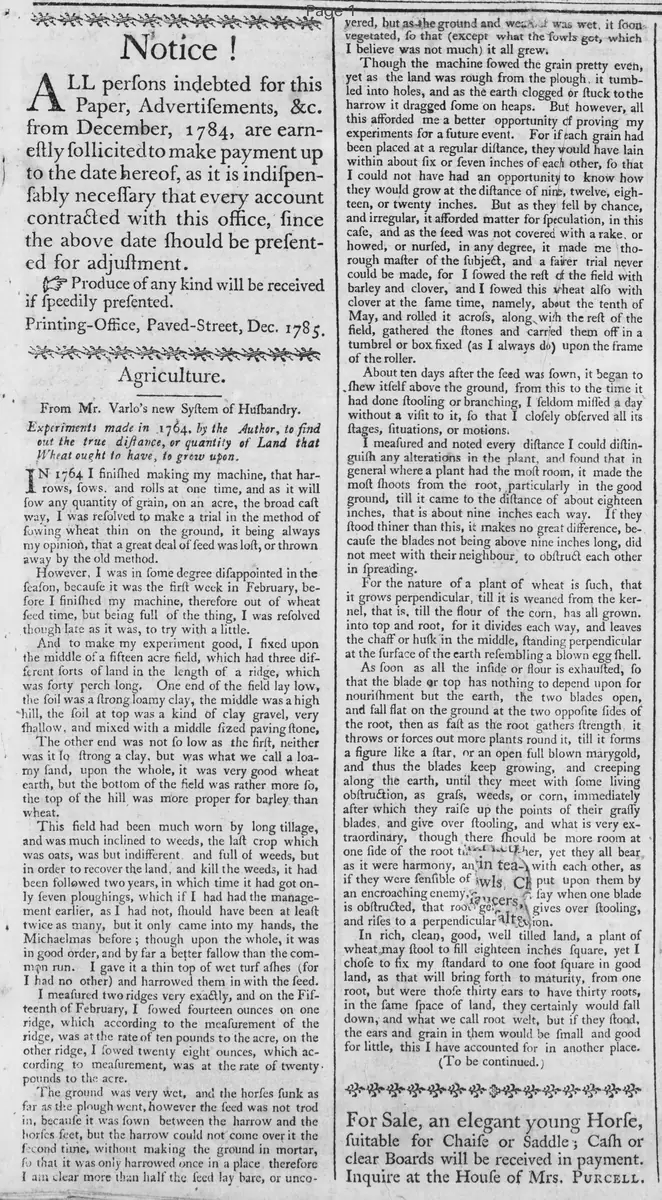
Agriculture.
From Mr. Varlo's new System of Husbandry.
Experiments made in 1764, by the Author, to find out the true distance, or quantity of Land that Wheat ought to have, to grow upon.
In 1764 I finished making my machine, that harrows, sows, and rolls at one time, and as it will sow any quantity of grain, on an acre, the broad cast way, I was resolved to make a trial in the method of sowing wheat thin on the ground, it being always my opinion, that a great deal of seed was lost, or thrown away by the old method.
However, I was in some degree disappointed in the season, because it was the first week in February, before I finished my machine, therefore out of wheat seed time, but being full of the thing, I was resolved though late as it was, to try with a little.
And to make my experiment good, I fixed upon the middle of a fifteen acre field, which had three different sorts of land in the length of a ridge, which was forty perch long. One end of the field lay low, the soil was a strong loamy clay, the middle was a high hill, the soil at top was a kind of clay gravel, very shallow, and mixed with a middle sized paving stone. The other end was not so low as the first, neither was it so strong a clay, but was what we call a loamy sand, upon the whole, it was very good wheat earth, but the bottom of the field was rather more o, the top of the hill was more proper for barley than wheat.
This field had been much worn by long tillage, and was much inclined to weeds, the last crop which was oats, was but indifferent, and full of weeds, but in order to recover the land, and kill the weeds, it had been followed two years, in which time it had got only seven ploughings, which if I had had the management earlier, as I had not, should have been at least twice as many, but it only came into my hands, the Michaelmas before; though upon the whole, it was in good order, and by far a better fallow than the common run. I gave it a thin top of wet turf ashes (for I had no other) and harrowed them in with the seed.
I measured two ridges very exactly, and on the Fifteenth of February, I sowed fourteen ounces on one ridge, which according to the measurement of the ridge, was at the rate of ten pounds to the acre, on the other ridge, I sowed twenty eight ounces, which according to measurement, was at the rate of twenty pounds to the acre.
The ground was very wet, and the horses sunk as far as the plough went, however the seed was not trod in, because it was sown between the harrow and the horses feet, but the harrow could not come over it the second time, without making the ground in mortar, so that it was only harrowed once in a place, therefore I am clear more than half the seed lay bare, or uncovered, but as the ground and seed was wet, it soon vegetated, so that (except what the fowls got, which I believe was not much) it all grew.
Though the machine sowed the grain pretty even, yet as the land was rough from the plough, it tumbled into holes, and as the earth clogged or stuck to the harrow it dragged some on heaps. But however, all this afforded me a better opportunity of proving my experiments for a future event. For if each grain had been placed at a regular distance, they would have lain within about six or seven inches of each other, so that I could not have had an opportunity to know how they would grow at the distance of nine, twelve, eighteen, or twenty inches. But as they fell by chance, and irregular, it afforded matter for speculation, in this case, and as the seed was not covered with a rake, or hoed, or manured, in any degree, it made me thorough master of the subject, and a fairer trial never could be made, for I sowed the rest of the field with barley and clover, and I sowed this wheat also with clover at the same time, namely, about the tenth of May, and rolled it across, along, with the rest of the field, gathered the stones and carried them off in a tumbrel or box fixed (as I always do) upon the frame of the roller.
About ten days after the seed was sown, it began to shew itself above the ground, from this to the time it had done stooling or branching, I seldom missed a day without a visit to it, so that I closely observed all its stages, situations, or motions.
I measured and noted every distance I could distinguish any alterations in the plant, and found that in general where a plant had the most room, it made the most shoots from the root, particularly in the good ground, till it came to the distance of about eighteen inches, that is about nine inches each way. If they stood thinner than this, it makes no great difference, because the blades not being above nine inches long, did not meet with their neighbour, to obstruct each other in spreading.
For the nature of a plant of wheat is such, that it grows perpendicular, till it is weaned from the kernel, that is, till the flour of the corn, has all grown into top and root, for it divides each way, and leaves the chaff or husk in the middle, standing perpendicular at the surface of the earth resembling a blown egg shell. As soon as all the inside or flour is exhausted, so that the blade or top has nothing to depend upon for nourishment but the earth, the two blades open, and fall flat on the ground at the two opposite sides of the root, then as fast as the root gathers strength, it throws or forces out more plants round it, till it forms a figure like a star, or an open full blown marygold, and thus the blades keep growing, and creeping along the earth, until they meet with some living obstruction, as grass, weeds, or corn, immediately after which they raise up the points of their gray blades, and give over stooling, and what is very extraordinary, though there should be more room at one side of the root than the other, yet they all bear as it were harmony, and in teams with each other, as if they were sensible of the calls of their companions, in rich, clean, good, well tilled land, a plant of wheat may stool to fill eighteen inches square, yet I choose to fix my standard to one foot square in good land, as that will bring forth to maturity, from one root, but were those thirty ears to have thirty roots, in the same space of land, they certainly would fall down, and what we call root melt, but if they stood, the ears and grain in them would be small and good for little, this I have accounted for in another place.
(To be continued.)
From Mr. Varlo's new System of Husbandry.
Experiments made in 1764, by the Author, to find out the true distance, or quantity of Land that Wheat ought to have, to grow upon.
In 1764 I finished making my machine, that harrows, sows, and rolls at one time, and as it will sow any quantity of grain, on an acre, the broad cast way, I was resolved to make a trial in the method of sowing wheat thin on the ground, it being always my opinion, that a great deal of seed was lost, or thrown away by the old method.
However, I was in some degree disappointed in the season, because it was the first week in February, before I finished my machine, therefore out of wheat seed time, but being full of the thing, I was resolved though late as it was, to try with a little.
And to make my experiment good, I fixed upon the middle of a fifteen acre field, which had three different sorts of land in the length of a ridge, which was forty perch long. One end of the field lay low, the soil was a strong loamy clay, the middle was a high hill, the soil at top was a kind of clay gravel, very shallow, and mixed with a middle sized paving stone. The other end was not so low as the first, neither was it so strong a clay, but was what we call a loamy sand, upon the whole, it was very good wheat earth, but the bottom of the field was rather more o, the top of the hill was more proper for barley than wheat.
This field had been much worn by long tillage, and was much inclined to weeds, the last crop which was oats, was but indifferent, and full of weeds, but in order to recover the land, and kill the weeds, it had been followed two years, in which time it had got only seven ploughings, which if I had had the management earlier, as I had not, should have been at least twice as many, but it only came into my hands, the Michaelmas before; though upon the whole, it was in good order, and by far a better fallow than the common run. I gave it a thin top of wet turf ashes (for I had no other) and harrowed them in with the seed.
I measured two ridges very exactly, and on the Fifteenth of February, I sowed fourteen ounces on one ridge, which according to the measurement of the ridge, was at the rate of ten pounds to the acre, on the other ridge, I sowed twenty eight ounces, which according to measurement, was at the rate of twenty pounds to the acre.
The ground was very wet, and the horses sunk as far as the plough went, however the seed was not trod in, because it was sown between the harrow and the horses feet, but the harrow could not come over it the second time, without making the ground in mortar, so that it was only harrowed once in a place, therefore I am clear more than half the seed lay bare, or uncovered, but as the ground and seed was wet, it soon vegetated, so that (except what the fowls got, which I believe was not much) it all grew.
Though the machine sowed the grain pretty even, yet as the land was rough from the plough, it tumbled into holes, and as the earth clogged or stuck to the harrow it dragged some on heaps. But however, all this afforded me a better opportunity of proving my experiments for a future event. For if each grain had been placed at a regular distance, they would have lain within about six or seven inches of each other, so that I could not have had an opportunity to know how they would grow at the distance of nine, twelve, eighteen, or twenty inches. But as they fell by chance, and irregular, it afforded matter for speculation, in this case, and as the seed was not covered with a rake, or hoed, or manured, in any degree, it made me thorough master of the subject, and a fairer trial never could be made, for I sowed the rest of the field with barley and clover, and I sowed this wheat also with clover at the same time, namely, about the tenth of May, and rolled it across, along, with the rest of the field, gathered the stones and carried them off in a tumbrel or box fixed (as I always do) upon the frame of the roller.
About ten days after the seed was sown, it began to shew itself above the ground, from this to the time it had done stooling or branching, I seldom missed a day without a visit to it, so that I closely observed all its stages, situations, or motions.
I measured and noted every distance I could distinguish any alterations in the plant, and found that in general where a plant had the most room, it made the most shoots from the root, particularly in the good ground, till it came to the distance of about eighteen inches, that is about nine inches each way. If they stood thinner than this, it makes no great difference, because the blades not being above nine inches long, did not meet with their neighbour, to obstruct each other in spreading.
For the nature of a plant of wheat is such, that it grows perpendicular, till it is weaned from the kernel, that is, till the flour of the corn, has all grown into top and root, for it divides each way, and leaves the chaff or husk in the middle, standing perpendicular at the surface of the earth resembling a blown egg shell. As soon as all the inside or flour is exhausted, so that the blade or top has nothing to depend upon for nourishment but the earth, the two blades open, and fall flat on the ground at the two opposite sides of the root, then as fast as the root gathers strength, it throws or forces out more plants round it, till it forms a figure like a star, or an open full blown marygold, and thus the blades keep growing, and creeping along the earth, until they meet with some living obstruction, as grass, weeds, or corn, immediately after which they raise up the points of their gray blades, and give over stooling, and what is very extraordinary, though there should be more room at one side of the root than the other, yet they all bear as it were harmony, and in teams with each other, as if they were sensible of the calls of their companions, in rich, clean, good, well tilled land, a plant of wheat may stool to fill eighteen inches square, yet I choose to fix my standard to one foot square in good land, as that will bring forth to maturity, from one root, but were those thirty ears to have thirty roots, in the same space of land, they certainly would fall down, and what we call root melt, but if they stood, the ears and grain in them would be small and good for little, this I have accounted for in another place.
(To be continued.)
What sub-type of article is it?
Essay
What themes does it cover?
Agriculture Rural
What keywords are associated?
Wheat Sowing
Agricultural Experiment
1764
Varlo Machine
Seed Density
Plant Growth
Soil Types
What entities or persons were involved?
Mr. Varlo
Literary Details
Title
Experiments Made In 1764, By The Author, To Find Out The True Distance, Or Quantity Of Land That Wheat Ought To Have, To Grow Upon.
Author
Mr. Varlo
Subject
Wheat Sowing Experiments
Key Lines
In 1764 I Finished Making My Machine, That Harrows, Sows, And Rolls At One Time...
I Measured And Noted Every Distance I Could Distinguish Any Alterations In The Plant, And Found That In General Where A Plant Had The Most Room, It Made The Most Shoots From The Root...
For The Nature Of A Plant Of Wheat Is Such, That It Grows Perpendicular, Till It Is Weaned From The Kernel...