Thank you for visiting SNEWPapers!
Sign up free
Story
September 13, 1842
The Middlebury People's Press
Middlebury, Addison County, Vermont
What is this article about?
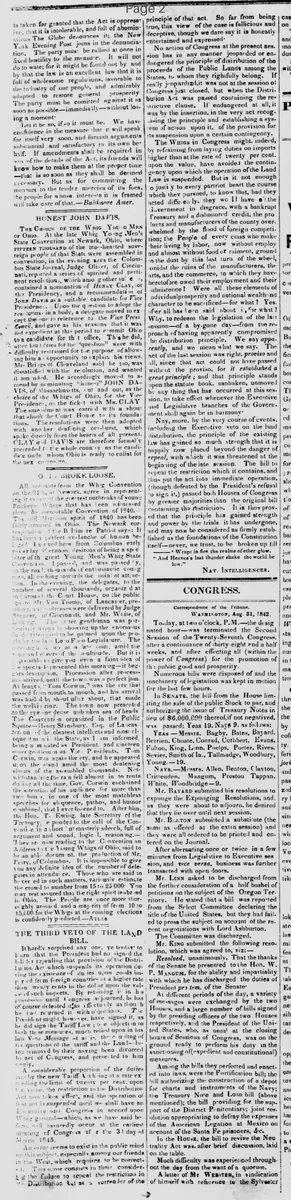
The President effectively vetoes the bill to repeal a restriction in the Distribution Act by not signing it before Congress adjourns, suspending land proceeds distribution due to high tariff rates. The article defends this as preserving national prosperity and strengthening the distribution principle.
Clipping
OCR Quality
95%
Excellent
Full Text
THE THIRD VETO OF THE LAND BILL.
It hardly surprised any one, yesterday, to learn that the President had not signed the bill for repealing that provision of the Distribution Act which suspends its operation during the existence of duties upon goods imported from foreign countries at a higher rate than twenty cents in the dollar upon the value of such imports. By retaining it in his possession until Congress adjourned, he has of course defeated it, as effectually as though he had returned it with objections. The President might, however, have signed it, as he did sign the Tariff Law; one objection to both these measures, much relied upon in his late Veto Message—that is, the coupling of the questions of the tariff and the Land—being removed by their having been divorced by act of Congress, and presented to him singly. A considerable proportion of the duties laid by the new Tariff Act being at a rate exceeding the limit of twenty per cent. upon the value, the restriction in the Distribution Act must, thus effect, and the operation of this act is suspended until we shall have an Executive and Congress in accord upon this ground—which, as we have said before, will assuredly occur at the earliest meeting of Congress after the 31 day of Much 1845. An error seems to exist in the public mind on this subject, especially among our friends in the West, which requires to be corrected. This error consists in their considering the failure to repeal the restriction in the Distribution Act as a surrender of the principle of that act. So far from being true, this view of the case is fallacious and deceptive, though we dare say it is honestly entertained and expressed. No action of Congress at the present session has in any manner jeopardized or endangered the principle of distribution of the proceeds of the Public Lands among the States, to whom they rightfully belong. If really jeopardized, it was not at the session of Congress just closed, but when the Distribution Act was passed containing the restrictive clause. If endangered at all, it was by the insertion, in the very act recognizing the principle and establishing a system of action upon it, of the provision for its suspension upon a certain contingency. The Whigs in Congress might, indeed, by refraining from laying duties on imports higher than at the rate of twenty per cent. upon the value, have avoided the contingency upon which the operation of the Land Law is suspended, But is it not enough to justify to every patriot heart the course which they pursued, to know that, had they acted differently, they would have left the government in disgrace, with a bankrupt Treasury and a dishonored credit, the products and manufacturers of the country overwhelmed by the flood of foreign competition; the People of every class who make their living by labor, now without employment and almost without food or raiment, ground to the dust by this last turn of the wheel, amidst the ruins of the manufacturers, the arts, and the commerce, to which they have heretofore owed their employment and their subsistence? Were all these elements of individual prosperity and national wealth and character to be sacrificed—for what? Yes, after all has been said about it. For what? Why, to redeem the legislation of the last session—of a by-gone day—from the reproach of having apparently compromised the distribution principle. We say apparently, and we mean what we say. The act of the last session was right, proviso and all, since that act could not have passed without the proviso, for it established a great principle; and that principle stands upon the statute book, unshaken, unmoved by any thing that has occurred at this session, to take effect whenever the Executive and Legislative branches of the Government shall again be in harmony. Nay, more. by the very course of events, including the Executive veto on the land distribution, the principle of the existing law has gained so much strength that it is happily now placed beyond the danger of repeal, with which it was threatened at the beginning of the late session. The bill to repeal the restriction which it contains, and thus put the act into immediate operation, (though defeated by the President's refusal to sign it,) passed both Houses of Congress by greater majorities than the original bill containing the restriction. It is thus proved that the principle has gained strength and power by the trials it has undergone and may now be considered as firmly established as the foundations of the Constitution itself—never, we trust, to be broken up till
Wrapt in fire the realms of ether glow,
"And Heaven's last thunder shake the world below."
NAt. Intelligencer.
It hardly surprised any one, yesterday, to learn that the President had not signed the bill for repealing that provision of the Distribution Act which suspends its operation during the existence of duties upon goods imported from foreign countries at a higher rate than twenty cents in the dollar upon the value of such imports. By retaining it in his possession until Congress adjourned, he has of course defeated it, as effectually as though he had returned it with objections. The President might, however, have signed it, as he did sign the Tariff Law; one objection to both these measures, much relied upon in his late Veto Message—that is, the coupling of the questions of the tariff and the Land—being removed by their having been divorced by act of Congress, and presented to him singly. A considerable proportion of the duties laid by the new Tariff Act being at a rate exceeding the limit of twenty per cent. upon the value, the restriction in the Distribution Act must, thus effect, and the operation of this act is suspended until we shall have an Executive and Congress in accord upon this ground—which, as we have said before, will assuredly occur at the earliest meeting of Congress after the 31 day of Much 1845. An error seems to exist in the public mind on this subject, especially among our friends in the West, which requires to be corrected. This error consists in their considering the failure to repeal the restriction in the Distribution Act as a surrender of the principle of that act. So far from being true, this view of the case is fallacious and deceptive, though we dare say it is honestly entertained and expressed. No action of Congress at the present session has in any manner jeopardized or endangered the principle of distribution of the proceeds of the Public Lands among the States, to whom they rightfully belong. If really jeopardized, it was not at the session of Congress just closed, but when the Distribution Act was passed containing the restrictive clause. If endangered at all, it was by the insertion, in the very act recognizing the principle and establishing a system of action upon it, of the provision for its suspension upon a certain contingency. The Whigs in Congress might, indeed, by refraining from laying duties on imports higher than at the rate of twenty per cent. upon the value, have avoided the contingency upon which the operation of the Land Law is suspended, But is it not enough to justify to every patriot heart the course which they pursued, to know that, had they acted differently, they would have left the government in disgrace, with a bankrupt Treasury and a dishonored credit, the products and manufacturers of the country overwhelmed by the flood of foreign competition; the People of every class who make their living by labor, now without employment and almost without food or raiment, ground to the dust by this last turn of the wheel, amidst the ruins of the manufacturers, the arts, and the commerce, to which they have heretofore owed their employment and their subsistence? Were all these elements of individual prosperity and national wealth and character to be sacrificed—for what? Yes, after all has been said about it. For what? Why, to redeem the legislation of the last session—of a by-gone day—from the reproach of having apparently compromised the distribution principle. We say apparently, and we mean what we say. The act of the last session was right, proviso and all, since that act could not have passed without the proviso, for it established a great principle; and that principle stands upon the statute book, unshaken, unmoved by any thing that has occurred at this session, to take effect whenever the Executive and Legislative branches of the Government shall again be in harmony. Nay, more. by the very course of events, including the Executive veto on the land distribution, the principle of the existing law has gained so much strength that it is happily now placed beyond the danger of repeal, with which it was threatened at the beginning of the late session. The bill to repeal the restriction which it contains, and thus put the act into immediate operation, (though defeated by the President's refusal to sign it,) passed both Houses of Congress by greater majorities than the original bill containing the restriction. It is thus proved that the principle has gained strength and power by the trials it has undergone and may now be considered as firmly established as the foundations of the Constitution itself—never, we trust, to be broken up till
Wrapt in fire the realms of ether glow,
"And Heaven's last thunder shake the world below."
NAt. Intelligencer.
What sub-type of article is it?
Historical Event
What themes does it cover?
Triumph
Justice
What keywords are associated?
Land Bill Veto
Distribution Act
Tariff Law
Congress Session
Public Lands
Whig Policy
What entities or persons were involved?
President
Whigs In Congress
Story Details
Key Persons
President
Whigs In Congress
Event Date
31 Day Of Much 1845
Story Details
The President refuses to sign the bill repealing the restriction in the Distribution Act, suspending its operation due to high tariffs; the article argues this preserves the principle of land distribution, strengthens it through trials, and justifies the Whigs' tariff actions to avoid national bankruptcy.