Thank you for visiting SNEWPapers!
Sign up free
Editorial
November 30, 1814
Norfolk Gazette And Publick Ledger
Norfolk, Virginia
What is this article about?
Editorial criticizes legislative interference in private contracts, arguing such laws favor debtors but ultimately harm them and society, praises Britain's justice system, urges honesty, and warns of impending currency depreciation from excessive paper money.
Clipping
OCR Quality
98%
Excellent
Full Text
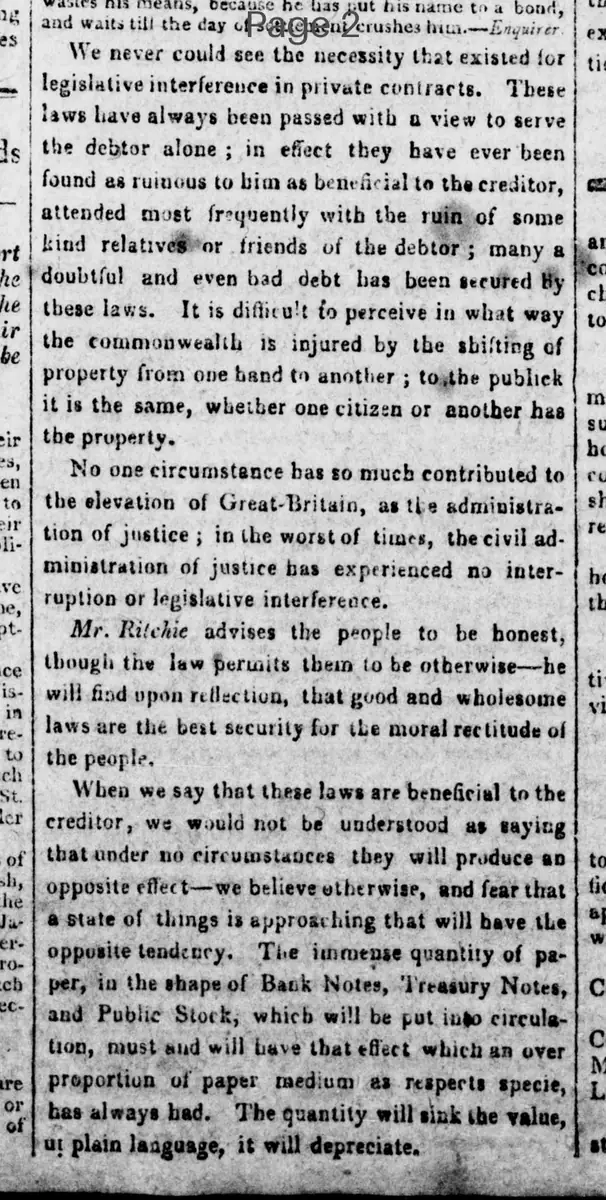
We never could see the necessity that existed for legislative interference in private contracts. These laws have always been passed with a view to serve the debtor alone ; in effect they have ever been found as ruinous to him as beneficial to the creditor, attended most frequently with the ruin of some kind relatives or friends of the debtor ; many a doubtful and even bad debt has been secured by these laws. It is difficult to perceive in what way the commonwealth is injured by the shifting of property from one hand to another ; to the publick it is the same, whether one citizen or another has the property.
No one circumstance has so much contributed to the elevation of Great-Britain, as the administration of justice; in the worst of times, the civil administration of justice has experienced no interruption or legislative interference.
Mr. Ritchie advises the people to be honest, though the law permits them to be otherwise--he will find upon reflection, that good and wholesome laws are the best security for the moral rectitude of the people.
When we say that these laws are beneficial to the creditor, we would not be understood as saying that under no circumstances they will produce an opposite effect--we believe otherwise, and fear that a state of things is approaching that will have the opposite tendency. The immense quantity of paper, in the shape of Bank Notes, Treasury Notes, and Public Stock, which will be put into circulation, must and will have that effect which an over proportion of paper medium as respects specie, has always had. The quantity will sink the value, in plain language, it will depreciate.
No one circumstance has so much contributed to the elevation of Great-Britain, as the administration of justice; in the worst of times, the civil administration of justice has experienced no interruption or legislative interference.
Mr. Ritchie advises the people to be honest, though the law permits them to be otherwise--he will find upon reflection, that good and wholesome laws are the best security for the moral rectitude of the people.
When we say that these laws are beneficial to the creditor, we would not be understood as saying that under no circumstances they will produce an opposite effect--we believe otherwise, and fear that a state of things is approaching that will have the opposite tendency. The immense quantity of paper, in the shape of Bank Notes, Treasury Notes, and Public Stock, which will be put into circulation, must and will have that effect which an over proportion of paper medium as respects specie, has always had. The quantity will sink the value, in plain language, it will depreciate.
What sub-type of article is it?
Legal Reform
Economic Policy
What keywords are associated?
Private Contracts
Debtor Laws
Creditor Benefits
Justice Administration
Paper Money
Currency Depreciation
What entities or persons were involved?
Mr. Ritchie
Great Britain
Editorial Details
Primary Topic
Opposition To Legislative Interference In Private Contracts
Stance / Tone
Critical Of Debtor Favoring Laws And Warning Of Currency Depreciation
Key Figures
Mr. Ritchie
Great Britain
Key Arguments
Legislative Interference In Private Contracts Unnecessary And Harmful
Such Laws Serve Debtors But Ruin Them, Relatives, And Secure Bad Debts
Property Shifts Do Not Injure The Commonwealth
Britain's Elevation Due To Uninterrupted Justice Administration
Good Laws Secure Moral Rectitude Over Permitting Dishonesty
Excessive Paper Money Will Depreciate Value