Thank you for visiting SNEWPapers!
Sign up free
Gazette Of The United States
New York, New York County, New York
What is this article about?
Report from Paris on June 22 details Jacobin efforts, execution of a Persian actress, Petion's meeting with King Louis denying June 20 constitutional breach, King's firm response to mob invasion of Tuileries demanding policy changes, and peaceful dispersal; Nantes castle retaken.
Merged-components note: Continuation of the detailed report on events in Paris, including the irruption into the Tuilleries.
Clippings
1 of 2
OCR Quality
Full Text
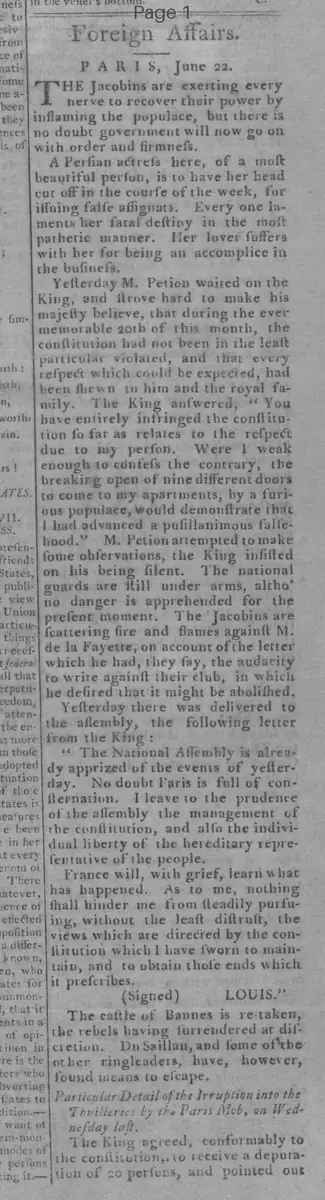
PARIS, June 22.
THE Jacobins are exerting every nerve to recover their power by inflaming the populace, but there is no doubt government will now go on with order and firmness.
A Persian actress here, of a most beautiful person, is to have her head cut off in the course of the week, for issuing false assignats. Every one laments her fatal destiny in the most pathetic manner. Her lover suffers with her for being an accomplice in the business.
Yesterday M. Petion waited on the King, and strove hard to make his majesty believe, that during the ever memorable 20th of this month, the constitution had not been in the least particular violated, and that every respect which could be expected, had been shewn to him and the royal family.
The King answered, "You have entirely infringed the constitution so far as relates to the respect due to my person. Were I weak enough to confess the contrary, the breaking open of nine different doors to come to my apartments, by a furious populace, would demonstrate that I had advanced a pusillanimous falsehood." M. Petion attempted to make some observations, the King insisted on his being silent.
The national guards are ill under arms, although no danger is apprehended for the present moment. The Jacobins are scattering fire and flames against M. de la Fayette, on account of the letter which he had, they say, the audacity to write against their club, in which he desired that it might be abolished.
Yesterday there was delivered to the assembly, the following letter from the King:
"The National Assembly is already apprised of the events of yesterday. No doubt Paris is full of consternation. I leave to the prudence of the assembly the management of the constitution, and also the individual liberty of the hereditary representative of the people. France will, with grief, learn what has happened. As to me, nothing shall hinder me from steadily pursuing, without the least distrust, the views which are directed by the constitution which I have sworn to maintain, and to obtain those ends which it prescribes."
(Signed) LOUIS.
The castle of Nantes is re-taken, the rebels having surrendered at discretion. Du Saillant, and some of the other ringleaders, have, however, found means to escape.
Particular Detail of the Irruption into the Thuilleries by the Paris Mob, on Wednesday last.
I.
The King agreed, conformably to the constitution, to receive a deputation of 20 persons, and pointed out himself the manner in which they should be introduced. They were to pass through the gate des Feuillants, and go out of the gate du Ménage. These orders of the King were sent to the commander in chief, who opposed to them the orders received from the municipality, enjoining him to receive, under the standard of the national guards, people of all denominations, dressed in all kinds of uniforms, and provided with any kind of arms.
The pikemen in their march had taken the declaration of rights, which was carried before them. The sections of the Bastille, and the men of the 11th of July appeared among them. For a banner they had an old pair of breeches, from the mob perhaps being called here, "Sans Culottes."
By three o'clock they had defiled through the hall of the Assembly, in the rear of the palace, through the garden, the guard having refused to oppose them, and round by the Quay to the place de Carousel, in front of the Chateau. Here they were joined by eight pieces of cannon, and two caissons of ammunition. After half an hour spent in parleying, the entrance being refused them, they proceeded to force. The commandant of the guard required authority from the Mayor and municipality to repel them, but was refused. The matches were lighted, and every thing seemed to prelude a formal battle, when the officer returned to announce his having received no orders. The gates were instantly forced, no resistance being made, and the people in thousands precipitated into the palace: the doors at the entrance of the king and queen's apartments being closed, without waiting to have them opened, they battered them to pieces.
The queen retired to a second apartment with the dauphin in her arms, and threw herself upon the protection of a reserve of grenadiers of the national guard. Here a third door was broke open. The crowd became so great, that with difficulty the queen found a corner of the window to escape from the great press. Here, exposed to all the gross and vile language that imagination can conceive, she was obliged to remain for several hours during which they presented her and the dauphin with a national cockade, which they immediately wore.
During this scene, another of a different nature went forward in the king's apartment: one of the chiefs of this mob presented the King a red bonnet, adorned with national cockades, and demanded the retraction of the Veto which the King has placed on the decree against the priests, and for the establishment of a camp. His answer was noble and manly; "If the welfare of the nation consists in wearing a red cap, I have no objection to wearing it. Pure in my conscience. I have no dread as to the decrees, this is no time to speak of them!"—Some one having remarked that he was afraid, he seized the hand of a grenadier near him, and clapping it upon his heart, he said, "Tell me, my friend, does my heart beat like a man in fear?" He immediately seated himself between the windows of his apartment, that looked towards the Tuileries, and put on a red cap. One of the mob offered him a glass to drink the health of the nation; he accepted it, and drank it without seeming to have the smallest apprehension of it.
The crowd began to press upon him. A national guard was nearly forced out of his place, near his majesty. "The King," cries this brave fellow, "is our safeguard, I would not desert him, for a hundred thousand crowns!" A municipal officer attempted to speak, but could not be heard. Several members made the same attempt without success. M. Santerre then tried what he could do; a roar ensued, of "Long live Petion! Long live the good, the worthy Petion!" The good, the worthy Petion then addressed the King. "The people (says he) have appeared with dignity, and with dignity they will depart. Your majesty may make yourself easy." Santerre ordered the deputation to come forward.
The pikemen accordingly demanded that the patriotic ministers be re-instated—that the Veto be retracted relative to the two obnoxious decrees.
The King answered: "I have sworn to maintain the constitution, and I will defend it at the risk of my life."
Clamours were renewed of "Long live the nation! Long live Sans Culottes! Long live liberty! No Veto!"
The eyes of the leaders of the mob, and of many of the mob themselves, glistened with rage. "Long live Santerre!" A grenadier attempted to quiet them, the Prince told him, "Let them alone, my friend; let their words be ever so injurious, it is all the same to me."
By this time several deputies, alarmed at the state of the Royal Family, had assembled, and a deputation of 24 members was named to surround the person of the King, and to be replaced every half hour by a fresh deputation, so as to inform the assembly of the state of his majesty. M. Petion arrived about the same time with the deputation. The people still continue their clamours, for the restoration of the late ministry, and the sanction of the decrees; but in vain; the King retained the same manly firmness and conversed with the deputation without the smallest appearance of inquietude. By persuasions and entreaties, the mayor and four of the deputies prevailed upon the people to withdraw. They had passed all over the palace, the roofs were covered with the multitude, they hung in clusters to the windows; and except the breaking of some doors and windows, no other mischief was done, no accident even ensued.
Towards night-fall the Palace was entirely cleared, the deputies had previously profited of an interval in the affluence of the crowd, and conducted the King to his bed chamber. Towards ten o'clock all was quiet; the citizens all retired peaceably to their respective homes and the night was passed in the utmost tranquility.
M. Santerre is a brewer.
What sub-type of article is it?
What keywords are associated?
What entities or persons were involved?
Where did it happen?
Foreign News Details
Primary Location
Paris
Event Date
June 20
Key Persons
Outcome
the mob dispersed without major harm or accidents; the castle of nantes re-taken, rebels surrendered, some ringleaders escaped.
Event Details
Jacobins attempt to regain power; Persian actress and lover to be executed for false assignats; Petion meets King denying constitutional violation on June 20; King's letter to assembly; detailed account of mob irruption into Tuileries on June 20, forcing entry, interactions with King and Queen, demands for ministry reinstatement and decree sanctions, King remains firm, mob withdraws peacefully.