Thank you for visiting SNEWPapers!
Sign up free
Letter to Editor
February 6, 1864
Springfield Weekly Republican
Springfield, Hampden County, Massachusetts
What is this article about?
Correspondence from Washington, DC, on Jan. 22, 1864, describes the vice-ridden Canterbury, delights of steamed oysters, acclaimed lectures by Agassiz, Lord, and Gough, Anna Dickinson's oratory in Congress, a social hop with fashion notes, and European cold weather. Critiques excess in social life.
Clipping
OCR Quality
98%
Excellent
Full Text
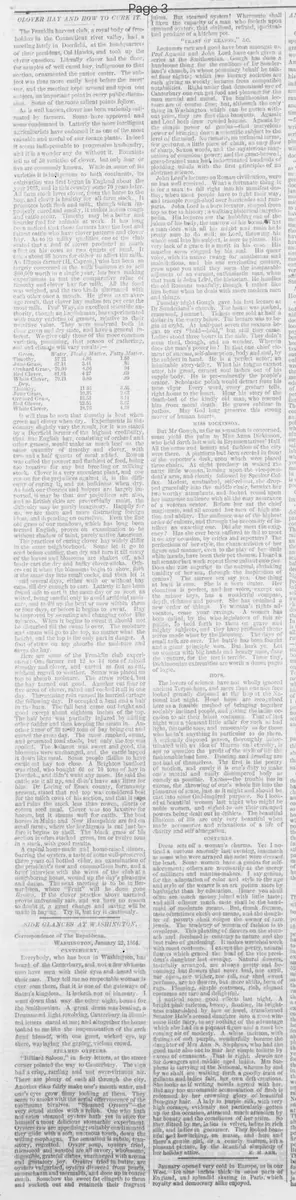
SIDE GLANCES AT WASHINGTON.
Correspondence of The Republican.
WASHINGTON, January 22, 1864.
CANTERBURY
Everybody who has been in Washington has heard of the Canterbury, and not a few virtuous men have seen with their eyes and heard with their ears. They tell me no respectable woman is ever seen there, that it is one of the gateways of Satan's kingdom. It lacketh not of blazonry. I went down that way the other night, bound for the Smithsonian. A great drum was beating, a Drummond light revolving. "Canterbury" in illuminated letters stared at me; and altogether the house looked to me like the impersonation of the arch fiend himself, with one great, wicked eye, up there, waylaying the gaping, vicious crowd.
"STEAMED OYSTERS. Billiard Saloon," in fiery letters, at the street corner pointed the way to Canterbury. The sign had a crisp, rattling and not over-virtuous air. There are plenty of such all through the city. Another class fairly make one's mouth water, and one's eyes grow filmy looking at them. They seem to smoke with the aerial effervescence of the toothsome bivalves. "Steamed Oysters"—the very sound sizzles with a relish. One who hath not eaten steamed oysters hath yet in store for himself a most delicious stomachic experiment.
Oysters raw are appetizing; suitably condimented they glide with a soft, unctuous touch, down the willing esophagus. The sensation is subtle, transitory, regretted. Oyster soup, oysters fried, fricasseed and roasted are all savory, wholesome, digestible, grateful dishes, surcharged with aroma and gustatory joy. Oysters fried in butter, are oysters vulgarized, oysters divorced from pearls, mermaids, and done up in coarse mush. Somehow the sweet fat clingeth to them and sucketh out and retaineth their fragrant juices. But steamed oysters! Whereto shall I liken the capacity of a man who feedeth upon steamed oysters, that civilized, refined, spiritualized produce of a kitchen pot.
"FEAST OF REASON," &c.
Lecturers rare and good have been amongst us. Prof. Agassiz and John Lord have each given a series at the Smithsonian. Gough has done a handsome thing for the creditors of Dr. Sunderland's church, in whose pecuniary behalf he talked four nights; whilst two literary societies are each giving us weekly lectures from compatible notabilities. Right under that demoniacal eye of Canterbury one can get food and pleasure for the man mental and moral. The Smithsonian lectures are of course free; but, although the only thing in Washington which can be gotten without price, they are first class banquets. Agassiz and Lord both drew crowded houses. Agassiz by the simple power of genius—that marvelous power of bringing down a scientific subject to the level of the mind. No rhetoric, no technical terms, few gestures, a little piece of chalk, an easy flow of sharp, Saxon words, and the mysterious magnetism of conscious power; and the great-browed, great-brained man had indoctrinated hundreds of plodding minds with the first principles of an abstruse science.
John Lord's lectures on Roman civilization, were no less well received. What a fortunate thing it is for a man to fall right into his manifest destiny, when most people have to fight their way, and trample rough-shod over barricades and ramparts. John Lord is a born lecturer, steeped from top to toe in history; a walking historical encyclopedia. His lectures are the bubbling out of the juices of his body, the marrow of his bones. What a man does with all his might and main he is pretty sure to do well: so Lord, throwing his whole soul into his subject, is sure to please. His very lack of a grace is a merit in his case. His muscles seem clogged by his zeal. His queer voice, with its native twang for anathemas and maledictions, and his one everlasting gesture, grow upon you until they seem the inseparable adjuncts of an earnest, enthusiastic man, when that man is John Lord, the historian. He handles the old Romans manfully, though I rather like him better when he deals with more modern men and things.
Tuesday night Gough gave his last lecture at Dr. Sunderland's church. The house was packed, crammed, jammed. Tickets were sold at half a dollar in the vestry below. The lecture was to begin at eight. At half-past seven the sextons began to cry "hold—hold," but still they came. Ladies stood three hours in the aisle. They didn't seem tired, though, and no wonder. Wherein does the man's power lie? In that one chief element of success, self-absorption, body and soul, by the subject in hand. He is a perfect actor; an inimitable story-teller. What his tongue cannot utter his great, earnest soul lashes out of his supple body. He is pre-eminently the people's orator. Scholastic polish would detract from his terse vigor. Every word, every gesture tells, right home to the heart. Hear his story of the death-bed of the kindly old man, who rescued him from moral death. He grows sublime in pathos. May God long preserve this strong mover of human hearts.
MISS DICKINSON
But Mr. Gough, as far as sensation is concerned, must yield the palm to Miss Anna Dickinson, who held forth last week in Representatives' Hall. All the sense and beauty and "fashion of the city were there. A platform had been erected in front of the reporter's desk, upon which were placed three chairs. At eight precisely in walked the natty little woman, leaning upon the vice-president's arm, and closely followed by Speaker Colfax. Modest, unabashed, self-reliant, she dropped gracefully into the middle chair, betwixt her two worthy attendants, and looked round upon her immense audience with all the easy assurance of a veteran orator. Before her sat the chief magistrate, and all around her men of high station and ability. The audience was of the highest order of culture, and through the necessity of intellect an exacting one. Did she meet the exigency? Has she ever been suffered to fail to meet it on any occasion, by critics and reporters? The perfections of her style, the characteristics of her figure and manner, even to the play of her little white hands, have been their pet themes. I heard a tall senator last week repeat these gallant eulogies. Does she rise superior to the natural, shrinking timidity of her sex, through the inspiration of genius? The sterner sex say yea. One thing at least is sure. She is a born orator. Her elocution is perfect, and her voice, except on the minor keys, has a wonderful compass, depth, richness and power. She has ordained a new order of things. Ye woman's rights advocates, cease your ravings. A woman has been called, by the wise legislators of this republic, to hold forth to them on grave and mighty subjects, and they have professed themselves made wiser by the listening. The days of small talk are over. The battle has been fought and a great principle won. But hark ye. Let no woman with big hands and beauty none, date the venture, for the test is terrible. Those tiny, Dickinsonian extremities are worth a dozen pages of logic.
HOPS.
The lovers of science have not wholly ignored ancient Terpsichore, and more than one nice face looked genially disposed at the hop at the National last night. Hotel hops are recognized here as a feasible method of bringing sociably inclined people together, and giving the ladies occasion to air their latest costumes. That of last night was a pleasant little affair for such as had light, fantastic toes, and reasonably so for those who haven't anything in particular to do there. A seriously disposed person, thoroughly indoctrinated with an idea of heaven on eternity, is apt to question the profit of the style of life the fashionable lead here. Dancing and dressing are not bad of themselves. The first is the poetry of motion, and surely it is one's duty to make one's mortal and easily distempered body as comely as possible. Excess—the trouble lies in excess, the throwing of one's whole life into the pleasures of sense, just as it might and should be cast into some God-inspired purpose. So I looked at beautiful women last night who might be noble women, and sighed to see their cramped powers being dealt out in driblets. The beautiful illusions of life are only very beautiful when made accessories and relaxations of a life of charity and self abnegation.
COSTUMES
Dress sets off a woman's charms. Yet I noticed a curious anomaly last evening, inasmuch as some who were arrayed the most were dressed the least. Some women have a genius for self-adornment; others are necessarily at the mercy of milliners and mantua-makers. I say genius, for the adaptation of color and style to the age and style of the wearer is an art gotten more by birthright than by education. Hence you shall often see much money joined with little taste; and still oftener much taste shall be the hand maid of moderate means. But, thank fortune, taste oftentimes eketh out means, and the daughter of poverty shall eclipse the owner of rare jewels. The tendency of woman of fashion is to overdress. This planting of flowers on the stomach and forehead is contrary to nature and the best rules of gardening. It makes wretched work with most contours. I except the pretty, natural flowers which graced the head of the vice president's daughter last evening. Natural flowers, tastefully arranged, are always pretty and becoming; but flowers that never bud, nor swell, nor open, nor wither, nor fall, nor shed sweet perfume, are no flowers, but more shifts, born of rags. Pleasing, simple costumes, rich, elegant costumes are rare and delightful.
I noticed some good effects last night. A bright pink tarleton, breezy, floating, its brightness untarnished by lace or jewel, transformed Senator Hale's second daughter into a most winsome little fairy, to say nothing of the advantage which she had in a piquant figure and a most becoming air of modesty. A white tarleton, with flutings of soft purple, wonderfully became the daughter of Mrs. Ann S. Stephens, who had the good taste also not to mar her simple toilette by excess of ornament. That is right. Jewels are for dowagers and middle aged ladies. Mrs. Stephens is tarrying at the National, whence by and by we shall see walking forth a goodly train of gallants and ladies fair, her own deft creations. She looks as if writing novels agreed with her. But any too unromantic accumulation of flesh is redeemed by her crowning glory of beautiful iron-gray hair. A lady in purple silk, with very high corsage, evidently not particularly gotten up for the occasion, attracted much attention by her beauty and the comeliness of her attire. So they flitted by me, in furs in velvet, ladies in rich silk, and ladies in gossamer. They looked beautiful and bewitching, en masse, and here and there a gentle girl, or a comely matron, left a pleasant picture, by the beautiful simplicity of her holiday attire.
E. H. ARR.
January opened very cold in Europe, as in our West. Ice nine inches thick in some parts of England, and splendid skating in Paris, which royalty and democracy alike enjoyed.
Correspondence of The Republican.
WASHINGTON, January 22, 1864.
CANTERBURY
Everybody who has been in Washington has heard of the Canterbury, and not a few virtuous men have seen with their eyes and heard with their ears. They tell me no respectable woman is ever seen there, that it is one of the gateways of Satan's kingdom. It lacketh not of blazonry. I went down that way the other night, bound for the Smithsonian. A great drum was beating, a Drummond light revolving. "Canterbury" in illuminated letters stared at me; and altogether the house looked to me like the impersonation of the arch fiend himself, with one great, wicked eye, up there, waylaying the gaping, vicious crowd.
"STEAMED OYSTERS. Billiard Saloon," in fiery letters, at the street corner pointed the way to Canterbury. The sign had a crisp, rattling and not over-virtuous air. There are plenty of such all through the city. Another class fairly make one's mouth water, and one's eyes grow filmy looking at them. They seem to smoke with the aerial effervescence of the toothsome bivalves. "Steamed Oysters"—the very sound sizzles with a relish. One who hath not eaten steamed oysters hath yet in store for himself a most delicious stomachic experiment.
Oysters raw are appetizing; suitably condimented they glide with a soft, unctuous touch, down the willing esophagus. The sensation is subtle, transitory, regretted. Oyster soup, oysters fried, fricasseed and roasted are all savory, wholesome, digestible, grateful dishes, surcharged with aroma and gustatory joy. Oysters fried in butter, are oysters vulgarized, oysters divorced from pearls, mermaids, and done up in coarse mush. Somehow the sweet fat clingeth to them and sucketh out and retaineth their fragrant juices. But steamed oysters! Whereto shall I liken the capacity of a man who feedeth upon steamed oysters, that civilized, refined, spiritualized produce of a kitchen pot.
"FEAST OF REASON," &c.
Lecturers rare and good have been amongst us. Prof. Agassiz and John Lord have each given a series at the Smithsonian. Gough has done a handsome thing for the creditors of Dr. Sunderland's church, in whose pecuniary behalf he talked four nights; whilst two literary societies are each giving us weekly lectures from compatible notabilities. Right under that demoniacal eye of Canterbury one can get food and pleasure for the man mental and moral. The Smithsonian lectures are of course free; but, although the only thing in Washington which can be gotten without price, they are first class banquets. Agassiz and Lord both drew crowded houses. Agassiz by the simple power of genius—that marvelous power of bringing down a scientific subject to the level of the mind. No rhetoric, no technical terms, few gestures, a little piece of chalk, an easy flow of sharp, Saxon words, and the mysterious magnetism of conscious power; and the great-browed, great-brained man had indoctrinated hundreds of plodding minds with the first principles of an abstruse science.
John Lord's lectures on Roman civilization, were no less well received. What a fortunate thing it is for a man to fall right into his manifest destiny, when most people have to fight their way, and trample rough-shod over barricades and ramparts. John Lord is a born lecturer, steeped from top to toe in history; a walking historical encyclopedia. His lectures are the bubbling out of the juices of his body, the marrow of his bones. What a man does with all his might and main he is pretty sure to do well: so Lord, throwing his whole soul into his subject, is sure to please. His very lack of a grace is a merit in his case. His muscles seem clogged by his zeal. His queer voice, with its native twang for anathemas and maledictions, and his one everlasting gesture, grow upon you until they seem the inseparable adjuncts of an earnest, enthusiastic man, when that man is John Lord, the historian. He handles the old Romans manfully, though I rather like him better when he deals with more modern men and things.
Tuesday night Gough gave his last lecture at Dr. Sunderland's church. The house was packed, crammed, jammed. Tickets were sold at half a dollar in the vestry below. The lecture was to begin at eight. At half-past seven the sextons began to cry "hold—hold," but still they came. Ladies stood three hours in the aisle. They didn't seem tired, though, and no wonder. Wherein does the man's power lie? In that one chief element of success, self-absorption, body and soul, by the subject in hand. He is a perfect actor; an inimitable story-teller. What his tongue cannot utter his great, earnest soul lashes out of his supple body. He is pre-eminently the people's orator. Scholastic polish would detract from his terse vigor. Every word, every gesture tells, right home to the heart. Hear his story of the death-bed of the kindly old man, who rescued him from moral death. He grows sublime in pathos. May God long preserve this strong mover of human hearts.
MISS DICKINSON
But Mr. Gough, as far as sensation is concerned, must yield the palm to Miss Anna Dickinson, who held forth last week in Representatives' Hall. All the sense and beauty and "fashion of the city were there. A platform had been erected in front of the reporter's desk, upon which were placed three chairs. At eight precisely in walked the natty little woman, leaning upon the vice-president's arm, and closely followed by Speaker Colfax. Modest, unabashed, self-reliant, she dropped gracefully into the middle chair, betwixt her two worthy attendants, and looked round upon her immense audience with all the easy assurance of a veteran orator. Before her sat the chief magistrate, and all around her men of high station and ability. The audience was of the highest order of culture, and through the necessity of intellect an exacting one. Did she meet the exigency? Has she ever been suffered to fail to meet it on any occasion, by critics and reporters? The perfections of her style, the characteristics of her figure and manner, even to the play of her little white hands, have been their pet themes. I heard a tall senator last week repeat these gallant eulogies. Does she rise superior to the natural, shrinking timidity of her sex, through the inspiration of genius? The sterner sex say yea. One thing at least is sure. She is a born orator. Her elocution is perfect, and her voice, except on the minor keys, has a wonderful compass, depth, richness and power. She has ordained a new order of things. Ye woman's rights advocates, cease your ravings. A woman has been called, by the wise legislators of this republic, to hold forth to them on grave and mighty subjects, and they have professed themselves made wiser by the listening. The days of small talk are over. The battle has been fought and a great principle won. But hark ye. Let no woman with big hands and beauty none, date the venture, for the test is terrible. Those tiny, Dickinsonian extremities are worth a dozen pages of logic.
HOPS.
The lovers of science have not wholly ignored ancient Terpsichore, and more than one nice face looked genially disposed at the hop at the National last night. Hotel hops are recognized here as a feasible method of bringing sociably inclined people together, and giving the ladies occasion to air their latest costumes. That of last night was a pleasant little affair for such as had light, fantastic toes, and reasonably so for those who haven't anything in particular to do there. A seriously disposed person, thoroughly indoctrinated with an idea of heaven on eternity, is apt to question the profit of the style of life the fashionable lead here. Dancing and dressing are not bad of themselves. The first is the poetry of motion, and surely it is one's duty to make one's mortal and easily distempered body as comely as possible. Excess—the trouble lies in excess, the throwing of one's whole life into the pleasures of sense, just as it might and should be cast into some God-inspired purpose. So I looked at beautiful women last night who might be noble women, and sighed to see their cramped powers being dealt out in driblets. The beautiful illusions of life are only very beautiful when made accessories and relaxations of a life of charity and self abnegation.
COSTUMES
Dress sets off a woman's charms. Yet I noticed a curious anomaly last evening, inasmuch as some who were arrayed the most were dressed the least. Some women have a genius for self-adornment; others are necessarily at the mercy of milliners and mantua-makers. I say genius, for the adaptation of color and style to the age and style of the wearer is an art gotten more by birthright than by education. Hence you shall often see much money joined with little taste; and still oftener much taste shall be the hand maid of moderate means. But, thank fortune, taste oftentimes eketh out means, and the daughter of poverty shall eclipse the owner of rare jewels. The tendency of woman of fashion is to overdress. This planting of flowers on the stomach and forehead is contrary to nature and the best rules of gardening. It makes wretched work with most contours. I except the pretty, natural flowers which graced the head of the vice president's daughter last evening. Natural flowers, tastefully arranged, are always pretty and becoming; but flowers that never bud, nor swell, nor open, nor wither, nor fall, nor shed sweet perfume, are no flowers, but more shifts, born of rags. Pleasing, simple costumes, rich, elegant costumes are rare and delightful.
I noticed some good effects last night. A bright pink tarleton, breezy, floating, its brightness untarnished by lace or jewel, transformed Senator Hale's second daughter into a most winsome little fairy, to say nothing of the advantage which she had in a piquant figure and a most becoming air of modesty. A white tarleton, with flutings of soft purple, wonderfully became the daughter of Mrs. Ann S. Stephens, who had the good taste also not to mar her simple toilette by excess of ornament. That is right. Jewels are for dowagers and middle aged ladies. Mrs. Stephens is tarrying at the National, whence by and by we shall see walking forth a goodly train of gallants and ladies fair, her own deft creations. She looks as if writing novels agreed with her. But any too unromantic accumulation of flesh is redeemed by her crowning glory of beautiful iron-gray hair. A lady in purple silk, with very high corsage, evidently not particularly gotten up for the occasion, attracted much attention by her beauty and the comeliness of her attire. So they flitted by me, in furs in velvet, ladies in rich silk, and ladies in gossamer. They looked beautiful and bewitching, en masse, and here and there a gentle girl, or a comely matron, left a pleasant picture, by the beautiful simplicity of her holiday attire.
E. H. ARR.
January opened very cold in Europe, as in our West. Ice nine inches thick in some parts of England, and splendid skating in Paris, which royalty and democracy alike enjoyed.
What sub-type of article is it?
Informative
Reflective
Social Critique
What themes does it cover?
Social Issues
Education
Morality
What keywords are associated?
Washington Dc
Canterbury
Smithsonian Lectures
Anna Dickinson
John Gough
Steamed Oysters
Hotel Hop
Women's Fashion
What entities or persons were involved?
E. H. Arr.
The Republican
Letter to Editor Details
Author
E. H. Arr.
Recipient
The Republican
Main Argument
reports on cultural and social scenes in washington, including critiques of vice at the canterbury, praises for lectures by agassiz, lord, gough, and dickinson's oratory, and observations on hotel hops and women's fashion excesses.
Notable Details
Description Of Canterbury As A Gateway Of Vice
Praise For Steamed Oysters
Lectures At Smithsonian By Prof. Agassiz And John Lord
Gough's Lectures For Church Creditors
Anna Dickinson's Speech In Representatives' Hall
Hop At National Hotel
Fashion Critiques And Descriptions