Thank you for visiting SNEWPapers!
Sign up free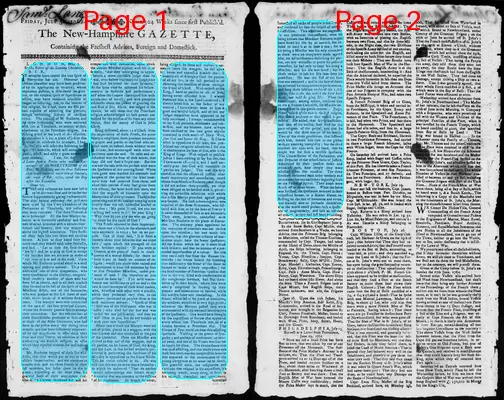
The New Hampshire Gazette
Portsmouth, Rockingham County, New Hampshire
What is this article about?
Report of the execution of Rev. M. Rochette and three Protestant noblemen in Toulouse on February 18, 1762, for adhering to their faith despite persecution by Catholic authorities. They faced trial, resisted conversion attempts, and died with serenity and conviction.
Merged-components note: This is a continuation of the same story about the martyrdom in Toulouse, with sequential reading order and direct text flow from page 1 to page 2.
Clippings
1 of 2
OCR Quality
Full Text
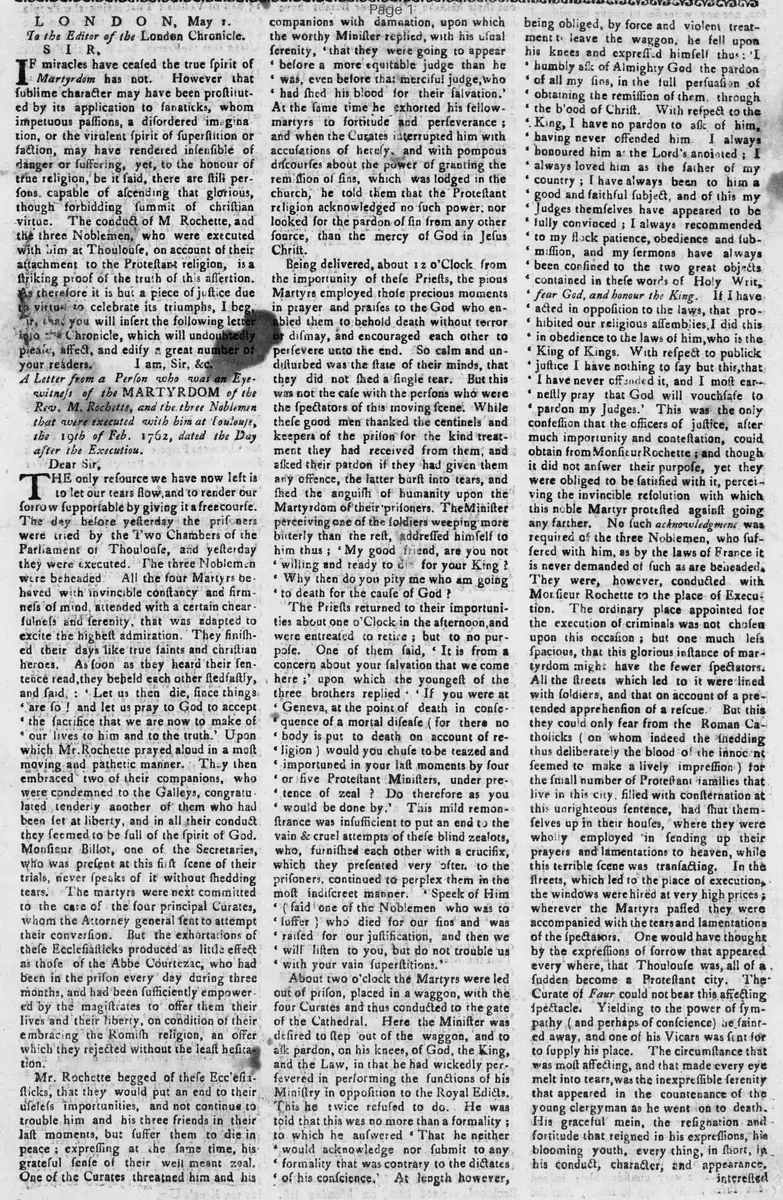
To the Editor of the London Chronicle.
Sir,
If miracles have ceased the true spirit of Martyrdom has not. However that sublime character may have been prostituted by its application to fanatics, whom impetuous passions, a disordered imagination, or the virulent spirit of superstition or faction, may have rendered insensible of danger or suffering, yet, to the honour of true religion, be it said, there are still persons capable of ascending that glorious, though forbidding summit of christian virtue. The conduct of M. Rochette, and the three Noblemen, who were executed with him at Toulouse, on account of their attachment to the Protestant religion, is a striking proof of the truth of this assertion. As therefore it is but a piece of justice due a virtue to celebrate its triumphs, I beg, Sir, that you will insert the following letter into your Chronicle, which will undoubtedly please, affect, and edify a great number of your readers.
I am, Sir, &c.
A Letter from a Person who was an Eye witness of the MARTYRDOM of the Rev. M. Rochette, and the three Noblemen that were executed with him at Toulouse, the 18th of Feb. 1762, dated the Day after the Execution.
Dear Sir,
The only resource we have now left is to let our tears flow, and to render our sorrow supportable by giving it a free course. The day before yesterday the prisoners were tried by the Two Chambers of the Parliament of Toulouse, and yesterday they were executed. The three Noblemen were beheaded. All the four Martyrs behaved with invincible constancy and firmness of mind, attended with a certain cheerfulness and serenity, that was adapted to excite the highest admiration. They finished their days like true saints and christian heroes. As soon as they heard their sentence read, they beheld each other steadfastly, and said: 'Let us then die, since things are so! and let us pray to God to accept the sacrifice that we are now to make of our lives to him and to the truth.' Upon which Mr. Rochette prayed aloud in a most moving and pathetic manner. They then embraced two of their companions, who were condemned to the Galleys, congratulated tenderly another of them who had been set at liberty, and in all their conduct they seemed to be full of the spirit of God. Monsieur Billot, one of the Secretaries, who was present at this fit scene of their trials, never speaks of it without shedding tears. The martyrs were next committed to the care of the four principal Curates, whom the Attorney general sent to attempt their conversion. But the exhortations of these Ecclesiastics produced as little effect as those of the Abbe Courtezac who had been in the prison every day during three months, and had been sufficiently empowered by the magistrates to offer them their lives and their liberty, on condition of their embracing the Romish religion, an offer which they rejected without the least hesitation.
Mr. Rochette begged of these Ecclesiastics, that they would put an end to their useless importunities, and not continue to trouble him and his three friends in their last moments, but suffer them to die in peace; expressing at the same time, his grateful sense of their well meant zeal. One of the Curates threatened him and his companions with damnation, upon which the worthy Minister replied, with his usual serenity, that they were going to appear before a more equitable judge than he was, even before that merciful judge, who had shed his blood for their salvation.' At the same time he exhorted his fellow-martyrs to fortitude and perseverance; and when the Curates interrupted him with accusations of heresy, and with pompous discourses about the power of granting the remission of sins, which was lodged in the church, he told them that the Protestant religion acknowledged no such power: nor looked for the pardon of sin from any other source, than the mercy of God in Jesus Christ.
Being delivered, about 12 o'Clock, from the importunity of these Priests, the pious Martyrs employed those precious moments in prayer and praises to the God who enabled them to behold death without terror or dismay, and encouraged each other to persevere unto the end. So calm and undisturbed was the state of their minds, that they did not shed a single tear. But this was not the case with the persons who were the spectators of this moving scene. While these good men thanked the sentinels and keepers of the prison for the kind treatment they had received from them, and asked their pardon if they had given them any offence, the latter burst into tears, and shed the anguish of humanity upon the Martyrdom of their prisoners. The Minister perceiving one of the soldiers weeping more bitterly than the rest, addressed himself to him thus; My good friend, are you not willing and ready to die for your King? Why then do you pity me who am going to death for the cause of God?
The Priests returned to their importunities about one o'Clock in the afternoon, and were entreated to retire; but to no purpose. One of them said, 'It is from a concern about your salvation that we come here;' upon which the youngest of the three brothers replied: 'If you were at Geneva, at the point of death in consequence of a mortal disease (for there no body is put to death on account of religion) would you choose to be teazed and importuned in your last moments by four or five Protestant Ministers, under pretence of zeal? Do therefore as you would be done by.' This mild remonstrance was insufficient to put an end to the vain & cruel attempts of these blind zealots, who, furnished each other with a crucifix, which they presented very often to the prisoners, continued to perplex them in the most indiscreet manner. 'Speak of Him (said one of the Noblemen who was to suffer) who died for our sins and was raised for our justification, and then we will listen to you, but do not trouble us with your vain superstitions.
About two o'clock the Martyrs were led out of prison, placed in a waggon, with the four Curates and thus conducted to the gate of the Cathedral. Here the Minister was desired to step out of the waggon, and to ask pardon, on his knees, of God, the King, and the Law, in that he had wickedly persevered in performing the functions of his Ministry in opposition to the Royal Edicts. This he twice refused to do. He was told that this was no more than a formality; to which he answered That he neither would acknowledge nor submit to any formality that was contrary to the dictates of his conscience.' At length however, being obliged, by force and violent treatment to leave the waggon, he fell upon his knees and expressed himself thus: 'I humbly ask of Almighty God the pardon of all my sins, in the full persuasion of obtaining the remission of them, through the blood of Christ. With respect to the King, I have no pardon to ask of him, having never offended him. I always honoured him as the Lord's anointed; I always loved him as the father of my country; I have always been to him a good and faithful subject, and of this my Judges themselves have appeared to be fully convinced; I always recommended to my flock patience, obedience and submission, and my sermons have always been confined to the two great objects contained in these words of Holy Writ, fear God, and honour the King. If I have acted in opposition to the laws, that prohibited our religious assemblies, I did this in obedience to the laws of him, who is the King of Kings. With respect to publick justice I have nothing to say but this, that I have never offended it, and I most earnestly pray that God will vouchsafe to pardon my Judges.' This was the only confession that the officers of justice, after much importunity and contestation, could obtain from Monsieur Rochette; and though it did not answer their purpose, yet they were obliged to be satisfied with it, perceiving the invincible resolution with which this noble Martyr protested against going any farther. No such acknowledgment was required of the three Noblemen, who suffered with him, as by the laws of France it is never demanded of such as are beheaded: They were, however, conducted with Monsieur Rochette to the place of Execution.
The ordinary place appointed for the execution of criminals was not chosen upon this occasion; but one much less spacious, that this glorious instance of martyrdom might have the fewer spectators. All the streets which led to it were lined with soldiers, and that on account of a pretended apprehension of a rescue. But this they could only fear from the Roman Catholics (on whom indeed the shedding thus deliberately the blood of the innocent seemed to make a lively impression) for the small number of Protestant families that live in this city, filled with consternation at this unrighteous sentence, had shut themselves up in their houses, where they were wholly employed in sending up their prayers and lamentations to heaven, while this terrible scene was transacting. In the streets, which led to the place of execution, the windows were hired at very high prices; wherever the Martyrs passed they were accompanied with the tears and lamentations of the spectators. One would have thought by the expressions of sorrow that appeared every where, that Toulouse was, all of a sudden become a Protestant city. The Curate of Faour could not bear this affecting spectacle. Yielding to the power of sympathy (and perhaps of conscience) he fainted away, and one of his Vicars was sent for to supply his place. The circumstance that was most affecting, and that made every eye melt into tears, was the inexpressible serenity that appeared in the countenance of the young clergyman as he went on to death. His graceful mien, the resignation and fortitude that reigned in his expressions, his blooming youth, every thing, in short, in his conduct, character, and appearance,
Interested all ranks of people in his favour. and rendered his fate the subject of universal affliction. This affliction was augmented by one particular circumstance, even its being known that Monsieur Rochette might have saved his life by an untruth. but refused to hold it at so dear a rate ; for as his being a Minister was his only crime, and as there were no complaints made against him, no advertisements describing his person, nor any witness to prove his pastoral character. he had only to deny his being a Minister. and his life was saved : but he chose rather to lose his life than deny his profession. He was the first of the four that was executed ; and in the face of death he exhorted his companions to perseverance, and sung those sublime verses of the 118th psalm, This is the day which the Lord hath made, we will be glad, &c. When the executioner. among others, conjured him to die a Roman Catholick, the Minister answered him in this gentle manner : Judge, friend, which of the two is the best religion, that which persecutes or that which is persecuted. He added, that his grandfather, and one of his uncles, had died for the pure religion of the gospel, and that he would be the third martyr of his family. Two of the three gentlemen. that suffered with him, beheld him tied to the gibbet with an amazing intrepidity ; but the third covered his eyes with his hand, that he might not see such a terrible spectacle. The Commissaries of the Parliament, and the Deputies of the other Courts of Justice. discovered by their pensive looks and downcast eyes, how deeply they were affected upon this occasion. The three brothers embraced each other tenderly and recommended mutually their departing souls to the Father of Spirits. Their heads were struck off at three blows. When the scene was finished. the spectators returned to their respective homes, in a solemn silence, reflecting on the fate of innocence and virtue. and scarcely able to persuade themselves, that the world could present such a spectacle of magnanimity, and such an instance of cruelty, as they had just been beholding.
What sub-type of article is it?
What keywords are associated?
What entities or persons were involved?
Where did it happen?
Foreign News Details
Primary Location
Toulouse
Event Date
18th Of Feb. 1762
Key Persons
Outcome
rev. m. rochette and three noblemen beheaded; two companions condemned to galleys; one set at liberty.
Event Details
Rev. M. Rochette and three Noblemen tried by Parliament of Toulouse, resisted conversion attempts by curates and Abbe Courtezac, maintained Protestant faith, executed with serenity and exhortations; public moved to tears.