Thank you for visiting SNEWPapers!
Sign up free
Literary
September 11, 1878
The Weekly Register
Point Pleasant, Mason County, West Virginia
What is this article about?
A young narrator recounts his journey to Western Virginia with his father, where he glimpses a beautiful girl on a mountain, later meeting her as his cousin Sophy. They share idyllic days, but years later in Washington, he discovers she has married, ending his youthful romance.
Clipping
OCR Quality
96%
Excellent
Full Text
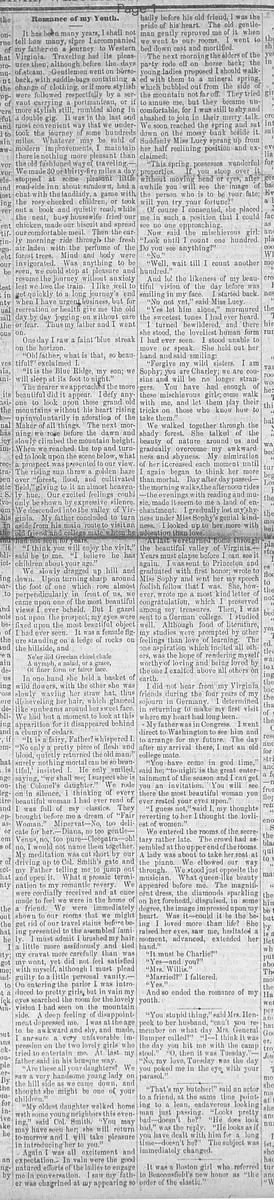
ROMANCE OF MY YOUTH.
It has been many years, I shall not tell how many, since I accompanied my father on a journey to Western Virginia. Traveling had its pleasures then, although before the days of steam. Gentlemen went on horseback, with saddle-bags containing a change of clothing, or if more stylish were followed respectfully by a servant carrying a portmanteau, or if more stylish still, rumbled along in a double gig. It was in the last and most convenient way that we undertook the journey of some hundreds miles. Whatever may be said of modern improvements, I maintain there is nothing more pleasant than the old fashioned way of traveling. We made 30 or thirty-five miles a day stopped at some pleasant little road-side inn about sundown, had a chat with the landlady, a game with the rosy cheeked children, or took out a book and quietly read, while the neat, busy housewife fried our chicken, made our biscuit and spread our comfortable meal. Then the early morning ride through the fresh air laden with the perfume of the forest trees. Mind and body were invigorated. Was anything to be seen, we could stop at pleasure and resume the journey without anxiety lest we lose the train. I like well to get quickly to a long journey's end when I have urgent business, but for recreation or health give me the old day by day jogging on without care or fear. Thus my father and I went on.
One day I saw a faint blue streak on the horizon.
"Oh! father, what is that, so beautiful?" exclaimed I.
"It is the Blue Ridge, my son; we will sleep at its foot to night."
The nearer we approached the more beautiful did it appear. I defy anyone to look upon those grand old mountains without his heart rising up involuntarily in adoration of the Maker of all things. The next morning we rose before the dawn and slowly climbed the mountain height. When we reached the top and turned to look upon the scene below, what a prospect was presented to our view. The rising sun threw a golden haze over "forest, flood, and cultivated field," giving to it an almost heavenly hue. Our excited feelings could only be shown by expressive silence. We descended into the valley of Virginia. My father concluded to turn aside from his main route to visit an old friend and college mate whom he had not seen for years.
"I think you will enjoy the visit," said he to me. "I believe he has children about your age."
We slowly dragged up hill and down. Upon turning sharp around the foot of one which rose almost perpendicularly in front of us, we came upon one of the most beautiful views I ever beheld. But I gazed not upon the prospect; my eyes were fixed upon the most beautiful object I had ever seen. It was a female figure standing on a ledge of rocks on the hillside, and
Ne'er did Grecian chisel trace
A nymph, a naiad, or a grace,
Of finer form or lovelier face.
In one hand she held a basket of wild flowers, with the other she was slowly waving her straw hat, thus disheveling her hair, which glanced like sunbeams around her sweet face. We had but a moment to look at this apparition for it disappeared behind a clump of cedars.
"It is a fairy, Father?" whispered I.
"No only a pretty piece of flesh and blood," quietly returned the old man.
"Surely nothing mortal can be so beautiful," insisted I. He only smiled, saying. "we shall see: I suspect she is the Colonel's daughter." We rode on in silence, I thinking of every beautiful woman I had ever read of. I was full of my classics. They brought before me a dream of "Fair Woman." Minerva—No. too delicate for her.—Diana, no too gentle— Venus, no, too pure—Cleopatra—oh! no, I would not name them together. My meditation was cut short by our driving up to Col. Smith's gate and my Father telling me to jump out and open it. What a prosaic termination to my romantic revery. We were cordially received and at once made to feel we were in the home of a friend. We were immediately shown to our rooms that we might get rid of our travel stains before being presented to the assembled family. I must admit I brushed my hair a little more assiduously and tied my cravat more carefully than was my wont, yet did not feel satisfied with myself, although I must plead guilty to a little personal vanity. On entering the parlor I was introduced to pretty girls, but in vain my eyes searched the room for the lovely vision I had seen on the mountain side. A deep feeling of disappointment depressed me. I was at the age to be awkward and shy, and made, I am sure a very unfavorable impression on the two lovely girls who tried to entertain me. At last my father said in his brusque way.
"Are these all your daughters? We saw a very handsome young lady on the hill side as we came down, and thought she might be one of your children."
"My oldest daughter walked home with some young neighbors this evening," said Col. Smith. "You may have seen her; she will return to-morrow and I will take pleasure in introducing her to you."
Again I was all excitement and expectation. In vain were the good natured efforts of the ladies to engage me in conversation. I saw my father was chagrined at my appearing so badly before his old friend, I was the pride of his heart. The old gentleman gently reproved me of it when we went to our rooms. I went to bed down cast and mortified.
The next morning the elders of the party rode off on horse back; the young ladies proposed I should walk with them to a mineral spring, which bubbled out from the side of the mountain not far off. They tried to amuse me, but they became uncomfortable, for I was still too shy and abashed to join in their merry talk. We soon reached the spring and sat down on the mossy bank beside it. Suddenly Miss Lucy sprang up from her half reclining position and exclaimed:
"This spring possesses wonderful properties.
If you stoop over it without moving head or eyes, after awhile you will see the image of the person who is to be your fate; will you try your fortune?"
Of course I consented, she placed me in such a position that I could see no one approaching.
"Now said the mischievous girl:
"Look until I count one hundred.
Do you see anything?"
"No."
"Well, wait till I count another hundred."
And lo! the likeness of my beautiful vision of the day before was smiling in my face. I started back.
"No not yet," said Miss Lucy.
"Yes let him alone," murmured the sweetest tones I had ever heard.
I turned bewildered, and there she stood. the loveliest human form I had ever seen. I stood unable to move or speak. She held out her hand and said smiling:
"Forgive my wild sisters. I am Sophy; you are Charley; we are cousins and will be no longer strangers. You have had enough of those mischievous girls; come walk with me, and let them play their tricks on those who know how to take them."
We walked together through the shady forest. She talked of the beauty of nature around us and gradually overcame my awkwardness and shyness. My admiration of her increased each moment until I again began to think her more than mortal. Day after day passed—the morning walks, the afternoon rides—the evenings with reading and music, made it seem to me a land of enchantment. I gradually lost my shyness under Miss Sophy's genial kindness. I looked up to her more with adoration than love. At last we returned home through the beautiful valley of Virginia. Years must elapse before I can see it again. I was sent to Princeton and graduated with first honor: wrote to Miss Sophy and sent her my speech foolish fellow that I was. She, however, wrote me a most kind letter of congratulation, which I preserved among my treasures. Then, I was sent to a German college. I studied well. Although fond of literature, my studies were prompted by other feelings than love of learning. The one aspiration which incited all others, was the hope of rendering myself worthy of loving and being loved by the one I exalted above all others on earth.
I did not hear from my Virginia friends during the four years of my sojourn in Germany. I determined in returning to make my first visit where my heart had long been. My father was in Congress. I went direct to Washington to see him and to arrange for my future. The day after my arrival there, I met an old college mate.
"You have come in good time," said he; "to-night is the great entertainment of the season and I can get you an invitation. You will see there the most beautiful woman you ever rested your eyes upon."
"I guess not," said I, my thoughts reverting to her I thought the loveliest of women.
We entered the rooms of the secretary rather late. The crowd had assembled at the upper end of the rooms. A lady was about to take her seat at the piano. We elbowed our way through. We stood just opposite the musician. What queen-like beauty appeared before me. The magnificent dress, the diamonds sparkling on her forehead, disguised, in some degree, the image impressed upon my heart. Was it—could it be the being I loved more than life? She raised her eyes, saw me, hesitated a moment, advanced, extended her hand.
"It must be Charlie?"
"Yes—and you?"
"Mrs. Willis."
"Married?" I faltered.
"Yes."
And so ended the romance of my youth.
It has been many years, I shall not tell how many, since I accompanied my father on a journey to Western Virginia. Traveling had its pleasures then, although before the days of steam. Gentlemen went on horseback, with saddle-bags containing a change of clothing, or if more stylish were followed respectfully by a servant carrying a portmanteau, or if more stylish still, rumbled along in a double gig. It was in the last and most convenient way that we undertook the journey of some hundreds miles. Whatever may be said of modern improvements, I maintain there is nothing more pleasant than the old fashioned way of traveling. We made 30 or thirty-five miles a day stopped at some pleasant little road-side inn about sundown, had a chat with the landlady, a game with the rosy cheeked children, or took out a book and quietly read, while the neat, busy housewife fried our chicken, made our biscuit and spread our comfortable meal. Then the early morning ride through the fresh air laden with the perfume of the forest trees. Mind and body were invigorated. Was anything to be seen, we could stop at pleasure and resume the journey without anxiety lest we lose the train. I like well to get quickly to a long journey's end when I have urgent business, but for recreation or health give me the old day by day jogging on without care or fear. Thus my father and I went on.
One day I saw a faint blue streak on the horizon.
"Oh! father, what is that, so beautiful?" exclaimed I.
"It is the Blue Ridge, my son; we will sleep at its foot to night."
The nearer we approached the more beautiful did it appear. I defy anyone to look upon those grand old mountains without his heart rising up involuntarily in adoration of the Maker of all things. The next morning we rose before the dawn and slowly climbed the mountain height. When we reached the top and turned to look upon the scene below, what a prospect was presented to our view. The rising sun threw a golden haze over "forest, flood, and cultivated field," giving to it an almost heavenly hue. Our excited feelings could only be shown by expressive silence. We descended into the valley of Virginia. My father concluded to turn aside from his main route to visit an old friend and college mate whom he had not seen for years.
"I think you will enjoy the visit," said he to me. "I believe he has children about your age."
We slowly dragged up hill and down. Upon turning sharp around the foot of one which rose almost perpendicularly in front of us, we came upon one of the most beautiful views I ever beheld. But I gazed not upon the prospect; my eyes were fixed upon the most beautiful object I had ever seen. It was a female figure standing on a ledge of rocks on the hillside, and
Ne'er did Grecian chisel trace
A nymph, a naiad, or a grace,
Of finer form or lovelier face.
In one hand she held a basket of wild flowers, with the other she was slowly waving her straw hat, thus disheveling her hair, which glanced like sunbeams around her sweet face. We had but a moment to look at this apparition for it disappeared behind a clump of cedars.
"It is a fairy, Father?" whispered I.
"No only a pretty piece of flesh and blood," quietly returned the old man.
"Surely nothing mortal can be so beautiful," insisted I. He only smiled, saying. "we shall see: I suspect she is the Colonel's daughter." We rode on in silence, I thinking of every beautiful woman I had ever read of. I was full of my classics. They brought before me a dream of "Fair Woman." Minerva—No. too delicate for her.—Diana, no too gentle— Venus, no, too pure—Cleopatra—oh! no, I would not name them together. My meditation was cut short by our driving up to Col. Smith's gate and my Father telling me to jump out and open it. What a prosaic termination to my romantic revery. We were cordially received and at once made to feel we were in the home of a friend. We were immediately shown to our rooms that we might get rid of our travel stains before being presented to the assembled family. I must admit I brushed my hair a little more assiduously and tied my cravat more carefully than was my wont, yet did not feel satisfied with myself, although I must plead guilty to a little personal vanity. On entering the parlor I was introduced to pretty girls, but in vain my eyes searched the room for the lovely vision I had seen on the mountain side. A deep feeling of disappointment depressed me. I was at the age to be awkward and shy, and made, I am sure a very unfavorable impression on the two lovely girls who tried to entertain me. At last my father said in his brusque way.
"Are these all your daughters? We saw a very handsome young lady on the hill side as we came down, and thought she might be one of your children."
"My oldest daughter walked home with some young neighbors this evening," said Col. Smith. "You may have seen her; she will return to-morrow and I will take pleasure in introducing her to you."
Again I was all excitement and expectation. In vain were the good natured efforts of the ladies to engage me in conversation. I saw my father was chagrined at my appearing so badly before his old friend, I was the pride of his heart. The old gentleman gently reproved me of it when we went to our rooms. I went to bed down cast and mortified.
The next morning the elders of the party rode off on horse back; the young ladies proposed I should walk with them to a mineral spring, which bubbled out from the side of the mountain not far off. They tried to amuse me, but they became uncomfortable, for I was still too shy and abashed to join in their merry talk. We soon reached the spring and sat down on the mossy bank beside it. Suddenly Miss Lucy sprang up from her half reclining position and exclaimed:
"This spring possesses wonderful properties.
If you stoop over it without moving head or eyes, after awhile you will see the image of the person who is to be your fate; will you try your fortune?"
Of course I consented, she placed me in such a position that I could see no one approaching.
"Now said the mischievous girl:
"Look until I count one hundred.
Do you see anything?"
"No."
"Well, wait till I count another hundred."
And lo! the likeness of my beautiful vision of the day before was smiling in my face. I started back.
"No not yet," said Miss Lucy.
"Yes let him alone," murmured the sweetest tones I had ever heard.
I turned bewildered, and there she stood. the loveliest human form I had ever seen. I stood unable to move or speak. She held out her hand and said smiling:
"Forgive my wild sisters. I am Sophy; you are Charley; we are cousins and will be no longer strangers. You have had enough of those mischievous girls; come walk with me, and let them play their tricks on those who know how to take them."
We walked together through the shady forest. She talked of the beauty of nature around us and gradually overcame my awkwardness and shyness. My admiration of her increased each moment until I again began to think her more than mortal. Day after day passed—the morning walks, the afternoon rides—the evenings with reading and music, made it seem to me a land of enchantment. I gradually lost my shyness under Miss Sophy's genial kindness. I looked up to her more with adoration than love. At last we returned home through the beautiful valley of Virginia. Years must elapse before I can see it again. I was sent to Princeton and graduated with first honor: wrote to Miss Sophy and sent her my speech foolish fellow that I was. She, however, wrote me a most kind letter of congratulation, which I preserved among my treasures. Then, I was sent to a German college. I studied well. Although fond of literature, my studies were prompted by other feelings than love of learning. The one aspiration which incited all others, was the hope of rendering myself worthy of loving and being loved by the one I exalted above all others on earth.
I did not hear from my Virginia friends during the four years of my sojourn in Germany. I determined in returning to make my first visit where my heart had long been. My father was in Congress. I went direct to Washington to see him and to arrange for my future. The day after my arrival there, I met an old college mate.
"You have come in good time," said he; "to-night is the great entertainment of the season and I can get you an invitation. You will see there the most beautiful woman you ever rested your eyes upon."
"I guess not," said I, my thoughts reverting to her I thought the loveliest of women.
We entered the rooms of the secretary rather late. The crowd had assembled at the upper end of the rooms. A lady was about to take her seat at the piano. We elbowed our way through. We stood just opposite the musician. What queen-like beauty appeared before me. The magnificent dress, the diamonds sparkling on her forehead, disguised, in some degree, the image impressed upon my heart. Was it—could it be the being I loved more than life? She raised her eyes, saw me, hesitated a moment, advanced, extended her hand.
"It must be Charlie?"
"Yes—and you?"
"Mrs. Willis."
"Married?" I faltered.
"Yes."
And so ended the romance of my youth.
What sub-type of article is it?
Prose Fiction
What themes does it cover?
Love Romance
What keywords are associated?
Youthful Romance
Virginia Journey
First Love
Mountain Vision
Lost Love
Cousins
Princeton Graduate
German Studies
Literary Details
Title
Romance Of My Youth.
Key Lines
Ne'er Did Grecian Chisel Trace
A Nymph, A Naiad, Or A Grace,
Of Finer Form Or Lovelier Face.
Forgive My Wild Sisters. I Am Sophy; You Are Charley; We Are Cousins And Will Be No Longer Strangers.
It Must Be Charlie?
Yes—And You?
Mrs. Willis.
Married? I Faltered.
Yes.
And So Ended The Romance Of My Youth.