Thank you for visiting SNEWPapers!
Sign up free
Editorial
November 17, 1802
The Recorder
Richmond, Virginia
What is this article about?
Editorial critiques shifting Democratic defenses of Thomas Jefferson's financial support for James Callender's anti-Federalist book 'The Prospect Before Us,' highlighting hypocrisy and political scandal through published letters.
Clipping
OCR Quality
95%
Excellent
Full Text
FROM THE FREDERICK-TOWN HERALD.
Saturday, October 30th. 1802.
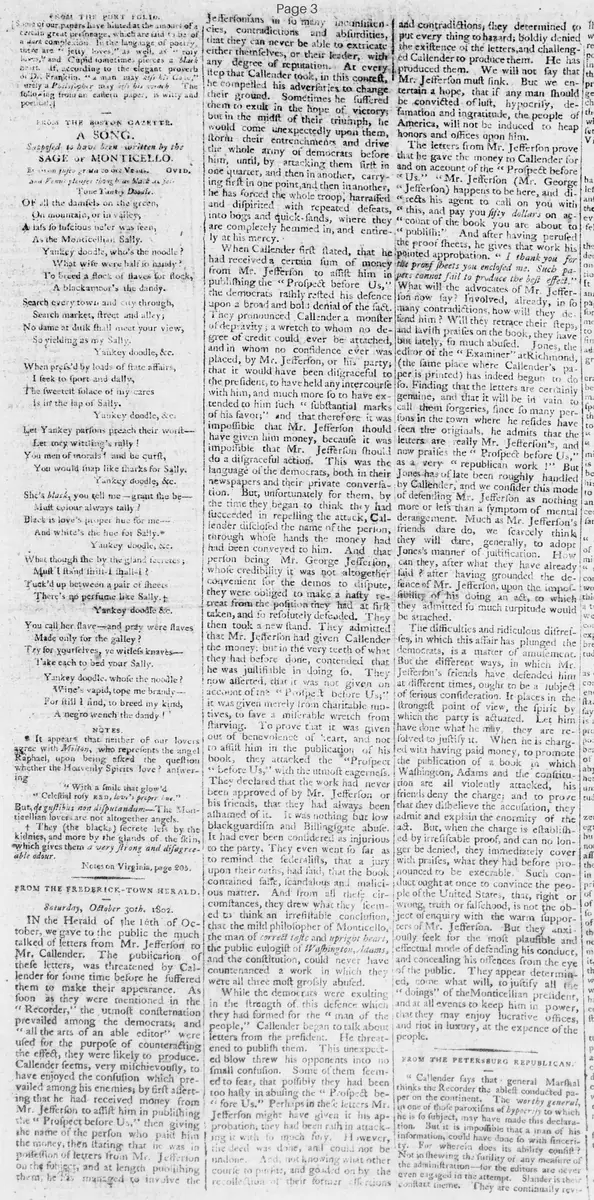
IN the Herald of the 10th of October, we gave to the public the much talked of letters from Mr. Jefferson to Mr. Callender. The publication of these letters, was threatened by Callender for some time before he suffered them to make their appearance. As soon as they were mentioned in the "Recorder," the utmost consternation prevailed among the democrats; and "all the arts of an able editor" were used for the purpose of counteracting the effect, they were likely to produce. Callender seems, very mischievously, to have enjoyed the confusion which prevailed among his enemies; by first asserting that he had received money from Mr. Jefferson to assist him in publishing the "Prospect before Us," then giving the name of the person who paid him the money, then stating that he was in possession of letters from Mr. Jefferson on the subject, and at length publishing them, he so managed to involve the Jeffersonians in so many inconsistencies, contradictions and absurdities, that they can never be able to extricate either themselves, or their leader, without any degree of reputation. At every step that Callender took, in this contest, he compelled his adversaries to change their ground. Sometimes he suffered them to exult in the hope of victory; but in the midst of their triumph, he would come unexpectedly upon them, storm their entrenchments and drive the whole army of democrats before him, until, by attacking them first in one quarter, and then in another, carrying first in one point, and then in another, he has forced the whole troop, harassed and dispirited with repeated defeats, into bogs and quick-sands, where they are completely hemmed in, and entirely at his mercy.
When Callender first stated, that he had received a certain sum of money from Mr. Jefferson to aid him in publishing the "Prospect before Us." the democrats rashly rested his defence upon a broad and bold denial of the fact. They pronounced Callender a monster of depravity; a wretch to whom no degree of credit could ever be attached. and in whom no confidence ever was placed, by Mr. Jefferson, or his party: that it would have been disgraceful to the president, to have held any intercourse with him, and much more so to have extended to him such "substantial marks of his favor;" and that therefore it was impossible that Mr. Jefferson should have given him money, because it was impossible that Mr. Jefferson should do a disgraceful action. This was the language of the democrats, both in their newspapers and their private conversation. But, unfortunately for them, by the time they began to think they had succeeded in repelling the attack, Callender disclosed the name of the person, through whose hands the money had been conveyed to him. And that person being Mr. George Jefferson, whose credibility it was not altogether convenient for the demos to dispute, they were obliged to make a hasty retreat from the position they had at first taken, and so resolutely defended. They then took a new stand. They admitted that Mr. Jefferson had given Callender the money: but in the very teeth of what they had before done, contended that he was justifiable in doing so. They now asserted, that it was not given on account of the "Prospect before Us;" it was given merely from charitable motives, to save a miserable wretch from starving. To prove that it was given out of benevolence of heart, and not to assist him in the publication of his book, they attacked the "Prospect before Us," with the utmost eagerness. They declared that the work had never been approved of by Mr. Jefferson or his friends, that they had always been ashamed of it. it was nothing but low blackguardism and Billingsgate abuse. It had ever been considered as injurious to the party. They even went so far as to remind the federalists, that a jury upon their oaths, had said, that the book contained false, scandalous and malicious matter. And from all these circumstances, they drew what they seemed to think an irresistible conclusion, that the mild philosopher of Monticello, the man of correct taste and upright heart, the public eulogist of Washington, Adams, and the constitution, could never have countenanced a work in which they were all three most grossly abused.
While the democrats were exulting in the strength of this defence which they had formed for the "man of the people," Callender began to talk about letters from the president. He threatened to publish them. This unexpected blow threw his opponents into no small confusion. Some of them seemed to fear, that possibly they had been too hasty in abusing the "Prospect before Us." Perhaps in these letters Mr. Jefferson might have given it his approbation, they had been rash in attacking it with so much folly. However, the deed was done, and could not be undone. And, not knowing what other course to pursue, and goaded on by the recollection of their former trifles and contradictions, they determined to put every thing to hazard; boldly denied the existence of the letters, and challenged Callender to produce them. He has produced them. We will not say that Mr. Jefferson must sink. But we entertain a hope, that if any man should be convicted of lust, hypocrisy, defamation and ingratitude, the people of America, will not be induced to heap honors and offices upon him.
The letters from Mr. Jefferson prove that he gave the money to Callender for and on account of the "Prospect before Us." "Mr. Jefferson (Mr. George Jefferson) happens to be here, and directs his agent to call on you with this, and pay you fifty dollars on account of the book you are about to publish:" And after having perused the proof sheets, he gives that work his pointed approbation. "I thank you for the proof sheets you enclosed me. Such papers cannot fail to produce the best effect."
What will the advocates of Mr. Jefferson now say? Involved, already, in so many contradictions, how will they defend him? Will they retrace their steps. and lavish praises on the book, they have but lately, so much abused. Jones, the editor of the "Examiner" at Richmond, (the same place where Callender's paper is printed) has indeed begun to do so. Finding that the letters are certainly genuine, and that it will be in vain to call them forgeries, since so many persons in the town where he resides have seen the originals, he admits that the letters are really Mr. Jefferson's, and now praises the "Prospect before Us," as a very "republican work!" But Jones has of late been roughly handled by Callender, and we consider this mode of defending Mr. Jefferson as nothing more or less than a symptom of mental derangement. Much as Mr. Jefferson's friends dare do, we scarcely think they will dare, generally, to adopt Jones's manner of justification. How can they, after what they have already said? after having grounded the defence of Mr. Jefferson upon the impossibility of his doing an act, to which they admit so much turpitude would be attached.
The difficulties and ridiculous distresses, in which this affair has plunged the democrats, is a matter of amusement. But the different ways, in which Mr. Jefferson's friends have defended him at different times, ought to be a subject of serious consideration. It places in the strongest point of view, the spirit by which the party is actuated. Let him have done what he may, they are resolved to justify it. When he is charged with having paid money, to promote the publication of a book in which Washington, Adams and the constitution are all violently attacked, his friends deny the charge; and to prove that they disbelieve the accusation, they admit and explain the enormity of the act. But, when the charge is established by irresistible proof, and can no longer be denied, they immediately cover with praises, what they had before pronounced to be execrable. Such conduct ought at once to convince the people of the United States, that, right or wrong, truth or falsehood, is not the object of enquiry with the warm supporters of Mr. Jefferson. But they anxiously seek for the most plausible and effectual mode of defending his conduct, and concealing his offences from the eye of the public. They appear determined, come what will, to justify all the "doings" of the Monticello president, and at all events to keep him in power, that they may enjoy lucrative offices, and riot in luxury, at the expense of the people.
Saturday, October 30th. 1802.
IN the Herald of the 10th of October, we gave to the public the much talked of letters from Mr. Jefferson to Mr. Callender. The publication of these letters, was threatened by Callender for some time before he suffered them to make their appearance. As soon as they were mentioned in the "Recorder," the utmost consternation prevailed among the democrats; and "all the arts of an able editor" were used for the purpose of counteracting the effect, they were likely to produce. Callender seems, very mischievously, to have enjoyed the confusion which prevailed among his enemies; by first asserting that he had received money from Mr. Jefferson to assist him in publishing the "Prospect before Us," then giving the name of the person who paid him the money, then stating that he was in possession of letters from Mr. Jefferson on the subject, and at length publishing them, he so managed to involve the Jeffersonians in so many inconsistencies, contradictions and absurdities, that they can never be able to extricate either themselves, or their leader, without any degree of reputation. At every step that Callender took, in this contest, he compelled his adversaries to change their ground. Sometimes he suffered them to exult in the hope of victory; but in the midst of their triumph, he would come unexpectedly upon them, storm their entrenchments and drive the whole army of democrats before him, until, by attacking them first in one quarter, and then in another, carrying first in one point, and then in another, he has forced the whole troop, harassed and dispirited with repeated defeats, into bogs and quick-sands, where they are completely hemmed in, and entirely at his mercy.
When Callender first stated, that he had received a certain sum of money from Mr. Jefferson to aid him in publishing the "Prospect before Us." the democrats rashly rested his defence upon a broad and bold denial of the fact. They pronounced Callender a monster of depravity; a wretch to whom no degree of credit could ever be attached. and in whom no confidence ever was placed, by Mr. Jefferson, or his party: that it would have been disgraceful to the president, to have held any intercourse with him, and much more so to have extended to him such "substantial marks of his favor;" and that therefore it was impossible that Mr. Jefferson should have given him money, because it was impossible that Mr. Jefferson should do a disgraceful action. This was the language of the democrats, both in their newspapers and their private conversation. But, unfortunately for them, by the time they began to think they had succeeded in repelling the attack, Callender disclosed the name of the person, through whose hands the money had been conveyed to him. And that person being Mr. George Jefferson, whose credibility it was not altogether convenient for the demos to dispute, they were obliged to make a hasty retreat from the position they had at first taken, and so resolutely defended. They then took a new stand. They admitted that Mr. Jefferson had given Callender the money: but in the very teeth of what they had before done, contended that he was justifiable in doing so. They now asserted, that it was not given on account of the "Prospect before Us;" it was given merely from charitable motives, to save a miserable wretch from starving. To prove that it was given out of benevolence of heart, and not to assist him in the publication of his book, they attacked the "Prospect before Us," with the utmost eagerness. They declared that the work had never been approved of by Mr. Jefferson or his friends, that they had always been ashamed of it. it was nothing but low blackguardism and Billingsgate abuse. It had ever been considered as injurious to the party. They even went so far as to remind the federalists, that a jury upon their oaths, had said, that the book contained false, scandalous and malicious matter. And from all these circumstances, they drew what they seemed to think an irresistible conclusion, that the mild philosopher of Monticello, the man of correct taste and upright heart, the public eulogist of Washington, Adams, and the constitution, could never have countenanced a work in which they were all three most grossly abused.
While the democrats were exulting in the strength of this defence which they had formed for the "man of the people," Callender began to talk about letters from the president. He threatened to publish them. This unexpected blow threw his opponents into no small confusion. Some of them seemed to fear, that possibly they had been too hasty in abusing the "Prospect before Us." Perhaps in these letters Mr. Jefferson might have given it his approbation, they had been rash in attacking it with so much folly. However, the deed was done, and could not be undone. And, not knowing what other course to pursue, and goaded on by the recollection of their former trifles and contradictions, they determined to put every thing to hazard; boldly denied the existence of the letters, and challenged Callender to produce them. He has produced them. We will not say that Mr. Jefferson must sink. But we entertain a hope, that if any man should be convicted of lust, hypocrisy, defamation and ingratitude, the people of America, will not be induced to heap honors and offices upon him.
The letters from Mr. Jefferson prove that he gave the money to Callender for and on account of the "Prospect before Us." "Mr. Jefferson (Mr. George Jefferson) happens to be here, and directs his agent to call on you with this, and pay you fifty dollars on account of the book you are about to publish:" And after having perused the proof sheets, he gives that work his pointed approbation. "I thank you for the proof sheets you enclosed me. Such papers cannot fail to produce the best effect."
What will the advocates of Mr. Jefferson now say? Involved, already, in so many contradictions, how will they defend him? Will they retrace their steps. and lavish praises on the book, they have but lately, so much abused. Jones, the editor of the "Examiner" at Richmond, (the same place where Callender's paper is printed) has indeed begun to do so. Finding that the letters are certainly genuine, and that it will be in vain to call them forgeries, since so many persons in the town where he resides have seen the originals, he admits that the letters are really Mr. Jefferson's, and now praises the "Prospect before Us," as a very "republican work!" But Jones has of late been roughly handled by Callender, and we consider this mode of defending Mr. Jefferson as nothing more or less than a symptom of mental derangement. Much as Mr. Jefferson's friends dare do, we scarcely think they will dare, generally, to adopt Jones's manner of justification. How can they, after what they have already said? after having grounded the defence of Mr. Jefferson upon the impossibility of his doing an act, to which they admit so much turpitude would be attached.
The difficulties and ridiculous distresses, in which this affair has plunged the democrats, is a matter of amusement. But the different ways, in which Mr. Jefferson's friends have defended him at different times, ought to be a subject of serious consideration. It places in the strongest point of view, the spirit by which the party is actuated. Let him have done what he may, they are resolved to justify it. When he is charged with having paid money, to promote the publication of a book in which Washington, Adams and the constitution are all violently attacked, his friends deny the charge; and to prove that they disbelieve the accusation, they admit and explain the enormity of the act. But, when the charge is established by irresistible proof, and can no longer be denied, they immediately cover with praises, what they had before pronounced to be execrable. Such conduct ought at once to convince the people of the United States, that, right or wrong, truth or falsehood, is not the object of enquiry with the warm supporters of Mr. Jefferson. But they anxiously seek for the most plausible and effectual mode of defending his conduct, and concealing his offences from the eye of the public. They appear determined, come what will, to justify all the "doings" of the Monticello president, and at all events to keep him in power, that they may enjoy lucrative offices, and riot in luxury, at the expense of the people.
What sub-type of article is it?
Partisan Politics
Moral Or Religious
Press Freedom
What keywords are associated?
Jefferson Callender
Prospect Before Us
Political Scandal
Democratic Hypocrisy
Federalist Critique
Published Letters
What entities or persons were involved?
Mr. Jefferson
Mr. Callender
George Jefferson
Jones (Examiner Editor)
Democrats
Federalists
Washington
Adams
Editorial Details
Primary Topic
Critique Of Democratic Defenses Of Jefferson's Support For Callender's 'Prospect Before Us'
Stance / Tone
Anti Jeffersonian Mockery And Condemnation Of Hypocrisy
Key Figures
Mr. Jefferson
Mr. Callender
George Jefferson
Jones (Examiner Editor)
Democrats
Federalists
Washington
Adams
Key Arguments
Democrats Initially Denied Jefferson Gave Money To Callender
Shifted To Claim It Was Charity, Not For The Book
Attacked The Book To Prove Lack Of Approval
Letters Prove Jefferson Approved And Funded The Book
Democrats' Contradictions Reveal Blind Loyalty
Callender's Tactics Exposed Jeffersonian Inconsistencies