Thank you for visiting SNEWPapers!
Sign up free
Editorial
September 5, 1949
Trainman News
Indianapolis, Marion County, Indiana
What is this article about?
Editorial criticizes big business and reactionaries for labeling beneficial government programs like the New Deal and Fair Deal as 'socialism' when they don't serve private interests, highlighting hypocrisy in public fund usage for health insurance, TVA, and public schools.
Clipping
OCR Quality
98%
Excellent
Full Text
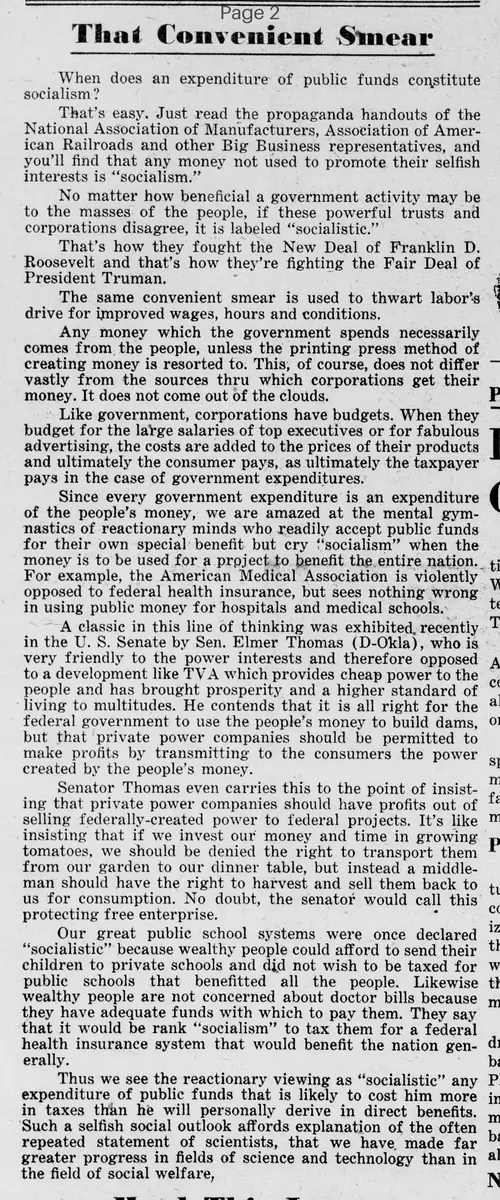
That Convenient Smear
When does an expenditure of public funds constitute socialism?
That's easy. Just read the propaganda handouts of the National Association of Manufacturers, Association of American Railroads and other Big Business representatives, and you'll find that any money not used to promote their selfish interests is "socialism."
No matter how beneficial a government activity may be to the masses of the people, if these powerful trusts and corporations disagree, it is labeled "socialistic."
That's how they fought the New Deal of Franklin D. Roosevelt and that's how they're fighting the Fair Deal of President Truman.
The same convenient smear is used to thwart labor's drive for improved wages, hours and conditions.
Any money which the government spends necessarily comes from the people, unless the printing press method of creating money is resorted to. This, of course, does not differ vastly from the sources thru which corporations get their money. It does not come out of the clouds.
Like government, corporations have budgets. When they budget for the large salaries of top executives or for fabulous advertising, the costs are added to the prices of their products and ultimately the consumer pays, as ultimately the taxpayer pays in the case of government expenditures.
Since every government expenditure is an expenditure of the people's money, we are amazed at the mental gymnastics of reactionary minds who readily accept public funds for their own special benefit but cry "socialism" when the money is to be used for a project to benefit the entire nation.
For example, the American Medical Association is violently opposed to federal health insurance, but sees nothing wrong in using public money for hospitals and medical schools.
A classic in this line of thinking was exhibited recently in the U. S. Senate by Sen. Elmer Thomas (D-Okla), who is very friendly to the power interests and therefore opposed to a development like TVA which provides cheap power to the people and has brought prosperity and a higher standard of living to multitudes. He contends that it is all right for the federal government to use the people's money to build dams, but that private power companies should be permitted to make profits by transmitting to the consumers the power created by the people's money.
Senator Thomas even carries this to the point of insisting that private power companies should have profits out of selling federally-created power to federal projects. It's like insisting that if we invest our money and time in growing tomatoes, we should be denied the right to transport them from our garden to our dinner table, but instead a middleman should have the right to harvest and sell them back to us for consumption. No doubt, the senator would call this protecting free enterprise.
Our great public school systems were once declared "socialistic" because wealthy people could afford to send their children to private schools and did not wish to be taxed for public schools that benefitted all the people. Likewise wealthy people are not concerned about doctor bills because they have adequate funds with which to pay them. They say that it would be rank "socialism" to tax them for a federal health insurance system that would benefit the nation generally.
Thus we see the reactionary viewing as "socialistic" any expenditure of public funds that is likely to cost him more in taxes than he will personally derive in direct benefits.
Such a selfish social outlook affords explanation of the often repeated statement of scientists, that we have made far greater progress in fields of science and technology than in the field of social welfare.
When does an expenditure of public funds constitute socialism?
That's easy. Just read the propaganda handouts of the National Association of Manufacturers, Association of American Railroads and other Big Business representatives, and you'll find that any money not used to promote their selfish interests is "socialism."
No matter how beneficial a government activity may be to the masses of the people, if these powerful trusts and corporations disagree, it is labeled "socialistic."
That's how they fought the New Deal of Franklin D. Roosevelt and that's how they're fighting the Fair Deal of President Truman.
The same convenient smear is used to thwart labor's drive for improved wages, hours and conditions.
Any money which the government spends necessarily comes from the people, unless the printing press method of creating money is resorted to. This, of course, does not differ vastly from the sources thru which corporations get their money. It does not come out of the clouds.
Like government, corporations have budgets. When they budget for the large salaries of top executives or for fabulous advertising, the costs are added to the prices of their products and ultimately the consumer pays, as ultimately the taxpayer pays in the case of government expenditures.
Since every government expenditure is an expenditure of the people's money, we are amazed at the mental gymnastics of reactionary minds who readily accept public funds for their own special benefit but cry "socialism" when the money is to be used for a project to benefit the entire nation.
For example, the American Medical Association is violently opposed to federal health insurance, but sees nothing wrong in using public money for hospitals and medical schools.
A classic in this line of thinking was exhibited recently in the U. S. Senate by Sen. Elmer Thomas (D-Okla), who is very friendly to the power interests and therefore opposed to a development like TVA which provides cheap power to the people and has brought prosperity and a higher standard of living to multitudes. He contends that it is all right for the federal government to use the people's money to build dams, but that private power companies should be permitted to make profits by transmitting to the consumers the power created by the people's money.
Senator Thomas even carries this to the point of insisting that private power companies should have profits out of selling federally-created power to federal projects. It's like insisting that if we invest our money and time in growing tomatoes, we should be denied the right to transport them from our garden to our dinner table, but instead a middleman should have the right to harvest and sell them back to us for consumption. No doubt, the senator would call this protecting free enterprise.
Our great public school systems were once declared "socialistic" because wealthy people could afford to send their children to private schools and did not wish to be taxed for public schools that benefitted all the people. Likewise wealthy people are not concerned about doctor bills because they have adequate funds with which to pay them. They say that it would be rank "socialism" to tax them for a federal health insurance system that would benefit the nation generally.
Thus we see the reactionary viewing as "socialistic" any expenditure of public funds that is likely to cost him more in taxes than he will personally derive in direct benefits.
Such a selfish social outlook affords explanation of the often repeated statement of scientists, that we have made far greater progress in fields of science and technology than in the field of social welfare.
What sub-type of article is it?
Economic Policy
Social Reform
Partisan Politics
What keywords are associated?
Socialism Smear
Government Spending
New Deal
Fair Deal
Big Business
Public Welfare
Tva
Federal Health Insurance
Reactionaries
What entities or persons were involved?
National Association Of Manufacturers
Association Of American Railroads
Big Business
Franklin D. Roosevelt
President Truman
American Medical Association
Sen. Elmer Thomas (D Okla)
Tva
Power Interests
Editorial Details
Primary Topic
Criticism Of Labeling Government Spending As Socialism
Stance / Tone
Critical Of Big Business Hypocrisy And Supportive Of Public Welfare Programs
Key Figures
National Association Of Manufacturers
Association Of American Railroads
Big Business
Franklin D. Roosevelt
President Truman
American Medical Association
Sen. Elmer Thomas (D Okla)
Tva
Power Interests
Key Arguments
Any Government Spending Not Benefiting Big Business Is Labeled Socialism
New Deal And Fair Deal Opposed As Socialistic By Powerful Interests
Government Expenditures Come From People, Similar To Corporate Costs Passed To Consumers
Hypocrisy In Accepting Public Funds For Special Benefits But Opposing National Projects
Ama Opposes Federal Health Insurance But Accepts Public Money For Hospitals And Schools
Sen. Thomas Supports Private Profits From Public Power Projects Like Tva
Public Schools Once Called Socialistic By Wealthy Who Could Afford Private Education
Reactionaries View Public Spending As Socialistic If It Costs Them More In Taxes Than Personal Benefits