Thank you for visiting SNEWPapers!
Sign up free
Richmond Daily Times
Richmond, Virginia
What is this article about?
The Whig Convention in Virginia reconvened, debated and rejected an amendment on delegate selection for the National Whig Convention, adopted resolutions supporting the Compromise measures, President Fillmore, and Whig principles, then adjourned with enthusiasm.
Clipping
OCR Quality
Full Text
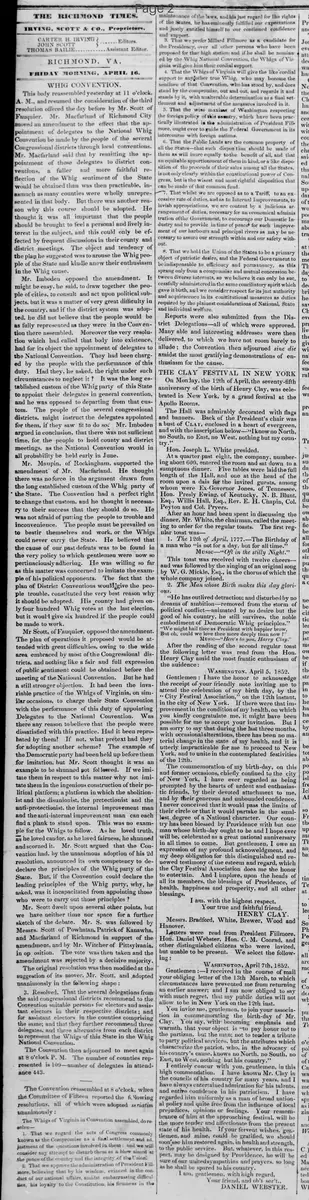
This body reassembled yesterday at 11 o'clock, A. M., and resumed the consideration of the third resolution offered the day before by Mr. Scott of Fauquier. Mr. Macfarland of Richmond City moved an amendment to the effect that the appointment of delegates to the National Whig Convention be made by the people of the several Congressional districts through local conventions.
Mr. Macfarland said that by remitting the appointment of those delegates to district conventions, a fuller and more faithful reflection of the Whig sentiment of the State would be obtained than was then practicable, inasmuch as many counties were wholly unrepresented in that body. But there was another reason why this course should be adopted. He thought it was all important that the people should be brought to feel a personal and lively interest in the subject, and this could only be effected by frequent discussions in their county and district meetings. The object and tendency of the plan he suggested was to arouse the Whig people of the State and kindle anew their enthusiasm in the Whig cause.
Mr. Imboden opposed the amendment. It might be easy, he said, to draw together the people of cities, to consult and act upon political subjects, but it was a matter of very great difficulty in the country, and if the district system was adopted, he did not believe that the people would be as fully represented as they were in the Convention there assembled. Moreover the very resolution which had called that body into existence, had for its object the appointment of delegates to the National Convention. They had been charged by the people with the performance of this duty. Had they, he asked, the right under such circumstances to neglect it? It was the long established custom of the Whig party of this State to appoint their delegates in general convention, and he was opposed to departing from that custom. The people of the several congressional districts, might instruct the delegates appointed for them, if they saw fit to do so. Mr. Imboden argued in conclusion, that there was not sufficient time, for the people to hold county and district meetings, as the National Convention would in all probability be held early in June.
Mr. Maupin, of Rockingham, supported the amendment of Mr. Macfarland. He thought there was no force in the argument drawn from the long established custom of the Whig party of the State. The Convention had a perfect right to change that custom, and he thought it necessary to their success that they should do so. He was not afraid of putting the people to trouble and inconvenience. The people must be prevailed on to bestir themselves and work, or the Whigs could never carry the State. He believed that the cause of our past defeats was to be found in the very policy to which gentlemen were now so pertinaciously adhering. He was willing so far as this matter was concerned to imitate the example of his political opponents. The fact that the plan of District Conventions would give the people trouble, constituted the very best reason why it should be adopted. His county had given only four hundred Whig votes at the last election, but it would give six hundred if the people could be made to work.
Mr. Scott, of Fauquier, opposed the amendment. The plan of operations it proposed would be attended with great difficulties, owing to the wide area embraced by most of the Congressional districts, and nothing like a fair and full expression of public sentiment could be obtained before the meeting of the National Convention. But he had a still stronger objection. It had been the invariable practice of the Whigs of Virginia, on similar occasions, to charge their State Convention with the performance of this duty of appointing Delegates to the National Convention. Was there any reason to believe that the people were dissatisfied with this practice. Had it been reprobated by them? If not, what pretext had they for adopting another scheme? The example of the Democratic party had been held up before them for imitation, but Mr. Scott thought it was an example to be shunned not followed. If we imitate them in respect to this matter why not imitate them in the ingenious construction of their political platform; a platform in which the abolitionist and the disunionist, the protectionist and the anti-protectionist, the internal improvement man and the anti-internal improvement man can each find a plank to stand upon. This was no example for the Whigs to follow. As he loved truth, as he loved candor, as he loved fairness, he shunned and scorned it. Mr. Scott argued that the Convention had, by the unanimous adoption of his 2d resolution, announced its own competency to declare the principles of the Whig party of the State. But, if the Convention could declare the leading principles of the Whig party, why, he asked, was it incapacitated from appointing those who were to carry out those principles?
Mr. Scott dwelt upon several other points, but we have neither time nor space for a further sketch of the debate. Mr. S. was followed by Messrs. Scott of Powhatan, Patrick of Kanawha, and Macfarland of Richmond in support of the amendment, and by Mr. Witcher of Pittsylvania, in opposition. The vote was then taken and the amendment was rejected by a decisive majority.
The original resolution was then modified at the suggestion of its mover, Mr. Scott, and adopted unanimously in the following shape:
3. Resolved, That the several delegations from the said congressional districts recommend to the Convention suitable persons for electors and assistant electors in their respective districts; and for assistant electors in the counties comprising the same; and that they further recommend three delegates, and three alternates from each district to represent the Whigs of this State in the Whig National Convention.
The Convention then adjourned to meet again at 8 o'clock P. M. The number of counties represented is 109—number of delegates in attendance 443.
The Convention reassembled at 8 o'clock, when the Committee of Fifteen reported the following resolutions, all of which were adopted seriatim unanimously:
The Whigs of Virginia in Convention assembled, resolve—
1. That we regard the acts of Congress commonly known as the Compromise as a final settlement and adjustment of the questions involved in them: and we will consider any attempt to disturb them as a blow aimed at the peace of the country and the integrity of the Union.
2. That we approve the administration of President Fillmore, believing that by his wisdom, evinced in the conduct of our national affairs, amidst embarrassing difficulties, his loyalty to the Constitution, his firmness in the maintenance of the laws, and his just regard for the rights of the States, he has eminently fulfilled our expectations and justly entitled himself to our continued confidence and support.
3. That we prefer Millard Fillmore as a candidate for the Presidency, over all other persons who have been proposed for that high station; and if he shall be nominated by the Whig National Convention, the Whigs of Virginia will give him their cordial support
4. That the Whigs of Virginia will give the like cordial support to any other true Whig, who may become the nominee of that Convention, who has stood by, and does stand by the compromise, out and out, and regards it and stands by it, with unalterable determination as a final settlement and adjustment of the measures involved in it.
5. That the wise maxims of Washington respecting the foreign policy of this country, which have been practically illustrated in the administration of President Fillmore, ought ever to guide the Federal Government in its intercourse with foreign nations.
6. That the Public Lands are the common property of all the States—that such disposition should be made of them as will inure equally to the benefit of all, and that an equitable apportionment of them in kind, or a like disposition of the proceeds of their sales among all the States, is not only clearly within the constitutional power of Congress, but is the wisest and most rightful disposition that can be made of that common fund.
7. That whilst we are opposed as to a Tariff, to an excessive rate of duties, and as to Internal Improvements, to lavish appropriations, we are content by a judicious arrangement of duties, necessary for an economical administration of the Government, to encourage our Domestic Industry and to provide in time of peace for such improvement of our harbours and principal rivers as may be necessary to assure our strength within and our safety without.
8. That we hold the Union of the States to be a primary object of patriotic desire, and the Federal Government to be indispensable to efficiency and permanency, as this sprang only from a compromise and mutual concession between diverse interests, so we believe it can only be successfully administered in the same conciliatory spirit which gave it birth, and we consider respect for its just authority and acquiescence in its constitutional measures as duties required by the plainest considerations of National, State and individual welfare.
Reports were also submitted from the District Delegations—all of which were approved.
Many able and interesting addresses were then delivered, to which we have not room barely to allude; the Convention then adjourned sine die amidst the most gratifying demonstrations of enthusiasm for the cause.
What sub-type of article is it?
What keywords are associated?
What entities or persons were involved?
Where did it happen?
Domestic News Details
Primary Location
Virginia
Event Date
Yesterday
Key Persons
Outcome
amendment rejected by decisive majority; original resolution modified and adopted unanimously; eight resolutions adopted unanimously supporting compromise, fillmore, whig principles; convention adjourned sine die with enthusiasm; 109 counties represented, 443 delegates.
Event Details
The Whig Convention reassembled and debated an amendment by Mr. Macfarland to appoint National Convention delegates via district conventions, opposed by Mr. Imboden, Mr. Maupin, and Mr. Scott; amendment rejected. Modified resolution adopted for delegations to recommend electors and delegates. Evening session adopted eight resolutions affirming Compromise as final, approving Fillmore's administration, preferring him for presidency, supporting other Whig nominees upholding Compromise, endorsing Washington's foreign policy, equitable public lands disposition, judicious tariff and internal improvements, and Union preservation. District reports approved; addresses delivered; adjourned.