Thank you for visiting SNEWPapers!
Sign up free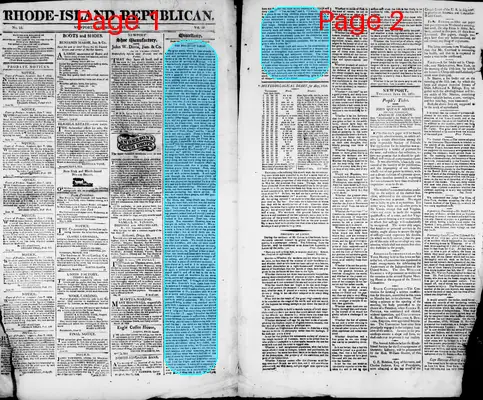
The Rhode Island Republican
Newport, Newport County, Rhode Island
What is this article about?
The narrator recounts his great uncle's aversion to May Day moving and his visit to a wealthy friend, Mrs. Courtly, where he laments how affluence has made her listless and spoiled her children, contrasting it with hardy pre-Revolutionary child-rearing that promoted temperance and activity.
Merged-components note: Merged across pages as the text in the second component directly continues the narrative essay from the first, forming a single literary piece titled 'The Breakfast Table'.
Clippings

1 of 2
OCR Quality
Full Text
THE BREAKFAST TABLE
My great uncle, whom I have already remarked, is an acute observer of men and manners, and possessed of the most retentive memory in the world, has a great aversion to the practice of moving on May day. "It is a marvellously stupid custom, Hans," said he to me, "and I can only account for it from the great cleanliness of our Amsterdam ancestors, who moved in one day, in order to have a general turn out of scrubbers and white-washers, and so get over it."— As they were pulling down an old Dutch built house with yellow brick and conical front, next door to my uncle's, and these mementos of former days and Dutch styles recede as the age of improvement advances he determined to escape from the whirlwind of dust and the fragments of brick and mortar, by accepting an invitation from a friend, to spend a few days; one who, from a neat two story house in the first ward, had been translated to a splendid mansion in the upper and court end of the city, and who, in addition to being blessed with an amiable, fashionable wife, and seven small children, possessed ample means to make them happy. An absence of three days, and my great uncle found himself once more in his elbow chair, with velvet cap on his head, and yellow slippers on— Mammy seated opposite him a basket of stockings before her.— "Well, Hans," said he, "here I am in my old quarters. Home is home, as the proverb says; and though I have been most kindly treated by my old friend Mrs. Courtly yet, I sighed for my elbow chair; and her snuff box, her monosyllables, and looks of affection" "Well sir," said I "did you find things altered at Mrs. Courtly's?" "Prodigiously so," said he, "when she lived in our neighborhood, she was an active, spirited bustling little body— would put her hand to everything, see that everything was properly done— superintend her domestic affairs in person— and was a plump, rosy cheeked— pretty little creature. Now, alas how altered! I found her lolling on a sofa covered with crimson damask. A soft light stole through the silken drapery which in ample folds shaded the windows.— Her little child was playing on the splendid Turkey carpet; and my former gay friend appeared pale, listless, and uninteresting. She minced some words, and there seemed to be a languishing lassitude pervading her whole person. O dear, how wealth alters people, and how bephemistake its usages.
But Hans, one thing struck me forcibly during my short visit, and that was the visible alteration in the manners and conduct of the boys. They rushed to the breakfast table helped themselves first and to everything they pleased, talked loud and saucily; and sat a half hour to a meal, which in old times was finished in five minutes. Dear me, what changes. You remember, Mammy, how we boys got on before the revolution? We always woke at day break, and to be sure, we would wrestle a little in bed, and throw the pillows at each other; but at early dawn out we would sally, down on shore picking up shells or a long walk to the Meadows, near where the city Hall now stands. We would be back in time for breakfast, and take our seats round the white oaken table, and with our tin cups, with milk and water and two large slices of bread and butter, we finished a hearty meal. Then our hands and faces were washed and rubbed dry with a coarse towel in despite of our yelling, and off to school we went. At 12 we had a piece of bread and molasses, plain dinner at 1, and at 2 in school again. We played until dark, got our milk and water again, a universal substitute for tea— played until 8, and off to bed in the dark. We could stand all weathers, for we were hardy, active and temperate— we could skate, swim, and snow ball. I thought of old times when Mrs. Courtly's boys came from their chambers at 8 dressed like dandies— with ruffled shirts and white handkerchiefs, and seated themselves at the breakfast table with an air of lordly and effeminate authority, I particularly remarked the treatment of infants, and with painful sensations. Mrs Courtly's youngest baby, a sweet rosy cheeked intelligent little creature of 18 months was placed in her high chair at the table— she cried for everything and had everything she cried for— coffee, hot tea, eggs, fish— after the infant was crammed almost to suffocation, a dispute arose between the husband and wife, whether the baby should have a radish— the wife carried the day: the child ate the radish, when also in a few minutes it turned up its little eyes and fell down in a fit In a moment an indescribable scene of confusion ensued; the mother shrieked in agony, the servants ran about distracted, the neighbors ran in; hot baths were ordered; the dear baby, stiff, insensible, and almost dying, was chafed, rubbed and put into the bath; two Doctors chaise were soon at the door; emetics, oil, tincture, communications and other remedies, were applied, and the infant was snatched out of the jaws of death by these timely applications. After my poor friend had somewhat recovered from her fright, and had her temples bathed in camphor, I ventured to expostulate with her on her treatment of children. "My dear sir," said she, in a subdued and melancholy tone," What can I do? Would you
Have me to suffer the child to cry constantly or hug and deny them? "Yes, ma'am," said I, "I would. In the first place do not bring children where these things are to be seen, and rather let them cry than cram them with deleterious substances; crying is good for children—their squalling is not very pleasant to be sure, but it strengthens their lungs. Imagine my dear madam, the effects of your discipline, here is an infant with its organs of digestion necessarily weak and tender, crammed with solids and cold and clammy food, to a degree that the tender blood vessels in the stomach are pressed upon, and the circulation stopped—convulsions and death are the results.
Give a child nourishing food in reasonable quantities, but by no means give it what it cries for."
There was much truth and reason in the observations of my great uncle: Children are not treated in a manner calculated to strengthen their constitutions, and make them hardy, enterprising and temperate citizens. The infant, when it begins to walk, crawls up the knee of its father, and dashes instinctively the hand into his pocket to get a penny, and off it toddles to the confectioners to buy a mint stick or some sweet substance to clog and cloy its little stomach. And this is repeated several times in a day, and grows with their growth, until by this neglect their teeth become early decayed and destroyed, and the tone of their stomach weakened. When a child cries for something, give it the best of things—a crust of dry bread.
What sub-type of article is it?
What themes does it cover?
What keywords are associated?
Literary Details
Title
The Breakfast Table
Subject
Observations On Social Changes Due To Wealth And Child Rearing Practices
Form / Style
Anecdotal Prose Reflection
Key Lines