Thank you for visiting SNEWPapers!
Sign up free
The Indianapolis Journal
Indianapolis, Marion County, Indiana
What is this article about?
In 1884, Pittsburgh's police chief ordered the Austrian-Hungarian consul to remove his country's flag, citing local ordinances; the consul refused, invoking treaty rights. The matter reached U.S. State Department, leading to investigation and assurances of respect for consular privileges. (214 chars)
Clipping
OCR Quality
Full Text
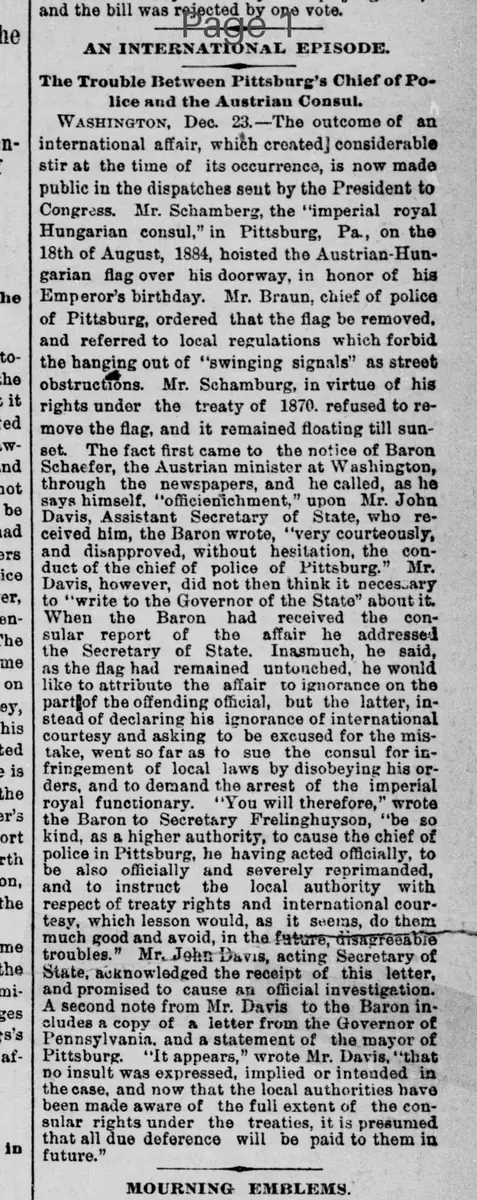
The Trouble Between Pittsburg's Chief of Police and the Austrian Consul.
Washington, Dec. 23.—The outcome of an international affair, which created considerable stir at the time of its occurrence, is now made public in the dispatches sent by the President to Congress. Mr. Schamberg, the "imperial royal Hungarian consul," in Pittsburg, Pa., on the 18th of August, 1884, hoisted the Austrian-Hungarian flag over his doorway, in honor of his Emperor's birthday. Mr. Braun, chief of police of Pittsburg, ordered that the flag be removed, and referred to local regulations which forbid the hanging out of "swinging signals" as street obstructions. Mr. Schamberg, in virtue of his rights under the treaty of 1870, refused to remove the flag, and it remained floating till sunset. The fact first came to the notice of Baron Schaefer, the Austrian minister at Washington, through the newspapers, and he called, as he says himself, "offizienlich" upon Mr. John Davis, Assistant Secretary of State, who received him, the Baron wrote, "very courteously, and disapproved, without hesitation, the conduct of the chief of police of Pittsburg." Mr. Davis, however, did not then think it necessary to "write to the Governor of the State" about it.
When the Baron had received the consular report of the affair he addressed the Secretary of State. Inasmuch, he said, as the flag had remained untouched, he would like to attribute the affair to ignorance on the part of the offending official, but the latter, instead of declaring his ignorance of international courtesy and asking to be excused for the mistake, went so far as to sue the consul for infringement of local laws by disobeying his orders, and to demand the arrest of the imperial royal functionary. "You will therefore," wrote the Baron to Secretary Frelinghuysen, "be so kind, as a higher authority, to cause the chief of police in Pittsburg, he having acted officially, to be also officially and severely reprimanded, and to instruct the local authority with respect of treaty rights and international courtesy, which lesson would, as it seems, do them much good and avoid, in the future, disagreeable troubles." Mr. John Davis, acting Secretary of State, acknowledged the receipt of this letter, and promised to cause an official investigation.
A second note from Mr. Davis to the Baron includes a copy of a letter from the Governor of Pennsylvania, and a statement of the mayor of Pittsburg. "It appears," wrote Mr. Davis, "that no insult was expressed, implied or intended in the case, and now that the local authorities have been made aware of the full extent of the consular rights under the treaties, it is presumed that all due deference will be paid to them in future."
What sub-type of article is it?
What themes does it cover?
What keywords are associated?
What entities or persons were involved?
Where did it happen?
Story Details
Key Persons
Location
Pittsburgh, Pa.; Washington
Event Date
August 18, 1884
Story Details
Austrian-Hungarian consul in Pittsburgh hoists flag for emperor's birthday; police chief orders removal citing local laws; consul refuses based on treaty rights; incident escalates to diplomatic protest and investigation, resolved with assurances of future deference to consular rights.