Thank you for visiting SNEWPapers!
Sign up free
The Hillsborough Recorder
Hillsboro, Orange County, North Carolina
What is this article about?
Opening proceedings of the 1821 North Carolina General Assembly in Raleigh: Senate elects Yancey as speaker and Clark as assistant clerk; House elects Mebane as speaker after contest; committees appointed; Governor Franklin addresses economy, judiciary, militia, improvements, boundaries, and declines re-election. (248 characters)
Merged-components note: This is a continuation of the Governor's message to the legislature across pages 2 and 3; the text flows directly from one to the other. Relabel the second component from 'letter_to_editor' to 'domestic_news' as it is part of the official proceedings report.
Clippings
1 of 2
OCR Quality
Full Text
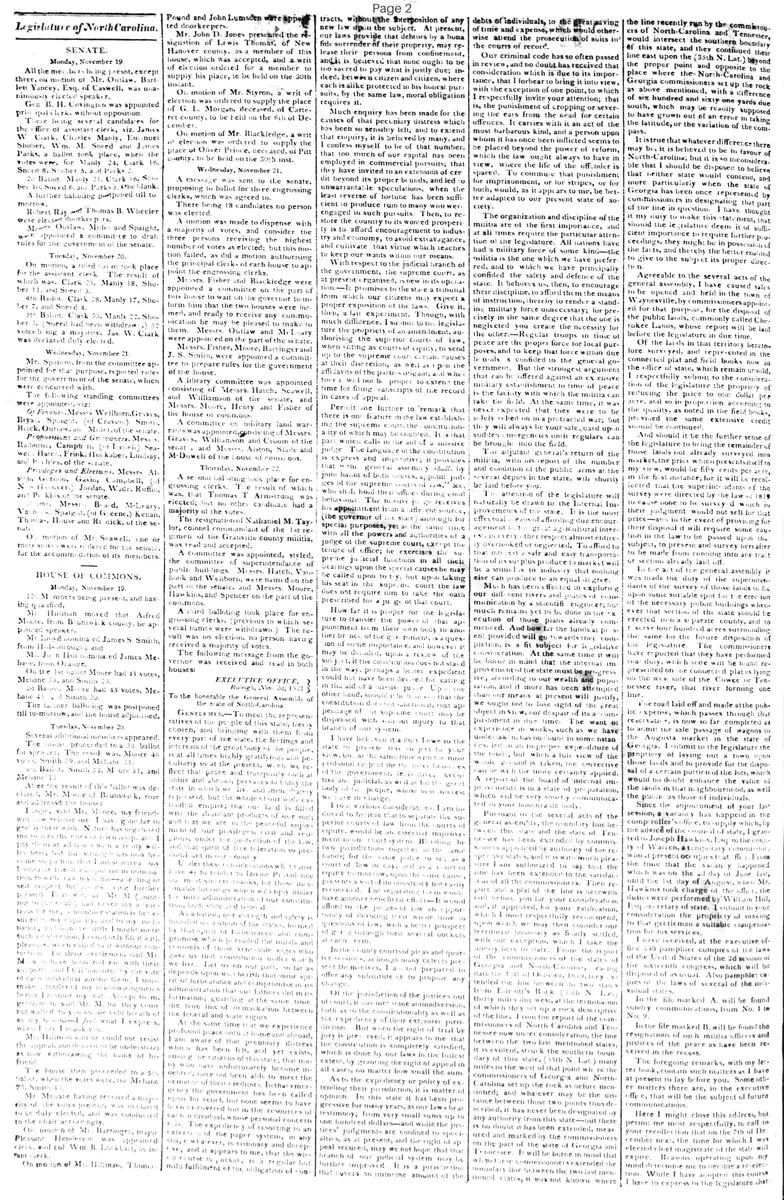
SENATE.
Monday, November 19.
All the members being present, except three, on motion of Mr. Outlaw, Bartlett Yancey, Esq. of Caswell, was unanimously elected speaker.
Gen. B. H. Covington was appointed principal clerk, without opposition.
There being several candidates for the office of assistant clerk, viz. James W. Clark, Charles Manly, Emanuel Shober, Wm. M. Sneed and James Parks, a ballot took place, when the votes were, for Manly 24, Clark 16, Sneed 8, Shober 5, and Parks 2.
2d Ballot. Manly 21, Clark 16, Shober 10, Sneed 6, and Parks 5, one blank.
A further balloting postponed till to-morrow.
Robert Ray and Thomas B. Wheeler were elected doorkeepers.
Messrs. Outlaw, Miles and Spaight, were appointed a committee to draft rules for the government of the senate.
Tuesday, November 20.
On motion, a third ballot took place for the assistant clerk. The result of which was, Clark 25, Manly 18, Shober 11, and Sneed 3.
4th Ballot. Clark 28, Manly 17, Shober 7, and Sneed 4.
5th Ballot. Clark 32, Manly 22, Shober 3, (Sneed had been withdrawn,) 32 votes being a majority. Jas. W. Clark was declared duly elected.
Wednesday, November 21.
Mr. Spaight, from the committee appointed for that purpose, reported rules for the government of the senate, which were concurred with.
The following standing committees were appointed, viz:
On Finance. Messrs. Wellborn, Graves, Bryan, Spaight, (of Craven,) Smith, Black, Outlaw, and Miller, of the senate.
Propositions and Grievances, Messrs. Raborne, Campbell, (of Iredell) Seawell, Hatch, Frink, Huckabee, Lindsay, and Pibles, of the senate.
Privileges and Elections. Messrs. Alston, Gordon, Gavin, Campbell, (of N. Hanover,) Jordan, Wade, Ruf fin, and Perkins of the senate.
Claims. Messrs. Bloodworth, McLeary, Vanhook, Spaight, (of Greene,) Kenan, Thomas, House and Riddick, of the senate.
On motion of Mr. Seawell, one or more stoves were ordered for the senate, for the accommodation of its members.
HOUSE OF COMMONS.
Monday, November 19.
120 Members being present, and having qualified,
Mr. Hillman moved that Alfred Moore, from Brunswick county, be appointed speaker.
Mr. Blood nominated James S. Smith, from Hillsborough; and
Mr. John Hill nominated James Mebane, from Orange.
On the 1st ballot Moore had 41 votes, Mebane 39, and Smith 23.
2d Ballot. Moore had 45 votes, Mebane 41, and Smith 30.
The further balloting was postponed till to-morrow, and the house adjourned.
Tuesday, November 20.
Several additional members appeared.
The house proceeded to a 3d ballot for speaker. The result was, Moore 48 votes, Smith 49, and Mebane 31.
4th Ballot. Smith 52, Moore 51, and Mebane 15.
After the result of this ballot was declared, Mr. Moore of Brunswick, rose and addressed the house:
"I hope, said Mr. Moore, my friends will release me. I have gone far to gratify their wish. Nature has organised me to feel the ties of friendship, and I pay them at all times when in my power; but this struggle has now become so great, that I must retire my pretensions, towards having my intentions of self respect for my friends and further pressed. That end all Mr. Moore (pointing to the chair) had never any attraction or me, some numbers' ambitious bese sue, my colleagues, and to many individuals have seen rule I might even it such good notion, I cordially fill it with pleasure, when called to it without contention. To those gentlemen said Mr. Moore, who have honoured me with their support and I honoured by the vote of each individual among them) I must make it tender of my acknowledgements before I resume my seat. Accept them, gentlemen, said Mr. Moore, for they come not wanted to you on, or (old breath of an Joy by snmn- I fe what I express, when I as Itank st."
Mr. Hillman said he could not resist the appeal, and desired to be understood as now withdrawing the name of his friend.
The house then proceeded to a 5th ballot, when the votes were, for Mebane 73, Smith 49.
Mr. Mebane having received a majority of the votes present, was declared to be duly elected, and was conducted to the chair accordingly.
On motion of Mr. Barringer, major Pleasant Henderson was appointed clerk, and col. Wm. B. Lockhart, as assistant clerk.
On motion of Mr. Hillman, Thomas Pound and John Lumsden were appointed doorkeepers.
Mr. John D. Jones presented the resignation of Lewis Thomas, of New Hanover county, as a member of this house, which was accepted, and a writ of election ordered for a member to supply his place, to be held on the 20th instant.
On motion of Mr. Styron, a writ of election was ordered to supply the place of G. I. Morgan, deceased, of Carteret county, to be held on the 6th of December.
On motion of Mr. Blackledge, a writ of election was ordered to supply the place of Oliver Prince, deceased, of Pitt county, to be held on the 20th inst.
Wednesday, November 21.
A message was sent to the senate, proposing to ballot for three engrossing clerks, which was agreed to.
There being 18 candidates no person was elected.
A motion was made to dispense with a majority of votes, and consider the three persons receiving the highest number of votes as elected: but this motion failed, as did a motion authorising the principal clerks of each house to appoint the engrossing clerks.
Messrs. Fisher and Blackledge were appointed a committee on the part of this house to wait on the governor to inform him that the two houses were formed, and ready to receive any communication he may be pleased to make to them. Messrs. Outlaw and McLeary were appointed on the part of the senate.
Messrs. Fisher, Moore, Barringer and J. S. Smith, were appointed a committee to prepare rules for the government of the house.
A library committee was appointed consisting of Messrs. Hatch, Seawell, and Williamson of the senate, and Messrs. Moore, Henry and Fisher of the house of commons.
A committee on military land warrants was appointed, consisting of Messrs. Graves, Williamson and Crook of the senate, and Messrs. Alston, Slade and McDowell of the house of commons.
Thursday, November 22.
A second balloting took place for engrossing clerks. The result of which was, that Thomas T. Armstrong was elected; but no other candidate had a majority of the votes.
The resignation of Nathaniel M. Taylor, colonel commandant of the 1st regiment of the Granville county militia, was read and accepted.
A committee was appointed, styled, the committee of superintendence of public buildings. Messrs. Hatch, Vanhook and Wellborn, were named on the part of the senate, and Messrs. Moore, Hawkins, and Spencer on the part of the commons.
A third balloting took place for engrossing clerks, (previous to which several names were withdrawn.) The result was no election, no person having received a majority of votes.
The following message from the governor was received and read in both houses:
EXECUTIVE OFFICE,
Raleigh, Nov. 20, 1821.
To the honorable the General Assembly of the State of North-Carolina.
Gentlemen,--To meet the representatives of the people of this state, freely chosen, and bringing with them from every part of the state, the feelings and interests of the great body of the people, is at all times highly gratifying--and peculiarly so at the present, when we reflect that peace and tranquility both at home and abroad, privileges not only the state in which we live and immediately represent, but the whole of our wide extended empire; that our land is filled with the abundant products of our soil and that we are in the peaceful enjoyment of our privileges, civil and religious, under the protection of the law, and that spirit of free toleration so prevalent in our country.
Under these considerations what cause we have to render to Divine Providence our most sincere thanks, for those many blessings which we enjoy under the mild administration of our constitutions, both state and federal.
As another source of strength and safety is derived on a union of the states, formed by that spirit of forbearance and compromise which pervaded the minds and counsels of those venerable sages who gave us that constitution under which we live. Let us on our part, so far as depends upon us, cherish that same spirit of forbearance and compromise in its administration that our fathers did in its formation; guarding at the same time the true line of demarkation between the federal and state rights.
At the same time that we experience profound peace both at home and abroad, I am aware of that pecuniary distress which has been felt, and yet exists, among the citizens of this state; that many who have unfortunately become indebted, have not been able to meet the demands of their creditors. In that emergency the government has been called upon for relief, but none seems to have been discovered but in the resources of each individual, whose personal concern it is. The expediency of resorting to an extension of the paper system, in any shape whatever, is visionary and deceptive; and it appears to me, that the wisest course to pursue, is a regular but mild fulfilment of the obligations of contracts, without the interposition of any new law upon the subject. At present, our laws provide that debtors by a bona fide surrender of their property, may release their persons from confinement, and it is believed that none ought to be too sacred to pay what is justly due; indeed, between citizen and citizen, where each is alike protected in his honest pursuits, by the same law, moral obligation requires it.
Much enquiry has been made for the causes of that pecuniary distress which has been so sensibly felt; and to extend that enquiry, it is believed by many, and I confess myself to be of that number, that too much of our capital has been employed in commercial pursuits; that they have invited to an extension of credit beyond its proper bounds, and led to unwarrantable speculations, when the least reverse of fortune has been sufficient to produce ruin to many who were engaged in such pursuits. Then, to restore the country to its wonted prosperity is to afford encouragement to industry and economy, to avoid extravagance, and cultivate that virtue which teaches to keep our wants within our means.
With respect to the judicial branch of the government, the supreme court, as at present organised, is new in its operation.--It promises to the state a tribunal from which our citizens may expect a proper exposition of the laws. Give it, then, a fair experiment. Though, with much diffidence, I submit to the legislature the propriety of an amendment, authorising the superior courts of law, when sitting as courts of equity, to send up to the supreme court certain causes at their discretion, as well as upon the affidavits of the parties litigant; and whether it will not be proper to extend the time for filing transcripts of the record in cases of appeal.
Permit me further to remark that there is one feature in the law establishing the supreme court, the constitutionality of which may be doubted. It is that part which calls in the aid of a missive judge. The language of the constitution is express and injunctive; it provides that … the general assembly shall, by joint ballot of both houses, appoint judges of the supreme courts of law, &c. who shall hold their office during good behaviour. The missive judge receives his appointment from a different source, (the governor of the state) although for special purposes, yet at the same time with all the powers and authorities of a judge of the supreme court, except the tenure of office; he exercises the supreme judicial functions in all their bearings upon the special causes he may be called upon to try: but upon taking his seat in the supreme court the law does not require him to take the oath prescribed for a judge of that court.
How far it is proper for the legislature to transfer the power of that appointment from their own body to another branch of the government, is a question of some importance, and however it may be decided, upon a review of the subject, if the constitution does not stand in the way, perhaps a better expedient could not have been devised for calling in the aid of a missive judge. On the other hand, should it be, that the constitution does not sanction it, that appointment of the supreme court may be dispensed with without injury to that branch of our system.
I have believed it a duty I owe to the state to present this subject to your view, by, at the same time with the most profound respect for the three branches of the government, legislative, executive and judicial, as well as for the great body of the people, whose best interest we have in charge.
From various considerations, I am induced to believe that to separate the superior courts of law from the courts of equity, would be an essential improvement in our court system. Blending the two jurisdictions together in the same hands; for the same judge to sit, as a court of law to-day, and as a court of equity to-morrow, upon the same cause presents a sort of inconsistency not easily reconciled. The separating them you will have another beneficial effect--It would afford to the judges of law an opportunity of devoting their whole time to questions of law, with a better prospect of getting through their several dockets at each term.
In the county courts of pleas and quarter sessions, although many defects present themselves, I am not prepared to offer any substitute or to propose any change.
Of the jurisdiction of the justices out of court, it may meet some animadversion, both as to the constitutionality as well as the expediency of their extensive jurisdiction. But when the right of trial by jury is preserved, it appears to me that the constitution is completely satisfied, which is done by our laws in the fullest extent, by granting the right of appeal in all cases, no matter how small the sum.
As to the expediency or policy of extending their jurisdiction, it is matter of opinion. In this state it has been progressive for many years, as our laws bear testimony; from very small sums up to one hundred dollars--and while the justices' judgments are confined to specialties, as at present, and the right of appeal secured, may we not hope that that branch of our judicial system may be further improved. It is a jurisdiction that covers an immense amount of the debts of individuals, to the great saving of time and expense, which would otherwise attend the prosecution of suits in the courts of record.
Our criminal code has so often passed in review, and no doubt has received that consideration which is due to its importance, that I forbear to bring it into view, with the exception of one point, to which I respectfully invite your attention; that is, the punishment of cropping or severing the ears from the head for certain offences. It carries with it an act of the most barbarous kind, and a person upon whom it has once been inflicted seems to be placed beyond the power of reform, which the law ought always to have in view, where the life of the offender is spared. To commute that punishment for imprisonment, or for stripes, or for both, would, as it appears to me, be better adapted to our present state of society.
The organization and discipline of the militia are of the first importance, and at all times require the particular attention of the legislature. All nations have had a military force of some kind--the militia is the one which we have preferred, and to which we have principally confided the safety and defence of the state. It behoves us, then, to encourage their discipline, to afford them the means of instruction, thereby to render a standing military force unnecessary; for precisely in the same degree that the one is neglected you create the necessity for the other.--Regular troops in time of peace are the proper force for local purposes, and to keep that force within due bounds is confided to the general government. But the strongest argument that can be offered against an extensive military establishment in time of peace is the facility with which the militia can take the field. At the same time, it was never expected that they were to be solely relied on in a protracted war; but they will always be your safeguard upon sudden emergencies until regulars can be brought into the field.
The adjutant general's return of the militia, with his report of the number and condition of the public arms at the several depots in the state, will shortly be laid before you.
In attention of the legislature will naturally be drawn to the Internal Improvements of the state. It is the most effectual means of affording due encouragement to the great agricultural interests, in every other respect almost entirely overlooked or neglected. To afford to that interest a safe and easy transportation of its surplus produce to market will be a stimulus to industry that nothing else can produce to an equal degree.
Much has been effected in exploring our different rivers and routes of communication by a scientific engineer; but much remains yet to be done in the execution of those plans already commenced. And how far the funds at present provided will go towards their completion, is a fit subject for legislative consideration. At the same time it will be borne in mind that the internal improvement of the state must be progressive, according to our wealth and population, and if more has been attempted than our means at present will justify, we ought not to lose sight of the great object in view, nor despair of its accomplishment in due time. The want of experience in works, such as we have undertaken, has no doubt in some instances led to an improper expenditure of the fund: but when a full view of the whole ground is taken, the corrective can be with the more certainty applied.
A report of the board of internal improvements is in a state of preparation, which will be very shortly communicated to your honourable bodies.
Pursuant to the several acts of the general assembly, the boundary line between this state and the state of Tennessee has been extended by commissioners appointed by authority of the respective states, and it is with much pleasure I am authorized to say that the line has been extended to the satisfaction of all the commissioners. Their report and a plat of the line is herewith laid before you for your consideration, and, if approved, for your ratification, which I most respectfully recommend, upon which we may then consider our territorial boundary as finally settled, with one exception, which I take the liberty here to state. From the report of the commissioners of the states of Georgia and North Carolina, bearing date the 1st of October, 1821, they extended the line between the two states from Ellicott's Rock (both N. Lat.) thirty miles due west, at the termination of which they set up a rock descriptive of the line. From the report of the commissioners of North Carolina and Tennessee now under consideration, the line between the two last mentioned states, it is evident, struck the southern boundary of this state, (35th N. Lat.) many miles to the west of that point where the commissioners of Georgia and North Carolina set up the rock as before mentioned; and whatever may be the distance between those two points thus described, it has never been designated by any authority from this state--but there is no doubt it has been extended, measured and marked by the commissioners on the part of the state of Georgia and Tennessee. It will be borne in mind that when these commissioners extended the boundary line between the two last mentioned states, it was not known where the line recently run by the commissioners of North-Carolina and Tennessee, would intersect the southern boundary of this state, and they continued their line east upon the (35th N. Lat.) beyond the proper point and opposite to the place where the North-Carolina and Georgia commissioners set up the rock as above mentioned, with a difference of six hundred and sixty one yards due south, which may be readily supposed to have grown out of an error in taking the latitude, or the variation of the compass.
It is true that whatever difference there may be, it is believed to be in favour of North-Carolina; but it is so inconsiderable that I should be disposed to believe that neither state would contend, and more particularly when the state of Georgia has been once represented by commissioners in designating that part of the line in question. I have thought it my duty to make this statement, that should the legislature deem it of sufficient importance to require further proceedings, they might be in possession of the facts, and thereby the better enabled to give to the subject its proper direction.
Agreeable to the several acts of the general assembly, I have caused sales to be opened and held in the town of Waynesville, by commissioners appointed for that purpose, for the disposal of the public lands, commonly called Cherokee Lands, whose report will be laid before the legislature in due time.
Of the lands in that territory heretofore surveyed, and represented in the connected plat and field books now in the office of state, which remain unsold, I respectfully submit to the consideration of the legislature the propriety of reducing the price to one dollar per acre, and so in proportion according to the quantity, as noted in the field books, provided the same extensive credit should be continued.
And should it be the further sense of the legislature to bring the remainder of those lands not already surveyed into market, the price which presents itself to my view, would be fifty cents per acre, in the first instance; for it will be recollected that the superintendents of the survey were directed by the law of 1819 to cause none to be surveyed which in their judgment would not sell for that price--and in the event of providing for their disposal it will require some caution in the law to be passed upon that subject, to prevent any survey hereafter to be made from running into any tract or section already laid off.
In the act of the general assembly it was made the duty of the superintendents of the survey of those lands to fix upon some suitable spot for the erection of the necessary public buildings whenever that section of the state should be erected into a separate county, and to reserve four hundred acres surrounding the same for the future disposition of the legislature. The commissioners have reported that they have performed that duty, which site will be found represented on the connected plats lying on the west side of the Cowee or Tennessee river, that river forming one line.
The road laid off and made at the public expense, which passes through that reservation, is now so far completed as to admit the safe passage of wagons to the Augusta market in the state of Georgia. I submit to the legislature the propriety of laying out a town upon those lands and to provide for the disposal of a certain portion of the lots, which would no doubt enhance the value of the lands in that neighbourhood, as well the public as those of individuals.
Since the adjournment of your last session, a vacancy has happened in the comptroller's office, to supply which, by the advice of the council of state, I granted to Joseph Hawkins, Esq. of the county of Warren, a temporary commission, which he at present occupies. From the time that the vacancy happened which was on the 2d day of June last, until the 1st day of August, when Mr. Hawkins took charge of the office, the duties were performed by William Hill, Esq. secretary of state. I submit to your consideration the propriety of making to that gentleman a suitable compensation for his services.
I have received, at the executive office, two hundred pamphlet copies of the laws of the United States of the 2d session of the sixteenth congress, which will be disposed of as usual. Also pamphlet copies of the laws of several of the individual states.
In the file marked A. will be found sundry communications, from No. 1 to No. 9.
In the file marked B. will be found the resignations of such militia officers and justices of the peace as have been received in the recess.
The foregoing remarks, with my letter book, contain such matters as I have at present to lay before you. Some other matters there are, in the executive office, that will be the subject of future communications.
Here I might close this address, but permit me most respectfully, to call to your recollection that on the 7th of December next, the time for which I was elected chief magistrate of the state will expire. Reasons operating upon my mind determine me to decline a re-election. While I have adopted this course I have to express to the legislature that
I have the honour to be, gentlemen,
with the highest consideration and respect, your most obedient servant,
J. FRANKLIN.
What sub-type of article is it?
What keywords are associated?
What entities or persons were involved?
Where did it happen?
Domestic News Details
Primary Location
Raleigh, North Carolina
Event Date
November 19 22, 1821
Key Persons
Outcome
officers elected for senate and house including speakers, clerks, and doorkeepers; standing committees appointed; rules adopted; writs of election ordered for vacancies; governor's message delivered addressing economy, judiciary, militia, internal improvements, and boundaries.
Event Details
The North Carolina Senate and House of Commons convened in late November 1821. In the Senate, Bartlett Yancey was elected speaker, B. H. Covington principal clerk, and James W. Clark assistant clerk after multiple ballots. Doorkeepers and a rules committee were appointed, followed by standing committees on finance, propositions, privileges, and claims. Stoves were ordered for the chamber. In the House, James Mebane was elected speaker after ballots involving Alfred Moore and James S. Smith, with Moore withdrawing. Clerks and doorkeepers were appointed, resignations accepted, and writs ordered for vacancies. Committees were formed for rules, library, military warrants, and public buildings. Engrossing clerks were balloted for without full election. A joint committee informed the governor of readiness. Governor J. Franklin's message discussed peace, economy, judicial reforms, militia, internal improvements, boundaries with Tennessee and Georgia, Cherokee lands sales, and his intent not to seek re-election.