Thank you for visiting SNEWPapers!
Sign up free
Literary
October 10, 1771
The Virginia Gazette
Richmond, Williamsburg, Richmond County, Virginia
What is this article about?
Narrative of 150 loyal Scottish officers who followed exiled King James II to France, formed a sentinel company, served valiantly in wars despite hardships, were cheated and disbanded without provision, with only four surviving to return home.
Clipping
OCR Quality
95%
Excellent
Full Text
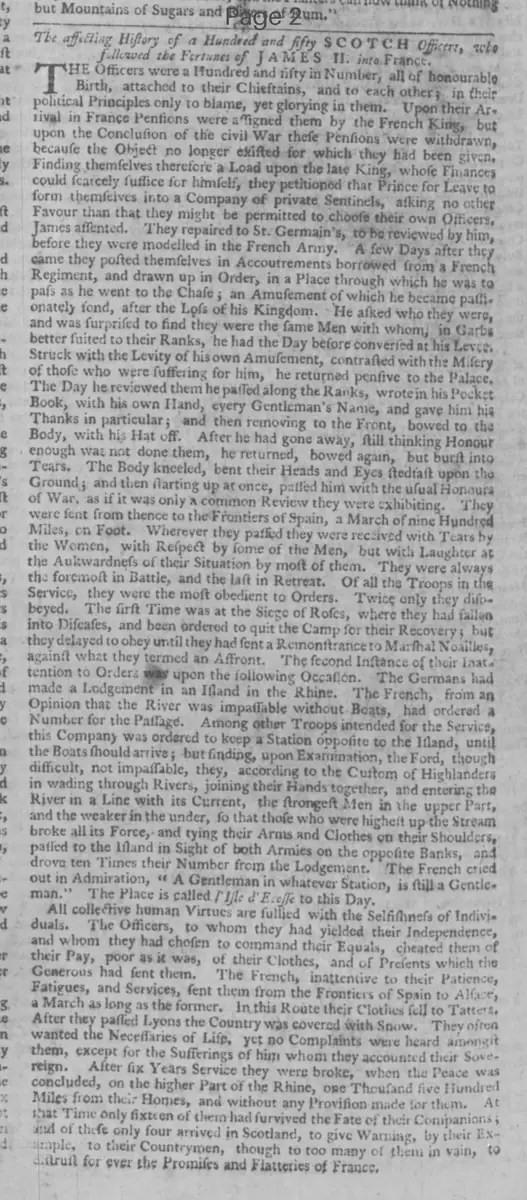
The affecting History of a Hundred and fifty SCOTCH Officers, who followed the Fortunes of JAMES II. into France.
The Officers were a Hundred and fifty in Number, all of honourable Birth, attached to their Chieftains, and to each other; in their political Principles only to blame, yet glorying in them. Upon their Arrival in France Pensions were assigned them by the French King, but upon the Conclusion of the civil War these Pensions were withdrawn, because the Object no longer existed for which they had been given. Finding themselves therefore a Load upon the late King, whose Finances could scarcely suffice for himself, they petitioned that Prince for Leave to form themselves into a Company of private Sentinels, asking no other Favour than that they might be permitted to choose their own Officers. James assented. They repaired to St. Germain's, to be reviewed by him, before they were modelled in the French Army. A few Days after they came they posted themselves in Accoutrements borrowed from a French Regiment, and drawn up in Order, in a Place through which he was to pass as he went to the Chace; an Amusement of which he became passionately fond, after the Loss of his Kingdom. He asked who they were, and was surprised to find they were the same Men with whom, in Garb better suited to their Ranks, he had the Day before conversed at his Levee. Struck with the Levity of his own Amusement, contrasted with the Misery of those who were suffering for him, he returned pensive to the Palace. The Day he reviewed them he passed along the Ranks, wrote in his Pocket Book, with his own Hand, every Gentleman's Name, and gave him his Thanks in particular; and then removing to the Front, bowed to the Body, with his Hat off. After he had gone away, still thinking Honour enough was not done them, he returned, bowed again, but burst into Tears. The Body kneeled, bent their Heads and Eyes steadfast upon the Ground; and then starting up at once, passed him with the usual Honours of War, as if it was only a common Review they were exhibiting. They were sent from thence to the Frontiers of Spain, a March of nine Hundred Miles, on Foot. Wherever they passed they were received with Tears by the Women, with Respect by some of the Men, but with Laughter at the Awkwardness of their Situation by most of them. They were always the foremost in Battle, and the last in Retreat. Of all the Troops in the Service, they were the most obedient to Orders. Twice only they disobeyed. The first Time was at the Siege of Roses, where they had fallen into Diseases, and been ordered to quit the Camp for their Recovery; but they delayed to obey until they had sent a Remonstrance to Marshal Noailles, against what they termed an Affront. The second Instance of their last Attention to Orders was upon the following Occasion. The Germans had made a Lodgement in an Island in the Rhine. The French, from an Opinion that the River was impassable without Boats, had ordered a Number for the Passage. Among other Troops intended for the Service, this Company was ordered to keep a Station opposite to the Island, until the Boats should arrive; but finding, upon Examination, the Ford, though difficult, not impassable, they, according to the Custom of Highlanders in wading through Rivers, joining their Hands together, and entering the River in a Line with its Current, the strongest Men in the upper Part, and the weaker in the under, so that those who were highest up the Stream broke all its Force, and tying their Arms and Clothes on their Shoulders, passed to the Island in Sight of both Armies on the opposite Banks, and drove ten Times their Number from the Lodgement. The French cried out in Admiration, "A Gentleman in whatever Station, is still a Gentleman." The Place is called L'Isle d'Eose to this Day.
All collective human Virtues are sullied with the Selfishness of Individuals. The Officers, to whom they had yielded their Independence, and whom they had chosen to command their Equals, cheated them of their Pay, poor as it was, of their Clothes, and of Presents which the Generous had sent them. The French, inattentive to their Patience, Fatigues, and Services, sent them from the Frontiers of Spain to Alsace, a March as long as the former. In this Route their Clothes fell to Tatters. After they passed Lyons the Country was covered with Snow. They often wanted the Necessaries of Life, yet no Complaints were heard amongst them, except for the Sufferings of him whom they accounted their Sovereign. After six Years Service they were broke, when the Peace was concluded, on the higher Part of the Rhine, one Thousand five Hundred Miles from their Homes, and without any Provision made for them. At What Time only sixteen of them had survived the Fate of their Companions; and of these only four arrived in Scotland, to give Warning, by their Example, to their Countrymen, though to too many of them in vain, to distrust for ever the Promises and Flatteries of France.
The Officers were a Hundred and fifty in Number, all of honourable Birth, attached to their Chieftains, and to each other; in their political Principles only to blame, yet glorying in them. Upon their Arrival in France Pensions were assigned them by the French King, but upon the Conclusion of the civil War these Pensions were withdrawn, because the Object no longer existed for which they had been given. Finding themselves therefore a Load upon the late King, whose Finances could scarcely suffice for himself, they petitioned that Prince for Leave to form themselves into a Company of private Sentinels, asking no other Favour than that they might be permitted to choose their own Officers. James assented. They repaired to St. Germain's, to be reviewed by him, before they were modelled in the French Army. A few Days after they came they posted themselves in Accoutrements borrowed from a French Regiment, and drawn up in Order, in a Place through which he was to pass as he went to the Chace; an Amusement of which he became passionately fond, after the Loss of his Kingdom. He asked who they were, and was surprised to find they were the same Men with whom, in Garb better suited to their Ranks, he had the Day before conversed at his Levee. Struck with the Levity of his own Amusement, contrasted with the Misery of those who were suffering for him, he returned pensive to the Palace. The Day he reviewed them he passed along the Ranks, wrote in his Pocket Book, with his own Hand, every Gentleman's Name, and gave him his Thanks in particular; and then removing to the Front, bowed to the Body, with his Hat off. After he had gone away, still thinking Honour enough was not done them, he returned, bowed again, but burst into Tears. The Body kneeled, bent their Heads and Eyes steadfast upon the Ground; and then starting up at once, passed him with the usual Honours of War, as if it was only a common Review they were exhibiting. They were sent from thence to the Frontiers of Spain, a March of nine Hundred Miles, on Foot. Wherever they passed they were received with Tears by the Women, with Respect by some of the Men, but with Laughter at the Awkwardness of their Situation by most of them. They were always the foremost in Battle, and the last in Retreat. Of all the Troops in the Service, they were the most obedient to Orders. Twice only they disobeyed. The first Time was at the Siege of Roses, where they had fallen into Diseases, and been ordered to quit the Camp for their Recovery; but they delayed to obey until they had sent a Remonstrance to Marshal Noailles, against what they termed an Affront. The second Instance of their last Attention to Orders was upon the following Occasion. The Germans had made a Lodgement in an Island in the Rhine. The French, from an Opinion that the River was impassable without Boats, had ordered a Number for the Passage. Among other Troops intended for the Service, this Company was ordered to keep a Station opposite to the Island, until the Boats should arrive; but finding, upon Examination, the Ford, though difficult, not impassable, they, according to the Custom of Highlanders in wading through Rivers, joining their Hands together, and entering the River in a Line with its Current, the strongest Men in the upper Part, and the weaker in the under, so that those who were highest up the Stream broke all its Force, and tying their Arms and Clothes on their Shoulders, passed to the Island in Sight of both Armies on the opposite Banks, and drove ten Times their Number from the Lodgement. The French cried out in Admiration, "A Gentleman in whatever Station, is still a Gentleman." The Place is called L'Isle d'Eose to this Day.
All collective human Virtues are sullied with the Selfishness of Individuals. The Officers, to whom they had yielded their Independence, and whom they had chosen to command their Equals, cheated them of their Pay, poor as it was, of their Clothes, and of Presents which the Generous had sent them. The French, inattentive to their Patience, Fatigues, and Services, sent them from the Frontiers of Spain to Alsace, a March as long as the former. In this Route their Clothes fell to Tatters. After they passed Lyons the Country was covered with Snow. They often wanted the Necessaries of Life, yet no Complaints were heard amongst them, except for the Sufferings of him whom they accounted their Sovereign. After six Years Service they were broke, when the Peace was concluded, on the higher Part of the Rhine, one Thousand five Hundred Miles from their Homes, and without any Provision made for them. At What Time only sixteen of them had survived the Fate of their Companions; and of these only four arrived in Scotland, to give Warning, by their Example, to their Countrymen, though to too many of them in vain, to distrust for ever the Promises and Flatteries of France.
What sub-type of article is it?
Prose Fiction
Essay
What themes does it cover?
Political
War Peace
Moral Virtue
What keywords are associated?
Scotch Officers
James Ii
France
Loyalty
War Service
Hardships
Exile
Literary Details
Title
The Affecting History Of A Hundred And Fifty Scotch Officers, Who Followed The Fortunes Of James Ii. Into France.
Key Lines
A Gentleman In Whatever Station, Is Still A Gentleman.
All Collective Human Virtues Are Sullied With The Selfishness Of Individuals.
To Distrust For Ever The Promises And Flatteries Of France.