Thank you for visiting SNEWPapers!
Sign up free
The Enquirer
Richmond, Henrico County, Virginia
What is this article about?
Report on American seamen detained as prisoners in France, based on New York paper citing Consul Barnard. Contrasts with widespread impressment of Americans into British navy, criticizing U.S. press silence. Lists detention sites totaling 55, explains two classes of prisoners: those in illicit trade and those on captured British vessels. Calls for resolution on impressment issue.
Merged-components note: The table lists the locations and numbers of American prisoners, integral to the preceding article on American prisoners in France.
Clipping
OCR Quality
Full Text
AMERICAN
PRISONERS
IN FRANCE.
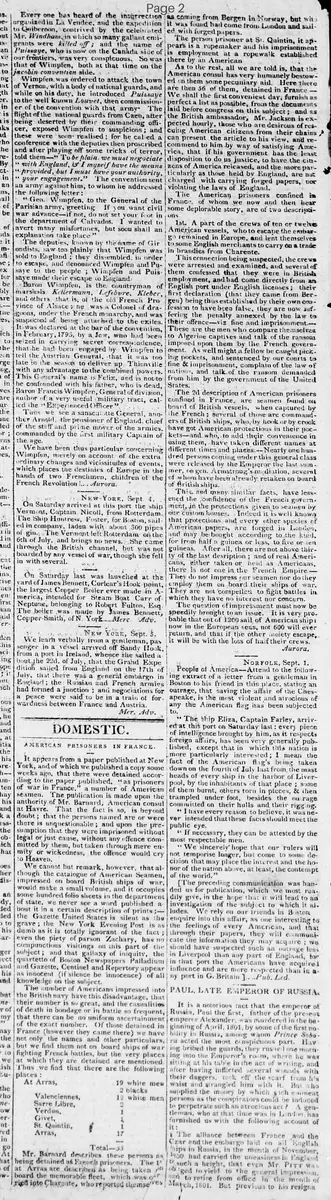
It appears from a paper published at New York, and of which we published a copy some weeks ago, that there were detained according to the paper published, "as prisoners of war in France." a number of American seamen. The publication is made upon the authority of Mr. Barnard, American consul at Havre. That the fact is so, is beyond doubt; that the persons named are or were there is unquestionable; and upon the presumption that they were imprisoned without legal or just cause, without any offence committed by them, but taken through mere enmity or wickedness, the offence would cry to Heaven.
We cannot but remark, however, that although the catalogue of American Seamen, impressed on board British ships of war, would make a small volume, and it occupies some hundred folio sheets in the department of state, we never see a word published about it in a certain description of prints; the Gazette United States is silent as the grave; the New York Evening Post is as dumb as it is totally ignorant of the fact; even the piety of parson Zachary, has no compunctious visitings on this part of the subject; and that galaxy of iniquity, the quartetto of Boston Newspapers Palladium and Gazette, Centinel and Repertory appear as innocent (if silence be innocence) of all knowledge on the subject.
The number of Americans impressed into the British navy have this disadvantage, that their number is so great, and the casualties of death in bondage or in battle so frequent, that there can be no uniform ascertainment of the exact number. Of those detained in France (however they came there) we have not only the names and other particulars, but we find them not on board ships of war fighting French battles, but the very places at which they are detained are mentioned.
Thus we find that there are the following places:
Total—55
Mr. Barnard describes these persons as being detained as French prisoners. The V at Arras are described as being taken on board the memorable fleet, which was carried into Charente, who reported themselves as coming from Bergen in Norway, but which it was found had come from London and sailed with forged papers.
The person prisoner at St. Quintin, it appears is a ropemaker and his imprisonment is employment at a ropewalk established there by an American
As to the rest, all we are told is, that the American consul has very humanely bestowed on them some pecuniary aid. Here there are then 56 of them, detained in France—We shall the first convenient day, furnish as perfect a list as possible, from the documents laid before congress on this subject; and as the British ambassador, Mr. Jackson is expected hourly, those who are desirous of rescuing American citizens from their chains can present the article to his view, and recommend to him by way of satisfying America, that if his government has the least disposition to do us justice, to have the citizens of America released, and the more particularly as those held by England, are not charged with carrying forged papers, nor violating the laws of England.
The American prisoners confined in France, of whom we now and then hear some deplorable story, are of two descriptions
1st. A part of the crews of ten or twelve American vessels, who to escape the embargo remained in Europe, and lent themselves to some English merchants to carry on a trade in brandies from Charente.
This connection being suspected, the crews were arrested and examined, and several of them confessed that they were in British employment, and had come directly from an English port under English licenses; their first declaration (that they came from Bergen) being thus established by their own confession to have been false, they are now suffering the penalty annexed by the law to their offence—viz fine and imprisonment.
These are the men who compare themselves to Algerine Captives and talk of the ransom imposed upon them by the French government. As well might a fellow be caught picking pockets, and sentenced by our courts to fine & imprisonment, complain of the law of nations, and talk of the ransom demanded from him by the government of the United States.
The 2d description of American prisoners confined in France, are seamen found on board of British vessels, when captured by the French; several of those are commanders of British ships, who, by hook or by crook have got American protections in their pockets—and who, to add their convenience in using them, have taken different names at different times and places.—Nearly one hundred persons coming under this general class were released by the Emperor the last summer, on gen. Armstrong's mediation, several of whom have been already retaken on board of British ships.
This, and many similar facts, have lessened the confidence of the French government, in the protections given to seamen by our custom houses. Indeed it is well known that protections and every other species of American papers, are forged in London, and may be bought according to the kind, for from half a guinea or less, to five or ten guineas. After all, there are not above thirty of the last description; and of real Americans, either taken or held as Americans, there is not one in the French Empire—They do not impress our seamen nor do they employ them on board their ships of war. They are not compelled to fight battles in which they have no interest nor concern.
The question of impressment must now be speedily brought to an issue. It is very probable that out of 1200 sail of American ships now in the European seas, not 600 will ever return, and that if the other moiety escape, it will be with the loss of half their crews.
Aurora.
| At Arras, | 19 white men |
| Valenciennes, | 2 blacks |
| Sarre Libre, | 12 white men |
| Verdun, | 2 |
| Givet, | 1 |
| St. Quintin, | 1 |
| Arras, | 17 |
What sub-type of article is it?
What keywords are associated?
What entities or persons were involved?
Where did it happen?
Domestic News Details
Primary Location
France
Key Persons
Outcome
55 american seamen detained in various french locations; some provided pecuniary aid by consul; nearly 100 previously released but some retaken; contrast with thousands impressed into british navy facing death in battle.
Event Details
Article reports on American seamen detained as prisoners in France per New York paper citing Consul Barnard at Havre. Details two classes: crews of American vessels involved in illicit brandy trade from Charente under false papers from Bergen, arrested and fined/imprisoned; and seamen found on captured British vessels, some with forged American protections. Lists detention sites including Arras (19+17 white men), Valenciennes (2 blacks), Sarre Libre (12 white men), Verdun (2), Givet (1), St. Quintin (1 ropemaker). Criticizes U.S. press silence on British impressment of Americans into navy. Urges British ambassador Jackson to seek release, notes French do not impress Americans unlike Britain. Predicts heavy losses for American shipping in Europe.