Thank you for visiting SNEWPapers!
Sign up free
Literary
September 8, 1853
The Religious Herald
Hartford, Hartford County, Connecticut
What is this article about?
Reflective prose on a Sunday scene in a rural New England church, highlighting the enduring moral influence of simple, austere worship on character and self-denial, contrasting it favorably with urban sophistication. Attributed to Mitchell.
Clipping
OCR Quality
98%
Excellent
Full Text
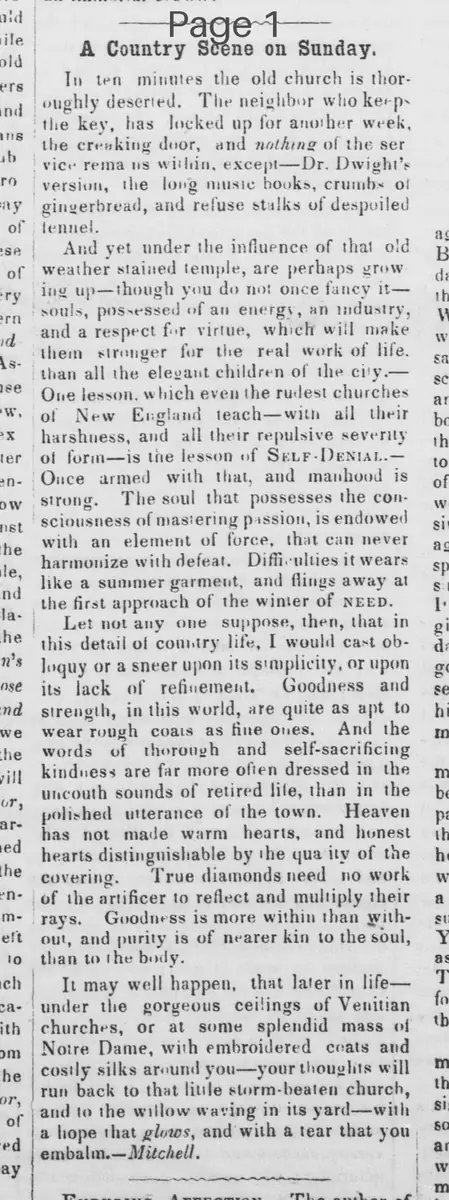
A Country Scene on Sunday.
In ten minutes the old church is thoroughly deserted. The neighbor who keeps the key, has locked up for another week, the creaking door, and nothing of the service remains within, except-Dr. Dwight's version, the long music books, crumbs of gingerbread, and refuse stalks of despoiled fennel.
And yet under the influence of that old weather stained temple, are perhaps growing up-though you do not once fancy it- souls, possessed of an energy, an industry, and a respect for virtue, which will make them stronger for the real work of life, than all the elegant children of the city.
One lesson, which even the rudest churches of New England teach-with all their harshness, and all their repulsive severity of form-is the lesson of Self-Denial. Once armed with that, and manhood is strong. The soul that possesses the consciousness of mastering passion, is endowed with an element of force, that can never harmonize with defeat. Difficulties it wears like a summer garment, and flings away at the first approach of the winter of need.
Let not any one suppose, then, that in this detail of country life, I would cast obloquy or a sneer upon its simplicity, or upon its lack of refinement. Goodness and strength, in this world, are quite as apt to wear rough coats as fine ones. And the words of thorough and self-sacrificing kindness are far more often dressed in the uncouth sounds of retired life, than in the polished utterance of the town. Heaven has not made warm hearts, and honest hearts distinguishable by the quality of the covering. True diamonds need no work of the artificer to reflect and multiply their rays. Goodness is more within than without, and purity is of nearer kin to the soul, than to the body.
It may well happen, that later in life- under the gorgeous ceilings of Venetian churches, or at some splendid mass of Notre Dame, with embroidered coats and costly silks around you-your thoughts will run back to that little storm-beaten church, and to the willow waving in its yard-with a hope that glows, and with a tear that you embalm.-Mitchell.
In ten minutes the old church is thoroughly deserted. The neighbor who keeps the key, has locked up for another week, the creaking door, and nothing of the service remains within, except-Dr. Dwight's version, the long music books, crumbs of gingerbread, and refuse stalks of despoiled fennel.
And yet under the influence of that old weather stained temple, are perhaps growing up-though you do not once fancy it- souls, possessed of an energy, an industry, and a respect for virtue, which will make them stronger for the real work of life, than all the elegant children of the city.
One lesson, which even the rudest churches of New England teach-with all their harshness, and all their repulsive severity of form-is the lesson of Self-Denial. Once armed with that, and manhood is strong. The soul that possesses the consciousness of mastering passion, is endowed with an element of force, that can never harmonize with defeat. Difficulties it wears like a summer garment, and flings away at the first approach of the winter of need.
Let not any one suppose, then, that in this detail of country life, I would cast obloquy or a sneer upon its simplicity, or upon its lack of refinement. Goodness and strength, in this world, are quite as apt to wear rough coats as fine ones. And the words of thorough and self-sacrificing kindness are far more often dressed in the uncouth sounds of retired life, than in the polished utterance of the town. Heaven has not made warm hearts, and honest hearts distinguishable by the quality of the covering. True diamonds need no work of the artificer to reflect and multiply their rays. Goodness is more within than without, and purity is of nearer kin to the soul, than to the body.
It may well happen, that later in life- under the gorgeous ceilings of Venetian churches, or at some splendid mass of Notre Dame, with embroidered coats and costly silks around you-your thoughts will run back to that little storm-beaten church, and to the willow waving in its yard-with a hope that glows, and with a tear that you embalm.-Mitchell.
What sub-type of article is it?
Essay
What themes does it cover?
Agriculture Rural
Moral Virtue
Religious
What keywords are associated?
Country Church
Self Denial
Rural Simplicity
Moral Strength
New England
Church Influence
What entities or persons were involved?
Mitchell
Literary Details
Title
A Country Scene On Sunday.
Author
Mitchell
Key Lines
One Lesson, Which Even The Rudest Churches Of New England Teach With All Their Harshness, And All Their Repulsive Severity Of Form Is The Lesson Of Self Denial.
Goodness And Strength, In This World, Are Quite As Apt To Wear Rough Coats As Fine Ones.
Goodness Is More Within Than Without, And Purity Is Of Nearer Kin To The Soul, Than To The Body.