Thank you for visiting SNEWPapers!
Sign up free
Story
October 27, 1887
The Saline County Journal
Salina, Saline County, Kansas
What is this article about?
Article profiles prominent women editors in American magazines, detailing their roles, achievements, and control over publications like St. Nicholas, Harper's Bazar, Godey's Lady's Book, and others, emphasizing their success and business acumen.
Clipping
OCR Quality
95%
Excellent
Full Text
WOMEN EDITORS.
Some Who Command High Salaries and Have Attained Distinction.
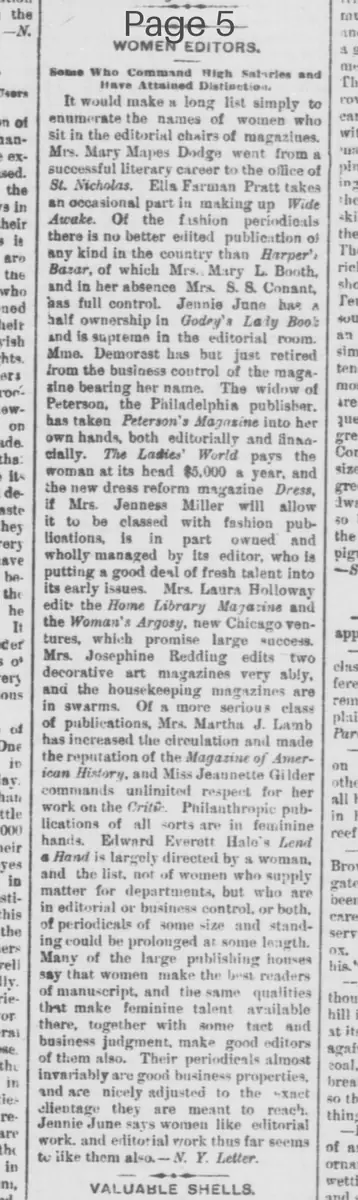
It would make a long list simply to enumerate the names of women who sit in the editorial chairs of magazines. Mrs. Mary Mapes Dodge went from a successful literary career to the office of St. Nicholas. Ella Farman Pratt takes an occasional part in making up Wide Awake. Of the fashion periodicals there is no better edited publication of any kind in the country than Harper's Bazar, of which Mrs. Mary L. Booth, and in her absence Mrs. S. S. Conant, has full control. Jennie June has a half ownership in Godey's Lady's Book and is supreme in the editorial room. Mme. Demorest has but just retired from the business control of the magazine bearing her name. The widow of Peterson, the Philadelphia publisher, has taken Peterson's Magazine into her own hands, both editorially and financially. The Ladies' World pays the woman at its head $5,000 a year, and the new dress reform magazine Dress, if Mrs. Jenness Miller will allow it to be classed with fashion publications, is in part owned and wholly managed by its editor, who is putting a good deal of fresh talent into its early issues. Mrs. Laura Holloway edits the Home Library Magazine and the Woman's Argosy, new Chicago ventures, which promise large success. Mrs. Josephine Redding edits two decorative art magazines very ably, and the housekeeping magazines are in swarms. Of a more serious class of publications, Mrs. Martha J. Lamb has increased the circulation and made the reputation of the Magazine of American History, and Miss Jeannette Gilder commands unlimited respect for her work on the Critic. Philanthropic publications of all sorts are in feminine hands. Edward Everett Hale's Lend a Hand is largely directed by a woman, and the list, not of women who supply matter for departments, but who are in editorial or business control, or both, of periodicals of some size and standing could be prolonged at some length.
Many of the large publishing houses say that women make the best readers of manuscript, and the same qualities that make feminine talent available there, together with some tact and business judgment, make good editors of them also. Their periodicals almost invariably are good business properties, and are nicely adjusted to the exact clientage they are meant to reach. Jennie June says women like editorial work, and editorial work thus far seems to like them also.—N. Y. Letter.
Some Who Command High Salaries and Have Attained Distinction.
It would make a long list simply to enumerate the names of women who sit in the editorial chairs of magazines. Mrs. Mary Mapes Dodge went from a successful literary career to the office of St. Nicholas. Ella Farman Pratt takes an occasional part in making up Wide Awake. Of the fashion periodicals there is no better edited publication of any kind in the country than Harper's Bazar, of which Mrs. Mary L. Booth, and in her absence Mrs. S. S. Conant, has full control. Jennie June has a half ownership in Godey's Lady's Book and is supreme in the editorial room. Mme. Demorest has but just retired from the business control of the magazine bearing her name. The widow of Peterson, the Philadelphia publisher, has taken Peterson's Magazine into her own hands, both editorially and financially. The Ladies' World pays the woman at its head $5,000 a year, and the new dress reform magazine Dress, if Mrs. Jenness Miller will allow it to be classed with fashion publications, is in part owned and wholly managed by its editor, who is putting a good deal of fresh talent into its early issues. Mrs. Laura Holloway edits the Home Library Magazine and the Woman's Argosy, new Chicago ventures, which promise large success. Mrs. Josephine Redding edits two decorative art magazines very ably, and the housekeeping magazines are in swarms. Of a more serious class of publications, Mrs. Martha J. Lamb has increased the circulation and made the reputation of the Magazine of American History, and Miss Jeannette Gilder commands unlimited respect for her work on the Critic. Philanthropic publications of all sorts are in feminine hands. Edward Everett Hale's Lend a Hand is largely directed by a woman, and the list, not of women who supply matter for departments, but who are in editorial or business control, or both, of periodicals of some size and standing could be prolonged at some length.
Many of the large publishing houses say that women make the best readers of manuscript, and the same qualities that make feminine talent available there, together with some tact and business judgment, make good editors of them also. Their periodicals almost invariably are good business properties, and are nicely adjusted to the exact clientage they are meant to reach. Jennie June says women like editorial work, and editorial work thus far seems to like them also.—N. Y. Letter.
What sub-type of article is it?
Biography
Historical Event
What themes does it cover?
Triumph
Social Manners
What keywords are associated?
Women Editors
Magazine Publishing
Female Achievements
Editorial Control
Fashion Periodicals
What entities or persons were involved?
Mrs. Mary Mapes Dodge
Ella Farman Pratt
Mrs. Mary L. Booth
Mrs. S. S. Conant
Jennie June
Mme. Demorest
Widow Of Peterson
Mrs. Jenness Miller
Mrs. Laura Holloway
Mrs. Josephine Redding
Mrs. Martha J. Lamb
Miss Jeannette Gilder
Where did it happen?
United States
Story Details
Key Persons
Mrs. Mary Mapes Dodge
Ella Farman Pratt
Mrs. Mary L. Booth
Mrs. S. S. Conant
Jennie June
Mme. Demorest
Widow Of Peterson
Mrs. Jenness Miller
Mrs. Laura Holloway
Mrs. Josephine Redding
Mrs. Martha J. Lamb
Miss Jeannette Gilder
Location
United States
Story Details
Profiles of successful women editors controlling major magazines, their salaries, ownership, and contributions to fashion, history, and philanthropic publications.