Thank you for visiting SNEWPapers!
Sign up free
Editorial
October 6, 1803
Alexandria Daily Advertiser
Alexandria, Virginia
What is this article about?
Editorial from Charleston Courier discusses British and French aggressions on American shipping, focusing on the Leander incident. Urges the President to demand reparation, defends against premature criticism of the Executive, and calls for national honor and vigilance in foreign affairs.
Clipping
OCR Quality
95%
Excellent
Full Text
From the Charleston (S. C.) Courier.
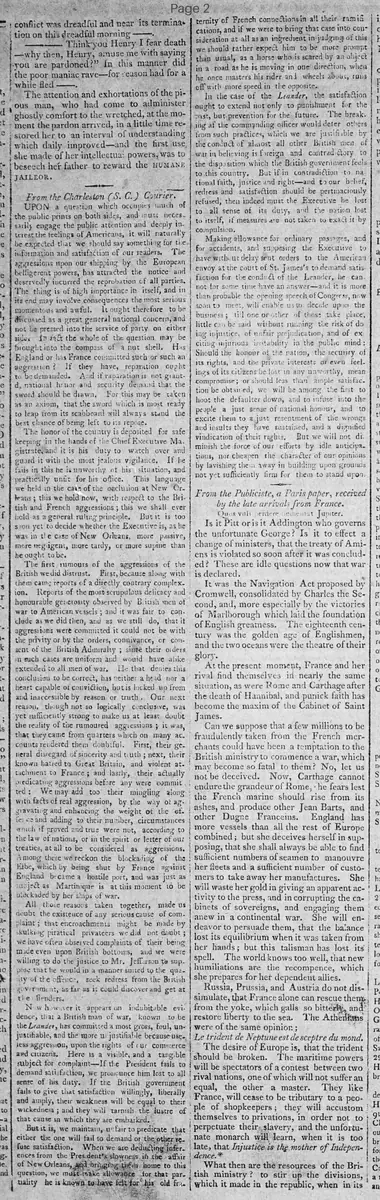
UPON a question which occupies much of the public prints on both sides, and must necessarily engage the public attention and deeply interest the feelings of Americans, it will naturally be expected that we should say something for the information and satisfaction of our readers. The aggressions upon our shipping by the European belligerent powers, has attracted the notice and deservedly incurred the reprobation of all parties. The thing is of high importance in itself, and in its end may involve consequences the most serious momentous and awful. It ought therefore to be discussed as a great general national concern, and not be pressed into the service of party on either side in haste the whole of the question may be through lit into the compass of a nut shell. Has England or has France committed such or such an aggression? If they have, reparation ought to be demanded. And if reparation is not granted, national honor and security demand that the sword should be drawn. For this may be taken as an axiom, that the sword which is most ready to leap from its scabbard will always stand the best chance of being left to its repose.
The honor of the country is deposited for safe keeping in the hands of the Chief Executive Magistrate, and it is his duty to watch over and guard it with the most jealous vigilance. If he fails in this he is unworthy of his situation, and practically unfit for his office. This language we held in the case of the occlusion at New Orleans; this we hold now, with respect to the British and French aggressions; this we shall ever hold as a general ruling principle. But it is too soon yet to decide whether the Executive is, as he was in the case of New Orleans, more passive, more negligent, more tardy, or more supine than he ought to be.
The first rumours of the aggressions of the British we did distrust. First, because along with them came reports of a directly contrary complexion. Reports of the most scrupulous delicacy and honourable generosity observed by British men of war to American vessels; and it was fair to conclude as we did then, and as we still do, that if aggressions were committed it could not be with the privity or by the orders, connivance, or consent of the British Admiralty: since their orders in such cases are uniform and would have alike extended to all men of war. He that denies this conclusion to be correct, has neither a head nor a heart capable of conviction, but is locked up from and inaccessible by reason or truth. Our next reason, though not so logically conclusive, was yet sufficiently strong to make us at least doubt the reality of the rumoured aggressions; it was, that they came from quarters which on many accounts rendered them doubtful. First, their general disregard of sincerity and truth; next, their known hatred to Great Britain, and violent attachment to France; and lastly, their actually predicating aggressions before any were committed: We may add too their mingling among facts of real aggression, by the way of aggravating and enhancing the weight of the offence and adding to their number. circumstances which if proved and true were not, according to the law of nations, or in the spirit or letter of our treaties, at all to be considered as aggressions. Among these we reckon the blockading of the Elbe, which by being shut by France against England became a hostile port, and was just as subject as Martinique is at this moment to be blockaded by her ships of war.
All those reasons taken together, made us doubt the existence of any serious cause of complaint; that encroachments might be made by skulking piratical privateers we did not doubt; we have often observed complaints of their being made even upon British bottoms, and we were willing to do the justice to Mr. Jefferson to suppose that he would in a manner suited to the quality of the offence, seek redress from the British government, as far as it could discover and get at the offenders.
Now however it appears on indubitable evidence, that a British man of war, known to be the Leander, has committed a most gross, foul, unjustifiable, and the more unjustifiable because useless aggression, upon the rights of our commerce and citizens. Here is a visible, and a tangible subject for complaint—If the President fails to demand satisfaction, we pronounce him lost to all sense of his duty. If the British government fails to give that satisfaction willingly, liberally and amply, their weakness will be equal to their wickedness; and they will tarnish the lustre of that cause in which they are embarked.
But it is, we maintain, unfair to predicate that either the one will fail to demand or the other refuse satisfaction. When we are deducting inferences from the President's slowness in the affair of New Orleans, and bringing them home to this question, we must make allowance for that partiality he is known to have felt—for his old fraternity of French connections in all their ramifications, and if we were to bring that case into consideration at all as an ingredient in judging of this we should rather expect him to be more prompt than usual, as a horse who is scared by an object in a road as he is moving in one direction, when he once masters his rider and wheels about, runs off with more speed in the opposite.
In the case of the Leander, the satisfaction ought to extend not only to punishment for the past, but prevention for the future. The breaking of the commanding officer would deter others from such practices, which we are justifiable by the conduct of almost all other British men of war in believing is foreign and contradictory to the disposition which the British government feels to this country. But if in contradiction to national faith, justice and right—and to our belief, redress and satisfaction should be pertinaciously refused, then indeed must the Executive be lost to all sense of its duty, and the nation lost to itself, if measures are not taken to exact it by compulsion.
Making allowance for ordinary passages, and for accidents, and supposing the Executive to have without delay sent orders to the American envoy at the court of St. James's to demand satisfaction for the conduct of the Leander, he cannot for some time have an answer—and it is more than probable the opening speech of Congress, now soon to meet, will enable us to decide upon the business; till one or other of those take place, little can be said without running the risk of doing injustice, of unfair prejudication, and of exciting injurious irritability in the public mind: Should the honour of the nation, the security of its rights, and the private interests or even feelings of its citizens be lost in any unworthy, mean compromise; or should less than ample satisfaction be obtained, we will be among the first to hoot the defaulter down, and to infuse into the people a just sense of national honour, and to excite them to a just resentment of the wrongs and insults they have sustained, and a dignified vindication of their rights. But we will not diminish the force of our efforts by idle anticipations, nor cheapen the character of our opinions by lavishing them away in building upon grounds not yet sufficiently firm for them to stand upon.
UPON a question which occupies much of the public prints on both sides, and must necessarily engage the public attention and deeply interest the feelings of Americans, it will naturally be expected that we should say something for the information and satisfaction of our readers. The aggressions upon our shipping by the European belligerent powers, has attracted the notice and deservedly incurred the reprobation of all parties. The thing is of high importance in itself, and in its end may involve consequences the most serious momentous and awful. It ought therefore to be discussed as a great general national concern, and not be pressed into the service of party on either side in haste the whole of the question may be through lit into the compass of a nut shell. Has England or has France committed such or such an aggression? If they have, reparation ought to be demanded. And if reparation is not granted, national honor and security demand that the sword should be drawn. For this may be taken as an axiom, that the sword which is most ready to leap from its scabbard will always stand the best chance of being left to its repose.
The honor of the country is deposited for safe keeping in the hands of the Chief Executive Magistrate, and it is his duty to watch over and guard it with the most jealous vigilance. If he fails in this he is unworthy of his situation, and practically unfit for his office. This language we held in the case of the occlusion at New Orleans; this we hold now, with respect to the British and French aggressions; this we shall ever hold as a general ruling principle. But it is too soon yet to decide whether the Executive is, as he was in the case of New Orleans, more passive, more negligent, more tardy, or more supine than he ought to be.
The first rumours of the aggressions of the British we did distrust. First, because along with them came reports of a directly contrary complexion. Reports of the most scrupulous delicacy and honourable generosity observed by British men of war to American vessels; and it was fair to conclude as we did then, and as we still do, that if aggressions were committed it could not be with the privity or by the orders, connivance, or consent of the British Admiralty: since their orders in such cases are uniform and would have alike extended to all men of war. He that denies this conclusion to be correct, has neither a head nor a heart capable of conviction, but is locked up from and inaccessible by reason or truth. Our next reason, though not so logically conclusive, was yet sufficiently strong to make us at least doubt the reality of the rumoured aggressions; it was, that they came from quarters which on many accounts rendered them doubtful. First, their general disregard of sincerity and truth; next, their known hatred to Great Britain, and violent attachment to France; and lastly, their actually predicating aggressions before any were committed: We may add too their mingling among facts of real aggression, by the way of aggravating and enhancing the weight of the offence and adding to their number. circumstances which if proved and true were not, according to the law of nations, or in the spirit or letter of our treaties, at all to be considered as aggressions. Among these we reckon the blockading of the Elbe, which by being shut by France against England became a hostile port, and was just as subject as Martinique is at this moment to be blockaded by her ships of war.
All those reasons taken together, made us doubt the existence of any serious cause of complaint; that encroachments might be made by skulking piratical privateers we did not doubt; we have often observed complaints of their being made even upon British bottoms, and we were willing to do the justice to Mr. Jefferson to suppose that he would in a manner suited to the quality of the offence, seek redress from the British government, as far as it could discover and get at the offenders.
Now however it appears on indubitable evidence, that a British man of war, known to be the Leander, has committed a most gross, foul, unjustifiable, and the more unjustifiable because useless aggression, upon the rights of our commerce and citizens. Here is a visible, and a tangible subject for complaint—If the President fails to demand satisfaction, we pronounce him lost to all sense of his duty. If the British government fails to give that satisfaction willingly, liberally and amply, their weakness will be equal to their wickedness; and they will tarnish the lustre of that cause in which they are embarked.
But it is, we maintain, unfair to predicate that either the one will fail to demand or the other refuse satisfaction. When we are deducting inferences from the President's slowness in the affair of New Orleans, and bringing them home to this question, we must make allowance for that partiality he is known to have felt—for his old fraternity of French connections in all their ramifications, and if we were to bring that case into consideration at all as an ingredient in judging of this we should rather expect him to be more prompt than usual, as a horse who is scared by an object in a road as he is moving in one direction, when he once masters his rider and wheels about, runs off with more speed in the opposite.
In the case of the Leander, the satisfaction ought to extend not only to punishment for the past, but prevention for the future. The breaking of the commanding officer would deter others from such practices, which we are justifiable by the conduct of almost all other British men of war in believing is foreign and contradictory to the disposition which the British government feels to this country. But if in contradiction to national faith, justice and right—and to our belief, redress and satisfaction should be pertinaciously refused, then indeed must the Executive be lost to all sense of its duty, and the nation lost to itself, if measures are not taken to exact it by compulsion.
Making allowance for ordinary passages, and for accidents, and supposing the Executive to have without delay sent orders to the American envoy at the court of St. James's to demand satisfaction for the conduct of the Leander, he cannot for some time have an answer—and it is more than probable the opening speech of Congress, now soon to meet, will enable us to decide upon the business; till one or other of those take place, little can be said without running the risk of doing injustice, of unfair prejudication, and of exciting injurious irritability in the public mind: Should the honour of the nation, the security of its rights, and the private interests or even feelings of its citizens be lost in any unworthy, mean compromise; or should less than ample satisfaction be obtained, we will be among the first to hoot the defaulter down, and to infuse into the people a just sense of national honour, and to excite them to a just resentment of the wrongs and insults they have sustained, and a dignified vindication of their rights. But we will not diminish the force of our efforts by idle anticipations, nor cheapen the character of our opinions by lavishing them away in building upon grounds not yet sufficiently firm for them to stand upon.
What sub-type of article is it?
Foreign Affairs
War Or Peace
Trade Or Commerce
What keywords are associated?
British Aggressions
American Shipping
Leander Incident
National Honor
Reparation Demand
Executive Duty
Foreign Policy
What entities or persons were involved?
Chief Executive Magistrate
Mr. Jefferson
British Admiralty
British Government
Leander
American Envoy At St. James's
Editorial Details
Primary Topic
British Aggressions On American Shipping, Especially The Leander Incident
Stance / Tone
Patriotic Demand For Reparation And Defense Of Executive Vigilance
Key Figures
Chief Executive Magistrate
Mr. Jefferson
British Admiralty
British Government
Leander
American Envoy At St. James's
Key Arguments
Aggressions By European Powers On American Shipping Require Demand For Reparation.
If Reparation Denied, National Honor Demands Drawing The Sword.
Executive Must Guard National Honor Jealously.
Initial Doubts About British Aggressions Due To Contrary Reports And Biased Sources.
Leander's Aggression Is Confirmed And Unjustifiable.
President Should Demand Satisfaction; British Should Provide It Liberally.
Too Soon To Criticize Executive's Response; Await Congress Or Envoy's Reply.
Satisfaction Must Include Punishment And Prevention.