Thank you for visiting SNEWPapers!
Sign up free
Letter to Editor
July 13, 1855
The Daily Nashville True Whig
Nashville, Davidson County, Tennessee
What is this article about?
A reprint of John Wesley's 1780 letter arguing against tolerating Roman Catholics in Protestant governments, as their allegiance to the Pope undermines oaths and security, in response to a Methodist Church controversy over the American party.
Clipping
OCR Quality
95%
Excellent
Full Text
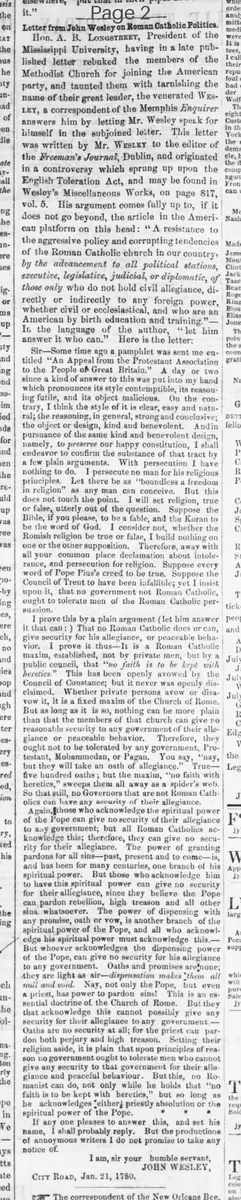
Letter from John Wesley on Roman Catholic Politics.
Hon. A. B. Longstreet, President of the Mississippi University, having in a late published letter rebuked the members of the Methodist Church for joining the American party, and taunted them with tarnishing the name of their great leader, the venerated Wesley, a correspondent of the Memphis Enquirer answers him by letting Mr. Wesley speak for himself in the subjoined letter. This letter was written by Mr. Wesley to the editor of the Freeman's Journal, Dublin, and originated in a controversy which sprung up upon the English Toleration Act, and may be found in Wesley's Miscellaneous Works, on page 817, vol. 5. His argument comes fully up to, if it does not go beyond, the article in the American platform on this head: "A resistance to the aggressive policy and corrupting tendencies of the Roman Catholic church in our country, by the advancement to all political stations, executive, legislative, judicial, or diplomatic, of those only who do not hold civil allegiance, directly or indirectly to any foreign power, whether civil or ecclesiastical, and who are an American by birth education and training." In the language of the author, "let him answer it who can." Here is the letter:
Sir—Some time ago a pamphlet was sent me entitled "An Appeal from the Protestant Association to the People of Great Britain." A day or two since a kind of answer to this was put into my hand which pronounces its style contemptible, its reasoning futile, and its object malicious. On the contrary, I think the style of it is clear, easy and natural; the reasoning, in general, strong and conclusive; the object or design, kind and benevolent. And in pursuance of the same kind and benevolent design, namely, to preserve our happy constitution, I shall endeavor to confirm the substance of that tract by a few plain arguments.
With persecution I have nothing to do. I persecute no man for his religious principles. Let there be as "boundless a freedom in religion" as any man can conceive. But this does not touch the point. I will set religion, true or false, utterly out of the question. Suppose the Bible, if you please, to be a fable, and the Koran to be the word of God. I consider not, whether the Romish religion be true or false, I build nothing on one or the other supposition. Therefore, away with all your common place declamation about intolerance, and persecution for religion.
Suppose every word of Pope Pius's creed to be true. Suppose the Council of Trent to have been infallible; yet I insist upon it, that no government not Roman Catholic, ought to tolerate men of the Roman Catholic persuasion. I prove this by a plain argument (let him answer it that can:) That no Roman Catholic does or can, give security for his allegiance, or peaceable behavior. I prove it thus—It is a Roman Catholic maxim, established, not by private men, but by a public council, that "no faith is to be kept with heretics." This has been openly avowed by the Council of Constance; but it never was openly disclaimed. Whether private persons avow or disavow it, it is a fixed maxim of the Church of Rome. But as long as it is so, nothing can be more plain than that the members of that church can give no reasonable security to any government of their allegiance or peaceable behavior. Therefore, they ought not to be tolerated by any government, Protestant, Mohammedan, or Pagan.
You say, "nay, but they will take an oath of allegiance." True—five hundred oaths: but the maxim, "no faith with heretics," sweeps them all away as a spider's web. So that still, no Governors that are not Roman Catholics can have any security of their allegiance.
Again, those who acknowledge the spiritual power of the Pope can give no security of their allegiance to any government; but all Roman Catholics acknowledge this; therefore, they can give no security for their allegiance. The power of granting pardons for all sins—past, present and to come—is, and has been for many centuries, one branch of his spiritual power. But those who acknowledge him to have this spiritual power can give no security for their allegiance, since they believe the Pope can pardon rebellion, high treason and all other sins. whatsoever.
The power of dispensing with any promise, oath or vow, is another branch of the spiritual power of the Pope, and all who acknowledge his spiritual power must acknowledge this.— But whoever acknowledges the dispensing power of the Pope, can give no security for his allegiance to any government. Oaths and promises are none; they are light as air—dispensation makes them all null and void.
Nay, not only the Pope, but even a priest, has power to pardon sins! This is an essential doctrine of the Church of Rome. But they that acknowledge this cannot possibly give any security for their allegiance to any government— Oaths are no security at all; for the priest can pardon both perjury and high treason."
Setting their religion aside, it is plain that upon principles of reason no government ought to tolerate men who cannot give any security to that government for their allegiance and peaceful behavior. But this, no Romanist can do, not only while he holds that "no faith is to be kept with heretics," but so long as he acknowledges either priestly absolution or the spiritual power of the Pope.
If any one pleases to answer this, and set his name, I shall probably reply. But the productions of anonymous writers I do not promise to take any notice of.
I am, sir your humble servant,
JOHN WESLEY,
City Road, Jan. 21, 1780.
Hon. A. B. Longstreet, President of the Mississippi University, having in a late published letter rebuked the members of the Methodist Church for joining the American party, and taunted them with tarnishing the name of their great leader, the venerated Wesley, a correspondent of the Memphis Enquirer answers him by letting Mr. Wesley speak for himself in the subjoined letter. This letter was written by Mr. Wesley to the editor of the Freeman's Journal, Dublin, and originated in a controversy which sprung up upon the English Toleration Act, and may be found in Wesley's Miscellaneous Works, on page 817, vol. 5. His argument comes fully up to, if it does not go beyond, the article in the American platform on this head: "A resistance to the aggressive policy and corrupting tendencies of the Roman Catholic church in our country, by the advancement to all political stations, executive, legislative, judicial, or diplomatic, of those only who do not hold civil allegiance, directly or indirectly to any foreign power, whether civil or ecclesiastical, and who are an American by birth education and training." In the language of the author, "let him answer it who can." Here is the letter:
Sir—Some time ago a pamphlet was sent me entitled "An Appeal from the Protestant Association to the People of Great Britain." A day or two since a kind of answer to this was put into my hand which pronounces its style contemptible, its reasoning futile, and its object malicious. On the contrary, I think the style of it is clear, easy and natural; the reasoning, in general, strong and conclusive; the object or design, kind and benevolent. And in pursuance of the same kind and benevolent design, namely, to preserve our happy constitution, I shall endeavor to confirm the substance of that tract by a few plain arguments.
With persecution I have nothing to do. I persecute no man for his religious principles. Let there be as "boundless a freedom in religion" as any man can conceive. But this does not touch the point. I will set religion, true or false, utterly out of the question. Suppose the Bible, if you please, to be a fable, and the Koran to be the word of God. I consider not, whether the Romish religion be true or false, I build nothing on one or the other supposition. Therefore, away with all your common place declamation about intolerance, and persecution for religion.
Suppose every word of Pope Pius's creed to be true. Suppose the Council of Trent to have been infallible; yet I insist upon it, that no government not Roman Catholic, ought to tolerate men of the Roman Catholic persuasion. I prove this by a plain argument (let him answer it that can:) That no Roman Catholic does or can, give security for his allegiance, or peaceable behavior. I prove it thus—It is a Roman Catholic maxim, established, not by private men, but by a public council, that "no faith is to be kept with heretics." This has been openly avowed by the Council of Constance; but it never was openly disclaimed. Whether private persons avow or disavow it, it is a fixed maxim of the Church of Rome. But as long as it is so, nothing can be more plain than that the members of that church can give no reasonable security to any government of their allegiance or peaceable behavior. Therefore, they ought not to be tolerated by any government, Protestant, Mohammedan, or Pagan.
You say, "nay, but they will take an oath of allegiance." True—five hundred oaths: but the maxim, "no faith with heretics," sweeps them all away as a spider's web. So that still, no Governors that are not Roman Catholics can have any security of their allegiance.
Again, those who acknowledge the spiritual power of the Pope can give no security of their allegiance to any government; but all Roman Catholics acknowledge this; therefore, they can give no security for their allegiance. The power of granting pardons for all sins—past, present and to come—is, and has been for many centuries, one branch of his spiritual power. But those who acknowledge him to have this spiritual power can give no security for their allegiance, since they believe the Pope can pardon rebellion, high treason and all other sins. whatsoever.
The power of dispensing with any promise, oath or vow, is another branch of the spiritual power of the Pope, and all who acknowledge his spiritual power must acknowledge this.— But whoever acknowledges the dispensing power of the Pope, can give no security for his allegiance to any government. Oaths and promises are none; they are light as air—dispensation makes them all null and void.
Nay, not only the Pope, but even a priest, has power to pardon sins! This is an essential doctrine of the Church of Rome. But they that acknowledge this cannot possibly give any security for their allegiance to any government— Oaths are no security at all; for the priest can pardon both perjury and high treason."
Setting their religion aside, it is plain that upon principles of reason no government ought to tolerate men who cannot give any security to that government for their allegiance and peaceful behavior. But this, no Romanist can do, not only while he holds that "no faith is to be kept with heretics," but so long as he acknowledges either priestly absolution or the spiritual power of the Pope.
If any one pleases to answer this, and set his name, I shall probably reply. But the productions of anonymous writers I do not promise to take any notice of.
I am, sir your humble servant,
JOHN WESLEY,
City Road, Jan. 21, 1780.
What sub-type of article is it?
Persuasive
Political
Religious
What themes does it cover?
Politics
Religion
Constitutional Rights
What keywords are associated?
Roman Catholic
Allegiance
Pope
Toleration
Oaths
Heretics
Spiritual Power
John Wesley
What entities or persons were involved?
John Wesley
Editor Of The Freeman's Journal, Dublin
Letter to Editor Details
Author
John Wesley
Recipient
Editor Of The Freeman's Journal, Dublin
Main Argument
no non-roman catholic government should tolerate roman catholics because they cannot provide security for their allegiance due to church doctrines allowing the pope and priests to absolve oaths, pardons for treason, and the maxim of no faith with heretics.
Notable Details
References Council Of Constance
Discusses Pope's Power To Grant Pardons For Sins Including Rebellion And High Treason
Mentions Power To Dispense With Oaths And Promises
Quotes The American Party Platform On Resistance To Roman Catholic Aggressive Policy