Thank you for visiting SNEWPapers!
Sign up free
Morgan County Democrat
Mcconnelsville, Morgan County, Ohio
What is this article about?
Description of a 2600-mile automobile trip by Harold Finley, his mother, Emmet A. Taylor, and his mother from McConnelsville, Ohio, starting July 2, through eastern U.S. scenic routes, cities like New York and Boston, natural wonders like White Mountains and Niagara Falls, emphasizing beauty and historical sites, with no mishaps.
Clipping
OCR Quality
Full Text
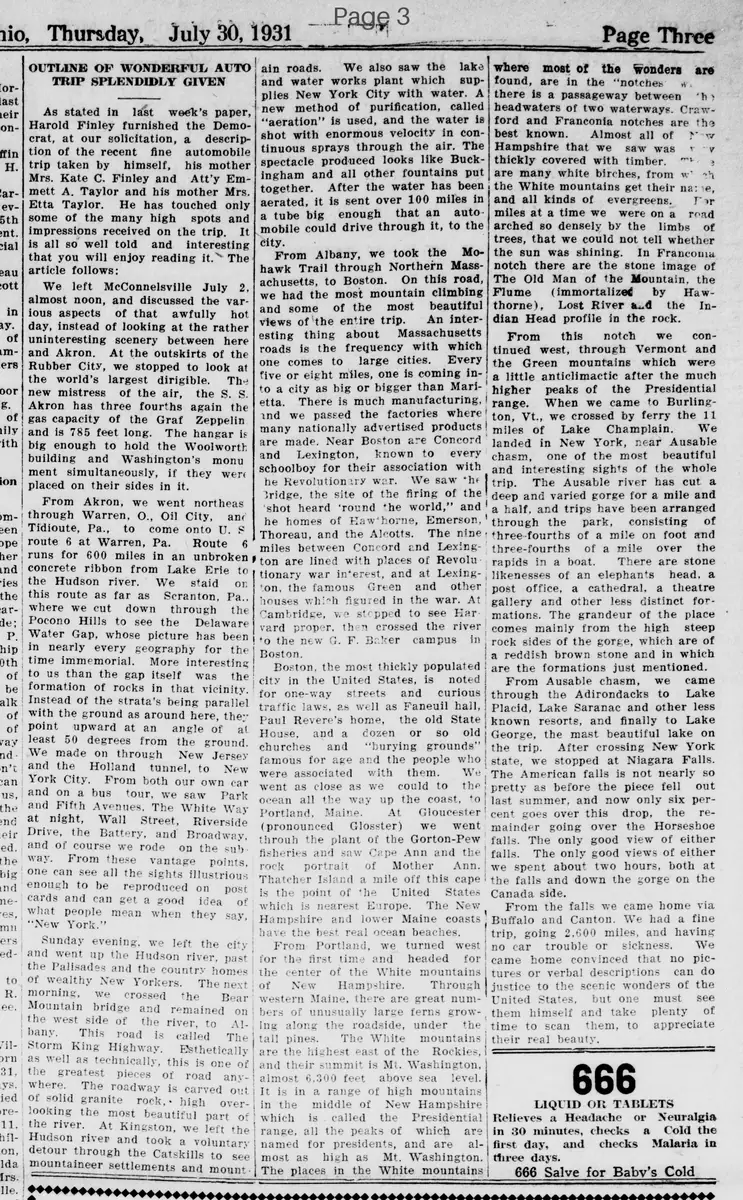
As stated in last week's paper, Harold Finley furnished the Democrat, at our solicitation, a description of the recent fine automobile trip taken by himself, his mother Mrs. Kate C. Finley and Att'y Emmet A. Taylor and his mother Mrs. Etta Taylor.
He has touched only some of the many high spots and impressions received on the trip.
It is all so well told and interesting that you will enjoy reading it.
The article follows:
We left McConnelsville July 2, almost noon, and discussed the various aspects of that awfully hot day, instead of looking at the rather uninteresting scenery between here and Akron.
At the outskirts of the Rubber City, we stopped to look at the world's largest dirigible.
The new mistress of the air, the S. S. Akron has three fourths again the gas capacity of the Graf Zeppelin and is 785 feet long.
The hangar is big enough to hold the Woolworth building and Washington's monument simultaneously, if they were placed on their sides in it.
From Akron, we went northeast through Warren, O., Oil City, and Tidioute, Pa., to come onto U. S. route 6 at Warren, Pa.
Route 6 runs for 600 miles in an unbroken concrete ribbon from Lake Erie to the Hudson river.
We stayed on this route as far as Scranton, Pa., where we cut down through the Pocono Hills to see the Delaware Water Gap, whose picture has been in nearly every geography for the time immemorial.
More interesting to us than the gap itself was the formation of rocks in that vicinity.
Instead of the strata's being parallel with the ground as around here, they point upward at an angle of at least 50 degrees from the ground.
We made on through New Jersey and the Holland tunnel, to New York City.
From both our own car and on a bus tour, we saw Park and Fifth Avenues, The White Way at night, Wall Street, Riverside Drive, the Battery, and Broadway, and of course we rode on the subway.
From these vantage points, one can see all the sights illustrious enough to be reproduced on post cards and can get a good idea of what people mean when they say, "New York."
Sunday evening, we left the city and went up the Hudson river, past the Palisades and the country homes of wealthy New Yorkers.
The next morning, we crossed the Bear Mountain bridge and remained on the west side of the river, to Albany.
This road is called The Storm King Highway.
Esthetically as well as technically, this is one of the greatest pieces of road anywhere.
The roadway is carved out of solid granite rock, high overlooking the most beautiful part of the river.
At Kingston, we left the Hudson river and took a voluntary detour through the Catskills to see mountaineer settlements and mountain roads.
We also saw the lake and water works plant which supplies New York City with water.
A new method of purification, called "aeration" is used, and the water is shot with enormous velocity in continuous sprays through the air.
The spectacle produced looks like Buckingham and all other fountains put together.
After the water has been aerated, it is sent over 100 miles in a tube big enough that an automobile could drive through it, to the city.
From Albany, we took the Mohawk Trail through Northern Massachusetts, to Boston.
On this road, we had the most mountain climbing and some of the most beautiful views of the entire trip.
An interesting thing about Massachusetts roads is the frequency with which one comes to large cities.
Every five or eight miles, one is coming into a city as big or bigger than Marietta.
There is much manufacturing, and we passed the factories where many nationally advertised products are made.
Near Boston are Concord and Lexington, known to every schoolboy for their association with the Revolutionary war.
We saw the Bridge, the site of the firing of the "shot heard round the world," and the homes of Hawthorne, Emerson, Thoreau, and the Alcotts.
The nine miles between Concord and Lexington are lined with places of Revolutionary war interest, and at Lexington, the famous Green and other houses which figured in the war.
At Cambridge, we stopped to see Harvard proper, then crossed the river to the new G. F. Baker campus in Boston.
Boston, the most thickly populated city in the United States, is noted for one-way streets and curious traffic laws, as well as Faneuil hall, Paul Revere's home, the old State House, and a dozen or so old churches and "burying grounds" famous for age and the people who were associated with them.
We went as close as we could to the ocean all the way up the coast, to Portland, Maine.
At Gloucester (pronounced Glosster) we went through the plant of the Gorton-Pew fisheries and saw Cape Ann and the rock portrait of Mother Ann.
Thatcher Island a mile off this cape is the point of the United States which is nearest Europe.
The New Hampshire and lower Maine coasts have the best real ocean beaches.
From Portland, we turned west for the first time and headed for the center of the White mountains of New Hampshire.
Through western Maine, there are great numbers of unusually large ferns growing along the roadside, under the tall pines.
The White mountains are the highest east of the Rockies, and their summit is Mt. Washington, almost 6300 feet above sea level.
It is in a range of high mountains in the middle of New Hampshire which is called the Presidential range, all the peaks of which are named for presidents, and are almost as high as Mt. Washington.
The places in the White mountains where most of the wonders are found, are in the "notches" there is a passageway between headwaters of two waterways.
Crawford and Franconia notches are the best known.
Almost all of New Hampshire that we saw was thickly covered with timber.
There are many white birches, from which the White mountains get their name, and all kinds of evergreens.
For miles at a time we were on a road arched so densely by the limbs of trees, that we could not tell whether the sun was shining.
In Franconia notch there are the stone image of The Old Man of the Mountain, the Flume (immortalized by Hawthorne), Lost River and the Indian Head profile in the rock.
From this notch we continued west, through Vermont and the Green mountains which were a little anticlimactic after the much higher peaks of the Presidential range.
When we came to Burlington, Vt., we crossed by ferry the 11 miles of Lake Champlain.
We landed in New York, near Ausable chasm, one of the most beautiful and interesting sights of the whole trip.
The Ausable river has cut a deep and varied gorge for a mile and a half, and trips have been arranged through the park, consisting of three-fourths of a mile on foot and three-fourths of a mile over the rapids in a boat.
There are stone likenesses of an elephant's head, a post office, a cathedral, a theatre gallery and other less distinct formations.
The grandeur of the place comes mainly from the high steep rock sides of the gorge, which are of a reddish brown stone and in which are the formations just mentioned.
From Ausable chasm, we came through the Adirondacks to Lake Placid, Lake Saranac and other less known resorts, and finally to Lake George, the most beautiful lake on the trip.
After crossing New York state, we stopped at Niagara Falls.
The American falls is not nearly so pretty as before the piece fell out last summer, and now only six percent goes over this drop, the remainder going over the Horseshoe falls.
The only good view of either falls we spent about two hours, both at the falls and down the gorge on the Canada side.
From the falls we came home via Buffalo and Canton.
We had a fine trip, going 2600 miles, and having no car trouble or sickness.
We came home convinced that no pictures or verbal descriptions can do justice to the scenic wonders of the United States, but one must see them himself and take plenty of time to scan them, to appreciate their real beauty.
What sub-type of article is it?
What themes does it cover?
What keywords are associated?
What entities or persons were involved?
Where did it happen?
Story Details
Key Persons
Location
Eastern United States, From Mcconnelsville, Ohio, Through Pennsylvania, New York, Massachusetts, New Hampshire, Vermont, Maine, And Back Via Niagara Falls
Event Date
July 2
Story Details
Harold Finley, his mother Mrs. Kate C. Finley, Emmet A. Taylor, and his mother Mrs. Etta Taylor took a 2600-mile automobile trip starting from McConnelsville on July 2, visiting Akron, New York City, Hudson River, Catskills, Boston, Portland Maine, White Mountains, Lake Champlain, Ausable Chasm, Adirondacks, Lake George, and Niagara Falls, highlighting scenic wonders, historical sites, and natural formations without car trouble or sickness.