Thank you for visiting SNEWPapers!
Sign up free
Virginia Argus
Richmond, Virginia
What is this article about?
In the US House of Representatives, Mr. J. Randolph delivers a speech opposing a resolution favoring the New England Mississippi Land Company's claim under the 1795 Georgia act, amid procedural debates, failed adjournment motions, and readings of relevant acts and petitions. He criticizes corruption and haste in the proceedings.
Clipping
OCR Quality
Full Text
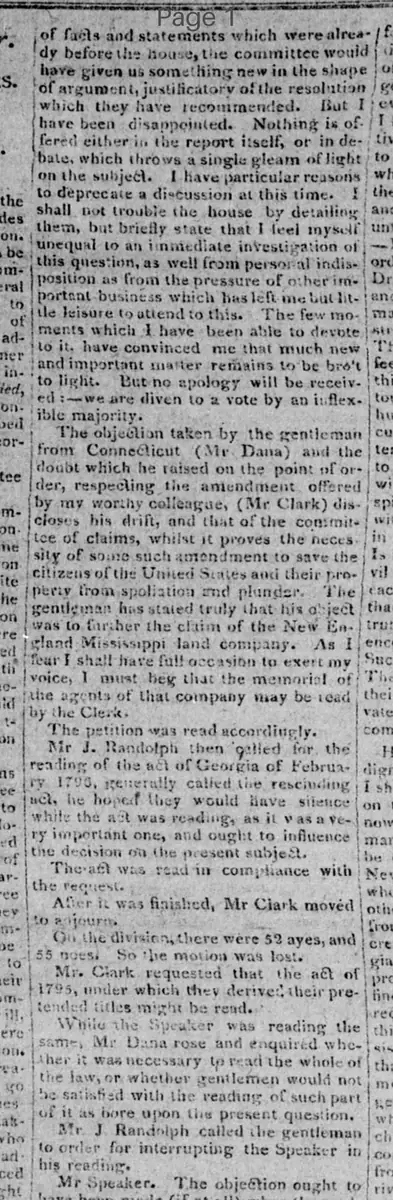
have given us something new in the shape
of argument, justificatory of the resolution
which they have recommended. But I
have been disappointed. Nothing is offered either in the report itself, or in debate, which throws a single gleam of light
on the subject. I have particular reasons
to deprecate a discussion at this time. I
shall not trouble the house by detailing
them, but briefly state that I feel myself
unequal to an immediate investigation of
this question, as well from personal indisposition as from the pressure of other important business which has left me but little leisure to attend to this. The few moments which I have been able to devote
to it, have convinced me that much new
and important matter remains to be brought to light. But no apology will be received :--we are driven to a vote by an inflexible majority.
The objection taken by the gentleman
from Connecticut (Mr Dana) and the
doubt which he raised on the point of order, respecting the amendment offered
by my worthy colleague, (Mr Clark) discloses his drift, and that of the committee of claims, whilst it proves the necessity of some such amendment to save the
citizens of the United States and their property from spoliation and plunder. The
gentleman has stated truly that his object
was to favor the claim of the New England Mississippi land company. As I
fear I shall have full occasion to exert my
voice, I must beg that the memorial of
the agents of that company may be read
by the Clerk.
The petition was read accordingly.
Mr J. Randolph then called for, the
reading of the act of Georgia of February 1795, generally called the rescinding
act, he hoped they would have silence
while the act was reading, as it was a very important one, and ought to influence
the decision on the present subject.
There it was read in compliance with
the request.
After it was finished, Mr Clark moved
to adjourn
On the division, there were 52 ayes, and
55 noes. So the motion was lost.
Mr. Clark requested that the act of
1795, under which they derived their pretended titles might be read..
While the Speaker was reading the
same, Mr Dana rose and enquired whether it was necessary to read the whole of
the law, or whether gentlemen would not
be satisfied with the reading of such part
of it as bore upon the present question.
Mr. J Randolph called the gentleman
to order for interrupting the Speaker in
his reading.
Mr Speaker. The objection ought to
have been made (if at all) when the reading of the law was first called for.
The reading was continued to the end
of the act--when,
Mr J. Clay moved that the house adjourn.
On a division there were 53 ayes and
60 noes.
Motion lost.
Mr J. Randolph. Perhaps it may be
supposed from the course which this business has taken, that the adversaries of
the present measure indulge the expectation of being able to come forward at a future day--not to this house, for that hope
is desperate, but to the public, with a
more matured opposition than it is in their power now to make. But past experience has shewn them that this is one of those
subjects which pollution has sanctified--
that the hallowed mysteries of corruption
are not to be profaned by the eye of public curiosity.--No, sir, the orgies of Yazoo
speculation are not to be laid open to the
vulgar gaze. None but the initiated are
permitted to behold the monstrous sacrifice of the best interests of the nation
on the altars of corruption, When this
abomination is to be practised we go into
conclave. Do we apply to the press? that
potent engine, the dread of tyrants & of villains, but the shield of freedom & of worth:
No, sir, the press is gagged. On this subject we have a virtual sedition law--not
with a specious title, but irresistible in its operation, which, in the language of a
gentleman from Connecticut (Mr Griswold) goes directly to its object. The demon
of speculation at one sweep has wrested
from the nation their best their only defence and closed every avenue of information. But a day of retribution may yet
come. If their rights are to be bartered
away and their property squandered, the
people must not, they shall not be kept
in ignorance by whom, or for whom it is
done.
We have often heard of party spirit, of
caucuses as they are termed, to settle legislative questions--but never have I seen
that spirit so visible as at this time. The
act-of door intrigue is too palpable to be
disguised. When it was proposed to abolish a judiciary system reared in the
last moments of an expiring administration, the detested offspring of a midnight
hour, when the question of repeal was before this house. it could not be taken up
(midnight, in the third or fourth week
of the discussion.-- When the great and
good man who now fills, and who, [whatever may be the wishes of our opponents]
I hope and trust will long fill the executive chair, not less to his own honor than
to the happiness of his fellow-citizens :
when he, sir, recommended the repeal of
the internal taxes, delay succeeded delay,
and discussion was followed by discussion until patience itself was worn threadbare.
--But now, when public plunder is the
order of the day, how are we treated?
Driven into the committee of the whole
and out again, in a breath, by an inflexible majority, exulting and stubborn in their
strength, a decision must be had, instanter.
The advocates of the proposed measure
feel that it will not bear a scrutiny. Hence
this precipitancy. They wince from the
touch of examination and are willing to
hurry through a painful & disgraceful discussion. But it may be asked why thus
tenacious adherence of certain gentlemen
to each other on every point connected
with this subject. As if animated by one
spirit, they perform all their evolutions
with the most exact discipline, and march
in firm phalanx directly up to their object.
Is it that men combined to effect some evil purpose, acting on previous pledge to
each other are ever more in unison
than those who seeking only to discover
truth, obey the impulse of that conscience which God has placed in our bosoms.
Such men do not stand compromised.--
They will not stifle the suggestions of
their own minds, and sacrifice their private opinions to the attainment of some
common, perhaps some nefarious object.
Having given vent to that effusion of indignation which I feel, and which I trust
I shall never fail to feel and to express
on this detestable subject, permit me
now to offer some crude and hasty remarks on the point in dispute. They will
be directed chiefly to the claim of the
New England Mississippi land company
whom we propose to debar (with all the
other claimants under the act of 1795)
from any benefit of the five millions of acres, reserved by our compact with Georgia, to satisfy such claims not specially
provided for in that compact, as we might
find worthy of recompense. I shall direct my observations more particularly to
this claim because it has been more insisted upon, and more zealously defended
than any other. It is alleged by the memorialists, who style themselves the agents of that company, that they, and those
whom they represent, were innocent purchasers;--in other words, ignorant of the
corruption and fraud by which the act
from which their pretended title was derived, was passed. I am well aware that
this fact is not material to the question of
any legal or equitable title, which they
may set up--but as it has been made a
pretext for exciting the compassion of
the legislature, I wish to examine into the
ground upon which this allegation rests.
Sir, when that act of stupendous villainy
was passed in 1795, attempting under the
forms and semblance of law, to rob unborn millions of their birth right and inheritance, and to convey to a band of unprincipled and flagitious men a territory more extensive, and beyond comparison more
fertile than any state of this union, it caused a sensation scarcely less violent than
that produced by the passage of the stamp
act or the shutting up of the port of Boston :-with this difference, that when the
port bill of Boston passed, her southern
brethren did not take advantage of her
forms of law, by which a corrupt legislature attempted to defraud her of the bounty of nature :--they did not speculate on
the necessities and wrongs of their abused
and insulted countrymen.--I repeat, that
this infamous act was succeeded by a general burst of indignation throughout the
continent. This is matter of public notoriety--and those--(I speak of men of
intelligence and education, purchasers too
of the very country in question) those who
affect to have been ignorant of any such
circumstances, I shall consider as guilty
of gross and wilful prevarication. They
offer indeed to virtue the only homage
which she is ever likely to receive at their
hands--the homage of their hypocrisy.
They could not make an assertion within
the limits of possibility less entitled to credit.
Yes, the act of the 7th January, 1795
excited emotions of detestation and abhorrence, equal to those produced by the
stamp act. or port bill of Boston. But
this was not all. It drew upon it the immediate attention of the federal government.
The authority which is about to be produced to the house is one which I am not
in the habit of prostituting to every light
occasion. It is one from which these
who are daily endeavoring to shelter their crimes and their folly under its venerable
shade, will not dare to appeal. Upon looking into the journals of this house, I find
the following message from the President,
dated on the 17th of February, 1795.
What sub-type of article is it?
What keywords are associated?
What entities or persons were involved?
Domestic News Details
Key Persons
Event Details
Debate in the House on a resolution regarding claims under the Georgia act of 1795, including reading of the company's memorial and the rescinding act, failed motions to adjourn by Mr. Clark and Mr. J. Clay, objections by Mr. Dana, and a speech by Mr. J. Randolph criticizing corruption in the Yazoo land speculation and defending an amendment to bar the New England Mississippi Land Company from benefits.