Thank you for visiting SNEWPapers!
Sign up free
The New Hampshire Gazette
Portsmouth, Rockingham County, New Hampshire
What is this article about?
On December 3, 1795, New Hampshire Governor J. T. Gilman addressed the convened General Court in Concord, expressing confidence in the federal government and criticizing opposition to a recent treaty. The legislature responded affirmatively on December 5, pledging support for state and federal constitutions.
Clipping
OCR Quality
Full Text
GENERAL COURT.
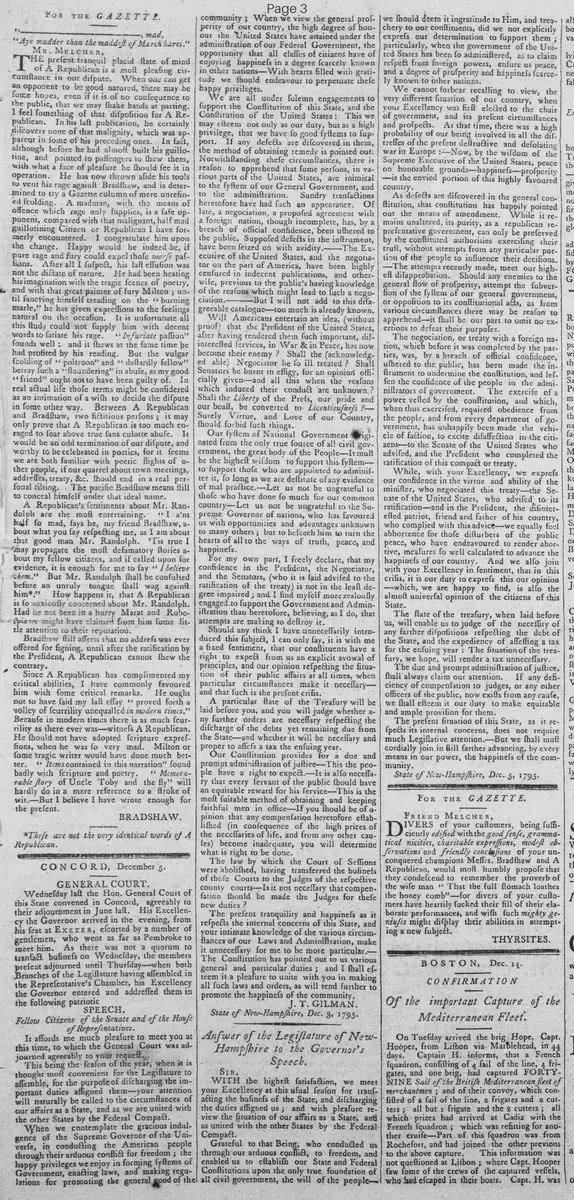
Wednesday last the Hon. General Court of this State convened in Concord, agreeably to their adjournment in June last. His Excellency the Governor arrived in the evening, from his seat at EXETER, escorted by a number of gentlemen, who went as far as Pembroke to meet him. As there was not a quorum to transact business on Wednesday, the members present adjourned until Thursday—when both Branches of the Legislature having assembled in the Representative's Chamber, his Excellency the Governor entered and addressed them in the following patriotic SPEECH.
Fellow Citizens of the Senate and of the House of Representatives.
It affords me much pleasure to meet you at this time, to which the General Court was adjourned agreeably to your request. This being the season of the year, when it is thought most convenient for the Legislature to assemble, for the purpose of discharging the important duties assigned them—your attention will naturally be called to the circumstances of our affairs as a State, and as we are united with the other States by the Federal Compact.
When we contemplate the gracious indulgence of the Supreme Governor of the Universe, in conducting the American people through their arduous conflict for freedom; the happy privileges we enjoy in forming systems of Government, enacting laws, and making regulations for promoting the general good of the community; When we view the general prosperity of our country, the high degree of honor the United States have attained under the administration of our Federal Government, the opportunity that all classes of citizens have of enjoying happiness in a degree scarcely known in other nations—With hearts filled with gratitude we should endeavour to perpetuate these happy privileges.
We are all under solemn engagements to support the Constitution of this State, and the Constitution of the United States: This we may esteem not only as our duty, but as a high privilege, that we have so good systems to support. If any defects are discovered in them, the method of obtaining remedy is pointed out. Notwithstanding these circumstances, there is reason to apprehend that some persons, in various parts of the United States, are inimical to the system of our General Government, and to the administration. Sundry transactions heretofore have had such an appearance. Of late, a negociation, a proposed agreement with a foreign nation, though incomplete, has, by a breach of official confidence, been ushered to the public. Supposed defects in the instrument, have been seized on with avidity. The Executive of the United States, and the negotiator on the part of America, have been highly censured in indecent publications, and otherwise, previous to the public's having knowledge of the reasons which might lead to such a negociation.—But I will not add to this disagreeable catalogue—too much is already known.
Will Americans entertain an idea, (without proof) that the President of the United States, after having rendered them such important, disinterested services, in War & in Peace, has now become their enemy? Shall the (acknowledged able) Negotiator be so ill treated? Shall Senators be burnt in effigy, for an opinion officially given—and all this when the reasons which induced their conduct are unknown? Shall the Liberty of the Press, our pride and our boast, be converted to Licentiousness?—Surely Virtue, and Love of our Country, should forbid such things.
Our system of National Government originated from the only true source of all civil government, the great body of the People—It must be the highest wisdom to support this system—to support those who are appointed to administer it, so long as we are destitute of any evidence of mal practice.—Let us not be ungrateful to those who have done so much for our common country—Let us not be ungrateful to the Supreme Governor of nations, who has favoured us with opportunities and advantages unknown to many others; but to beseech him to turn the hearts of all to the ways of truth, peace, and happiness.
For my own part, I freely declare, that my confidence in the President, the Negotiator, and the Senators, (who it is said advised to the ratification of the treaty) is not in the least degree impaired; and I find myself more zealously engaged to support the Government and Administration than heretofore, believing, as I do, that attempts are making to destroy it.
Should any think I have unnecessarily introduced this subject. I can only say, it is with me a fixed sentiment, that our constituents have a right to expect from us an explicit avowal of principles, and our opinion respecting the situation of their public affairs at all times, when particular circumstances make it necessary—and that such is the present crisis.
A particular state of the Treasury will be laid before you, and you will judge whether any further orders are necessary respecting the discharge of the debts yet remaining due from the State—and whether it will be necessary and proper to assess a tax the ensuing year.
Our Constitution provides for a due and prompt administration of justice—This the people have a right to expect.—It is also necessary that every servant of the public should have an equitable reward for his service—This is the most suitable method of obtaining and keeping faithful men in office—If you should be of opinion that any compensation heretofore established (in consequence of the high prices of the necessaries of life, and from any other causes) become inadequate, you will determine what is right to be done.
The law by which the Court of Sessions were abolished, having transferred the business of those Courts to the Judges of the respective county courts—Is it not necessary that compensation should be made the Judges for these new duties?
The present tranquility and happiness as it respects the internal concerns of this State, and your intimate knowledge of the various circumstances of our Laws and Administration, make it unnecessary for me to be more particular.—The Constitution has pointed out to us various general and particular duties; and I shall esteem it a pleasure to unite with you in making all such laws and orders, as will tend further to promote the happiness of the community.
J. T. GILMAN.
State of New-Hampshire, Dec. 3, 1795.
Answer of the Legislature of New-Hampshire to the Governor's Speech.
SIR,
WITH the highest satisfaction, we meet your Excellency at this usual season for transacting the business of the State, and discharging the duties assigned us; and with pleasure review the situation of our affairs as a State, and as united with the other States by the Federal Compact.
Grateful to that Being, who conducted us through our arduous conflict, to freedom, and enabled us to establish our State and Federal Constitutions upon the only true foundation of all civil government, the will of the people—we should deem it ingratitude to Him, and treachery to our constituents, did we not explicitly express our determination to support them; particularly, when the government of the United States has been so administered, as to claim respect from foreign powers, ensure us peace, and a degree of prosperity and happiness scarcely known to other nations.
We cannot forbear recalling to view, the very different situation of our country, when your Excellency was first elected to the chair of government, and its present circumstances and prospects. At that time, there was a high probability of our being involved in all the distresses of the present destructive and desolating war in Europe :—Now, by the wisdom of the Supreme Executive of the United States, peace on honorable grounds—happiness—prosperity—is the envied portion of this highly favoured country.
As defects are discovered in the general constitution, that constitution has happily pointed out the means of amendment. While it remains unaltered, its purity, as a republican representative government, can only be preserved by the constituted authorities exercising their trust, without attempts from any particular portion of the people to influence their decisions. —The attempts recently made, meet our highest disapprobation. Should any enemies to the general flow of prosperity, attempt the subversion of the system of our general government, or opposition to its constitutional acts, as from various circumstances there may be reason to apprehend—it shall be our part to omit no exertions to defeat their purposes.
The negociation, or treaty with a foreign nation, which before it was completed by the parties, was, by a breach of official confidence, ushered to the public, has been made the instrument to undermine the constitution, and lessen the confidence of the people in the administrators of government. The exercise of a power vested by the constitution, and which, when thus exercised, required obedience from the people, and from every department of government, has unhappily been made the vehicle of faction, to excite disaffection in the citizens—to the Senate of the United States who advised, and the President who completed the ratification of this compact or treaty.
While, with your Excellency, we express our confidence in the virtue and ability of the minister, who negotiated this treaty—the Senate of the United States, who advised to its ratification—and in the President, the disinterested patriot, friend and father of his country, who complied with this advice—we equally feel abhorrence for those disturbers of the public peace, who have endeavoured to render abortive, measures so well calculated to advance the happiness of our country. And we also join with your Excellency in sentiment, that in this crisis, it is our duty to express this our opinion—which, we are happy to find, is also the almost universal opinion of the citizens of this State.
The state of the treasury, when laid before us, will enable us to judge of the necessity of any farther dispositions respecting the debt of the State, and the expediency of assessing a tax for the ensuing year : The situation of the treasury, we hope, will render a tax unnecessary.
The due and prompt administration of justice, shall always claim our attention. If any deficiency of compensation to judges, or any other officers of the public, now exists from any cause, we shall esteem it our duty to make equitable and ample provision for them.
The present situation of this State, as it respects its internal concerns, does not require much Legislative attention.—But we shall most cordially join in still farther advancing, by every means in our power, the happiness of the community.
State of New-Hampshire, Dec. 5, 1795.
What sub-type of article is it?
What keywords are associated?
What entities or persons were involved?
Where did it happen?
Domestic News Details
Primary Location
Concord
Event Date
December 3 5, 1795
Key Persons
Outcome
legislature affirms support for state and federal governments, confidence in president and treaty negotiators, and addresses treasury, justice, and compensation issues.
Event Details
The New Hampshire General Court convened in Concord on Wednesday, December 3, 1795. Governor J. T. Gilman delivered a speech urging support for the federal government amid controversies over a treaty with a foreign nation, criticizing opposition and affirming confidence in the President, negotiator, and Senators. The legislature responded on December 5, echoing the Governor's sentiments and pledging to support constitutions and address state affairs.