Thank you for visiting SNEWPapers!
Sign up free
Story
June 14, 1874
Nashville Union And American
Nashville, Davidson County, Tennessee
What is this article about?
A divorced lady, Mrs. B., was denied presentation to Queen Victoria at a London drawing room by her sponsor, the Duchess of C., because the Queen objected to her past marriage, despite it being legally ended, affecting her daughter's social debut.
Clipping
OCR Quality
95%
Excellent
Full Text
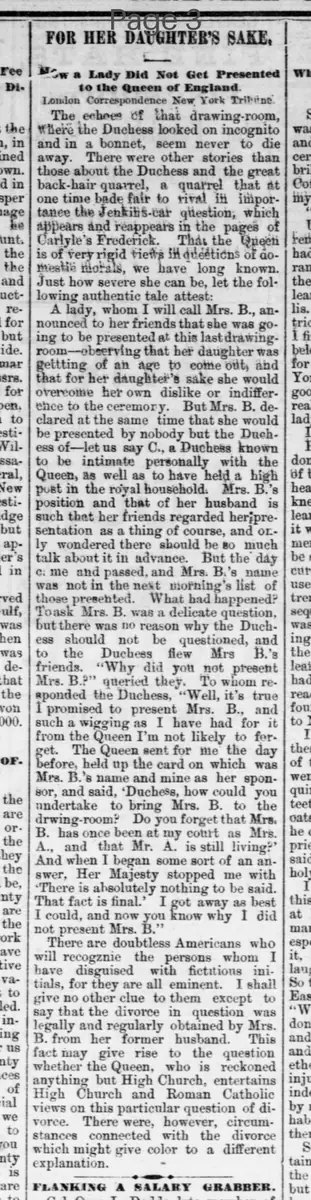
FOR HER DAUGHTER'S SAKE
How a Lady Did Not Get Presented to the Queen of England.
London Correspondence New York Tribune
The echoes that drawing-room,
Where the Duchess looked on incognito
and in a bonnet, seem never to die
away. There were other stories than
those about the Duchess and the great
back-hair quarrel, a quarrel that at
one time bade fair to rival in importance
the Jenkins-ear question, which
appears and reappears in the pages of
Carlyle's Frederick. That the Queen
is of very rigid views in deductions of domestic
morals, we have long known.
Just how severe she can be, let the following
authentic tale attest:
A lady, whom I will call Mrs. B., announced
to her friends that she was going
to be presented at this last drawing
room—observing that her daughter was
getting of an age to come out, and
that for her daughter's sake she would
overcome her own dislike or indifference
to the ceremony. But Mrs. B. declared
at the same time that she would
be presented by nobody but the Duchess
of—let us say C., a Duchess known
to be intimate personally with the
Queen, as well as to have held a high
post in the royal household. Mrs. B.'s
position and that of her husband is
such that her friends regarded her presentation
as a thing of course, and only
wondered there should be so much
talk about it in advance. But the day
came and passed, and Mrs. B.'s name
was not in the next morning's list of
those presented. What had happened?
To ask Mrs. B. was a delicate question,
but there was no reason why the Duchess
should not be questioned, and
to the Duchess went Mrs. B.'s
friends. "Why did you not present
Mrs. B.?" queried they. To whom responded
the Duchess, "Well, it's true
I promised to present Mrs. B., and
such a wigging as I have had for it
from the Queen I'm not likely to forget.
The Queen sent for me the day
before, held up the card on which was
Mrs. B.'s name and mine as her sponsor,
and said, 'Duchess, how could you
undertake to bring Mrs. B. to the
drawing-room? Do you forget that Mrs.
B. has once been at my court as Mrs.
A., and that Mr. A. is still living?'
And when I began some sort of an answer,
Her Majesty stopped me with
'There is absolutely nothing to be said.
That fact is final.' I got away as best
I could, and now you know why I did
not present Mrs. B.'"
There are doubtless Americans who
will recognize the persons whom I
have disguised with fictitious initials.
for they are all eminent. I shall
give no other clue to them except to
say that the divorce in question was
legally and regularly obtained by Mrs.
B. from her former husband. This
fact may give rise to the question
whether the Queen, who is reckoned
anything but High Church, entertains
High Church and Roman Catholic
views on this particular question of divorce.
There were, however, circumstances
connected with the divorce
which might give color to a different
explanation.
How a Lady Did Not Get Presented to the Queen of England.
London Correspondence New York Tribune
The echoes that drawing-room,
Where the Duchess looked on incognito
and in a bonnet, seem never to die
away. There were other stories than
those about the Duchess and the great
back-hair quarrel, a quarrel that at
one time bade fair to rival in importance
the Jenkins-ear question, which
appears and reappears in the pages of
Carlyle's Frederick. That the Queen
is of very rigid views in deductions of domestic
morals, we have long known.
Just how severe she can be, let the following
authentic tale attest:
A lady, whom I will call Mrs. B., announced
to her friends that she was going
to be presented at this last drawing
room—observing that her daughter was
getting of an age to come out, and
that for her daughter's sake she would
overcome her own dislike or indifference
to the ceremony. But Mrs. B. declared
at the same time that she would
be presented by nobody but the Duchess
of—let us say C., a Duchess known
to be intimate personally with the
Queen, as well as to have held a high
post in the royal household. Mrs. B.'s
position and that of her husband is
such that her friends regarded her presentation
as a thing of course, and only
wondered there should be so much
talk about it in advance. But the day
came and passed, and Mrs. B.'s name
was not in the next morning's list of
those presented. What had happened?
To ask Mrs. B. was a delicate question,
but there was no reason why the Duchess
should not be questioned, and
to the Duchess went Mrs. B.'s
friends. "Why did you not present
Mrs. B.?" queried they. To whom responded
the Duchess, "Well, it's true
I promised to present Mrs. B., and
such a wigging as I have had for it
from the Queen I'm not likely to forget.
The Queen sent for me the day
before, held up the card on which was
Mrs. B.'s name and mine as her sponsor,
and said, 'Duchess, how could you
undertake to bring Mrs. B. to the
drawing-room? Do you forget that Mrs.
B. has once been at my court as Mrs.
A., and that Mr. A. is still living?'
And when I began some sort of an answer,
Her Majesty stopped me with
'There is absolutely nothing to be said.
That fact is final.' I got away as best
I could, and now you know why I did
not present Mrs. B.'"
There are doubtless Americans who
will recognize the persons whom I
have disguised with fictitious initials.
for they are all eminent. I shall
give no other clue to them except to
say that the divorce in question was
legally and regularly obtained by Mrs.
B. from her former husband. This
fact may give rise to the question
whether the Queen, who is reckoned
anything but High Church, entertains
High Church and Roman Catholic
views on this particular question of divorce.
There were, however, circumstances
connected with the divorce
which might give color to a different
explanation.
What sub-type of article is it?
Curiosity
Family Drama
What themes does it cover?
Social Manners
Family
Misfortune
What keywords are associated?
Court Presentation
Divorce Scandal
Queen Refusal
Social Etiquette
What entities or persons were involved?
Mrs. B.
Duchess Of C.
Queen Of England
Mr. A.
Where did it happen?
London
Story Details
Key Persons
Mrs. B.
Duchess Of C.
Queen Of England
Mr. A.
Location
London
Story Details
Mrs. B. planned to be presented at the Queen's drawing room by the Duchess of C. for her daughter's sake, but the Queen refused due to Mrs. B.'s prior divorce from Mr. A., who was still living, preventing the presentation.