Thank you for visiting SNEWPapers!
Sign up free
Editorial
September 6, 1943
Imperial Valley Press
El Centro, Imperial County, California
What is this article about?
Ruth Millett argues that women's essential femininity persists despite taking on roles in politics, business, military, or factories, using Lady Astor's fine for violating rationing rules over feminine clothing as evidence that even prominent women remain drawn to finery.
Clipping
OCR Quality
98%
Excellent
Full Text
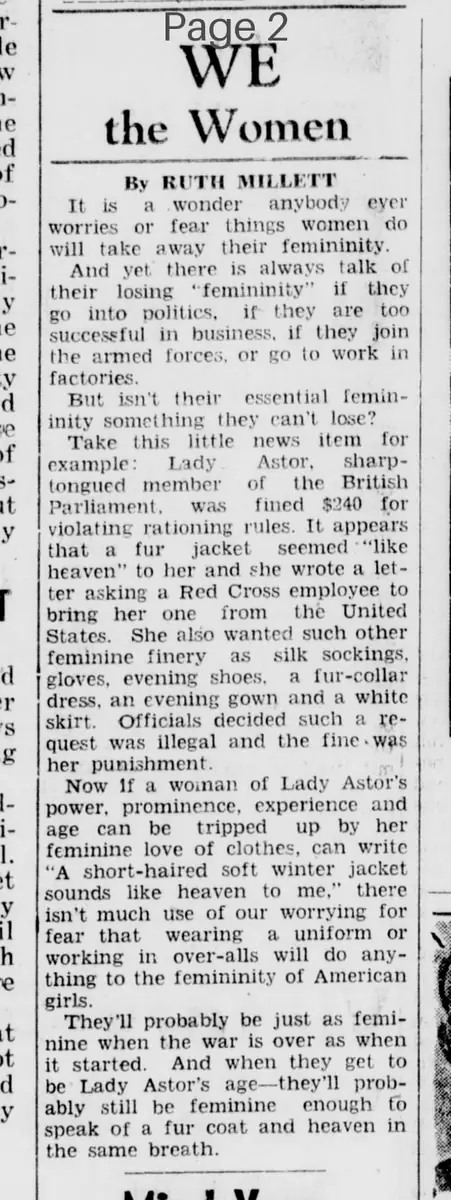
WE the Women
By RUTH MILLETT
It is a wonder anybody ever worries or fears things women do will take away their femininity.
And yet there is always talk of their losing "femininity" if they go into politics, if they are too successful in business, if they join the armed forces, or go to work in factories.
But isn't their essential femininity something they can't lose?
Take this little news item for example:
Lady Astor, sharp-tongued member of the British Parliament, was fined $240 for violating rationing rules. It appears that a fur jacket seemed "like heaven" to her and she wrote a letter asking a Red Cross employee to bring her one from the United States. She also wanted such other feminine finery as silk stockings, gloves, evening shoes, a fur-collar dress, an evening gown and a white skirt. Officials decided such a request was illegal and the fine was her punishment.
Now if a woman of Lady Astor's power, prominence, experience and age can be tripped up by her feminine love of clothes, can write "A short-haired soft winter jacket sounds like heaven to me," there isn't much use of our worrying for fear that wearing a uniform or working in over-alls will do anything to the femininity of American girls.
They'll probably be just as feminine when the war is over as when it started. And when they get to be Lady Astor's age—they'll probably still be feminine enough to speak of a fur coat and heaven in the same breath.
By RUTH MILLETT
It is a wonder anybody ever worries or fears things women do will take away their femininity.
And yet there is always talk of their losing "femininity" if they go into politics, if they are too successful in business, if they join the armed forces, or go to work in factories.
But isn't their essential femininity something they can't lose?
Take this little news item for example:
Lady Astor, sharp-tongued member of the British Parliament, was fined $240 for violating rationing rules. It appears that a fur jacket seemed "like heaven" to her and she wrote a letter asking a Red Cross employee to bring her one from the United States. She also wanted such other feminine finery as silk stockings, gloves, evening shoes, a fur-collar dress, an evening gown and a white skirt. Officials decided such a request was illegal and the fine was her punishment.
Now if a woman of Lady Astor's power, prominence, experience and age can be tripped up by her feminine love of clothes, can write "A short-haired soft winter jacket sounds like heaven to me," there isn't much use of our worrying for fear that wearing a uniform or working in over-alls will do anything to the femininity of American girls.
They'll probably be just as feminine when the war is over as when it started. And when they get to be Lady Astor's age—they'll probably still be feminine enough to speak of a fur coat and heaven in the same breath.
What sub-type of article is it?
Feminism
What keywords are associated?
Women's Femininity
Wartime Work
Lady Astor
Rationing Violation
Gender Roles
What entities or persons were involved?
Lady Astor
Ruth Millett
Editorial Details
Primary Topic
Women's Femininity In Wartime Roles
Stance / Tone
Reassuring And Supportive Of Women's Roles
Key Figures
Lady Astor
Ruth Millett
Key Arguments
Essential Femininity Cannot Be Lost Through Professional Or Wartime Activities
Lady Astor's Violation Of Rationing For Clothing Shows Persistent Feminine Desires
American Women Will Remain Feminine Post War