Thank you for visiting SNEWPapers!
Sign up free
Story
April 26, 1877
The Red Cloud Chief
Red Cloud, Webster County, Nebraska
What is this article about?
Dr. Schliemann reports from Athens on Feb. 1 a new tomb discovered at Mycenae by his engineer, yielding golden goblets, vessels, and rings depicting scenes reminiscent of Homer's descriptions, confirming Achaian links.
Clipping
OCR Quality
88%
Good
Full Text
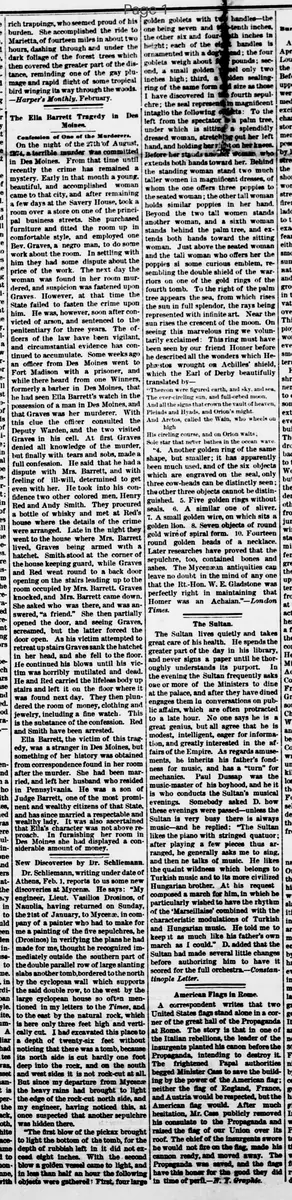
Dr. Schliemann, writing under date of Athens, Feb. 1, reports to us some new discoveries at Mycenae. He says: My engineer, Lieut. Vasilios Drosinos, of Naupila, having returned on Sunday, the 21st of January, to Mycenae, in company of a painter who had to make for me a painting of the five sepulchres, he (Drosinos) in verifying the plans he had made for me, thought he recognized immediately outside the southern part of the double parallel row of large slanting slabs another tomb, bordered to the north by the cyclopean wall which supports the said double row, to the west by the large cyclopean house so often mentioned in my letters to the Times, and to the east by the natural rock, which is here only three feet high and vertically cut. I had excavated this place to a depth of twenty-six feet without noticing that there was a tomb, because its north side is cut hardly one foot deep into the rock, and on the south and west sides it is not rock-cut at all. But since my departure from Mycenae the heavy rains had brought to light the edge of the rock-cut north side, and my engineer, having noticed this, at once suspected that another sepulchre was hidden there.
The first blow of the pickaxe brought to light the bottom of the tomb, for the depth of rubbish left in it did not exceed eight inches. With the second blow a golden vessel came to light, and in less than half an hour the following objects were gathered: First, four large golden goblets with handles—the one being seven and the other six and four height; each of the handles is ornamented with a head; the four goblets weigh about pounds; second, a small golden vessel only two inches high; third, golden sealing ring of the same form and size as those I have discovered in the fourth sepulchre; the seal represents in magnificent intaglio the following scene:
To the left from the spectator palm tree, under which is sitting splendidly dressed woman, stretching out her left hand, and holding her right on her knees. Before her stands another woman who extends both hands toward her. Behind the standing woman stand two much taller women in magnificent dresses, of whom the one offers three poppies to the seated woman; the other tall woman holds similar poppies in her hand. Beyond the two tall women stands another woman, and a sixth woman stands behind the palm tree, and extends both hands toward the sitting woman. Just above the seated woman and the tall woman who offers her the poppies is some curious emblem, resembling the double shield of the warriors on one of the gold rings of the fourth tomb. To the right of the palm tree appears the sea, from which rises the sun in full splendor, the rays being represented with infinite art. Near the sun rises the crescent of the moon. On seeing this marvelous ring we voluntarily exclaimed: This ring must have been seen by our friend Homer before he described all the wonders which Hephaestus wrought on Achilles's shield, which the Earl of Derby beautifully translated by—
"Thereon were figured earth, and sky, and sea.
The ever-circling sun, and full-orbed moon,
And all the signs that crown the vault of heaven,
Pleiads and Hyades, and Orion's might.
And Arctos, called the Wain, who wheels on high
His circling course, and on Orion waits
Sole star that never bathes in the ocean wave."
4. Another golden ring of the same shape, but smaller: it has apparently been much used, and of the six objects which are engraved on the seal, only three cow-heads can be distinctly seen: the other three objects cannot be distinguished. 5. Five golden rings without seals.
6. A similar one of silver.
7. A small golden wire, on which sits a golden lion. 8. Seven objects of round gold wire of spiral form. 10. Fourteen round golden beads of a necklace.
Later researches have proved that the sepulchre, too, contained bones and ashes. The Mycenaean antiquities can leave no doubt in the mind of any one that the Rt.-Hon. W. E. Gladstone was perfectly right in maintaining that Homer was an Achaian."—London Times.
The first blow of the pickaxe brought to light the bottom of the tomb, for the depth of rubbish left in it did not exceed eight inches. With the second blow a golden vessel came to light, and in less than half an hour the following objects were gathered: First, four large golden goblets with handles—the one being seven and the other six and four height; each of the handles is ornamented with a head; the four goblets weigh about pounds; second, a small golden vessel only two inches high; third, golden sealing ring of the same form and size as those I have discovered in the fourth sepulchre; the seal represents in magnificent intaglio the following scene:
To the left from the spectator palm tree, under which is sitting splendidly dressed woman, stretching out her left hand, and holding her right on her knees. Before her stands another woman who extends both hands toward her. Behind the standing woman stand two much taller women in magnificent dresses, of whom the one offers three poppies to the seated woman; the other tall woman holds similar poppies in her hand. Beyond the two tall women stands another woman, and a sixth woman stands behind the palm tree, and extends both hands toward the sitting woman. Just above the seated woman and the tall woman who offers her the poppies is some curious emblem, resembling the double shield of the warriors on one of the gold rings of the fourth tomb. To the right of the palm tree appears the sea, from which rises the sun in full splendor, the rays being represented with infinite art. Near the sun rises the crescent of the moon. On seeing this marvelous ring we voluntarily exclaimed: This ring must have been seen by our friend Homer before he described all the wonders which Hephaestus wrought on Achilles's shield, which the Earl of Derby beautifully translated by—
"Thereon were figured earth, and sky, and sea.
The ever-circling sun, and full-orbed moon,
And all the signs that crown the vault of heaven,
Pleiads and Hyades, and Orion's might.
And Arctos, called the Wain, who wheels on high
His circling course, and on Orion waits
Sole star that never bathes in the ocean wave."
4. Another golden ring of the same shape, but smaller: it has apparently been much used, and of the six objects which are engraved on the seal, only three cow-heads can be distinctly seen: the other three objects cannot be distinguished. 5. Five golden rings without seals.
6. A similar one of silver.
7. A small golden wire, on which sits a golden lion. 8. Seven objects of round gold wire of spiral form. 10. Fourteen round golden beads of a necklace.
Later researches have proved that the sepulchre, too, contained bones and ashes. The Mycenaean antiquities can leave no doubt in the mind of any one that the Rt.-Hon. W. E. Gladstone was perfectly right in maintaining that Homer was an Achaian."—London Times.
What sub-type of article is it?
Extraordinary Event
Curiosity
Historical Event
What themes does it cover?
Exploration
Triumph
What keywords are associated?
Mycenae Discovery
Golden Artifacts
Homer Reference
Ancient Tomb
Cyclopean Wall
What entities or persons were involved?
Dr. Schliemann
Lieut. Vasilios Drosinos
Where did it happen?
Mycenae
Story Details
Key Persons
Dr. Schliemann
Lieut. Vasilios Drosinos
Location
Mycenae
Event Date
January 21
Story Details
Engineer Drosinos discovers a hidden tomb at Mycenae after rains expose it; excavation reveals golden goblets, vessels, sealing rings with scenes of women and palm tree, sun and moon, and other artifacts, evoking Homeric imagery.