Thank you for visiting SNEWPapers!
Sign up free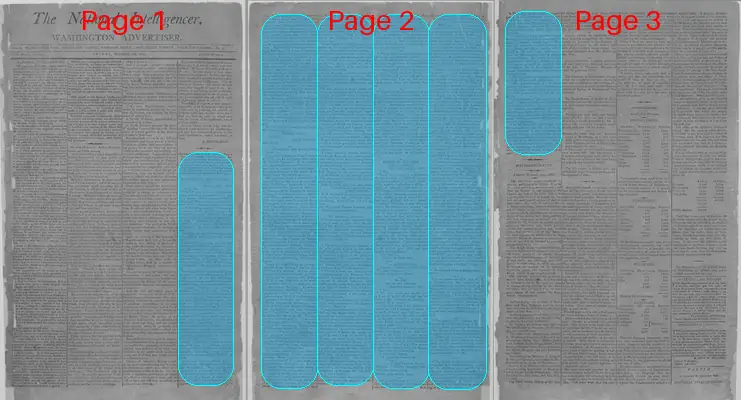
The National Intelligencer And Washington Advertiser
Washington, District Of Columbia
What is this article about?
Publication of John Adams' 1792 letter to Tench Coxe discussing Thomas Pinckney's appointment as ambassador to Britain, suspected British influence, and manufactures; Adams' 1800 response clarifying suspicions; Alexander Hamilton's pamphlet excerpts criticizing Adams' character and fitness for presidency, including letters from Hamilton to Adams.
Merged-components note: Continuous publication of John Adams' letters to Tench Coxe and Thomas Pinckney, along with Alexander Hamilton's strictures and excerpts from his pamphlet critiquing Adams' character and policies, spanning pages 1-3. Original labels include letter_to_editor, domestic_news, and foreign_news; unified as domestic_news due to focus on U.S. political figures and internal affairs.
Clippings
1 of 3
OCR Quality
Full Text
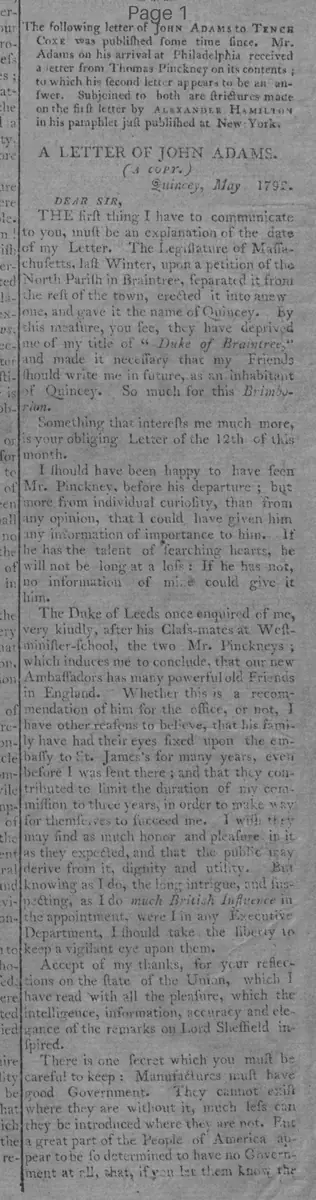
A LETTER OF JOHN ADAMS.
(COPY.)
Quincy, May 1792.
DEAR SIR,
THE first thing I have to communicate to you, must be an explanation of the date of my Letter. The Legislature of Massachusetts, last Winter, upon a petition of the North Parish in Braintree, separated it from the rest of the town, erected it into a new one, and gave it the name of Quincy. By this measure, you see, they have deprived me of my title of "Duke of Braintree," and made it necessary that my Friends should write me in future, as an inhabitant of Quincy. So much for this Brimborion.
Something that interests me much more, is your obliging Letter of the 12th of this month.
I should have been happy to have seen Mr. Pinckney, before his departure; but more from individual curiosity, than from any opinion, that I could have given him any information of importance to him. If he has the talent of searching hearts, he will not be long at a loss: If he has not, no information of mine could give it him.
The Duke of Leeds once enquired of me, very kindly, after his Class-mates at Westminster-school, the two Mr. Pinckneys; which induces me to conclude, that our new Ambassador has many powerful old Friends in England. Whether this is a recommendation of him for the office, or not, I have other reasons to believe, that his family have had their eyes fixed upon the embassy to St. James's for many years, even before I was sent there; and that they contributed to limit the duration of my commission to three years, in order to make way for themselves to succeed me. I wish they may find as much honor and pleasure in it as they expected, and that the public may derive from it, dignity and utility. But knowing as I do, the long intrigue, and suspecting, as I do much British Influence in the appointment, were I in any Executive Department, I should take the liberty to keep a vigilant eye upon them.
Accept of my thanks, for your reflections on the state of the Union, which I have read with all the pleasure, which the intelligence, information, accuracy and elegance of the remarks on Lord Sheffield inspired.
There is one secret which you must be careful to keep: Manufactures must have good Government. They cannot exist where they are without it, much less can they be introduced where they are not. Put a great part of the People of America at their ease, and they appear to be so determined to have no Government at all, that, if you let them know the whole Truth, you will excite an unmanageable Party against Manufactures. Manufactures cannot live, much less thrive, without honor, fidelity, punctuality, public and private faith, a sacred respect to property, and the moral obligation of promises and contracts, virtues and habits which never did, and never will generally prevail in any populous nation, without a decisive, as well as an intelligent and honest Government. The science of political economy is but a late study, and is not yet generally understood among us. Though I have read most of the Authors of reputation on the subject, both among the French and English, I pretend not to have digested any thing relative to it, with the precision of a Master. But to me it appears, that the general interests of Agriculture in particular, as well as of the Nation in general, will be promoted by a discreet and judicious encouragement of Manufactures; and that it is only the Land-jobber, who can be benefitted in the rapid rise of his monopoly, by drawing every labouring hand into the Wilderness to fell trees.
The continual accessions of Foreigners will endanger and destroy our peace, if we know not how to govern them. They will moreover corrupt our Elections, and tear us to pieces. Sufficient to the day, however, is its own evil; and in that day, and hour it always has been, and I doubt not always will be, given us to provide against its dangers.
Remember me affectionately to all Friends and believe me to be,
Faithfully yours,
(Signed) JOHN ADAMS.
MR. COXE.
Philadelphia, 26th October, 1800.
Dear Sir,
It was only on yesterday, that I received the letter, you did me honor to write me on the 16th of September. In the friendly and respectful stile in which it is written, I pray you to accept of my hearty thanks; and you shall receive in my answer all the satisfaction in my power to give you.
Of the letter, which is published in my name, I have no copy, nor any very particular recollection. In general, I remember, that when Mr. Coxe was assistant to the Secretary of the Treasury, he was very assiduous in his attentions to me; made me many visits at my house and many invitations to his own, when I was at the seat of government, and wrote me many letters when I was absent from it. I have also an indistinct idea of his writing me a letter, before your embarkation for Europe, expressing a great anxiety, that an interview should take place between you and me, before you should depart, and an opinion that it would be in my power to communicate to you, some useful information and advice relative to the subject of your mission. As I knew of nothing that could make it necessary for you to take a journey to Philadelphia, it is probable I wrote him something like the letter that is published. This, however, has been manifestly, either so carelessly copied or unfaithfully printed, that I must refer to the original letter, which, if it is in my hand writing will be easily known.
It may not be easy for me to give you a clear idea of the situation I was in, when that letter was written. In order to accomplish this necessary purpose, as well as I can, it must be observed, that in May, 1792, it was my misfortune to be wholly unacquainted with all the gentlemen who bear the name of Pinckney. I had never seen one of them in my life, as I can recollect, and I knew not that there were more than two. When I heard of your appointment, I recollected the conversation with the Marquis of Carmarthen, now Duke of Leeds, and imagined it probable that his Lordship might have intimated directly or indirectly, to some one near the President, that one of the Mr. Pinckneys would be agreeable at Court. I never had an idea of any other influence, than that which is very common in Europe, when one government causes intimations to be given to another, that the appointment of some particular gentleman, would be agreeable; and I now fully believe that my suspicion of even that kind of influence, was wholly unfounded in reality, though it had then some colour, in appearance.
The other insinuation concerning the Pinckney family had no other foundation than this. When I received my commission to the Court of St. James, I observed in it a limitation to three years. As I did not recollect any example of this before, I was at a loss for the reason of it; but as I did not intend at that time to remain in Europe, even so long a time as three years, I thought very little of it, until afterwards on my arrival in London, in 1785, I received information, without enquiry, that Mr. Pinckney, a member of Congress from South Carolina, had said, that the limitation to three years, had been inserted in my commission, for the purpose of getting rid of me: that the mission to London was too good a thing for me, and that the intention was, as soon as I could be removed to send a Mr. Pinckney of South Carolina in my room."
When I heard of a Mr. Pinckney's appointment, this London information came into my mind and diverted me, because I supposed Mr. Pinckney after 8 years, had carried his point, and occasioned the sentiment expressed in the letter, which, from the sportive, playful, careless air of it, throughout, must be easily perceived to have been confidential.
It may be easily ascertained, who was the member of Congress in 1784 or 1785, when my commission was granted and dated, and when the limitation to three years was inserted.
On this occasion it is but justice and equity in me to declare, that I have not at this time, the smallest reason to believe or suspect, that you or your brother ever solicited any appointment under Government, abroad or at home: that the whole conduct of both, as far as it has come to my knowledge, and I have had, considerable opportunities to know the conduct of both since 1792, has shewn minds candid, able and independent, wholly free from any kind of influence from Britain and from any improper bias in favour of that Country or any other: and that both have rendered, with honor and dignity to themselves, great and important services to our Country. And I will add, in the sincerity of my heart, that I know of no two gentlemen, whose characters and conduct, are more deserving of confidence.
I cannot conclude without observing, that we are fallen on evil times; on evil times indeed, are we fallen, if every private conversation is immediately to be betrayed and misrepresented in the newspapers, and if every frivolous and confidential letter is to be dragged by the hand of treachery, from its oblivion of eight years and published by malice and revenge, for the purpose of making mischief.
I am, Sir, with great truth and regard,
Your friend and humble Servant.
JOHN ADAMS.
P. S. As your letter has been so long on its way to me, I shall publish this answer immediately, which, I hope you will excuse.
The Honourable Thomas Pinckney, Esq.
Charleston, South Carolina.
Mr. Hamilton's Strictures.
"Occurrences which have either happened or come to light since the election of Mr. Adams to the presidency, confirming my unfavourable foreboding of his character, have given new and decisive energy in my mind, to the sentiment of his unfitness for the station.
"The letter which has just appeared in the public prints, written by him, when Vice President, to Tench Coxe, is of itself conclusive evidence of the justice of his sentiment. It is impossible to speak of this transaction in terms suited to its nature, without losing sight that Mr. Adams is President of the United States.
"This letter avows the suspicion, that the appointment of Mr. Pinckney, to the Court of London, had been procured or promoted by British Influence. And considering the parade with which the story of the Duke of Leeds is told, it is fair to consider, that circumstance is the principal, if not the sole ground of the odious and degrading suspicion.
"Let any man of candour or knowledge of the world pronounce on this species of evidence." Page 14.
"But a more serious question remains—How will Mr. Adams answer to the government and to his country, for having thus wantonly given the sanction of his opinion to the worst of the assertions which the enemies of the administration have impudently thrown upon it? Can we be surprised that such a torrent of slander has poured out against it, when a man, the second in official rank, the second in the favor of the friends of the government, stooped to become himself one of the calumniators? It is peculiarly unlucky for Mr. Adams in this affair, that he is known to have desired, at the time, the appointment which was given to Mr. Pinckney. The President declined the measure, thinking that it was compatible neither with the spirit of the constitution, nor with the dignity of the government, to designate the Vice-President to such a station.
"This letter, better than volumes, develops the unfortunate character of Mr. Adams!" Page 20.
ALEXANDER HAMILTON, of New York, has this day published a Pamphlet replete with interesting political matter. Under the character of a vindication of himself, it is the vehicle of keen crimination of Mr. Adams, whom he declares unfit for the Presidency. The copy-right being secured, it is only permissible to make extracts from it: these, however, are selected in such a manner as not only to excite but reward curiosity.
"Having been repeatedly informed that Mr. Adams had delineated me as the leader of a British faction, and having understood that his partisans, to counteract the influence of my opinion, were pressing the same charge against me, I wrote him a letter on the subject, dated the first of August last: No reply having been given by him to this letter, I on the 1st of the present month, wrote him another. Page 4,5.
"To promote this co-operation, to defend my own character, to vindicate those friends, who with myself have been unkindly aspersed, are the inducements for writing this letter. Accordingly it will be my endeavor to regulate the communication of it in such a manner as will not be likely to deprive Mr. Adams of, a single vote. Indeed it is much my wish, that its circulation could forever be confined within narrow limits. I am sensible of the inconveniences of giving publicity to a similar development of the character of the chief magistrate of our country; and I lament the necessity of taking a step which will involve that result. Yet to suppress truths, the disclosure of which is so interesting to the public welfare, as well as to the vindication of my friends and myself, did not appear to me justifiable.' p. 51.
COPIES OF LETTERS,
(Above alluded to.)
New-York, August 1, 1800.
"SIR,
"It has been repeatedly mentioned to me, that you have on different occasions asserted the existence of a British faction in this country, embracing a number of leading or influential characters of the federal party, (as usually denominated) and that you have sometimes named me; at others, alluded to me as one of this description of persons: & I have likewise been assured that some of your warm adherents, for electioneering purposes, have employed a corresponding language. I must Sir, take it for granted, that you cannot have made such assertions or insinuations, without being willing to avow them; and to assign the reason to a party who may conceive himself injured by them. I therefore trust, that you will not deem it improper, that I apply directly to yourself, to ascertain from you, in reference to your own declarations, whether the information I have received has been correct or not; and if correct, what are the grounds upon which you have founded the suggestions?"
With respect,
I have the honor to be,
Sir,
Your obedient servant,
(Signed) ALEX. HAMILTON.
TO JOHN ADAMS, ESQ.
President of the United States.
No VII.
THE SECOND LETTER.
"New-York October 1, 1800
"SIR,
"The time which has elapsed since my letter of the 1st of August was delivered to you, precludes the further expectation of an answer.
"From this silence I will draw no inference; nor will I presume to judge of the fitness of silence upon such an occasion, on the part of the chief magistrate of a republic towards a citizen, who without a stain has discharged so many important public trusts.
"But thus much I will affirm, that by whomsoever a charge of the kind mentioned in my former letter, may at any time have been made or insinuated against me, it is a base, wicked, and cruel calumny; destitute even of a plausible pretext to excuse the folly, or mask the depravity which must have dictated it.
"With due respect,
"I have the honor to be
"Sir,
"Your Obedient Servant
(Signed) "ALEX. HAMILTON."
TO JOHN ADAMS, ESQ.
President of the United States.
"The circumstances of my late military situation have much less to do with my personal discontent than some others. In respect to them, I shall only say, that my appointment to the station and rank I held, to the express stipulation of General Washington when he accepted the command of the army; afterwards peremptorily insisted upon by him, in opposition to the strong wishes of the President; and that though second in rank, I was not promoted to the first place when it became vacant by the death of the Commander in Chief. As to the former, I should have no cause to complain, if there had not been an apparent inconsistency in the measures of the President: if he had not nominated me first on the list of major generals, and afterwards attempted to place me third in rank!"
"On other topics my sensations are far less neutral. If as I have been assured, from respectable authorities, Mr. Adams has repeatedly indulged himself in virulent and indecent abuse of me; if he has denominated me a man destitute of every moral principle; if he has stigmatized me as the leader of a British faction; then certainly I have a right to think that I have been not only cruelly and wickedly traduced: then have I an exclusive right to appeal to all those who have been spectators of my public actions; to all who are acquainted with my private character in its various relations, whether such treatment of me by Mr. Adams, is of a nature to weaken or strengthen his claim to the approbation of wise and good men; then will I so far yield to the consciousness of worth as to declare, that in the cardinal points of public and private rectitude, above all in pure and disinterested zeal for the interests and services of the country, I shrink not from a comparison with any arrogant pretender to superior and exclusive merit.
"I ought to premise, that the ground upon which I stand, is different from that of most of those who are confederated with me in pursuit of the same plan. While our object is common, our motives are variously and dissimilar. A party well affected to Mr. Adams, have no other wish, than to take a double chance against Mr. JEFFERSON. Another part feeling a diminution of confidence in him, still hope that the general tenor of his conduct will be right. Few go as far in their obligations as I do. Not denying to Mr. Adams patriotism and integrity, and even talents of a certain kind, I should be deficient of candor were I to conceal the conviction, that he does not possess the talents adapted to the administration of government, and that there are great and intrinsic defects in his character, which unfit him for the office of chief magistrate." Page 4.
"Being among the guests appointed to dine with the Count De Vergennes, minister for foreign affairs, Mr. Adams thought fit to give a specimen of American politeness, by conducting Madam Vergennes to dinner; in the way she was pleased to make retribution in the current coin of French politeness, by saying to him, "*Monsieur Adams, vous etes le Washington de negociation." Stating this incident (Mr. Adams in his journal) makes this comment upon it "These people have a very pretty knack of paying compliments." He might have added, they have also a very dexterous knack at disguising a sarcasm." Page 9.
* Mr. Adams, you are the Washington of negotiation.
"It was agreed that a few votes should be diverted from Mr. Adams to other persons, so as to ensure to General Washington a plurality. Great was my astonishment, and equally great my regret, when afterwards, I learned from persons of unquestionable veracity, that Mr. Adams had complained of, unfair treatment, in not having been permitted to take an equal chance with general Washington, by leaving the votes to an uninfluenced current.'" P.9.
"The outset (of Mr. Adams's administration) was distinguished by a speech which his friends lamented as temporising. It had the air of a lure for the favour of his opponents at the expense of his sincerity; but being of an unequivocal complexion, to which no precise design can be annexed, it is barely mentioned as a circumstance, which, in conjunction with others of a more positive tint, may serve to explain his character." P. 20.
"The friends of the government were not agreed as to ulterior measures. Some were for immediate and unqualified war: others for a more mitigated course: to dissolution of treaties, preparations of force by sea and land—partial hostilities of a defensive tendency, leaving to France the option of seeking accommodation, or proceeding to open war." p. 25.
The session which ended this promulgation of the despatches of our commissioners, was about to commence. Mr. Adams arrived at Philadelphia from his seat in Quincy. The tone of his mind seemed to have been raised, rather than depressed.
"It was suggested to him, that it might be expedient to insert in his speech to Congress, a sentiment of this import; That after the repeatedly rejected advances of this country, its dignity required that it should be left with France in future, to make the first overture, that if desirous of reconciliation, she would evince the disposition, by sending a minister to this government, he would be received with the respect due to his character, and treated with in the frankness of a sincere accommodation."
The suggestion was received in a manner both indignant and intemperate.
"Mr. Adams declared as a sentiment which he adopted on mature reflection: That if France should send a minister tomorrow he would order him back the day after."
"So imprudent an idea was easily refuted. Little argument was requisite to show, that by a similar system of retaliation, when our government in a particular instance had refused the envoy of another, nations might entail upon each other perpetual hostility; mutually barring the avenues of explanation."
"In less than forty eight hours from this extraordinary ally, the mind of Mr. Adams underwent a total revolution—he resolved not only to insert in his speech the sentiment which had been proposed to him, but to go farther, and to declare, that if France would give explicit assurances of receiving a minister from this country, with due respect, he would send one." Page 24, 25.
What sub-type of article is it?
What keywords are associated?
What entities or persons were involved?
Where did it happen?
Domestic News Details
Primary Location
Philadelphia
Event Date
October 1800
Key Persons
Outcome
publication of adams' letters and hamilton's pamphlet criticizing adams' character and fitness for presidency, amid 1800 election tensions.
Event Details
Newspaper publishes Adams' 1792 letter to Coxe suspecting British influence in Pinckney's ambassador appointment, Adams' 1800 clarification denying unfounded suspicions, and excerpts from Hamilton's pamphlet accusing Adams of calumny and unfitness, including Hamilton's unanswered letters to Adams.