Thank you for visiting SNEWPapers!
Sign up free
The New Hampshire Gazette And Historical Chronicle
Portsmouth, Greenland, Rockingham County, New Hampshire
What is this article about?
This editorial urges colonists to prioritize communal interest over private gain, blaming the East India Company and British ministry for oppressive tea trade policies that sparked resistance, including tea destruction and the Boston Port Bill. It advocates colonial unity, non-importation, and pressuring Britain for repeal of acts.
Merged-components note: These two components form a single continuous editorial essay, as the text flows directly from one to the other and is signed 'CAMILLUS' at the end.
Clipping
OCR Quality
Full Text
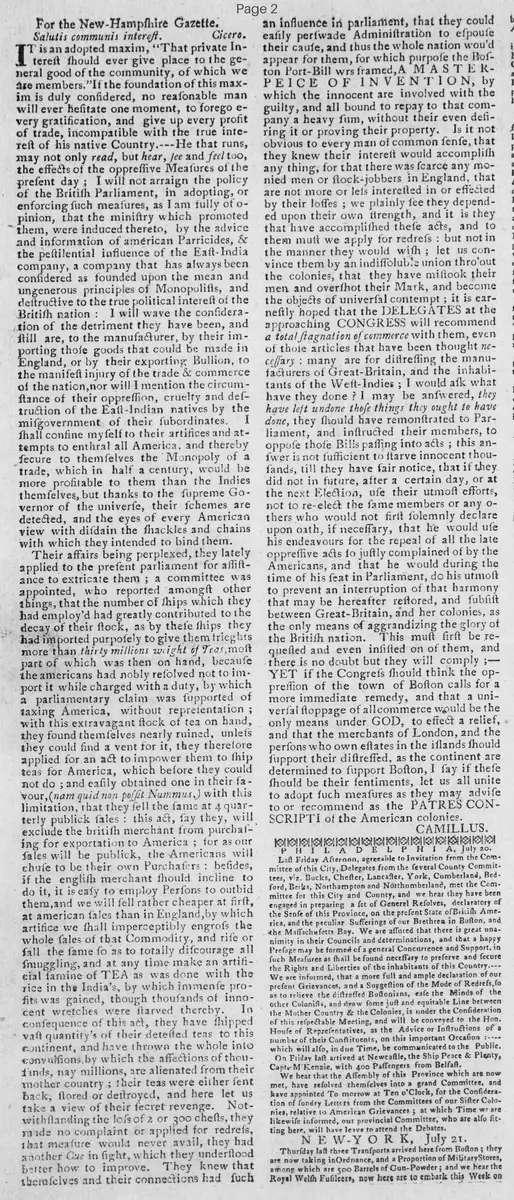
Salutis communis interest.
Cicero.
It is an adopted maxim, "That private Interest should ever give place to the general good of the community, of which we are members." If the foundation of this maxim is duly considered, no reasonable man will ever hesitate one moment, to forego every gratification, and give up every profit of trade, incompatible with the true interest of his native Country.---He that runs, may not only read, but hear, see and feel too, the effects of the oppressive Measures of the present day; I will not arraign the policy of the British Parliament, in adopting, or enforcing such measures, as I am fully of opinion, that the ministry which promoted them, were induced thereto, by the advice and information of American Parricides, & the pestilential influence of the East-India company, a company that has always been considered as founded upon the mean and ungenerous principles of Monopolists, and destructive to the true political interest of the British nation: I will wave the consideration of the detriment they have been, and still are, to the manufacturer, by their importing those goods that could be made in England, or by their exporting Bullion, to the manifest injury of the trade & commerce of the nation, nor will I mention the circumstance of their oppression, cruelty and destruction of the East-Indian natives by the misgovernment of their subordinates.
I shall confine myself to their artifices and attempts to enthral all America, and thereby secure to themselves the Monopoly of a trade, which in half a century, would be more profitable to them than the Indies themselves, but thanks to the supreme Governor of the universe. their schemes are detected, and the eyes of every American view with disdain the shackles and chains with which they intended to bind them.
Their affairs being perplexed, they lately applied to the present parliament for assistance to extricate them; a committee was appointed, who reported amongst other things, that the number of ships which they had employ'd had greatly contributed to the decay of their stock, as by these ships they had imported purposely to give them freights more than thirty millions weight of Teas, most part of which was then on hand, because the Americans had nobly resolved not to import it while charged with a duty, by which a parliamentary claim was supported of taxing America, without representation; with this extravagant stock of tea on hand, they found themselves nearly ruined, unless they could find a vent for it, they therefore applied for an act to empower them to ship teas for America, which before they could not do; and easily obtained one in their favour, (nam quid non possit Nummus,) with this limitation, that they sell the same at 4 quarterly publick sales: this act, say they, will exclude the British merchant from purchasing for exportation to America; for as our sales will be publick. the Americans will chuse to be their own Purchasers: besides, if the English merchant should incline to do it, it is easy to employ Persons to outbid them, and we will sell rather cheaper at first, at American sales than in England, by which artifice we shall imperceptibly engross the whole sales of that Commodity, and rise or fall .the same so as to totally discourage all smuggling, and at any time make an artificial famine of TEA as was done with the rice in the India's, by which immense profits was gained, though thousands of innocent wretches were starved thereby. In consequence of this act, they have shipped vast quantity's of their detested teas to this continent, and have thrown the whole into convulsions, by which the affections of thousands, nay millions, are alienated from their mother country; their teas were either sent back. stored or destroyed, and here let us take a view of their secret revenge. Notwithstanding the loss of 300 or 400 chests, they made no complaint or applied for redress. that measure would never avail, they had another Cue in sight, which they understood better how to improve. They knew that themselves and their connections had such
an influence in parliament, that they could easily persuade Administration to espouse their cause, and thus the whole nation wou'd appear for them, for which purpose the Boston Port-Bill was framed, A MASTER-PIECE OF INVENTION, by which the innocent are involved with the guilty, and all bound to repay to that company a heavy sum, without their even desiring it or proving their property. Is it not obvious to every man of common sense, that they knew their interest would accomplish any thing, for that there was scarce any monied men or stock-jobbers in England. that are not more or less interested in or affected by their losses; we plainly see they depended upon their own strength, and it is they that have accomplished these acts. and to them must we apply for redress: but not in the manner they would wish; let us convince them by an indissoluble union thro'out the colonies, that they have mistook their men and overshot their Mark, and become the objects of universal contempt; it is earnestly hoped that the DELEGATES at the approaching CONGRESS will recommend a total stagnation of commerce with them, even of those articles that have been thought necessary: many are for distressing the manufacturers of Great-Britain, and the inhabitants of the West-Indies: I would ask what have they done? I may be answered, they have left undone those things they ought to have done, they should have remonstrated to Parliament, and instructed their members, to oppose those Bills passing into acts; this answer is not sufficient to starve innocent thousands, till they have fair notice, that if they did not in future, after a certain day, or at the next Election, use their utmost efforts, not to re-elect the same members or any Others who would not first solemnly declare upon oath, if necessary, that he would use his endeavours for the repeal of all the late oppressive acts so justly complained of by the Americans, and that he would during the time of his seat in Parliament, do his utmost to prevent an interruption of that harmony that may be hereafter restored, and subsist between Great-Britain, and her colonies, as the only means of aggrandizing the glory of the British nation. This must first be requested and even insisted on of them, and there is no doubt but they will comply ;- YET if the Congress should think the oppression of the town of Boston calls for a more immediate remedy, and that a universal stoppage of all commerce would be the only means under GOD. to effect a relief, and that the merchants of London, and the persons who own estates in the islands should support their distressed, as the continent are determined to support Boston, I say if these should be their sentiments. let us all unite to adopt such measures as they may advise to or recommend as the PATRES CONSCRIPTI of the American colonies.
CAMILLUS.
What sub-type of article is it?
What keywords are associated?
What entities or persons were involved?
Editorial Details
Primary Topic
Opposition To East India Company Tea Monopoly And British Oppressive Acts
Stance / Tone
Strongly Pro Colonial Unity And Anti East India Company Schemes
Key Figures
Key Arguments