Thank you for visiting SNEWPapers!
Sign up free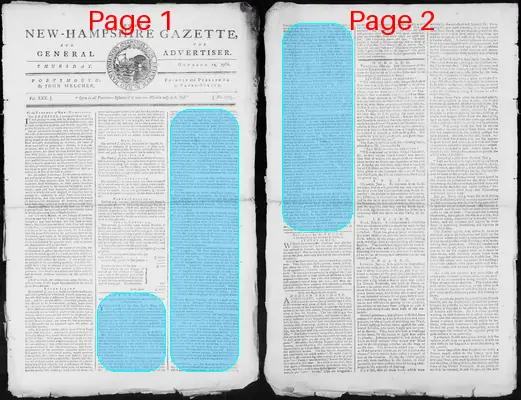
Fowle's New Hampshire Gazette And General Advertiser
Portsmouth, Rockingham County, New Hampshire
What is this article about?
On October 12, Rufus King addressed the Massachusetts House of Representatives, reporting on Congress affairs including continental bills, Penobscot expedition costs, federal treasury woes, domestic debt, commercial regulations, and the critical commotions in Massachusetts, urging vigorous response.
Merged-components note: Continuation of the article on Mr. King's communications to the House of Representatives across pages 1 and 2.
Clippings
1 of 2
OCR Quality
Full Text
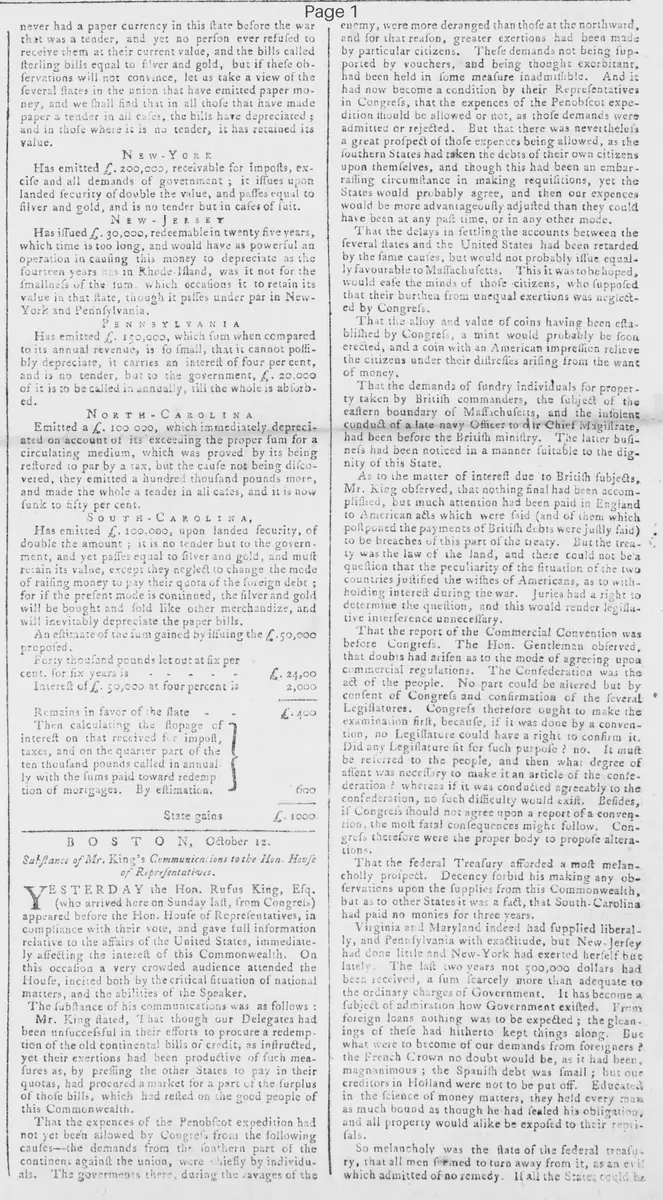
Substance of Mr. King's Communications to the Hon. House of Representatives.
YESTERDAY the Hon. Rufus King, Esq. (who arrived here on Sunday last, from Congress) appeared before the Hon. House of Representatives, in compliance with their vote, and gave full information relative to the affairs of the United States, immediately affecting the interest of this Commonwealth. On this occasion a very crowded audience attended the House, incited both by the critical situation of national matters, and the abilities of the Speaker.
The substance of his communications was as follows:
Mr. King stated, that though our Delegates had been unsuccessful in their efforts to procure a redemption of the old continental bills or credit, as instructed, yet their exertions had been productive of such measures as, by pressing the other States to pay in their quotas, had procured a market for a part of the surplus of those bills, which had rested on the good people of this Commonwealth.
That the expences of the Penobscot expedition had not yet been allowed by Congress, from the following causes—the demands from the southern part of the continent against the union, were chiefly by individuals. The governments there, during the ravages of the enemy, were more deranged than those at the northward, and for that reason, greater exertions had been made by particular citizens. These demands not being supported by vouchers, and being thought exorbitant, had been held in some measure inadmissible. And it had now become a condition by their Representatives in Congress, that the expences of the Penobscot expedition should be allowed or not, as those demands were admitted or rejected. But that there was nevertheless a great prospect of those expences being allowed, as the southern States had taken the debts of their own citizens upon themselves, and though this had been an embarrasing circumstance in making requisitions, yet the States would probably agree, and then our expences would be more advantageously adjusted than they could have been at any past time, or in any other mode.
That the delays in settling the accounts between the several states and the United States had been retarded by the same causes, but would not probably issue equally favourable to Massachusetts. This it was to be hoped, would ease the minds of those citizens, who supposed that their burthen from unequal exertions was neglected by Congress.
That the alloy and value of coins having been established by Congress, a mint would probably be soon erected, and a coin with an American impression relieve the citizens under their distresses arising from the want of money.
That the demands of sundry individuals for property taken by British commanders, the subject of the eastern boundary of Massachusetts, and the insolent conduct of a late navy Officer to our Chief Magistrate, had been before the British ministry. The latter business had been noticed in a manner suitable to the dignity of this State.
As to the matter of interest due to British subjects, Mr. King observed, that nothing final had been accomplished, but much attention had been paid in England to American acts which were said (and of them which postponed the payments of British debts were justly said) to be breaches of this part of the treaty. But the treaty was the law of the land, and there could not be a question that the peculiarity of the situation of the two countries justified the wishes of Americans, as to withholding interest during the war. Juries had a right to determine the question, and this would render legislative interference unnecessary.
That the report of the Commercial Convention was before Congress. The Hon. Gentleman observed, that doubts had arisen as to the mode of agreeing upon commercial regulations. The Confederation was the act of the people. No part could be altered but by consent of Congress and confirmation of the several Legislatures. Congress therefore ought to make the examination first, because, if it was done by a convention, no Legislature could have a right to confirm it. Did any Legislature sit for such purpose? no. It must be referred to the people, and then what degree of assent was necessary to make it an article of the confederation? whereas if it was conducted agreeably to the confederation, no such difficulty would exist. Besides, if Congress should not agree upon a report of a convention, the most fatal consequences might follow. Congress therefore were the proper body to propose alterations.
That the federal Treasury afforded a most melancholy prospect. Decency forbid his making any observations upon the supplies from this Commonwealth, but as to other States it was a fact, that South-Carolina had paid no monies for three years.
Virginia and Maryland indeed had supplied liberally, and Pennsylvania with exactitude, but New-Jersey had done little and New-York had exerted herself but lately. The last two years not 500,000 dollars had been received, a sum scarcely more than adequate to the ordinary charges of Government. It has become a subject of admiration how Government existed. From foreign loans nothing was to be expected; the gleanings of these had hitherto kept things along. But what were to become of our demands from foreigners? the French Crown no doubt would be, as it had been, magnanimous; the Spanish debt was small: but our creditors in Holland were not to be put off. Educated in the science of money matters, they held every man as much bound as though he had sealed his obligation. and all property would alike be exposed to their reptials.
So melancholy was the state of the federal treasury, that all men seemed to turn away from it, as an evil which admitted of no remedy. If all the States could be
brought into the Continental Impost, this resource indeed might be anticipated, and the national credit strengthened in that way, but there remained two States which had not acceded to it, Pennsylvania and New-York. The situation of the former was known, and should that State be brought over, New-York would not dare longer to oppose the Union.
That as to the domestic debt, it had been urged that the people were not able to pay it; but there were not wanting means of reducing it in a short time. At any rate the great Representative Body of the States would never disgrace themselves by any dishonest measures relative to the securities. There were good grounds for the creditors to entertain a confidence of this. The State of New-York had already collected their proportion into their treasury; and Pennsylvania had done more. They had assumed the debt due to individuals, by the sale of their lands, and otherwise, and they would not fail therefore, to enforce an honourable payment of this debt. -- The means which Congress possessed to extinguish it, were not trifling. Their lands were now almost ready to be sold; near 3,000,000 of acres would be surveyed by November next, and purchases were eagerly sought after. That, in short, if America had any virtue left, she might yet be happy.
Her resources from the impost duty, and her lands, would very soon relieve her from her burdens. Near half a million of dollars might in a short time be applied from the duty, to sinking the domestic debt, and this fund would in a few years be nearly adequate to extinguishing the whole.
But the Honourable Gentleman observed, that there was an evil in public affairs, infinitely greater than any he had mentioned. It was not perhaps, immediately within the order, under which he had the honor to stand before that House: but so serious were the effects which it seemed to him must follow, that considerations of duty to the Legislature, and to his country, had emboldened him to mention it. The House, to be sure, would anticipate, that he spoke of the commotions now existing in Massachusetts. This was viewed by Congress, as the most important subject that ever came before that respectable assembly. Every member considered himself as personally interested in it. He realized his life, liberty and property, as involved in the issue of their decisions. There was a league subsisting between the States of America, to oppose every force that should arise against either of them. The United States would not be inactive on such an occasion. They were concerned--deeply concerned, in the result. If such a barrier was removed, every other government would eventually be swept away. Let numbers be compared; if government had only a minority, let it be remembered, that they had a majority, of every state in the Union, to join them. It ought not to be concealed, that the British Packet had been dispatched a day earlier, merely in consequence of the commotions which had happened with us.
Advantages might be taken of the divided state of the people, to bring about measures which otherwise could never be effected by the enemies of our country. When Congress should know this; when they should see government prostrated in the dust, what would be their feelings? They were not authorized to see any government subverted. If the Speaker had been too earnest on this subject, he requested the pardon of the House, as he spoke from a fear lest palliatives might be adopted where vigour was required.
The Hon. Gentleman then read several private letters, from a gentleman in office, at a foreign Court, to confirm the sentiments which he had advanced.
What sub-type of article is it?
What keywords are associated?
What entities or persons were involved?
Where did it happen?
Domestic News Details
Primary Location
Boston
Event Date
October 12
Key Persons
Event Details
Rufus King addressed the House of Representatives on national affairs affecting Massachusetts, covering continental bills, Penobscot expedition expenses, state accounts, coinage and mint, British demands and treaty issues, commercial convention, federal treasury shortages, domestic debt management, and the urgent commotions in Massachusetts.