Thank you for visiting SNEWPapers!
Sign up free
Story
December 6, 1816
Daily National Intelligencer
Washington, District Of Columbia
What is this article about?
Report of Kentucky Congressman Richard M. Johnson's speech in the House of Representatives defending the Compensation Law of 1816 while moving to inquire into its repeal due to public discontent. He clarifies misconceptions, compares salaries, and emphasizes duty to constituents.
Clipping
OCR Quality
98%
Excellent
Full Text
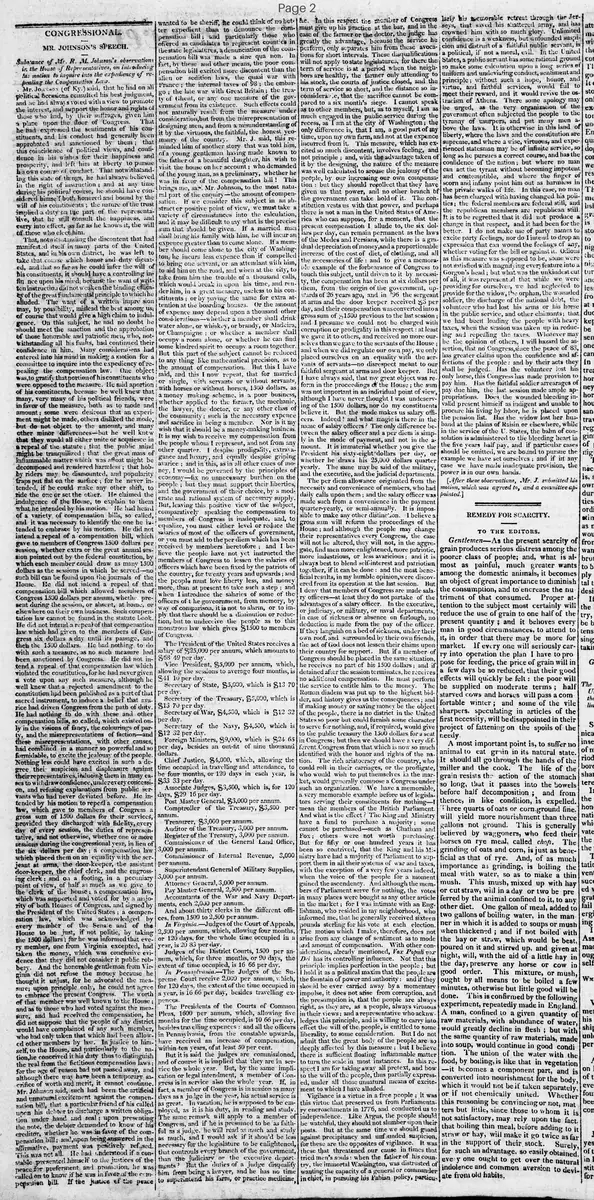
CONGRESSIONAL:
MR. JOHNSON'S SPEECH
Substance of Mr. R. M. Johnson's observations in the House of Representatives, on introducing his motion to inquire into the expediency of repealing the Compensation Law.
Mr. Johnson (of Ky.) said, that he had on all political occasions consulted his best judgment, and he had always voted with a view to promote the interest, and support the honor and rights of those who had, by their suffrages, given him a place upon the floor of Congress. That he had expressed the sentiments of his constituents, and his conduct had generally been approbated and sanctioned by them; that this coincidence of political views, and confidence in his wishes for their happiness and prosperity, had left him at liberty to pursue his own course of conduct. That notwithstanding this state of things, he had always believed in the right of instruction; and at any time during his political course, he should have considered himself both honored and bound by the will of his constituents; the nature of the trust implied a duty on the part of the representative, that he will consult the happiness, and carry into effect, as far as he knows it, the will of those who elect him.
That, notwithstanding the discontent that had manifested itself in many parts of the United States, and in his own district, he was left to take that course which honor and duty dictated, and that so far as he could infer the will of his constituents, it should have a controlling influence upon his mind; because the want of written instruction did not weaken the binding efficacy of the great fundamental principle to which he alluded. The want of a written impression may, by possibility, mislead the best among us; of course that would give a high claim to indulgence. On this subject, he had no doubt he should meet the sanction and the approbation of those honorable and patriotic men, who, notwithstanding all his faults, had continued their confidence in him. Many considerations had entered into his mind in making a motion for a committee to inquire into the expediency of repealing the compensation law. One object was, to gratify that portion of his constituents who were opposed to the measure. He said a portion of his constituents, because he well knew that many, very many of his political friends, were in favor of the measure, both as to mode and amount; some were desirous that an experiment might be made, others disliked the mode, but do not object to the amount, and many other minor differences—but he well knew that they would all either unite or acquiesce in a repeal of the statute; that the public mind might be tranquilized; that the great mass of inflammable matter which was afloat might be decomposed and rendered harmless; that hobby riders may be dismounted, and popularity traps put flat on the surface; for he never intended, if he could make any other shift, to ride the one or set the other. He claimed the indulgence of the House, to explain to them what he intended by his motion. He had heard of a variety of compensation bills, so called, and it was necessary to identify the one he intended to embrace by his motion. He did not intend a repeal of a compensation bill, which gave to members of Congress 1500 dollars per session, whether extra or the great annual session pointed out by the federal constitution, by which each member could draw as many 1500 dollars as the sessions in which he served—no such bill can be found upon the journals of the House. He did not intend a repeal of that compensation bill which allowed members of Congress 1500 dollars per annum, whether present during the session, or absent, at home, or elsewhere on their own business. Such compensation law cannot be found in the statute book. He did not intend a repeal of that compensation law which had given to the members of Congress six dollars a day until its passage, and then the 1500 dollars. He had nothing to do with such a measure, as no such measure had been sanctioned by Congress. He did not intend a repeal of that compensation law which violated the constitution, for he had never given a vote upon any such measure, although he well knew that a rejected amendment to the constitution had been published as a part of that sacred instrument, to induce a belief that avarice had driven Congress from the path of duty. He had nothing to do with these and other compensation bills, so called; which existed only in the visions of fancy, the colourings of party, and the misrepresentations of faction—and these misrepresentations, with other causes, had combined in a manner so powerful and so formidable, to excite the jealousy of the people. Nothing less could have excited in such a degree, their suspicion and displeasure against their representatives, inducing them in many cases to withdraw confidence, under every concession, and refusing explanations from public servants who had never deviated before. He intended by his motion to repeal a compensation law, which gave to members of Congress a gross sum of 1500 dollars for their services, provided they discharged with fidelity, every day of every session, the duties of representative, and not otherwise, whether one or more sessions during the congressional year, in lieu of the six dollars per day; a compensation law which placed them on an equality with the sergeant at arms, the door-keeper, the assistant door-keeper, the chief clerk, and the engrossing clerk: and on a footing, in a pecuniary point of view, of half as much as we give to the clerk of the house: a compensation law, which was supported and voted for by a majority of both Houses of Congress, and signed by the President of the United States; a compensation law, which was acknowledged by every member of the Senate and of the House to be just, if not politic, by taking the 1500 dollars; for he was informed that every member, one from Virginia excepted, had taken the money, which was conclusive evidence that they did not consider it public robbery. And the honorable gentleman from Virginia did not refuse the money because he thought it unjust, for he advocated the measure; upon principle only, he could not agree to embrace the present Congress. The worth of that member was well known to the House; and as to those who had voted against the measure, and had received the compensation, he did not suppose that the people of any district would have complained of any such member, who had only taken that which had been allowed other members by law. In justice to himself, to the House, and particularly to the nation, he conceived it his duty thus to distinguish the real from the fictitious compensation laws; for the age of reason had not passed away, and although there may have been a temporary sacrifice of worth and merit, it cannot continue.
Mr. Johnson said, such had been the artificial and unnatural excitement against the compensation bill, that a particular friend of his called upon his debtor to discharge a written obligation under hand and seal; upon presenting the note, the debtor demanded to know of the creditor, whether he was in favor of the compensation bill; and, upon being answered in the affirmative, payment was positively refused. This was not all. He had understood if a constable presented himself to the justices of the peace for preferment and promotion, he was called on to know if he was in favor of the compensation bill. If the justice of the peace wanted to be sheriff, he could think of no better expedient than to denounce the compensation bill; and particularly those who offered as candidates to represent counties in the state legislatures, a denunciation of the compensation bill was made a sine qua non. In fact, by these and other means, the poor compensation bill excited more discontent than the alien or sedition laws, the quasi war with France; the internal taxes of 98: the embargo; the late war with Great Britain; the treaty of Ghent, or any one measure of the government from its existence. Such effects could not naturally result from the measure under consideration, but from the misrepresentation of designing men, and from a misunderstanding of it by the virtuous, the faithful, the honest yeomanry of the country.
Mr. J. said, this reminded him of another story that was told him, of a young gentleman having made known to the father of a beautiful daughter, his wish to visit the house on her account; who demanded of the young man, as a preliminary, whether he was in favor of the compensation bill! This brings me, said Mr. Johnson, to the most natural part of the enquiry—the amount of compensation. If we consider this subject in an abstract or positive point of view, we must take a variety of circumstances into the calculation and it may be difficult to say what is the precise sum that should be given. If a married man shall bring his family with him, he will incur an expense greater than to come alone. If a member should come alone to the city of Washington, he incurs less expense than if compelled to bring one servant, or an attendant with him, to aid him on the road, and when at the city, to take from him the trouble of a thousand calls, which would break in upon his time, and render him, in a great measure, useless to his constituents; or by paying the same for extra attention at the boarding houses. Or the amount of expense may depend upon a thousand other considerations—whether a member shall drink water alone, or whiskey, or brandy, or Madeira, or Champagne; or whether a member shall occupy a room alone, or whether he can find some kindred spirit to occupy a room together. But this part of the subject cannot be reduced to any thing like mathematical precision, as to the amount of compensation. But this I have said, and this I now repeat, that for married or single, with servants or without servants, with horses or without horses, 1500 dollars, as a money making scheme, is a poor business, whether applied to the farmer, the mechanic, the lawyer, the doctor, or any other class of the community; such is the necessary expense and sacrifice in being a member. Nor is it my wish that it should be a money-making business. It is my wish to receive my compensation from the people whom I represent, and not from any other quarter. I despise prodigality, extravagance and luxury, and equally despise griping avarice; and in this, as in all other cases of money, I would be governed by the principles of economy—fix no unnecessary burthen on the people; but they must support their liberties, and the government of their choice, by a moderate and rational system of necessary supply.
But, leaving this positive view of the subject, comparatively speaking the compensation to members of Congress is inadequate, and, to equalize, you must either level or reduce the salaries of most of the officers of government, or you must add to the per diem which has been received by members heretofore: and I believe the people have not yet instructed the members of Congress to lessen the salaries of officers which have been fixed by the patriots of the country, for twenty years and upwards; and the people must love liberty less, and money more, than at present to take such a step; and when I introduce the salaries of some of the officers of the government, from memory, by way of comparison, it is not to alarm, or to imply that there should be a diminution or reduction, but to undeceive the people as to this monstrous law which gives $1500 to members of Congress.
The President of the United States receives a salary of $25,000 per annum, which amounts to $68 49 per day. Vice President, $5,000 per annum, which, allowing the sessions to average four months, is $41 10 per day. Secretary of State, $5,000, which is $13 70 per day. Secretary of the Treasury, $5,000, which is $13 70 per day. Secretary of War, $4,500, which is $12 32 per day. Secretary of the Navy, $4,500, which is $12 32 per day. Foreign Ministers, $9,000, which is $24 65 per day, besides an out-fit of nine thousand dollars. Chief Justice, $4,000, which, allowing the time occupied in travelling and attendance, to be four months, or 120 days in each year, is $33 33 per day. Associate Judges, $3,500, which is, for 120 days, $29 16 per day. Post Master General, $3,000 per annum. Comptroller of the Treasury, $3,500 per annum. Treasurer, $3,000 per annum. Auditor of the Treasury, $3,000 per annum. Register of the Treasury, $3,000 per annum. Commissioner of the General Land Office, $3,000 per annum. Commissioner of Internal Revenue, $3,000 per annum. Superintendant General of Military Supplies, $3,000 per annum. Attorney General, $3,000 per annum. Pay Master General, $2,500 per annum. Accountants of the War and Navy Departments, each $2,000 per annum. And about thirty clerks in the different offices, from $1500 to $2,500 per annum.
In Virginia.—Judges of the Court of Appeals, $2,500 per annum, which, allowing four months, or 120 days, for the whole time occupied in a year, is $20 83 per day. Judges of the District Courts, $1500 per annum, which, or three months, or 90 days, the extent of time occupied, is $16 66 per day.
In Pennsylvania.—The Judges of the Supreme Court receive $2,000 per annum, which, for 120 days, the extent of the time occupied in a year, is $16 66 per day, besides travelling expenses. The Presidents of the Courts of Common Pleas, $1600 per annum, which, allowing five months for the time occupied, is $10 66 per day, besides traveling expenses: and all the officers in Pennsylvania, from the constable upwards, have received an increase of compensation, within ten years, of at least 50 per cent.
But it is said the judges are commissioned, and of course it is implied that they are in service the whole year. But, by the same implication or legal intendment, a member of Congress is in service also the whole year. If, in fact, a member of Congress is in session as many days as a judge in the year, his actual service is as great. In vacation, he is supposed to be employed, as it is his duty, in reading and study. The same remark will apply to a member of Congress, and if he is presumed to be as faithful as a judge, he will read as much and study as much. And I would ask if it should be less necessary for the legislature to be enlightened, that controls every branch of the government, than the judiciary or the executive departments? But the duties of a judge disqualify him from being a lawyer, and he has no time to superintend his farm, or practice medicine. &c. In this respect the member of Congress must give up his practice at the bar, and in the case of the farmer or the doctor, the judge has greatly the advantage, because the service he performs, only separates him from these avocations for short intervals. These disqualifications will not apply to state legislatures, for there the term of service is at a period when the neighbors are healthy, the farmer only attending to his stock, the courts of justice closed, and the term of service so short, and the distance so inconsiderable, that the sacrifice cannot be compared to a six month's siege. I cannot speak as to other members, but, as to myself, I am as much engaged in the public service during the recess, as I am at the city of Washington; the only difference is, that I am, a good part of my time, upon my own farm, and not at the expense incurred from it. This measure, which has excited so much discontent, involves feeling, and not principle; and, with the advantage taken of it by the designing, the nature of the measure was well calculated to arouse the jealousy of the people, by our increasing our own compensation: but they should recollect that they have given us that power, and no other branch of the government can take hold of it. The constitution vests us with that power, and perhaps there is not a man in the United States of America who can suppose, for a moment, that the present compensation I allude to, the six dollars per day, can remain permanent as the laws of the Medes and Persians, while there is a gradual depreciation of money, and a proportionable increase of the cost of diet, of clothing, and all the necessaries of life: and to give a memorable example of the forbearance of Congress to touch this subject, until driven to it by necessity, the compensation has been at six dollars per diem, from the origin of the government, upwards of 26 years ago, and in '96 the sergeant at arms and the door keeper received 3 per day, and their compensation was converted into a gross sum of 1500 previous to the last session; and I presume we could not be charged with corruption or prodigality in this respect: at least we gave it to others, and received no more ourselves than we gave to the servants of the House; and when we did regulate our own pay, we only placed ourselves on an equality with the servants of servants—no disrespect meant to our faithful sergeant at arms and door keeper. But I have always said, that my great object was reform in the proceedings of the House; the sum was not important in an individual point of view, although I have never thought I was undeserving of the 1500 dollars, nor do my constituents believe it. But the mode makes us salary officers. Indeed! and what magic is there in the name of salary officers? The only difference between the salary officer and a per diem is simply in the mode of payment, and not in the amount. It is immaterial whether you give the President his sixty-eight dollars per day, or whether he draws his 25,000 dollars quarterly. The same may be said of the military, and the executive, and the judicial departments. The per diem allowance originated from the necessity and convenience of members, who had daily calls upon them; and the salary officer was made such from a convenience in the payment quarterly, or semi-annually. It is impossible to make any other distinction. I believe a gross sum will reform the proceedings of the House; and although the people may change their representatives every Congress, the case will not be altered, they will not, in the aggregate, find men more enlightened, more patriotic, more industrious, or less avaricious; and it is always best to blend self-interest and patriotism together, if it can be done: and the most beneficial results, in my humble opinion, were discovered from its operation at the last session. But I deny that members of Congress are made salary officers—at least they do not partake of the advantages of a salary officer. In the executive, or judiciary, or military, or naval departments, in case of sickness or absence on furlough, no deduction is made from the pay of the officer. If they languish on a bed of sickness, under their own roof, and surrounded by their own friends, the act of God does not lessen their claims upon their country for support. But if a member of Congress should be placed in the same situation, he receives no part of his 1500 dollars; and if detained after the session terminates, he receives no additional compensation. He must perform the service to entitle him to the money. The Roman diadem was put up to the highest bidder, and history gives us the consequences; and if making money or saving money be the object of the people, there is no district in the United States so poor but could furnish some character to serve for nothing, and, if required, would give to the public treasury the 1500 dollars for a seat in Congress; but then we should have a very different Congress from that which is now so much identified with the honor and rights of the nation. The rich aristocracy of the country, who could roll in their carriages, or the profligate, who would wish to put themselves in the market, would generally compose a Congress under such an organization. We have a memorable, a very memorable example before us of legislators serving their constituents for nothing—I mean the members of the British Parliament. And what is the effect? The King and Ministry have a fund to purchase a majority; some cannot be purchased—such as Chatham and Fox; others were not worth purchasing. But for fifty or one hundred years it has been so contrived, that the King and his Ministry have had a majority of Parliament to support them in all their systems of war and taxes, with the exception of a very few years indeed, when the voice of the people for a moment gained the ascendency. And although the members of Parliament serve for nothing, the votes in many places were bought as any other article in the market; for I was intimate with an Englishman, who resided in my neighborhood, who informed me, that he generally received sixteen pounds sterling for his vote at each election.
The motion which I make, therefore, does not arise from any change of sentiment as to mode and amount of compensation. With other considerations, already mentioned, Vox Populi vox Dei has its controlling influence. Not that this principle implies perfection in the people; but I hold it as a political maxim that the people are the fountain of power and authority: and if they should be ever carried away by a momentary impulse, it does not arise from corruption, and the presumption is, that the people are always right, as they are, as a people, always virtuous in their views; and a representative who acknowledges this principle, and is willing to carry into effect the will of the people, is entitled to some liberality, to some consideration. But I do not admit that the great body of the people are so deeply affected by this measure; but I believe there is sufficient floating inflammable matter to turn the scale in most instances. In this respect I am for taking away all pretext, and bow to the will of the people, thus partially expressed, under all those unnatural means of excitement to which I have alluded.
Vigilance is a virtue in a free people; it was this virtue that preserved us from Parliamentary encroachments in 1776, and conducted us to independence. Like Argus, the people should be watchful, they should not slumber upon their posts. But at the same time we should guard against precipitancy and unfounded suspicion, for these are the opposites of vigilance. It was these that threatened our cause in times that tried men's souls: when the father of his country, the immortal Washington, was distrusted of wanting the capacity of a general or commander in chief, in pursuing his Fabian policy, particularly his memorable retreat through the Jerseys, that saved his shattered army, and has crowned him with so much glory. Unlimited confidence is a weakness, but unfounded suspicion and distrust of a faithful public servant, is a political, if not a moral, evil. In the United States, a public servant has some rational ground to make some calculation upon a long series of uniform and undeviating conduct, sentiment and principle; without such a hope, honor, and virtue, and faithful services, would fail to meet their reward, and it would revive the ostracism of Athens. There some apology may be urged, as the very organization of the government often subjected the people to the tyranny of usurpers, and put many men above the laws. it is otherwise in this land of liberty, where the laws and the constitution are supreme, and where a wise, virtuous, and experienced statesman may be of infinite service, so long as he pursues a correct course, and has the confidence of the nation: but where no man can act the tyrant without becoming impotent and contemptible. and where the finger of scorn and infamy point him out as harmless in the private walks of life. In this case, no man has been charged with having changed his politics; the federal members are federal still, and the republican members are republican still. It is to be regretted that it did not produce a change in that respect, and it had been for the better. I do not make use of party names to excite party feelings, nor do I intend to drop an expression that can wound the feelings of any, whether voting for the bill or against it. Odious as this measure was supposed to be, some were not satisfied with magnifying every feature into a Gorgon's head; but what was the unkindest cut of all, it was represented that while we were providing for ourselves. we had neglected to provide for the widow, the orphan, the wounded soldier. the discharge of the national debt, the volunteer who had lost his arms or his horse in the public service. and other claimants; that we had been loading the people with heavy taxes, when the session was taken up in reducing and repealing the taxes. Whatever may be the opinion of others. I will hazard the assertion, that no Congress, since the peace of 83, has greater claims upon the confidence and affections of the people: and by their acts they shall be judged. Has the volunteer lost his only horse, this Congress has made provision to pay him. Has the faithful soldier arrearages of pay due him, the last session made ample appropriations. Does the wounded bleeding invalid present himself as indigent and unable to procure his living by labor. he is placed upon the pension list. Has the widow lost her husband at the plains of Raisin or elsewhere, while in the service of the U. States, the balm of consolation is administered to the bleeding heart in the five years half pay, and if particular cases should be omitted, we are bound to pursue the example we have set ourselves; and if in any case we have made inadequate provision, the power is in our own hands.
After these observations, Mr. J. submitted his motion, which was agreed to, and a committee appointed.
MR. JOHNSON'S SPEECH
Substance of Mr. R. M. Johnson's observations in the House of Representatives, on introducing his motion to inquire into the expediency of repealing the Compensation Law.
Mr. Johnson (of Ky.) said, that he had on all political occasions consulted his best judgment, and he had always voted with a view to promote the interest, and support the honor and rights of those who had, by their suffrages, given him a place upon the floor of Congress. That he had expressed the sentiments of his constituents, and his conduct had generally been approbated and sanctioned by them; that this coincidence of political views, and confidence in his wishes for their happiness and prosperity, had left him at liberty to pursue his own course of conduct. That notwithstanding this state of things, he had always believed in the right of instruction; and at any time during his political course, he should have considered himself both honored and bound by the will of his constituents; the nature of the trust implied a duty on the part of the representative, that he will consult the happiness, and carry into effect, as far as he knows it, the will of those who elect him.
That, notwithstanding the discontent that had manifested itself in many parts of the United States, and in his own district, he was left to take that course which honor and duty dictated, and that so far as he could infer the will of his constituents, it should have a controlling influence upon his mind; because the want of written instruction did not weaken the binding efficacy of the great fundamental principle to which he alluded. The want of a written impression may, by possibility, mislead the best among us; of course that would give a high claim to indulgence. On this subject, he had no doubt he should meet the sanction and the approbation of those honorable and patriotic men, who, notwithstanding all his faults, had continued their confidence in him. Many considerations had entered into his mind in making a motion for a committee to inquire into the expediency of repealing the compensation law. One object was, to gratify that portion of his constituents who were opposed to the measure. He said a portion of his constituents, because he well knew that many, very many of his political friends, were in favor of the measure, both as to mode and amount; some were desirous that an experiment might be made, others disliked the mode, but do not object to the amount, and many other minor differences—but he well knew that they would all either unite or acquiesce in a repeal of the statute; that the public mind might be tranquilized; that the great mass of inflammable matter which was afloat might be decomposed and rendered harmless; that hobby riders may be dismounted, and popularity traps put flat on the surface; for he never intended, if he could make any other shift, to ride the one or set the other. He claimed the indulgence of the House, to explain to them what he intended by his motion. He had heard of a variety of compensation bills, so called, and it was necessary to identify the one he intended to embrace by his motion. He did not intend a repeal of a compensation bill, which gave to members of Congress 1500 dollars per session, whether extra or the great annual session pointed out by the federal constitution, by which each member could draw as many 1500 dollars as the sessions in which he served—no such bill can be found upon the journals of the House. He did not intend a repeal of that compensation bill which allowed members of Congress 1500 dollars per annum, whether present during the session, or absent, at home, or elsewhere on their own business. Such compensation law cannot be found in the statute book. He did not intend a repeal of that compensation law which had given to the members of Congress six dollars a day until its passage, and then the 1500 dollars. He had nothing to do with such a measure, as no such measure had been sanctioned by Congress. He did not intend a repeal of that compensation law which violated the constitution, for he had never given a vote upon any such measure, although he well knew that a rejected amendment to the constitution had been published as a part of that sacred instrument, to induce a belief that avarice had driven Congress from the path of duty. He had nothing to do with these and other compensation bills, so called; which existed only in the visions of fancy, the colourings of party, and the misrepresentations of faction—and these misrepresentations, with other causes, had combined in a manner so powerful and so formidable, to excite the jealousy of the people. Nothing less could have excited in such a degree, their suspicion and displeasure against their representatives, inducing them in many cases to withdraw confidence, under every concession, and refusing explanations from public servants who had never deviated before. He intended by his motion to repeal a compensation law, which gave to members of Congress a gross sum of 1500 dollars for their services, provided they discharged with fidelity, every day of every session, the duties of representative, and not otherwise, whether one or more sessions during the congressional year, in lieu of the six dollars per day; a compensation law which placed them on an equality with the sergeant at arms, the door-keeper, the assistant door-keeper, the chief clerk, and the engrossing clerk: and on a footing, in a pecuniary point of view, of half as much as we give to the clerk of the house: a compensation law, which was supported and voted for by a majority of both Houses of Congress, and signed by the President of the United States; a compensation law, which was acknowledged by every member of the Senate and of the House to be just, if not politic, by taking the 1500 dollars; for he was informed that every member, one from Virginia excepted, had taken the money, which was conclusive evidence that they did not consider it public robbery. And the honorable gentleman from Virginia did not refuse the money because he thought it unjust, for he advocated the measure; upon principle only, he could not agree to embrace the present Congress. The worth of that member was well known to the House; and as to those who had voted against the measure, and had received the compensation, he did not suppose that the people of any district would have complained of any such member, who had only taken that which had been allowed other members by law. In justice to himself, to the House, and particularly to the nation, he conceived it his duty thus to distinguish the real from the fictitious compensation laws; for the age of reason had not passed away, and although there may have been a temporary sacrifice of worth and merit, it cannot continue.
Mr. Johnson said, such had been the artificial and unnatural excitement against the compensation bill, that a particular friend of his called upon his debtor to discharge a written obligation under hand and seal; upon presenting the note, the debtor demanded to know of the creditor, whether he was in favor of the compensation bill; and, upon being answered in the affirmative, payment was positively refused. This was not all. He had understood if a constable presented himself to the justices of the peace for preferment and promotion, he was called on to know if he was in favor of the compensation bill. If the justice of the peace wanted to be sheriff, he could think of no better expedient than to denounce the compensation bill; and particularly those who offered as candidates to represent counties in the state legislatures, a denunciation of the compensation bill was made a sine qua non. In fact, by these and other means, the poor compensation bill excited more discontent than the alien or sedition laws, the quasi war with France; the internal taxes of 98: the embargo; the late war with Great Britain; the treaty of Ghent, or any one measure of the government from its existence. Such effects could not naturally result from the measure under consideration, but from the misrepresentation of designing men, and from a misunderstanding of it by the virtuous, the faithful, the honest yeomanry of the country.
Mr. J. said, this reminded him of another story that was told him, of a young gentleman having made known to the father of a beautiful daughter, his wish to visit the house on her account; who demanded of the young man, as a preliminary, whether he was in favor of the compensation bill! This brings me, said Mr. Johnson, to the most natural part of the enquiry—the amount of compensation. If we consider this subject in an abstract or positive point of view, we must take a variety of circumstances into the calculation and it may be difficult to say what is the precise sum that should be given. If a married man shall bring his family with him, he will incur an expense greater than to come alone. If a member should come alone to the city of Washington, he incurs less expense than if compelled to bring one servant, or an attendant with him, to aid him on the road, and when at the city, to take from him the trouble of a thousand calls, which would break in upon his time, and render him, in a great measure, useless to his constituents; or by paying the same for extra attention at the boarding houses. Or the amount of expense may depend upon a thousand other considerations—whether a member shall drink water alone, or whiskey, or brandy, or Madeira, or Champagne; or whether a member shall occupy a room alone, or whether he can find some kindred spirit to occupy a room together. But this part of the subject cannot be reduced to any thing like mathematical precision, as to the amount of compensation. But this I have said, and this I now repeat, that for married or single, with servants or without servants, with horses or without horses, 1500 dollars, as a money making scheme, is a poor business, whether applied to the farmer, the mechanic, the lawyer, the doctor, or any other class of the community; such is the necessary expense and sacrifice in being a member. Nor is it my wish that it should be a money-making business. It is my wish to receive my compensation from the people whom I represent, and not from any other quarter. I despise prodigality, extravagance and luxury, and equally despise griping avarice; and in this, as in all other cases of money, I would be governed by the principles of economy—fix no unnecessary burthen on the people; but they must support their liberties, and the government of their choice, by a moderate and rational system of necessary supply.
But, leaving this positive view of the subject, comparatively speaking the compensation to members of Congress is inadequate, and, to equalize, you must either level or reduce the salaries of most of the officers of government, or you must add to the per diem which has been received by members heretofore: and I believe the people have not yet instructed the members of Congress to lessen the salaries of officers which have been fixed by the patriots of the country, for twenty years and upwards; and the people must love liberty less, and money more, than at present to take such a step; and when I introduce the salaries of some of the officers of the government, from memory, by way of comparison, it is not to alarm, or to imply that there should be a diminution or reduction, but to undeceive the people as to this monstrous law which gives $1500 to members of Congress.
The President of the United States receives a salary of $25,000 per annum, which amounts to $68 49 per day. Vice President, $5,000 per annum, which, allowing the sessions to average four months, is $41 10 per day. Secretary of State, $5,000, which is $13 70 per day. Secretary of the Treasury, $5,000, which is $13 70 per day. Secretary of War, $4,500, which is $12 32 per day. Secretary of the Navy, $4,500, which is $12 32 per day. Foreign Ministers, $9,000, which is $24 65 per day, besides an out-fit of nine thousand dollars. Chief Justice, $4,000, which, allowing the time occupied in travelling and attendance, to be four months, or 120 days in each year, is $33 33 per day. Associate Judges, $3,500, which is, for 120 days, $29 16 per day. Post Master General, $3,000 per annum. Comptroller of the Treasury, $3,500 per annum. Treasurer, $3,000 per annum. Auditor of the Treasury, $3,000 per annum. Register of the Treasury, $3,000 per annum. Commissioner of the General Land Office, $3,000 per annum. Commissioner of Internal Revenue, $3,000 per annum. Superintendant General of Military Supplies, $3,000 per annum. Attorney General, $3,000 per annum. Pay Master General, $2,500 per annum. Accountants of the War and Navy Departments, each $2,000 per annum. And about thirty clerks in the different offices, from $1500 to $2,500 per annum.
In Virginia.—Judges of the Court of Appeals, $2,500 per annum, which, allowing four months, or 120 days, for the whole time occupied in a year, is $20 83 per day. Judges of the District Courts, $1500 per annum, which, or three months, or 90 days, the extent of time occupied, is $16 66 per day.
In Pennsylvania.—The Judges of the Supreme Court receive $2,000 per annum, which, for 120 days, the extent of the time occupied in a year, is $16 66 per day, besides travelling expenses. The Presidents of the Courts of Common Pleas, $1600 per annum, which, allowing five months for the time occupied, is $10 66 per day, besides traveling expenses: and all the officers in Pennsylvania, from the constable upwards, have received an increase of compensation, within ten years, of at least 50 per cent.
But it is said the judges are commissioned, and of course it is implied that they are in service the whole year. But, by the same implication or legal intendment, a member of Congress is in service also the whole year. If, in fact, a member of Congress is in session as many days as a judge in the year, his actual service is as great. In vacation, he is supposed to be employed, as it is his duty, in reading and study. The same remark will apply to a member of Congress, and if he is presumed to be as faithful as a judge, he will read as much and study as much. And I would ask if it should be less necessary for the legislature to be enlightened, that controls every branch of the government, than the judiciary or the executive departments? But the duties of a judge disqualify him from being a lawyer, and he has no time to superintend his farm, or practice medicine. &c. In this respect the member of Congress must give up his practice at the bar, and in the case of the farmer or the doctor, the judge has greatly the advantage, because the service he performs, only separates him from these avocations for short intervals. These disqualifications will not apply to state legislatures, for there the term of service is at a period when the neighbors are healthy, the farmer only attending to his stock, the courts of justice closed, and the term of service so short, and the distance so inconsiderable, that the sacrifice cannot be compared to a six month's siege. I cannot speak as to other members, but, as to myself, I am as much engaged in the public service during the recess, as I am at the city of Washington; the only difference is, that I am, a good part of my time, upon my own farm, and not at the expense incurred from it. This measure, which has excited so much discontent, involves feeling, and not principle; and, with the advantage taken of it by the designing, the nature of the measure was well calculated to arouse the jealousy of the people, by our increasing our own compensation: but they should recollect that they have given us that power, and no other branch of the government can take hold of it. The constitution vests us with that power, and perhaps there is not a man in the United States of America who can suppose, for a moment, that the present compensation I allude to, the six dollars per day, can remain permanent as the laws of the Medes and Persians, while there is a gradual depreciation of money, and a proportionable increase of the cost of diet, of clothing, and all the necessaries of life: and to give a memorable example of the forbearance of Congress to touch this subject, until driven to it by necessity, the compensation has been at six dollars per diem, from the origin of the government, upwards of 26 years ago, and in '96 the sergeant at arms and the door keeper received 3 per day, and their compensation was converted into a gross sum of 1500 previous to the last session; and I presume we could not be charged with corruption or prodigality in this respect: at least we gave it to others, and received no more ourselves than we gave to the servants of the House; and when we did regulate our own pay, we only placed ourselves on an equality with the servants of servants—no disrespect meant to our faithful sergeant at arms and door keeper. But I have always said, that my great object was reform in the proceedings of the House; the sum was not important in an individual point of view, although I have never thought I was undeserving of the 1500 dollars, nor do my constituents believe it. But the mode makes us salary officers. Indeed! and what magic is there in the name of salary officers? The only difference between the salary officer and a per diem is simply in the mode of payment, and not in the amount. It is immaterial whether you give the President his sixty-eight dollars per day, or whether he draws his 25,000 dollars quarterly. The same may be said of the military, and the executive, and the judicial departments. The per diem allowance originated from the necessity and convenience of members, who had daily calls upon them; and the salary officer was made such from a convenience in the payment quarterly, or semi-annually. It is impossible to make any other distinction. I believe a gross sum will reform the proceedings of the House; and although the people may change their representatives every Congress, the case will not be altered, they will not, in the aggregate, find men more enlightened, more patriotic, more industrious, or less avaricious; and it is always best to blend self-interest and patriotism together, if it can be done: and the most beneficial results, in my humble opinion, were discovered from its operation at the last session. But I deny that members of Congress are made salary officers—at least they do not partake of the advantages of a salary officer. In the executive, or judiciary, or military, or naval departments, in case of sickness or absence on furlough, no deduction is made from the pay of the officer. If they languish on a bed of sickness, under their own roof, and surrounded by their own friends, the act of God does not lessen their claims upon their country for support. But if a member of Congress should be placed in the same situation, he receives no part of his 1500 dollars; and if detained after the session terminates, he receives no additional compensation. He must perform the service to entitle him to the money. The Roman diadem was put up to the highest bidder, and history gives us the consequences; and if making money or saving money be the object of the people, there is no district in the United States so poor but could furnish some character to serve for nothing, and, if required, would give to the public treasury the 1500 dollars for a seat in Congress; but then we should have a very different Congress from that which is now so much identified with the honor and rights of the nation. The rich aristocracy of the country, who could roll in their carriages, or the profligate, who would wish to put themselves in the market, would generally compose a Congress under such an organization. We have a memorable, a very memorable example before us of legislators serving their constituents for nothing—I mean the members of the British Parliament. And what is the effect? The King and Ministry have a fund to purchase a majority; some cannot be purchased—such as Chatham and Fox; others were not worth purchasing. But for fifty or one hundred years it has been so contrived, that the King and his Ministry have had a majority of Parliament to support them in all their systems of war and taxes, with the exception of a very few years indeed, when the voice of the people for a moment gained the ascendency. And although the members of Parliament serve for nothing, the votes in many places were bought as any other article in the market; for I was intimate with an Englishman, who resided in my neighborhood, who informed me, that he generally received sixteen pounds sterling for his vote at each election.
The motion which I make, therefore, does not arise from any change of sentiment as to mode and amount of compensation. With other considerations, already mentioned, Vox Populi vox Dei has its controlling influence. Not that this principle implies perfection in the people; but I hold it as a political maxim that the people are the fountain of power and authority: and if they should be ever carried away by a momentary impulse, it does not arise from corruption, and the presumption is, that the people are always right, as they are, as a people, always virtuous in their views; and a representative who acknowledges this principle, and is willing to carry into effect the will of the people, is entitled to some liberality, to some consideration. But I do not admit that the great body of the people are so deeply affected by this measure; but I believe there is sufficient floating inflammable matter to turn the scale in most instances. In this respect I am for taking away all pretext, and bow to the will of the people, thus partially expressed, under all those unnatural means of excitement to which I have alluded.
Vigilance is a virtue in a free people; it was this virtue that preserved us from Parliamentary encroachments in 1776, and conducted us to independence. Like Argus, the people should be watchful, they should not slumber upon their posts. But at the same time we should guard against precipitancy and unfounded suspicion, for these are the opposites of vigilance. It was these that threatened our cause in times that tried men's souls: when the father of his country, the immortal Washington, was distrusted of wanting the capacity of a general or commander in chief, in pursuing his Fabian policy, particularly his memorable retreat through the Jerseys, that saved his shattered army, and has crowned him with so much glory. Unlimited confidence is a weakness, but unfounded suspicion and distrust of a faithful public servant, is a political, if not a moral, evil. In the United States, a public servant has some rational ground to make some calculation upon a long series of uniform and undeviating conduct, sentiment and principle; without such a hope, honor, and virtue, and faithful services, would fail to meet their reward, and it would revive the ostracism of Athens. There some apology may be urged, as the very organization of the government often subjected the people to the tyranny of usurpers, and put many men above the laws. it is otherwise in this land of liberty, where the laws and the constitution are supreme, and where a wise, virtuous, and experienced statesman may be of infinite service, so long as he pursues a correct course, and has the confidence of the nation: but where no man can act the tyrant without becoming impotent and contemptible. and where the finger of scorn and infamy point him out as harmless in the private walks of life. In this case, no man has been charged with having changed his politics; the federal members are federal still, and the republican members are republican still. It is to be regretted that it did not produce a change in that respect, and it had been for the better. I do not make use of party names to excite party feelings, nor do I intend to drop an expression that can wound the feelings of any, whether voting for the bill or against it. Odious as this measure was supposed to be, some were not satisfied with magnifying every feature into a Gorgon's head; but what was the unkindest cut of all, it was represented that while we were providing for ourselves. we had neglected to provide for the widow, the orphan, the wounded soldier. the discharge of the national debt, the volunteer who had lost his arms or his horse in the public service. and other claimants; that we had been loading the people with heavy taxes, when the session was taken up in reducing and repealing the taxes. Whatever may be the opinion of others. I will hazard the assertion, that no Congress, since the peace of 83, has greater claims upon the confidence and affections of the people: and by their acts they shall be judged. Has the volunteer lost his only horse, this Congress has made provision to pay him. Has the faithful soldier arrearages of pay due him, the last session made ample appropriations. Does the wounded bleeding invalid present himself as indigent and unable to procure his living by labor. he is placed upon the pension list. Has the widow lost her husband at the plains of Raisin or elsewhere, while in the service of the U. States, the balm of consolation is administered to the bleeding heart in the five years half pay, and if particular cases should be omitted, we are bound to pursue the example we have set ourselves; and if in any case we have made inadequate provision, the power is in our own hands.
After these observations, Mr. J. submitted his motion, which was agreed to, and a committee appointed.
What sub-type of article is it?
Historical Event
What themes does it cover?
Moral Virtue
Justice
What keywords are associated?
Compensation Law
Congressional Speech
Richard Johnson
Public Discontent
Representative Duty
Salary Comparison
What entities or persons were involved?
Mr. Johnson (Of Ky.)
R. M. Johnson
Where did it happen?
House Of Representatives, Washington
Story Details
Key Persons
Mr. Johnson (Of Ky.)
R. M. Johnson
Location
House Of Representatives, Washington
Story Details
Kentucky Congressman Richard M. Johnson delivers a speech defending the $1500 gross compensation law for Congress members, clarifying misconceptions and comparisons to other officials' salaries, while proposing a committee to inquire into its repeal to address public discontent and uphold constituent will.