Thank you for visiting SNEWPapers!
Sign up free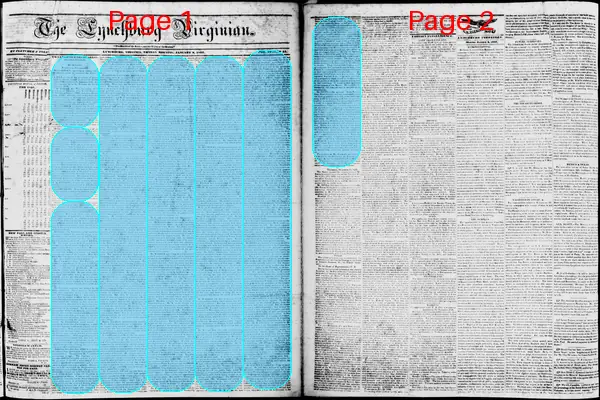
Lynchburg Virginian
Lynchburg, Virginia
What is this article about?
In the U.S. Senate on December 21, 1836, Sen. Calhoun introduced a bill to deposit surplus Treasury funds with states per the 1836 act, predicting an $8M surplus. Debate ensued with Sens. Clay, Walker, Buchanan, and Rives on revenue reduction, the Compromise Act, and land sales. The bill was referred to the Finance Committee after a 22-22 tie vote broken by the Chair.
Merged-components note: This is a continuation of the Senate debate on the deposit bill across pages 1 and 2, with sequential reading orders (6 and 7). Original label 'story' changed to 'domestic_news' as it reports US political proceedings.
Clippings
1 of 2
OCR Quality
Full Text
SECOND SESSION.
IN SENATE.
Wednesday, December 21.
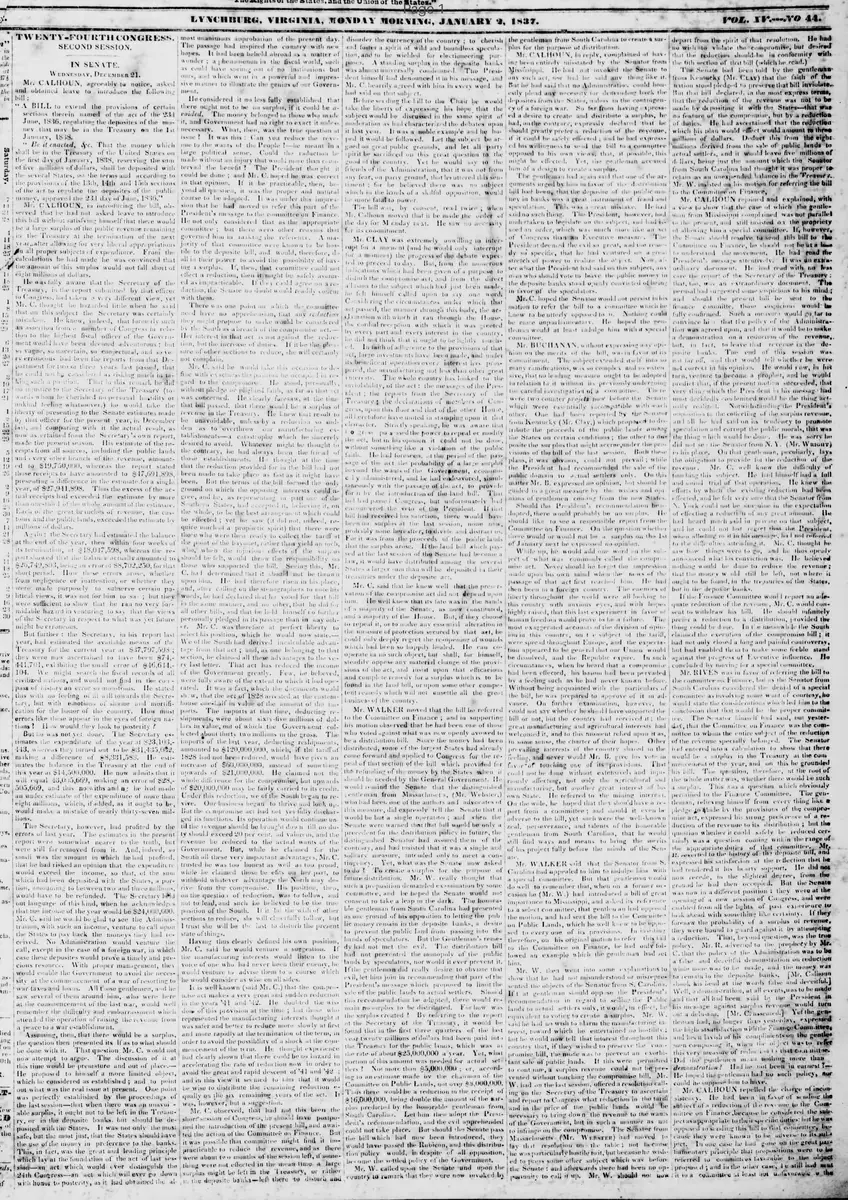
Mr. CALHOUN, agreeably to notice, asked and obtained leave to introduce the following bill:
"A BILL to extend the provisions of certain sections therein named of the act of the 23d June, 1836, regulating the deposites of the money that may be in the Treasury on the 1st January, 1838."
"Be it enacted, &c. That the money which shall be in the Treasury of the United States on the first day of January, 1838, reserving the sum of five millions of dollars, shall be deposited with the several States, on the terms and according to the provisions of the 13th, 14th and 15th sections of the act to regulate the deposites of the public money, approved the 23d day of June, 1836."
Mr. CALHOUN, in introducing the bill, observed that he had not asked leave to introduce this bill without satisfying himself that there would be a large surplus of the public revenue remaining in the Treasury at the termination of the next year, after allowing for very liberal appropriations in all proper subjects of expenditure. From the calculations he had made he was convinced that the amount of this surplus would not fall short of eight millions of dollars.
He was fully aware that the Secretary of the Treasury, in the report submitted by that officer to Congress, had taken a very different view; yet Mr. C. thought he hazarded little when he said that on this subject the Secretary was certainly mistaken. He knew, indeed, that formerly such an assertion from a member of Congress in relation to the highest fiscal officer of the Government would have been deemed adventurous; but so vague, so uncertain, so conjectural, and so very erroneous had been the reports from that Department for two or three years last passed, that he could not but consider as risking much in taking such a position. That in this remark he did no injustice to the Secretary of the Treasury (towards whom he cherished no personal hostility or unkind feeling whatsoever) he would take the liberty of presenting to the Senate estimates made by that officer for the present year, in December last, and comparing with it the actual result, as now ascertained from the Secretary's own report, made the present season. This estimate of the receipts from all sources, including the public lands and every other branch of the revenue, amounted to $19,750,000, whereas the report stated those receipts to have amounted to $47,691,898, presenting a difference in the estimate for a single year, of $27,941,898. Thus the excess of the actual receipts had exceeded the estimate by more than one-third of the whole amount of the estimate. Each of the great branches of revenue, the customs and the public lands, exceeded the estimate by millions of dollars.
Again: the Secretary had estimated the balance at the end of the year, then within four weeks of its termination, at $18,017,598, whereas the report showed that the balance actually amounted to $26,749,503, being an excess of $8,731,905 for that short period. How these errors arose, whether from negligence or inattention, or whether they were made purposely to subserve certain political views, it was not for him to say; but they were sufficient to show that he ran no very formidable hazard in venturing to say that the views of the Secretary in respect to what was yet future might be erroneous.
But further: the Secretary, in his report last year, had estimated the available means of the Treasury for the current year at $37,797,593; they were now ascertained to have been $74,441,701, exhibiting the small error of $36,644,108. We might search the fiscal records of all civilized nations, and would not find in the compass of history an error so monstrous. He stated thus with no feeling of ill will towards the Secretary, but with emotions of shame and mortification for the honor of the country. How must errors like these appear in the eyes of foreign nations? How would they look to posterity?
But he was not yet done. The Secretary estimates the expenditure of the year at $23,103,443, whereas they turned out to be $31,435,032, making a difference of $8,331,589. He estimates the balance in the Treasury at the end of this year at $14,500,000. He now admits that it will equal $43,005,669, making an error of $28,505,669, and this without his having made an under estimate of the expenditure of more than eight millions, which, if added, as it ought to be, would make a mistake of nearly thirty-seven millions.
The Secretary, however, had profited by the errors of last year. The estimates in the present report were somewhat nearer to the truth, but were still far removed from it. And, indeed, so small was the amount in which he had profited, that he had risked an opinion that the expenditure would exceed the income, so that, of the sum which had been deposited with the States, a portion, amounting to between two and three millions, would have to be refunded. The Secretary held out language of this kind, when he acknowledges that the income of the year would be $24,000,000.
Mr. C. said he would be glad to see the Administration, with such an income, venture to call upon the States to pay back the moneys they had received. No Administration would venture the call, except in the case of a foreign war, in which case these deposites would prove a timely and precious resource. With proper management, they would enable the Government to avoid the necessity at the commencement of a war of resorting to war taxes and loans. All those gentlemen, and he saw several of them around him, who were here at the commencement of the last war, would well remember the difficulty and embarrassment which attended the operation of raising the revenue from a peace to a war establishment.
Assuming, then, that there would be a surplus, the question then presented itself as to what should be done with it. That question Mr. C. would not now attempt to argue. The discussion of it at this time would be premature and out of place. He proposed to himself a more limited object, which he considered as established; and to point out what was the real issue at present. One point was perfectly established by the proceedings of the last session—that when there was an unavoidable surplus, it ought not to be left in the Treasury, or in the deposite banks, but should be deposited with the States. It was not only the most safe, but the most just, that the States should have the use of the money in preference to the banks. This, in fact, was the great and leading principle which lay at the foundation of the act of last session—an act which would ever distinguish the 24th Congress—an act which will ever go down with honor to posterity, as it had obtained the almost unanimous approbation of the present day.
The passage had inspired the country with new hopes. It had been beheld abroad as a matter of wonder; a phenomenon in the fiscal world, such as could have sprung out of no institutions but ours, and which went in a powerful and impressive manner to illustrate the genius of our Government.
He considered it no less fully established that there ought not to be any surplus, if it could be avoided. The money belonged to those who made it, and Government had no right to exact it unless necessary. What, then, was the true question at issue? It was thus: Can you reduce the revenue to the wants of the People?—he meant in a large political sense. Could the reduction be made without an injury that would more than countervail the benefit? The President thought it could be done; and Mr. C. hoped he was correct in that opinion. If it be practicable, then, beyond all question, it was the proper and natural course to be adopted. It was under this impression that he had moved to refer this part of the President's message to the committee on Finance. He not only considered that as the appropriate committee; but there were other reasons that governed him in making the reference. A majority of that committee were known to be hostile to the deposite bill, and would, therefore, do all in their power to avoid the possibility of having a surplus. If, then, that committee could not effect a reduction, then it might be safely assumed as impracticable. If they could agree on a reduction, the Senate no doubt would readily concur with them.
There was one point on which the committee need have no apprehension, that any reduction they might propose to make would be considered by the South as a breach of the compromise act. Their interest in that act is not against the reduction, but the increase of duties. If it be the pleasure of other sections to reduce, she will certainly not complain.
Mr. C. said he would take this occasion to define with greater clearness the position he occupied in regard to the compromise. He stood, personally, without pledge or plighted faith, as far as that act was concerned. He clearly foresaw, at the time that bill passed, that there would be a surplus of revenue in the Treasury. He knew that result to be unavoidable, unless by a reduction so sudden as to overthrow our manufacturing establishments—a catastrophe which he sincerely desired to avoid. Whatever might be thought to the contrary, he had always been the friend of those establishments. He thought at the time that the reduction provided for in the bill had not been made to take place as fast as it might have been. But the terms of the bill formed the only ground on which the opposing interests could agree, and he, as representing in part one of the Southern States, had accepted it, believing it, on the whole, to be the best arrangement which could be effected; yet he saw (it did not, indeed, require much of a prophetic spirit) that there were those who were then ready to collect the tariff at the point of the bayonet, rather than yield an inch, who, when the injurious effects of the surplus should be felt, would throw the responsibility on those who supported the bill. Seeing this, Mr. C. had determined that it should not be thrown upon him. He had therefore risen in his place, and, after calling on the stenographers to note his words, he had declared that he voted for that bill in the same manner, and no other, that he did for all other bills, and that he held himself no further personally pledged in its passage than in any other. Mr. C. was therefore at perfect liberty to select his position, which he would now state.
We of the South had derived incalculable advantage from that act; and, as one belonging to that section, he claimed all these advantages to the very last letter. That act has reduced the income of the Government greatly. Few, he believed, were fully aware of the extent to which it had operated. It was a fact, which the documents would show, that the act of 1828 arrested at the custom-house one-half in value of the amount of the imports. The imports at that time, deducting re-shipments, were about sixty-five millions of dollars in value, out of which the Government collected about thirty-two millions in the gross. The imports of the last year, deducting re-shipments, amounted to $120,000,000, which, if the tariff of 1828 had not been reduced, would have given an increase of $60,000,000, instead of something upwards of $21,000,000. He claimed not the whole difference for the compromise, but upwards of $20,000,000 may be fairly carried to its credit.
Under this reduction, we of the South began to revive. Our business began to thrive and look up. But the compromise act had not yet fully discharged its functions. Its operation would continue until the revenue should be brought down till no duty should exceed 20 per cent. ad valorem, and the revenue be reduced to the actual wants of the Government. But, while he claimed for the South all these very important advantages, Mr. C. trusted he was too honest as well as too proud, while he claimed those benefits on her part, to withhold whatever advantage the North may derive from the compromise. His position, then, on the question of reduction, was to follow, and not to lead, and such he believed to be the true position of the South. If it be the wish of other sections to reduce, she will cheerfully follow, but I trust she will be the last to disturb the present state of things.
Having thus clearly defined his own position, Mr. C. said he would venture a suggestion. If the manufacturing interests would listen to the voice of one who had never been their enemy, he would venture to advise them to a course which he would consider as wise on all sides.
It is well known (said Mr. C.) that the compromise act makes a very great and sudden reduction in the years '41 and '42. He doubted the wisdom of this provision at the time; but those who represented the manufacturing interests thought it was safer and better to reduce more slowly at first and more rapidly at the termination of the term, in order to avoid the possibility of a shock at the commencement of the term. He thought experience had clearly shown that there could be no hazard in accelerating the rate of reduction now in order to avoid the great and rapid descent of '41 and '42; and in this view it seemed to him that it would be wise to distribute the remaining reduction equally on the six remaining years of the act. It was, however, but a suggestion.
Mr. C. observed, that had not this been the short session of Congress, he should have postponed the introduction of the present bill, and awaited the action of the Committee on Finance. But it was possible that committee might find it impracticable to reduce the revenue, and as there were about two months of the session left, if something were not effected in the mean time a large surplus might be left in the Treasury, or rather, in the deposite banks—left there to disorder the currency of the country; to cherish and foster a spirit of wild and boundless speculation, and to be wielded for electioneering purposes. A standing surplus in the deposite banks was almost universally condemned. The President himself had denounced it in his message, and Mr. C. heartily agreed with him in every word he had said on that subject.
Before sending the bill to the Chair he would take the liberty of expressing his hope that the subject would be discussed in the same spirit of moderation as had characterized the debates upon it last year. It was a noble example and he hoped it would be followed. Let the subject be argued on great public grounds, and let all party spirit be sacrificed on this great question to the good of the country. Yet he would say to the friends of the Administration, that it was not from any fear, on party ground, that he uttered this sentiment; for he believed there was no subject which in the hands of a skillful opposition, would be more fatal to power.
The bill was, by consent, read twice; when Mr. Calhoun moved that it be made the order of the day for Monday next. He saw no necessity for its commitment.
Mr. CLAY was extremely unwilling to interrupt for a moment (and he would only interrupt for a moment) the progress of the debate expected to proceed to-day. But, from the numerous indications which had been given of a purpose to disturb the compromise act, and from the direct allusion to the subject which had just been made, he felt himself called upon to say one word. Considering the circumstances under which that act passed, the manner through this body, the acclamation with which it ran through the House, the cordial reception with which it was greeted by every part and every interest in the country, he did not think that it ought to be lightly touched. In faith of adherence to the provisions of that act, large investments have been made, and under its beneficent operation every interest has prospered, the manufacturing not less than other great interests. The whole country has looked to the inviolability of the act: the messages of the President; the reports from the Secretary of the Treasury; the declarations of members of Congress, upon this floor and that of the other House, all heretofore have united in stamping upon it that character. Strictly speaking, he was aware that Congress possessed the power to repeal or modify the act, but in his opinion it could not be done, without something like a violation of the public faith. He had foreseen, at the period of the passage of the act the probability of a large surplus beyond the wants of the Government, economically administered, and he had endeavored, simultaneously with the passage of the act, to provide for it by the introduction of the land bill. That bill had passed Congress, but unfortunately had encountered the veto of the President. If that bill had received his sanction, there would have been no surplus at the last session, none now, probably none hereafter, to divide and distract us. For it was from the proceeds of the public lands that the surplus arose. If the land bill which passed at the last session of the Senate had become a law, it would have distributed among the several States a larger sum than will be deposited in their treasuries under the deposite act.
Mr. C. said that he knew well that the preservation of the compromise act did not depend upon him. He well knew that its fate was in the hands of a majority of the Senate, as now constituted, and a majority of the House. But, if they choose to repeal it, or to make any essential alteration in the measure of protection secured by that act, he could only deeply regret the re-opening of wounds which had been so happily healed. He can co-operate in no such object, but shall, for himself, steadily oppose any material change of the provisions of the act, and insist upon that efficacious and complete remedy for a surplus which is to be found in the land bill, or upon some other competent remedy which will not unsettle all the great business of the country.
Mr. WALKER moved that the bill be referred to the Committee on Finance; and in supporting his motion observed that he had been one of those who voted against what was now openly avowed to be a distribution bill. Since the money had been distributed, some of the largest States had already come forward and applied to Congress for the repeal of that section of the bill which provided for the refunding of the money by the States when it should be needed by the General Government. He would remind the Senate that the distinguished gentleman from Massachusetts (Mr. Webster,) who had been one of the authors and advocates of this measure, did expressly tell the Senate that it would be but a single operation; and when the Senate were warned that that bill would be only a precedent for the distribution policy in future, the distinguished Senator had assured them of the contrary, and had insisted that it was a single and solitary measure, intended only to meet a contingency. Yet, what was the Senate now asked to do? To create a surplus for the purpose of future distribution, Mr. W. really thought that such a proposition demanded examination by some committee, and he hoped the Senate would not consent to take a leap in the dark. The honorable gentleman from South Carolina had presented as one ground of his opposition to letting the public money remain in the deposite banks, a desire to prevent the public land from passing into the hands of speculators. But the Gentleman's remedy had not met the evil. The distribution bill had not prevented the monopoly of the public lands by speculators, nor would it ever prevent it. If the gentleman did really desire to obviate that evil, let him join in recommending that part of the President's message which proposed to limit the sale of the public lands to actual settlers. Should this recommendation be adopted, there would remain no surplus to be distributed. For how was the surplus created? By referring to the report of the Secretary of the Treasury, it would be found that in the first three quarters of the last year twenty millions of dollars had been paid into the Treasury for the public lands, which was at the rate of about $25,000,000 a year. Yet, what portion of this amount was needed for actual settlers? Not more than $5,000,000; or, according to an estimate made by the chairman of the Committee on Public Lands, not over $8,000,000. Thus there would be a reduction in the receipt of $16,000,000, being double the amount of the surplus predicted by the honorable gentleman from South Carolina. Let him then adopt the President's recommendation, and the evil apprehended could not take place. But should the Senate pass the bill which had now been introduced, they would have passed the Rubicon, and this distribution policy would, in despite of all opposition, become the settled policy of the Government.
Mr. W. called upon the Senate and upon the country to remark that they were now invoked by the gentleman from South Carolina to create a surplus for the purpose of distribution.
Mr. CALHOUN, in reply, complained of having been entirely misstated by the Senator from Mississippi. He had not invoked the Senate to any such act, nor had he said any thing like it. But he had said that no Administration could honestly plead any necessity for demanding back the deposites from the States, unless in the contingency of a foreign war. So far from having expressed a desire to create and distribute a surplus, he had, on the contrary, expressly declared that he should greatly prefer a reduction of the revenue, if it could be safely effected; and he had expressed his willingness to send the bill to a committee opposed to his own views, that, if possible, this might be effected. Yet, the gentleman accused him of a design to create a surplus.
The gentleman had again said that one of the arguments urged by him in favor of the distribution bill had been, that the deposite of the public money in banks was a great instrument of fraud and speculation. This was a great mistake. He had said no such thing. The President, however, had undertaken to legislate on this subject, and had issued an order, which was much more like an act of Congress than an Executive measure. The President deemed the evil so great, and the remedy so specific, that he had ventured on a great stretch of power to realize the object. Now, after what the President had said on this subject, any man who should vote to leave the public money in the deposite banks stood openly convicted of being in favor of the speculators.
Mr. C. hoped the Senator would not persist in his motion to refer the bill to a committee which he knew to be utterly opposed to it. Nothing could be more unparliamentary. He hoped the gentleman would at least indulge him with a special committee.
Mr. BUCHANAN, without expressing any opinion on the merits of the bill, was in favor of its commitment. The subject extends itself into so many ramifications, is so complex and so extensive, that no leading measure ought to be adopted in relation to it without its previously undergoing the careful investigation of a committee. There were two counter projects now before the Senate which were essentially incompatible with each other. One had been reported by the Senator from Kentucky (Mr. Clay,) which proposed to distribute the proceeds of the public lands among the States on certain conditions; the other to deposite the surplus that might accrue, under the provisions of the bill of the last session. Both these plans, it was obvious, could not prevail; while the President had recommended the sale of the public domain to actual settlers only. On this matter Mr. B. expressed no opinion, but should be guided in a great measure by the wishes and opinions of gentlemen coming from the new States. Should the President's recommendation be adopted, there would probably no surplus. He should like to see a responsible report from the Committee on Finance. On the question whether there would or would not be a surplus on the 1st of January next he expressed no opinion.
While up, he would add one word on the subject of what was commonly called the compromise act. Never should he forget the impression made upon his own mind when the news of the passage of that act first reached him. He had then been in a foreign country. The enemies of liberty throughout the world were all looking to this country with anxious eyes, and with hopes highly raised, that this last experiment in favor of human freedom would prove to be a failure. The most exaggerated accounts of the division of opinion in this country, on the subject of the tariff, were spread throughout Europe, and the expectation appeared to be general that our Union would be dissolved, and the Republic expire. In such circumstances, when he heard that a compromise had been effected, his bosom had been pervaded by a feeling such as he had never known before. Without being acquainted with the particulars of the bill, he was prepared to approve of it in advance. On further examination, however, he could not say whether he should have supported the bill or not, but the country had received it; the great manufacturing and agricultural interests had welcomed it, and to this moment relied upon it as, in some sense, the charter of their hopes. Other prevailing interests of the country shared in the feeling, and never would Mr. B. give his vote in favor of touching one of its provisions. That could not be done without extensively and injuriously affecting, not only the agricultural and manufacturing, but another great interest of his own State, to which he referred to the mining interest.
On the whole, he hoped that they should have a report from a committee; and should it even be adverse to the bill, yet such were the well-known zeal, perseverance, and talents of the honorable gentleman from South Carolina, that he would still find ways and means to bring the merits of his project fully before the minds of the Senate.
Mr. WALKER said that the Senator from S. Carolina had appealed to him to indulge him with a special committee. But that gentleman would do well to remember that, when on a former occasion he (Mr. W.) had introduced a bill of great importance to Mississippi, and asked its reference to a select committee, that gentleman had opposed the motion, and had sent the bill to the Committee on Public Lands, which he well knew to be opposed to every one of its provisions. In insisting, therefore, on his original motion to refer this bill to the Committee on Finance, he had only followed an example which the gentleman had set him.
Mr. W. then went into some explanations to show that he had not misunderstood or misrepresented the objects of the Senator from S. Carolina. If that gentleman should oppose the President's recommendation with regard to selling the Public lands to actual settlers only, it would, in effect, be equivalent to voting to create a surplus. Mr. W. said he had no wish to alarm the manufacturing interest, toward which he entertained no hostility. but he would now tell that interest throughout this country that, if they wished to preserve the compromise bill, the mode was to prevent an exorbitant sale of public lands. If this were permitted to continue, a surplus revenue could not be prevented without touching the compromise bill. Mr. W. had on the last session, offered a resolution calling on the Secretary of the Treasury to ascertain and report to Congress what reduction in the tariff and in the price of the public lands would be necessary to bring down the revenue to the wants of the Government, but in such a manner as not to infringe on the compromise. The Senator from Massachusetts—(Mr. Webster) had moved to lay that resolution on the table; not because he was particularly hostile to it, but because he wished to press some other subject which was before the Senate: and afterwards there had been no opportunity to call it up. Mr. W. should not now depart from the spirit of that resolution. He had no wish to violate the compromise, but desired that the reduction should be in conformity with the 8th section of that bill (which he read.)
The Senate had been told by the gentleman from Kentucky (Mr. Clay) that the faith of the nation stood pledged to preserve that bill inviolate. But that bill declared, in the most express terms, that the reduction of the revenue was not to be made by depositing it with the States—that was no feature of the compromise, but by a reduction of duties. He had ascertained that the reduction which his plan would effect would amount to three millions of dollars. Deduct this from the eight millions derived from the sale of public lands to actual settlers, and it would leave five millions of dollars, being just the amount which the Senator from South Carolina had thought it was proper to retain as an unexpended balance in the Treasury.
Mr. W. insisted on his motion for referring the bill to the Committee on Finance.
Mr. CALHOUN rejoined and explained, with a view to show that the case of which the gentleman from Mississippi complained was not parallel to the present, and still insisted on the propriety of allowing him a special committee. If, however, the Senate should resolve to send this bill to the Committee on Finance, he should not be at a loss to understand the movement. He had read the President's message attentively. It was an extraordinary document. He had read with no less care the report of the Secretary of the Treasury: that, too, was an extraordinary document. The perusal had suggested some suspicions to his mind; and should the present bill be sent to the finance committee, those suspicions would be fully confirmed. Such a measure would go far to convince him that the policy of the Administration was agreed upon, and that it would be to make a demonstration on a reduction of the revenue, but, in fact, to leave that revenue in the deposite banks. The end of this session was not far off, and that would well whether he were not correct in his opinion. He would now, in his turn, venture to become a prophet, and he would predict that, if the present motion succeeded, that very thing which the President in his message, had most decidedly condemned would be the thing actually realized. Notwithstanding the President's opposition to the collecting of the surplus revenue, and all he had said on its tendency to promote speculation and corrupt the public morals, that was the thing which would be done. He was sorry he did not see the Senator from N. Y. (Mr. WRIGHT) in his place. On that gentleman, peculiarly, lays the obligation to provide for the reduction of the revenue. Mr. C. well knew the difficulty of touching this subject. He had himself had a fair and solid trial of that operation. He knew the efforts by which the existing reduction had been effected, and he felt very sure that the Senator from N. York could not be sanguine in the expectation of effecting a reduction of any great amount. He had heard much said in private on that subject, and he could not but regret that the President, when alluding to it in his message, had not referred to the difficulties attending it. Mr. C. thought he saw how things were to go, and he thus openly announced what his conviction was. He believed nothing would be done to reduce the revenue; that the money would still be left, not where it ought to be found, in the treasuries of the States, but in the deposite banks.
If the Finance Committee would report an adequate reduction of the revenue, Mr. C. would consent to withdraw his bill. He should infinitely prefer a reduction to a distribution, provided the thing could be done. In the meanwhile the South claimed the execution of the compromise bill; it had not only closed a long and painful controversy, but had enabled them to make some feeble stand against the progress of Executive influence. He concluded by moving for a special committee.
Mr. RIVES was in favor of referring the bill to the committee on Finance, but as the Senator from South Carolina considered the denial of a special committee as involving some want of courtesy, he would state the considerations which led him to the conclusion that that would be the proper committee. The Senator himself had said, but yesterday, that the Committee on Finance was the committee to whom the entire subject of the reduction of the revenue specially belonged. The Senator had entered into a calculation to show that there would be a surplus in the Treasury at the commencement of the year, and on this he grounded his bill. The question, therefore, at the root of the whole matter was, whether there would be such a surplus. This was a question which obviously pertained to the Finance Committee. The gentleman, relieving himself from every thing like pledge to abide by the provisions of the compromise act, expressed his strong preference of a reduction of the revenue to its distribution; but the question whether it could safely be reduced certainly was a question coming within the range of the appropriate duties of that committee. Mr. R. reverted to the history of the deposite bill, and the appropriate duties of that committee. Mr. R. expressed his satisfaction at the reflection that he had rendered it his hearty support. He did not now recede, in the slightest degree, from the ground he had then occupied. But the Senate was now in a different position: they were at the opening of a new session of Congress, and were enabled from all the lights of past experience to look ahead with something like certainty. If they foresaw the probability of a surplus of revenue, they were bound to guard against it by attempting a reduction. That, beyond question, was the true policy. Mr. R. alluded to the prophecy by Mr. C. that the policy of the Administration was to be a false and deceitful demonstration on reduction while none was to be made, and the money was to remain in the deposite banks. [Mr. Calhoun shook his head at the words false and deceitful.] Well, a demonstration, at all events, was to be made and that all had been said by the President in his message against surplus revenue would turn out a delusion. [Mr. C. assented.] Yet the gentleman had, no longer than yesterday, expressed the highest satisfaction with the Finance Committee and been lavish of his compliments on the gentlemen composing it, when the object was to refer this very measure of reduction to that committee. Did the gentleman mean nothing more than demonstration? Had he not been in earnest?—He hoped the gentleman had no such policy, nor could he suppose him to have.
Mr. CALHOUN repelled the charge of inconsistency. He had been in favor of sending the subject of a reduction of the revenue to the Committee on Finance, because he considered the subject as appropriate to their specific duties; but he was opposed to sending this bill to that committee, because they were known to be adverse to its object. In one case he had gone on the great parliamentary principle that propositions were to be referred to committees favorable to the object proposed; and in the other case, he still had entire confidence in the committee, at least so far as...
Mr. C. said he was rejoiced to hear the honourable Senator from Virginia declare so explicitly that he did not repent the course he had taken in reference to the deposit bill: he was confident the gentleman never would repent the able and honourable course he had pursued on that memorable occasion; and he trusted the gentleman would agree in sentiment with those who were opposed to leaving the public money in the deposit banks.
Mr. C. had given many evidences of his desire that a reduction should be made in the revenue; and had, on a former occasion, sent a bill to the Committee on Manufactures for that object, which afterwards had passed the Senate almost unanimously, and had been sent to the other House, after which it was never again heard of. He was not the man, however, to disturb the terms of the compromise, which had so happily been effected, unless it should be done by common consent. The South were prepared to assent to such a step, and if the North would also agree to it, there need be no difficulty in the case. The gentleman from Virginia seemed to suppose that, because it was the duty of the Finance Committee to consider the question whether there was likely to be a surplus revenue or not, therefore, this bill ought to be sent to them. The argument was too wide; on the same principle, every proposition which related to the application of any portion of the public resources must be sent to that committee. It would swallow up almost all the business of the Senate. He concluded by demanding the yeas and nays on the question of commitment.
Mr. RIVES briefly rejoined. As the Senator from South Carolina was only conditionally in favor of the proposition in the bill, in the event that there would be a surplus, and that the revenue could not be reduced; and as the question whether it could be reduced belonged confessedly to the committee on Finance, it involved no violation of the parliamentary principle to which the Senator had alluded, to send this bill to that committee. Mr. R. hoped he should not be understood as wishing wantonly to interfere with the provisions of the Compromise bill; he was far from desiring any such thing. He held the compromise in great respect, as having effected a great national good in the settlement of an agitating and alarming question. But he was free to say that if any mode could be devised of bringing down the revenue to the wants of the Government without interfering with the enactments of that bill, he should be opposed to disturbing them in any way. But it was a fundamental duty of legislation to dispense with all unnecessary taxes, and reduce the burdens of the People as far as the necessities of Government would permit. If this could not be done without touching some parts of the Compromise bill, it must be touched; but if it could, then that bill, in all its provisions, ought to be sacredly maintained.
The question on Mr. Walker's motion to refer the bill to the Committee on Finance being now put, the vote stood as follows: Yeas 22, Nays 22. The yeas and nays being equal, the Chair voted in the affirmative; and the bill was committed accordingly to the Committee on Finance.
What sub-type of article is it?
What keywords are associated?
What entities or persons were involved?
Where did it happen?
Domestic News Details
Primary Location
United States Senate
Event Date
Wednesday, December 21, 1836
Key Persons
Outcome
the bill was read twice and, after debate, referred to the committee on finance on a 22-22 tie vote broken by the chair in the affirmative.
Event Details
Sen. Calhoun introduced a bill to deposit surplus Treasury funds (reserving $5M) with states per the 1836 act, citing an expected $8M surplus and criticizing Treasury estimates. Debate covered revenue reduction, the Compromise Act of 1833, land sales to settlers, and avoiding surplus in banks. Sens. Clay defended the Compromise, Walker pushed for Finance Committee referral and land limits, Buchanan favored commitment, and Rives supported referral while upholding the deposite act.