Thank you for visiting SNEWPapers!
Sign up free
The Daily Worker
Chicago, Cook County, Illinois
What is this article about?
In Gary, Ind., steel workers hold a mass meeting protesting the June 14 explosion at Illinois Steel Co. that killed 13 and injured many, denouncing the coroner's biased verdict blaming workers and demanding a federal investigation. Speakers like William Z. Foster urge unity and predict future labor struggles.
Merged-components note: Continuation of steel workers story across pages 1 and 2.
Clippings
1 of 2
OCR Quality
Full Text
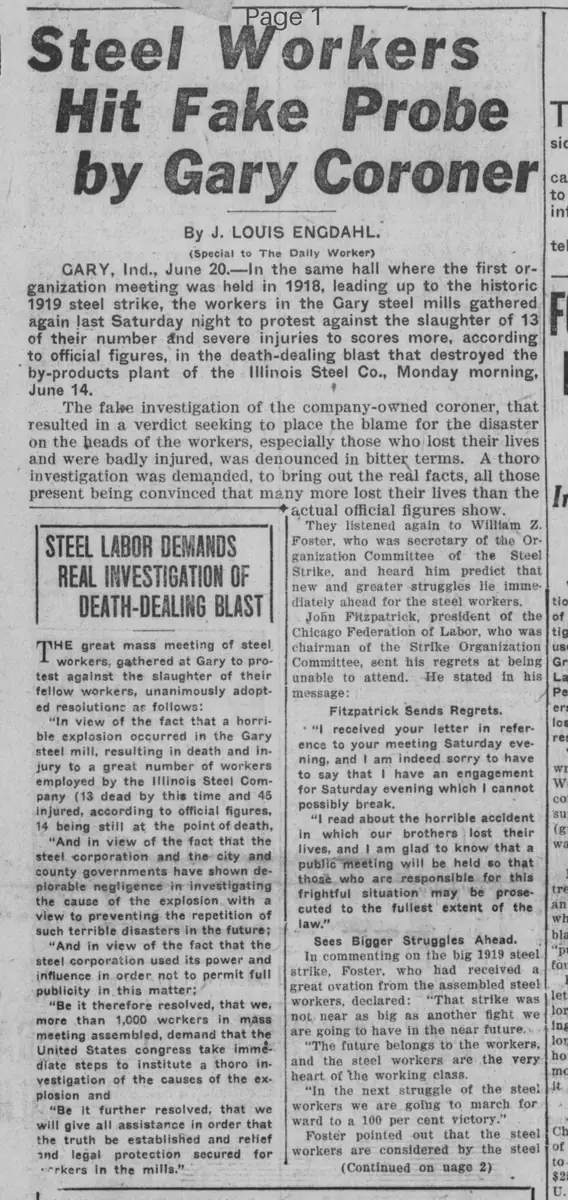
By J. LOUIS ENGDAHL.
(Special to The Daily Worker)
GARY, Ind., June 20.—In the same hall where the first organization meeting was held in 1918, leading up to the historic 1919 steel strike, the workers in the Gary steel mills gathered again last Saturday night to protest against the slaughter of 13 of their number and severe injuries to scores more, according to official figures, in the death-dealing blast that destroyed the by-products plant of the Illinois Steel Co., Monday morning, June 14.
The fake investigation of the company-owned coroner, that resulted in a verdict seeking to place the blame for the disaster on the heads of the workers, especially those who lost their lives and were badly injured, was denounced in bitter terms. A thorough investigation was demanded, to bring out the real facts, all those present being convinced that many more lost their lives than the official figures indicate.
STEEL LABOR DEMANDS REAL INVESTIGATION OF DEATH-DEALING BLAST
The great mass meeting of steel workers, gathered at Gary to protest against the slaughter of their fellow workers, unanimously adopted resolutions as follows:
"In view of the fact that a horrible explosion occurred in the Gary steel mill, resulting in death and injury to a great number of workers employed by the Illinois Steel Company (13 dead by this time and 45 injured, according to official figures, 14 being still at the point of death),
"And in view of the fact that the steel corporation and the city and county governments have shown deplorable negligence in investigating the cause of the explosion with a view to preventing the repetition of such terrible disasters in the future:
"And in view of the fact that the steel corporation used its power and influence in order not to permit full publicity in this matter:
"Be it therefore resolved, that we, more than 1,000 workers in mass meeting assembled, demand that the United States congress take immediate steps to institute a thorough investigation of the causes of the explosion and
"Be it further resolved, that we will give all assistance in order that the truth be established and relief and legal protection secured for workers in the mills."
They listened again to William Z. Foster, who was secretary of the Organization Committee of the Steel Strike, and heard him predict that new and greater struggles lie immediately ahead for the steel workers.
John Fitzpatrick, president of the Chicago Federation of Labor, who was chairman of the Strike Organization Committee, sent his regrets at being unable to attend. He stated in his message:
Fitzpatrick Sends Regrets.
"I received your letter in reference to your meeting Saturday evening, and I am indeed sorry to have to say that I have an engagement for Saturday evening which I cannot possibly break.
"I read about the horrible accident in which our brothers lost their lives, and I am glad to know that a public meeting will be held so that those who are responsible for this frightful situation may be prosecuted to the fullest extent of the law."
Sees Bigger Struggles Ahead.
In commenting on the big 1919 steel strike, Foster, who had received a great ovation from the assembled steel workers, declared: "That strike was not near as big as another fight we are going to have in the near future.
"The future belongs to the workers, and the steel workers are the very heart of the working class.
"In the next struggle of the steel workers we are going to march forward to a 100 per cent victory."
Foster pointed out that the steel workers are considered by the steel trust as the key to the entire basic industry situation, and that a victory for them would mean a victory for the entire working class.
(Continued on page 2)
Steel Workers Expose Inquiry of Company-Owned Coroner
Continued from page 1.
profiteers in the same way that they look upon the coke and ore and machinery that goes into the steel mills.
He cited the testimony of John D. Rockefeller, Jr., before a congressional investigating committee, when he replied to a question as to whether he thot that the 15 cents per hour he paid at that time to some of his workers was a living wage. Rockefeller Jr. had stated:
Rockefeller Things Workers Fools.
"If they are fools enough to accept it, why should I pay them more?"
Foster declared that Judge Elbert H. Gary, head of the steel trust, looked upon the steel workers in the same way.
"The workers must fight for every protection they get in the steel industry," declared Foster, pointing out that it was only the protest of the workers that caused the announcement of the abolition of the 12-hour day in the industry.
All Workers Represented.
The great gathering held in Turner Hall was representative of all the workers in the mills, including the Negro and Mexican workers, many of whom have been brought in since the strike. All the speakers urged steel labor to stand together in spite of differences of race, religion, nationality and color. This sentiment was greeted with thunderous approval.
James Garnett, chairman of the Investigating Committee of Steel Workers that organized the protest, was also chairman of the meeting.
Boris Borisoff, who is working together with Garnett, in an effort to protect the interests of the workers, exposed the fake investigation of the disaster by company officials and company tools, as a result of which an effort is being made to put all blame on the workers.
"If we are to accept the verdict of Coroner E. E. Evans, then we have to accept the theory that the workers actually and deliberately committed suicide," declared Borisoff.
Here's the Fake Verdict.
The official verdict, which is ridiculed by the workers, as it has been announced by Coroner Evans, was that 12 men were killed "as the result of an explosion by gas, the cause of which is unknown, but apparently the result of some person, unknown, opening a valve and allowing gas to escape, it becoming ignited from some undiscovered source."
Three mill officials were called to testify as to the probable causes of the explosion.
They were: K. M. J. Burr, head of the so-called "safety department" of the steel trust; Glenn A. Recktenwald, assistant superintendent of the coke plant of which the destroyed by-products plant was a part, and Fred A. Weber, pipefitter at the coke plant. All of their efforts were directed to whitewashing the steel trust insofar as any blame that might be put on it.
He Heard "His Master's Voice."
Borisoff told the steel workers in Turner Hall of his visit to the coroner's office, following the announcement of the verdict, and of the weak defense the coroner made in support of it. The coroner showed he was not interested in the claims of the workers.
In commenting on what Borisoff had reported, Foster pointed out that "the government is in the hands of the capitalists, from top to bottom, in city, state and nation. That is why Borisoff received the cold shoulder from the coroner that he did. The coroner, like the dog in the phonograph advertisement, hears his master's voice,' and his master is Judge Gary, head of the steel trust."
Other speakers were A. L. Isbell, president of the Chicago local of the American Negro Labor Congress; Melicio Espinosa, of the Sociedad Protectora; Irving Dungee, managing editor of the Negro Champion; Corrine O'Brien Robinson, and Morris Yusem, of the Young Workers League, who urged the cause of the young workers in the steel mills.
Thirteenth Victim Dies.
Only a few hours before the steel workers were gathering in their protest meeting, official announcement was made of the death of the thirteenth blast victim, James Fort, a Negro worker, of 2519 Madison street.
He died in the Gary hospital as the result of severe burns received a week ago. Fort was the eighth victim to die in the hospital. This leaves 14 victims still in the hospital listed as seriously injured, with 25 others whose condition is claimed to be favorable.
The steel workers are convinced that many more died than were actually reported in the "official figures."
What sub-type of article is it?
What themes does it cover?
What keywords are associated?
What entities or persons were involved?
Where did it happen?
Story Details
Key Persons
Location
Gary, Ind., Steel Mills
Event Date
June 14, 1920
Story Details
Steel workers in Gary protest the explosion at Illinois Steel Co. by-products plant that killed 13 and injured scores, denouncing the company coroner's fake investigation blaming workers and demanding a thorough U.S. Congress probe. Mass meeting features speeches by Foster predicting future strikes and unity among workers.