Thank you for visiting SNEWPapers!
Sign up free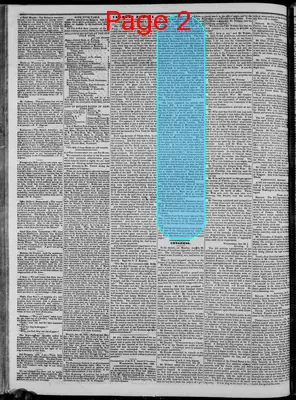
Editorial
February 2, 1838
Vermont Phœnix
Brattleboro, Bellows Falls, Ludlow, Windham County, Windsor County, Vermont
What is this article about?
An editorial opposes the Sub-Treasury Scheme proposed by Van Buren's administration, arguing it increases executive patronage and is worse than a previous failed bill. It discusses Rives' alternative bank plan and quotes the Richmond Enquirer's criticisms of new officers and insecurity of funds.
Clipping
OCR Quality
95%
Excellent
Full Text
Prospects of the Sub-Treasury Scheme.-
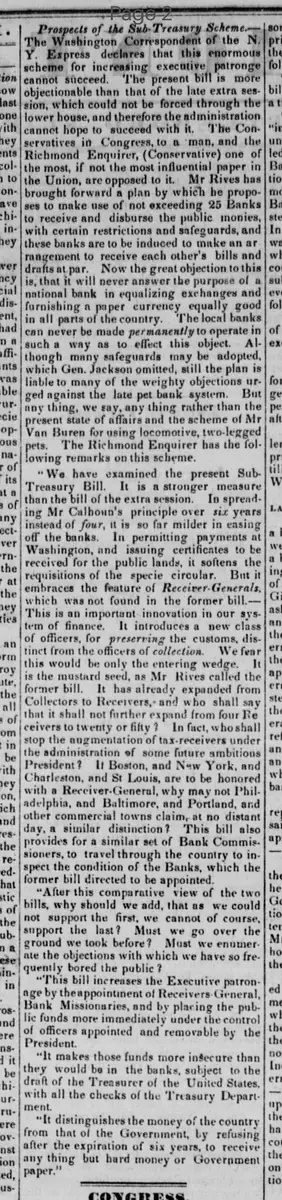
The Washington Correspondent of the N Y. Express declares that this enormous scheme for increasing executive patronage cannot succeed. The present bill is more objectionable than that of the late extra session, which could not be forced through the lower house, and therefore the administration cannot hope to succeed with it. The Conservatives in Congress, to a man, and the Richmond Enquirer, (Conservative) one of the most, if not the most influential paper in the Union, are opposed to it. Mr Rives has brought forward a plan by which he proposes to make use of not exceeding 25 Banks to receive and disburse the public monies, with certain restrictions and safeguards, and these banks are to be induced to make an arrangement to receive each other's bills and drafts at par. Now the great objection to this is, that it will never answer the purpose of a national bank in equalizing exchanges and furnishing a paper currency equally good in all parts of the country. The local banks can never be made permanently to operate in such a way as to effect this object. Although many safeguards may be adopted, which Gen. Jackson omitted, still the plan is liable to many of the weighty objections urged against the late pet bank system. But any thing, we say, any thing rather than the present state of affairs and the scheme of Mr Van Buren for using locomotive, two-legged pets.
The Richmond Enquirer has the following remarks on this scheme
"We have examined the present Sub Treasury Bill. It is a stronger measure than the bill of the extra session. In spreading Mr Calhoun's principle over six years instead of four, It is so far milder in easing off the banks. In permitting payments at Washington, and issuing certificates to be received for the public lands. it softens the requisitions of the specie circular. But it embraces the feature of Receiver-Generals which was not found in the former bill.--This is an important innovation in our system of finance. It introduces a new class of officers, for preserving the customs, distinct from the officers of collection. We fear this would be only the entering wedge. It is the mustard seed, as Mr Rives called the former bill. It has already expanded from Collectors to Receivers,--and who shall say that it shall not further expand from four Receivers to twenty or fifty? In fact, who shall stop the augmentation of tax-receivers under the administration of some future ambitious President? If Boston. and New York. and Charleston. and St Louis. are to be honored with a Receiver-General, why may not Philadelphia, and Baltimore, and Portland, and other commercial towns claim-- at no distant day, a similar distinction? This bill also provides for a similar set of Bank Commissioners, to travel through the country to inspect the condition of the Banks. which the former bill directed to be appointed.
"After this comparative view of the two bills, why should we add, that as we could not support the first, we cannot of course, support the last? Must we go over the ground we took before? Must we enumerate the objections with which we have so frequently bored the public?
"This bill increases the Executive patronage by the appointment of Receivers-General, Bank Missionaries, and by placing the public funds more immediately under the control of officers appointed and removable by the President.
"It makes those funds more insecure than they would be in the banks, subject to the draft of the Treasurer of the United States. with all the checks of the Treasury Department.
"It distinguishes the money of the country from that of the Government, by refusing after the expiration of six years, to receive any thing but hard money or Government paper."
The Washington Correspondent of the N Y. Express declares that this enormous scheme for increasing executive patronage cannot succeed. The present bill is more objectionable than that of the late extra session, which could not be forced through the lower house, and therefore the administration cannot hope to succeed with it. The Conservatives in Congress, to a man, and the Richmond Enquirer, (Conservative) one of the most, if not the most influential paper in the Union, are opposed to it. Mr Rives has brought forward a plan by which he proposes to make use of not exceeding 25 Banks to receive and disburse the public monies, with certain restrictions and safeguards, and these banks are to be induced to make an arrangement to receive each other's bills and drafts at par. Now the great objection to this is, that it will never answer the purpose of a national bank in equalizing exchanges and furnishing a paper currency equally good in all parts of the country. The local banks can never be made permanently to operate in such a way as to effect this object. Although many safeguards may be adopted, which Gen. Jackson omitted, still the plan is liable to many of the weighty objections urged against the late pet bank system. But any thing, we say, any thing rather than the present state of affairs and the scheme of Mr Van Buren for using locomotive, two-legged pets.
The Richmond Enquirer has the following remarks on this scheme
"We have examined the present Sub Treasury Bill. It is a stronger measure than the bill of the extra session. In spreading Mr Calhoun's principle over six years instead of four, It is so far milder in easing off the banks. In permitting payments at Washington, and issuing certificates to be received for the public lands. it softens the requisitions of the specie circular. But it embraces the feature of Receiver-Generals which was not found in the former bill.--This is an important innovation in our system of finance. It introduces a new class of officers, for preserving the customs, distinct from the officers of collection. We fear this would be only the entering wedge. It is the mustard seed, as Mr Rives called the former bill. It has already expanded from Collectors to Receivers,--and who shall say that it shall not further expand from four Receivers to twenty or fifty? In fact, who shall stop the augmentation of tax-receivers under the administration of some future ambitious President? If Boston. and New York. and Charleston. and St Louis. are to be honored with a Receiver-General, why may not Philadelphia, and Baltimore, and Portland, and other commercial towns claim-- at no distant day, a similar distinction? This bill also provides for a similar set of Bank Commissioners, to travel through the country to inspect the condition of the Banks. which the former bill directed to be appointed.
"After this comparative view of the two bills, why should we add, that as we could not support the first, we cannot of course, support the last? Must we go over the ground we took before? Must we enumerate the objections with which we have so frequently bored the public?
"This bill increases the Executive patronage by the appointment of Receivers-General, Bank Missionaries, and by placing the public funds more immediately under the control of officers appointed and removable by the President.
"It makes those funds more insecure than they would be in the banks, subject to the draft of the Treasurer of the United States. with all the checks of the Treasury Department.
"It distinguishes the money of the country from that of the Government, by refusing after the expiration of six years, to receive any thing but hard money or Government paper."
What sub-type of article is it?
Economic Policy
Partisan Politics
What keywords are associated?
Sub Treasury Scheme
Executive Patronage
Van Buren Administration
Banking System
Receiver Generals
Public Funds
Economic Policy
What entities or persons were involved?
Mr Van Buren
Mr Rives
Gen. Jackson
Richmond Enquirer
Mr Calhoun
Conservatives In Congress
Editorial Details
Primary Topic
Opposition To The Sub Treasury Scheme
Stance / Tone
Strongly Opposed To The Sub Treasury Scheme
Key Figures
Mr Van Buren
Mr Rives
Gen. Jackson
Richmond Enquirer
Mr Calhoun
Conservatives In Congress
Key Arguments
The Sub Treasury Scheme Increases Executive Patronage And Cannot Succeed Due To Opposition.
The Current Bill Is More Objectionable Than The Previous Failed One.
Rives' Bank Plan Fails To Equalize Exchanges Like A National Bank.
Introduces New Officers Like Receiver Generals, Risking Expansion Of Patronage.
Makes Public Funds More Insecure Than In Banks.
Distinguishes Government Money From Country Money By Requiring Hard Money After Six Years.