Thank you for visiting SNEWPapers!
Sign up free
Portland Gazette, And Maine Advertiser
Portland, Cumberland County, Maine
What is this article about?
This editorial details and critiques the 1811-1812 Massachusetts valuation committee's process for assessing property taxes and senatorial apportionment, alleging partisan Democratic influence led to under-valuation of Boston's personal property and biased adjustments favoring certain counties like Maine, resulting in unfair taxation for a decade.
Merged-components note: Continuation of the 'Democratic Valuation' editorial across pages 1-2, including the aggregate table at the end.
Clippings
1 of 2
OCR Quality
Full Text
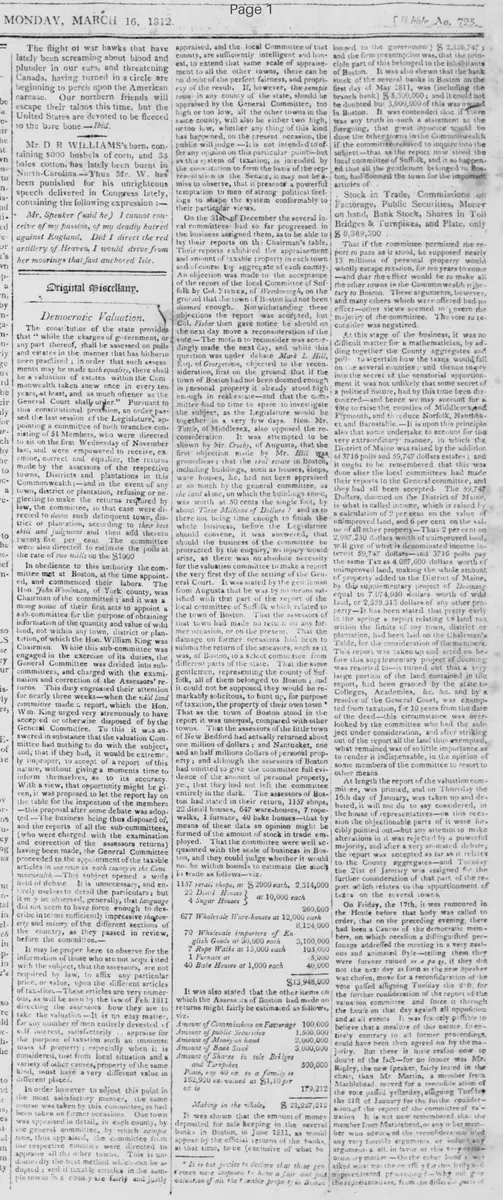
Democratic Valuation.
The constitution of the state provides that "while the charges of government, or any part thereof, shall be assessed on polls and estates in the manner that has hitherto been practised: in order that such assessments may be made with equality, there shall be a valuation of estates within the Commonwealth taken anew once in every ten years, at least, and as much oftener as the General Court shall order." Pursuant to this constitutional provision, an order passed the last session of the Legislature, appointing a committee of both branches consisting of 51 Members, who were directed to sit on the first Wednesday of November last, and were empowered to receive, examine, correct and equalize, the returns made by the assessors of the respective towns, Districts and plantations in this Commonwealth;—and in the event of any town, district or plantation, refusing or neglecting to make the returns required by law, the committee, in that case were directed to doom such delinquent town, district or plantation, according to their best skill and judgment and then add thereto twenty five per cent. The committee were also directed to estimate the polls at the rate of two mills on the $1000.
In obedience to this authority the committee met at Boston, at the time appointed, and commenced their labors. The Hon. John Woodman, of York county, was Chairman of the committee; and it was among some of their first acts to appoint a sub-committee for the purpose of obtaining information of the quantity and value of wild land, not within any town, district or plantation, of which the Hon. William King was Chairman. While this sub-committee was engaged in the exercise of its duties, the General Committee was divided into sub-committees, and charged with the examination and correction of the Assessors' returns. This duty engrossed their attention for nearly three weeks—when the wild land committee made their report, which the Hon. Wm. King urged very strenuously to have accepted or otherwise disposed of by the General Committee. To this it was answered in substance that the valuation Committee had nothing to do with the subject, and, that if they had, it would be extremely improper, to accept of a report of this nature, without giving a moments time to inform themselves, as to its accuracy. With a view, that opportunity might be given, it was proposed to let the report lay on the table for the inspection of the members—this proposal after some debate was adopted—The business being thus disposed of, and the reports of all the sub-committees, (who were charged with the examination and correction of the assessors returns) having been made, the General Committee proceeded to the appointment of the taxable articles in one town in each county in the Commonwealth—This subject opened a wide field of debate. It is unnecessary, and entirely useless to detail the particulars; but it may be observed, generally, that language did not seem to have force enough to describe in terms sufficiently impressive the poverty and misery of the different sections of the country, as they passed in review, before the committee.—
It may be proper here to observe for the information of those who are not acquainted with the subject, that the assessors, are not required by law, to affix any particular price, or value, upon the different articles of taxation.—These articles are very numerous, as will be seen by the law of Feb. 1811 directing the assessors how they are to take the valuation—It is no easy matter, for any number of men entirely divested of self interest, satisfactorily appraise for the purpose of taxation such an immense mass of property; especially when it is considered, that from local situation and a variety of other causes, property of the same kind, must have a very different value in different places.
In order however to adjust this point in the most satisfactory manner, the same course was taken by this committee, as had been taken on former occasions. One town was appraised in detail, in each county, by the general committee, by which sample town, thus appraised, the committee from the respective counties were directed to appraise all the other towns. This is undoubtedly the best method which can be adopted; and if taxable articles in the sample towns in a county are fairly and justly appraised, and the local Committee of that county, are sufficiently intelligent and honest, to extend that same scale of appraisement to all the other towns, there can be no doubt of the perfect fairness, and propriety of the result. If, however, the sample town in any county of the state, should be appraised by the General Committee, too high or too low, all the other towns in the same county, will also be either too high, or too low, whether any thing of this kind has happened, on the present occasion, the public will judge—It is not intended to offer any opinion on this particular point—but as this system of taxation, is intended by the constitution to form the basis of the representation in the Senate, it may not be amiss to observe, that it presents a powerful temptation to men of strong political feelings to shape the system conformably to their particular views.
On the 31st of December the several local committees had so far progressed in the business assigned them, as to be able to lay their reports on the Chairman's table. Their reports exhibited the appraisement and amount of taxable property in each town and of course the aggregate of each county. An objection was made to the acceptance of the report of the local Committee of Suffolk by Col. Fisher, of Westborough, on the ground that the town of Boston had not been Doomed enough. Notwithstanding these objections the report was accepted, but Col. Fisher then gave notice he should on the next day move a reconsideration of the vote—The motion to reconsider was accordingly made the next day, and while this question was under debate Mark L. Hill, Esq. of Georgetown, objected to the reconsideration, first on the ground that if the town of Boston had not been doomed enough in personal property it already stood high enough in real estate—and that the committee had no time to spare to investigate the subject, as the Legislature would be together in a very few days. Hon. Mr. Tuttle, of Middlesex, also opposed the reconsideration. It was attempted to be shown by Mr. Crosby, of Augusta, that the first objection made by Mr. Hill was groundless; that the real estate in Boston, including buildings, such as houses, shops, ware houses, &c. had not been appraised at so much by the general committee, as the land alone, on which the buildings stood, was worth at 50 cents the single foot, by about Three Millions of Dollars! and as to there not being time enough to finish the whole business, before the Legislature should convene, it was answered, that should the business of the committee be protracted by the enquiry, no injury would arise, as there was no absolute necessity for the valuation committee to make a report the very first day of the sitting of the General Court. It was stated by the gentleman from Augusta that he was by no means satisfied with that part of the report of the local committee of Suffolk which related to the town of Boston. That the assessors of that town had made no return on any former occasion, or on the present. That the practice on former occasions had been to submit the return of the assessors, such as it was, of Boston, to a select committee from different parts of the state. That the same gentlemen, representing the county of Suffolk, all of them belonged to Boston; and it could not be supposed they would be remarkably solicitous, to hunt up, for purpose of taxation, the property of their own town. That as the town of Boston stood in the report it was unequal, compared with other towns. That the assessors of the little town of New Bedford had actually returned about one million of dollars; and Nantucket, one and an half millions dollars of personal property: and although the assessors of Boston had omitted to give the committee full evidence of the amount of personal property, yet, that they had not left the committee entirely in the dark. The assessors of Boston had stated in their return, 1157 shops, 22 distill houses, 647 ware-houses, 7 rope-walks, 1 furnace, 40 bake houses—that by means of these data an opinion might be formed of the amount of stock in trade employed. That the committee were well acquainted with the scale of business in Boston, and they could judge whether it would not be within bounds to estimate the stock in trade as follows—viz.
1157 retail shops, at $2000 each, 2,314,000
22 Distil Houses at 10,000 each 220,000
4 Sugar Houses 260,000
647 Wholesale Warehouses at 12,000 each 8,124,000
70 Wholesale importers of English Goods at 30,000 each 2,100,000
7 Rope Walks at 15,000 each 105,000
1 Furnace at 5,000
40 Bake Houses at 1,000 each 40,000
$13,948,000
It was also stated that the other items on which the Assessors of Boston had made no returns might fairly be estimated as follows, viz.
Amount of Commissions on Factorage 100,000
Amount of public Securities 1,500,000
Amount of Money on hand 2,000,000
Amount of Bank Stock 3,000,000
Amount of Shares in Toll Bridges and Turnpikes 500,000
Plate, say 40 oz. to a family is 162,920 oz. valued at $1.10 per OZ 179,212
It was shown that the amount of money deposited for safe keeping in the several banks in Boston, in June 1811, as would appear by the official returns of the banks, at that time, to be (exclusive of what belonged to the government) $2,556,747: and the firm presumption was, that the principle part of this belonged to the inhabitants of Boston. It was also shewn that the bank stock of the several banks in Boston on the first day of May 1811, was (including the branch bank) $5,300,000; and it could not be doubted but $3,000,000 of this was owned in Boston. It was contended that if there was any truth in such a statement as the foregoing, that great injustice would be done the other towns in the Commonwealth if the committee refused to inquire into the subject—that as the report now stood the local committee of Suffolk, and it so happened that all the gentlemen belonged to Boston, had doomed the town for the important articles of Stock in Trade, Commissions on Factorage, Public Securities, Money on hand, Bank Stock, Shares in Toll Bridges & Turnpikes, and Plate, only $8,389,300. That if the committee permitted the report to pass as it stood, he supposed nearly 13 millions of personal property would wholly escape taxation, for ten years to come—and that the effect would be to make all the other towns in the Commonwealth, tributary to Boston. These arguments, however, and many others which were offered had no effect—other views seemed to govern the majority of the committee. The vote to reconsider was negatived.
At this stage of the business, it was no difficult matter for a mathematician, by adding together the County aggregates and poll to ascertain how the taxes would fall on the several counties; and thence to pry into the secret of the senatorial apportionment. it was not unlikely that some secret of a political nature, had by this time been discovered—and hence we may account for the vote to raise the counties of Middlesex and Plymouth, and to reduce Norfolk, Nantucket, et and Barnstable.—It is upon this principle also that some undertake to account for the very extraordinary manner, in which the District of Maine was raised by the addition of 3716 polls and $59,747 dollars estates; and it ought to be remembered that this was done after the local committees had made their reports to the General committee, and they had all been accepted. The $59,747 Dollars, doomed on the District of Maine, is what is called income, which is raised by a calculation of 2 per cent on the value of unimproved land, and 6 per cent on the value of all other property—Thus 2 per cent on $2,987,350 dollars worth of unimproved land, will give of what is denominated income interest $59,747 dollars—and 3716 polls pay the same Tax as $4,087,600 dollars worth of unimproved land, making the whole amount of property added to the District of Maine, by this supplementary project of Dooming equal to $7,074,950 dollars worth of wild land, or $2,358,313 dollars of any other property—It has been stated that pretty early in the spring a report relating to land not within the limits of any town, district or plantation, had been laid on the Chairman's Table. for the consideration of the members. This report was taken up and acted on before this supplementary project of dooming was resorted to—it turned out that a very large portion of the land contained in the report. had been granted by the state to Colleges, Academies, &c. &c. and by a resolve of the General Court, was exempted from taxation. for 10 years from the date of the deed—this circumstance was overlooked by the committee who had the subject under consideration, and after striking out of the report all the land thus exempted, what remained was of so little importance as to render it indispensable, in the opinion of some members of the committee to resort to other means.
At length the report of the valuation committee, was printed, and on Thursday the 16th day of January, was taken up and debated, it will not do to say considered, in the house of representatives—on this occasion the objectionable parts of it were forcibly pointed out—but any attempt to make alterations in it was rejected by a powerful majority, and after a very animated debate, the report was accepted as far as it relates to the County aggregates—and Tuesday the 21st of January was assigned for the further consideration of that part of the report which relates to the apportionment of taxes on the several towns.
On Friday, the 17th, it was rumoured in the House before that body was called to order, that on the preceding evening, there had been a Caucus of the democratic members, on which occasion a distinguished personage addressed the meeting in a very zealous and animated style—telling them they were forever ruined as a party, if they did not the next day as soon as the new Speaker was chosen, move for a reconsideration of the vote passed assigning Tuesday the 21st. for the further consideration of the report of the valuation committee and force it through the house on that day against all opposition and at all events. It was scarcely possible to believe that a measure of this nature so entirely contrary to all former proceedings, could have been then agreed on by the majority. But there is little reason now to doubt of the fact—for no sooner was Mr. Ripley, the new speaker, fairly seated in the chair, than Mr. Martin, a member from Marblehead moved for a reconsideration of the vote passed yesterday, assigning Tuesday the 21st of January for the further consideration of the report of the committee of valuation. It is not now remembered that the member from Marblehead, or any other member who advocated the reconsideration used any very forcible arguments or indeed any arguments at all. in favor of this very extraordinary motion—On the other hand it was asked what was there in this unprecedented proceeding?—why not give the representatives, from the different parts of the state, an opportunity to examine the report, and make up their minds upon it, before they were called upon to act finally upon it?
Seize an opportunity to examine the details of a system of apportionment, which was to operate for ten years to come—why not give time to correct some errors which had been discovered! Unto these enquiries, and to many others which were made, no satisfactory answer was given; and after many hours spent in a very spirited debate, the vote to reconsider passed. On the 11th, the same report was taken up, debated in the Senate, and recommitted. The chairman of the committee requested the attendance of such members as were acquainted with the subject, that the defects and errors might be pointed out and amended; several members did attend for this purpose. The Committee were informed that there were many errors in casting in the report, as it then stood; and a very material and important mistake had been made in the dooming of the town of Boston, amounting to one million of dollars; but the committee soon decided they would make no alteration in the county aggregates—after which it was entirely unnecessary to say anything on the subject of the 12 millions of taxable property, which it was confidently believed ought, in justice to the other sections of the state, to have been added to the town of Boston. The committee reported some unimportant amendments, relating to errors in casting, and these with the original report was accepted. The report was then sent to the house of representatives, when upon the very strong representation made, of the great impropriety of hurrying unnecessarily such a subject, very reluctantly postponed to the 28th of January, and committed to a committee consisting of one member from each county, with a view that any member of the Legislature might be heard before them if he had any complaint to make, as to the apportionment on his town. The members of the legislature from the different counties, held separate meetings and agreed on a number of alterations and corrections, which it was intended should be made; but before this could be effected, the order of the day on the valuation report was loudly called for. The speaker informed the house that the committee had not yet reported; upon which a vote passed to order the committee into the house; a messenger was sent to the committee to this effect—but as the committee were assiduously engaged in effecting the alterations which had been agreed on by the representation from the several counties, they did not immediately come in. A second message from the speaker brought them into the house. The chairman, Mr. Walter, of Boston, was called on to make a report: he stated that it would require about two hours to finish the business with which they had been intrusted; that they had already passed on sixteen counties, and that there remained no doubt but that in two hours, the committee would accomplish the rest satisfactorily. Notwithstanding it was voted to take the papers from the committee, and the committee of the house were prevented from making any report. It was voted to accept the report as it came from the Senate. All opportunity was precluded of correcting errors and inequalities—and a report, to say the least of it, containing many imperfections and errors of which all seemed to be convinced, was made the basis of senatorial apportionment and taxation for ten years to come.
| Making in the wholes | $ 21,227,212 |
What sub-type of article is it?
What keywords are associated?
What entities or persons were involved?
Editorial Details
Primary Topic
Critique Of Biased Property Valuation For Taxation And Senatorial Apportionment
Stance / Tone
Critical Of Partisan Manipulation And Unfair Under Valuation
Key Figures
Key Arguments