Thank you for visiting SNEWPapers!
Sign up free
Editorial
June 7, 1947
The Chicago Star
Chicago, Cook County, Illinois
What is this article about?
Herman Schendel responds to a reader's question on why depressions are not constant, explaining that wages from heavy industries temporarily sustain buying power for consumer goods, but as production outpaces wages, markets clog, leading to layoffs and depressions in the profit-driven system.
Clipping
OCR Quality
98%
Excellent
Full Text
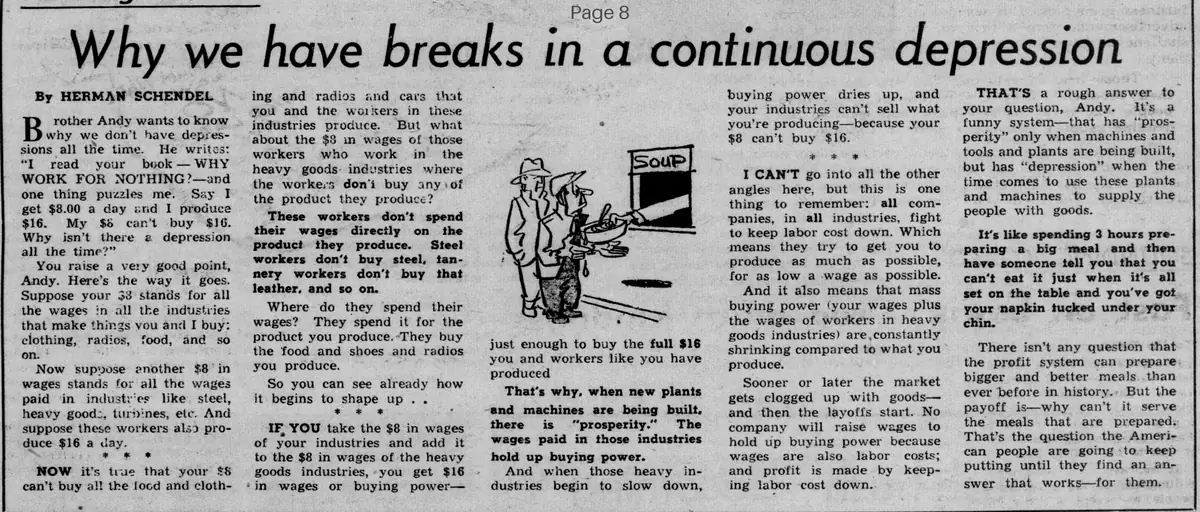
Why we have breaks in a continuous depression
By HERMAN SCHENDEL
Brother Andy wants to know why we don't have depressions all the time. He writes:
"I read your book—WHY WORK FOR NOTHING?—and one thing puzzles me. Say I get $8.00 a day and I produce $16. My $8 can't buy $16. Why isn't there a depression all the time?"
You raise a very good point, Andy. Here's the way it goes.
Suppose your $8 stands for all the wages in all the industries that make things you and I buy: clothing, radios, food, and so on.
Now suppose another $8 in wages stands for all the wages paid in industries like steel, heavy goods, turbines, etc. And suppose these workers also produce $16 a day.
Now it's true that your $8 can't buy all the food and clothing
and radios and cars that you and the workers in these industries produce. But what about the $8 in wages of those workers who work in the heavy goods industries where the workers don't buy any of the product they produce?
These workers don't spend their wages directly on the product they produce. Steel workers don't buy steel, tannery workers don't buy that leather, and so on.
Where do they spend their wages? They spend it for the product you produce. They buy the food and shoes and radios you produce.
So you can see already how it begins to shape up.
IF YOU take the $8 in wages of your industries and add it to the $8 in wages of the heavy goods industries, you get $16 in wages or buying power—just enough to buy the full $16 you and workers like you have produced.
That's why, when new plants and machines are being built, there is "prosperity." The wages paid in those industries hold up buying power.
And when those heavy industries begin to slow down, buying power dries up, and your industries can't sell what you're producing—because your $8 can't buy $16.
I CAN'T go into all the other angles here, but this is one thing to remember: all companies, in all industries, fight to keep labor cost down. Which means they try to get you to produce as much as possible, for as low a wage as possible.
And it also means that mass buying power (your wages plus the wages of workers in heavy goods industries) are constantly shrinking compared to what you produce.
Sooner or later the market gets clogged up with goods—and then the layoffs start. No company will raise wages to hold up buying power because wages are also labor costs; and profit is made by keeping labor cost down.
THAT'S a rough answer to your question, Andy. It's a funny system—that has "prosperity" only when machines and tools and plants are being built, but has "depression" when the time comes to use these plants and machines to supply the people with goods.
It's like spending 3 hours preparing a big meal and then have someone tell you that you can't eat it just when it's all set on the table and you've got your napkin tucked under your chin.
There isn't any question that the profit system can prepare bigger and better meals than ever before in history. But the payoff is—why can't it serve the meals that are prepared.
That's the question the American people are going to keep putting until they find an answer that works—for them.
By HERMAN SCHENDEL
Brother Andy wants to know why we don't have depressions all the time. He writes:
"I read your book—WHY WORK FOR NOTHING?—and one thing puzzles me. Say I get $8.00 a day and I produce $16. My $8 can't buy $16. Why isn't there a depression all the time?"
You raise a very good point, Andy. Here's the way it goes.
Suppose your $8 stands for all the wages in all the industries that make things you and I buy: clothing, radios, food, and so on.
Now suppose another $8 in wages stands for all the wages paid in industries like steel, heavy goods, turbines, etc. And suppose these workers also produce $16 a day.
Now it's true that your $8 can't buy all the food and clothing
and radios and cars that you and the workers in these industries produce. But what about the $8 in wages of those workers who work in the heavy goods industries where the workers don't buy any of the product they produce?
These workers don't spend their wages directly on the product they produce. Steel workers don't buy steel, tannery workers don't buy that leather, and so on.
Where do they spend their wages? They spend it for the product you produce. They buy the food and shoes and radios you produce.
So you can see already how it begins to shape up.
IF YOU take the $8 in wages of your industries and add it to the $8 in wages of the heavy goods industries, you get $16 in wages or buying power—just enough to buy the full $16 you and workers like you have produced.
That's why, when new plants and machines are being built, there is "prosperity." The wages paid in those industries hold up buying power.
And when those heavy industries begin to slow down, buying power dries up, and your industries can't sell what you're producing—because your $8 can't buy $16.
I CAN'T go into all the other angles here, but this is one thing to remember: all companies, in all industries, fight to keep labor cost down. Which means they try to get you to produce as much as possible, for as low a wage as possible.
And it also means that mass buying power (your wages plus the wages of workers in heavy goods industries) are constantly shrinking compared to what you produce.
Sooner or later the market gets clogged up with goods—and then the layoffs start. No company will raise wages to hold up buying power because wages are also labor costs; and profit is made by keeping labor cost down.
THAT'S a rough answer to your question, Andy. It's a funny system—that has "prosperity" only when machines and tools and plants are being built, but has "depression" when the time comes to use these plants and machines to supply the people with goods.
It's like spending 3 hours preparing a big meal and then have someone tell you that you can't eat it just when it's all set on the table and you've got your napkin tucked under your chin.
There isn't any question that the profit system can prepare bigger and better meals than ever before in history. But the payoff is—why can't it serve the meals that are prepared.
That's the question the American people are going to keep putting until they find an answer that works—for them.
What sub-type of article is it?
Economic Policy
Labor
What keywords are associated?
Economic Depressions
Buying Power
Wages Vs Production
Heavy Industries
Profit System
Labor Costs
Market Clogs
What entities or persons were involved?
Herman Schendel
Brother Andy
Companies
Workers
Editorial Details
Primary Topic
Explanation Of Intermittent Depressions In The Profit System
Stance / Tone
Critical Of Capitalist Profit System
Key Figures
Herman Schendel
Brother Andy
Companies
Workers
Key Arguments
Wages From Heavy Industries Sustain Buying Power For Consumer Goods During Construction Booms
Production Exceeds Wages, Leading To Market Clogs And Depressions
Companies Keep Labor Costs Low To Maximize Profits, Shrinking Buying Power
Profit System Creates Prosperity In Building Phases But Fails To Distribute Goods Effectively