Thank you for visiting SNEWPapers!
Sign up free
Navajo Times
Window Rock, Apache County, Arizona
What is this article about?
Congressman E.Y. Berry attacks AG Robert F. Kennedy's Life magazine article mocking Indian land claims, highlighting government resistance to compensating tribes for seized lands and broken treaties, with specifics on a Navajo case and ethical concerns. Speech from April 4, 1962 Congressional Record.
Merged-components note: Page 1 teaser explicitly refers to 'See Story on Page 5'; merged with main story and its continuation on page 6; relabeled continuation from editorial to story as it is narrative reporting.
Clippings
1 of 3
OCR Quality
Full Text
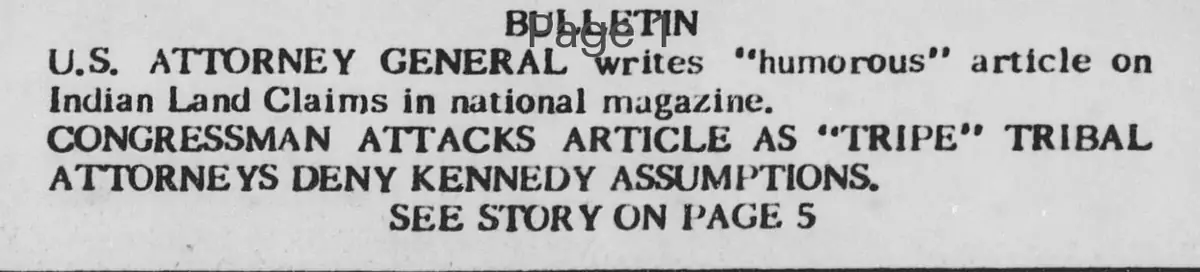
Congressman Attacks Article as "Tripe" Tribal Attorneys Deny Kennedy Assumptions.
See Story on Page 5
ATTORNEY GENERAL SURPRISED INDIANS ASK LAND PAY
Congressman Berry Lashes Bob Kennedy For Indian Article
Reproduced below is a speech recorded in the April 4 proceedings of the 87th Congress, Congressional Record, which was made by Congressman E. Y. Berry, Republican of South Dakota. In it, he takes violent issue with Attorney General Robert F. Kennedy for statements in an article by Kennedy entitled "Buying It Back from the Indians", which appeared in the March 23 issue of Life magazine. Congressman Berry is a member of the House Committee on Interior and Insular Affairs, a longtime Congressman and practicing lawyer, former newspaper editor and publisher.
Although the article deals with Indian Claims in general a Navajo Tribal claim case was specifically referred to by Kennedy as follows:
"In another instance, the government was skeptical of a claim that the Navajos had occupied an area for many years. The Navajos introduced into evidence a ridge pole from an old hogan. They contended that if the ridge pole was compared with another piece of wood from the same grove but cut only recently, the difference in ages would be indicated by the rings and it could thus show how long ago the ridge pole was cut."
Kennedy further stated, "It was good try, but Attorney William R. Lundin of the Indian Claims Section introduced evidence to show the growth rings are not necessarily annual and that different sections of a single tree sometimes show different numbers of rings"
Tribal attorneys state in rebuttal of Kennedy's statement that the "Tribe's dendrochronology evidence was based on one of the oldest and most commonly used methods of archeological examination to determine age of structures. This method is in common use by the federal government in such cases".
The government's alleged development "was based on a SINGLE experiment conducted by a dendrochronologist who for a short time was an employee of the University of Arizona. He made the study using a controlled growth system resorting to freezing and measured limb growth to determine the age of the tree."
By contrast a Tribal archeologist stated that the Tribe collected 3,604 specimens of which an estimated 40% yielded dates for the claim case. This is a very high percentage for yielding dates.
"The government presented their case on the basis of evidence of the only person known who has used this new system, while the tree ring specimens used by the Tribe were from trunks of trees. This is the commonly accepted system of the University of Arizona's Dendrochronology Laboratory which previously has been used by the government technicians."
A serious question is presented as to whether the Attorney General has violated legal ethics in printing information pertaining to a case in which he is counsel and which is undetermined.
The following is the speech of Congressman E.Y. Berry, in rebuttal to Attorney General Kennedy's article on "Buying It Back From the Indians". It is reproduced verbatim from the Congressional Record of April 4, 1962, except for editorial subheads.
INDIAN CLAIMS AGAINST THE FEDERAL GOVERNMENT
Mr. BERRY: Mr. Speaker, I believe anyone who has any knowledge of Indians and the Indian problems of America will agree with me that one of the most disgusting articles to appear in print in recent years is one appearing in the March issue of Life magazine over the authorship of Robert F. Kennedy, the Attorney General of the United States, entitled "Buying It Back From the Indians." This young man, brother of the President, who has been traveling all over the world, telling peoples of other nations what they must do and how they must get their own house in order, tells the world in this article how surprised he was to find that the United States must still pay for lands and property taken by force from the Indians, for which settlement has never been made by the Government.
The whole article, Mr. Speaker, is written with a view of making light of Indian claims against the Federal Government. It was really quite humorous to young Bobby to find that there have been some 370 claims filed before the Indian Claims Commission. It seems strange to me for him to set forth the fact that in 15 years only 33 of these claims have been finished, that 10 others are on appeal to the U.S. Court of Claims, and that some 76 are nearing completion and about 200 in various stages of trial.
Mr. Speaker, the reason these claims have not been settled is, because, as young Bobby indicates, the Federal Government has gone to every extreme in attempting to prove that the Indians are wrong, that the white man owes no money for the lands and property that he has taken from the Indians, that the Federal Government is not under obligation to keep its treaties with the Indian people."
BOATLOADS OF GOLD?
"Mr. Speaker, if the American Indian were located on any island in the world, or in any country in the world, other than within the United States, this same Federal Government would be flocking to that shore with boat loads of money trying to force them to take the cash and to use our gold and our currency to build up their economy --not so, Mr. Speaker, when these people live within our borders. Peoples all around the world, who are in equal living standards, who are in similar economic conditions, and who are even less interested in becoming civilized and raising their standards of living to those of the non-Indian people in the United States, are in their laps, year after year, having billions of dollars dumped through a program known as foreign aid but when it comes to aiding and assisting the Indians within the borders of America the Federal Government will give them nothing and Mr. Kennedy and his trained staff of assistants are taking every case to the highest court in the land to keep from paying the Indian the damages that are justly due to him."
COMPENSATION
"Mr. Speaker, I assume the purpose of this article to be cute and to make interesting reading for those who know nothing about Indians and the Indian problem. I suppose it may be interesting reading and quite light and trifling for a young man whose father is a multi-multi-millionaire and who has never wanted for anything, for a young man whose brother has become President of the United States and has appointed him to one of the most important Cabinet spots in America. To him it is funny. To him it is humorous to even think that someone who formerly owned property, who formerly owned territory, who formerly owned these regions, and who were driven out by force, should now have the audacity to ask compensation from this great Federal Government. To him it is probably humorous to imagine that the great grandfathers of the Sioux Indian people who lived in the State of South Dakota, for example, and who made a firm and binding contract with the Federal Government, believing that their contract and their treaty was as good as the gold behind it, only to find that neither the contract nor the treaty are worth the paper they were written on, and Bobbie's job is to get the courts to agree with this "treaty breaking" philosophy of the Department of Justice.
These are the things the young Attorney General tells the people of America were such a surprise to him. Why should the Indian people lay claim in damages for their lands?"
PRICE ASKED
In the Article he says:
"Another determination necessary in the Indian claims may be the most difficult of all. How much was the land in a specific area worth at the time it was acquired by the white man?
This, Mr. Speaker, is one of the most unfair questions that can be asked. Mr. Speaker, the price of land is or should be determined by what a willing seller is willing to accept from a willing buyer.
In not one single instance, Mr. Speaker, has there been the case of a willing seller and a willing buyer. In every claim before the Indian Claims Commission the Indians were not willing sellers, they were forced to sell, they were forced to move, they were forced to flee at the point of a gun. Neither was the Federal Army nor the white settlers a willing buyer. They took the land at the point of a gun. Yet the young Attorney General writes a voluminous article, telling about the numbers of attorneys he has working in the Archives, digging through old files, attempting to arrive at a fair market price for this land, at the time it was taken.
You can be sure, Mr. Speaker, the Federal Government has no one digging through the Archives attempting to represent the Indian people in trying to determine what
(Continued on Page 6)
ATTORNEY GENERAL
(Continued from Page 5)
would be just and fair for them, having been routed from their homes and forced to suffer from the inclemencies of winter storms and blizzards. No one is digging through the Archives attempting to compensate these people for these hardships suffered by them.
TREATIES
"The young Attorney General has not indicated that he plans to hire any help to dig into the meaning of some of the treaties with these Indian people, treaties wherein the Federal Government agreed to provide assistance for the Indians so long as the water shall flow and the grass is green. Possibly the Attorney General could find something humorous in those phrases if he tried. The Indian people can be sure of one thing, this young Attorney General will be turning all of his efforts and all of his talent toward defeating them in court, rather than paying them in justice."
BUSINESS LOSS
"In his article the young Attorney General had this to say: In a second case involving income from canoes, one Chippewa complained to the Commission about a personal loss, even though the Indian Claims Act does not provide for industrial claims. He held up a picture of an enormous canoe. He said it would hold 20, and judging by the picture there was no doubting him. "You've ruined my business," he said. "I used to get $5 a head for taking people over the rapids. Now the rapids are gone." The rapids, near Sault Ste. Marie, Mich., had been eliminated by construction of locks on the St. Mary's River.
"The white man may have taken away your business," responded Mr. Barney, appearing for the Government, "but he also gave you your business in the first place. The young Attorney General is using this example, Mr. Speaker, to make the Indian look silly before the reading public. It is no doubt true that this Indian had a large canoe that would hold 20 people and that he made a good living taking tourists over the rapids near Sault Ste. Marie, Mich. It may be real funny to the young Attorney General to think that he would come before the Claims Commission asking damages for the white man having taken away his business from him. This may seem real funny to him and to many of his readers."
TARIFFS
"I would point out, Mr. Speaker, that while the young Attorney General was writing his article and getting it sold to Life magazine, his brother, the President of the United States was writing another article. This article was a message to Congress in which the President of the United States asked the American taxpayer to give him the authority to cut tariffs or completely dispense with tariffs, permitting imports to come into this country from every foreign country in the world and then he asked Congress to provide subsidies and direct payments to the businesses and industries and firms that would be damaged by such competitive imports. In this message that the President was writing to Congress he not only asked Congress to subsidize the industries injured but also to subsidize the labor that was put out of jobs and the communities that were injured by both the industry being damaged and the labor being thrown out of work.
Nor, Mr. Speaker, it was a real scream for the youthful Attorney General to have an Indian come to the Federal Government to ask for a subsidy, because his industry had been injured by Federal manipulation, but it is strictly good business for the youthful President of the United States to come before Congress and ask for assistance to other industries injured by Federal manipulation of trade and tariffs. Is there so much difference between turning off the trade spigot and the water spigot in this river? Certainly there is a difference, Mr. Speaker. In one instance we are dealing with our own people-- good American citizens. In the other instance we are dealing with foreign investors and foreign industrialists and attempting to provide a market for them. When the young Attorney General tells about one person who is injured by Federal action this is a joke and sufficiently humorous to be able to sell his article to a large publishing company. When the other brother provides a parallel situation it is dead serious and he claims the subsidies must be paid to American industries and American labor and American communities in order to protect the American economy."
ATOMIC ARROWS?
"The young Attorney General continues in his article by saying: And yet I have to remind myself that in this area the spirit of the New Frontier must be tempered to cope with the unique problems of the old frontier--and these are not simply legal problems. I am not sure, Mr. Speaker, whether this is intended as a witticism or a statement of a fact. If it is a witticism it is a very humble attempt and if it is a fact then Congress should begin to take action. If the New Frontier is to serve the Indian people as the old frontier did, then the Indian people had better get atomic warheads on their arrows and head toward Washington because in the old frontier the Army moved westward with the pioneer. They rounded up the Indians and placed them in concentration camps and then down through the years they forced the Indian to live on these concentration camp areas. In later years they became known as Indian reservations--the poorest, the most worthless soil of any land in the area."
EXPORT INDIAN AID SYSTEM?
"It was 50 years ago that the Federal Government established what is today known as "foreign aid" on all of these Indian reservations and after 50 years of foreign aid in which the purpose of the Government was to bring the Indian people up to the standard of living of the non-Indian people they are beginning to discover that the system has been wrong for 50 years, that it has been a complete failure, so this system that has proven worthless and valueless, this system that has wasted two generations of Indian people, is now being copied by the State Department and tried again in every country in the free world. Yes, the youthful Attorney General, who was so surprised when he moved into his office to find that the Indian people might have the intestinal fortitude to claim payment for that which is rightfully theirs, now must remind himself that in this era the spirit of the New Frontier must be tempered to cope with the unique problems of the old frontier. Mr. Speaker, if the Kennedy boys are so hard up financially that they must use the prestige of their offices to sell this kind of tripe to the publishers of the Nation, working on taxpayers' time and putting the proceeds from the sale in their own private pockets, they should at least vent their humor on someone and some group other than the Indian people. They scream about civil rights and the minorities in the South but they make money and sell magazine stories by tearing down the minority groups in the North. Mr. Speaker, this, in my judgment, is an unpardonable sin."
What sub-type of article is it?
What themes does it cover?
What keywords are associated?
What entities or persons were involved?
Where did it happen?
Story Details
Key Persons
Location
United States
Event Date
April 4, 1962
Story Details
Congressman E. Y. Berry delivers a speech criticizing Attorney General Robert F. Kennedy's Life magazine article 'Buying It Back from the Indians,' which mocks government obligations to compensate tribes for seized lands, including a Navajo dendrochronology claim rebuttal and broader treaty violations.