Thank you for visiting SNEWPapers!
Sign up free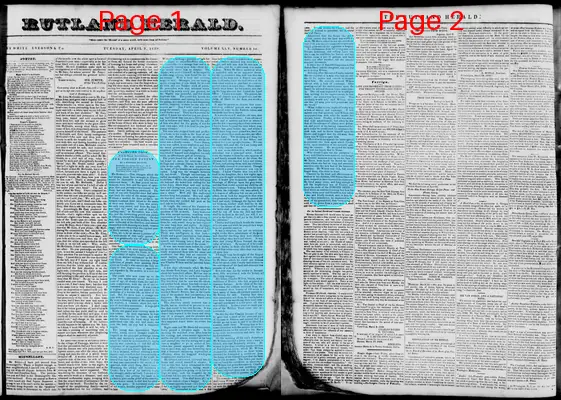
Literary
April 9, 1839
Rutland Herald
Rutland, Rutland County, Vermont
What is this article about?
In 1819 Illinois frontier, a young Bostonian, Charles Wilson, falls ill and is aided by Simon Davis and daughter Lucy after being shunned. Their farm's patent is forged by villain Squire Crosby. Wilson reveals he owns the land, exposes the forgery, marries Lucy, and rewards the family's kindness with security.
Merged-components note: Continuation of the story 'The Forged Patent' across pages.
Clippings
1 of 2
OCR Quality
95%
Excellent
Full Text
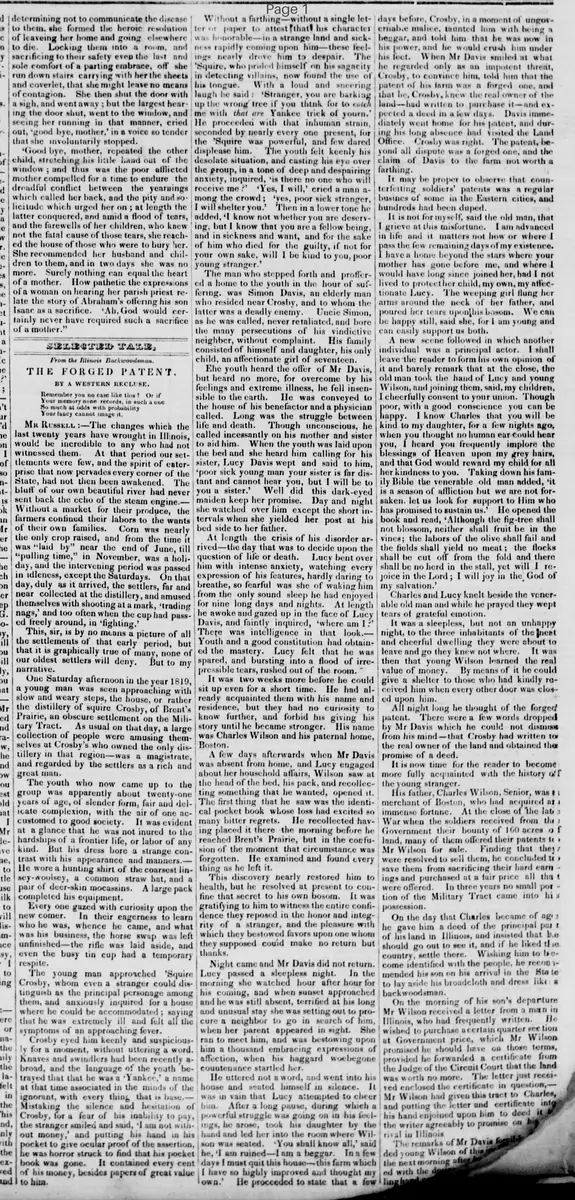
SELECTED TALE.
From the Illinois Backwoodsman.
THE FORGED PATENT.
BY A WESTERN RECLUSE.
Remember you no case like this? Or if
Your memory none records, in such a one
So much at odds with probability
Your fancy cannot image it.
MR. Russell: - The changes which the last twenty years have wrought in Illinois, would be incredible to any who had not witnessed them. At that period our settlements were few, and the spirit of enterprise that now pervades every corner of the State, had not then been awakened. The bluff of our own beautiful river had never sent back the echo of the steam engine. - Without a market for their produce, the farmers confined their labors to the wants of their own families. Corn was nearly the only crop raised, and from the time it was "laid by" near the end of June, till "pulling time," in November, was a holiday, and the intervening period was passed in idleness, except the Saturdays. On that day, duly as it arrived, the settlers, far and near collected at the distillery, and amused themselves with shooting at a mark, 'trading nags,' and too often when the cup had passed freely around, in 'fighting.' This, sir, is by no means a picture of all the settlements of that early period, but that it is graphically true of many, none of our oldest settlers will deny.
But to my narrative.
One Saturday afternoon in the year 1819, a young man was seen approaching with slow and weary steps, the house, or rather the distillery of Squire Crosby, of Brent's Prairie, an obscure settlement on the Military Tract. As usual on that day, a large collection of people were amusing themselves at Crosby's who owned the only distillery in that region - was a magistrate, and regarded by the settlers as a rich and great man.
The youth who now came up to the group was apparently about twenty-one years of age, of slender form, fair and delicate complexion, with the air of one accustomed to good society. It was evident at a glance that he was not inured to the hardships of a frontier life, or labor of any kind. But his dress bore a strange contrast with his appearance and manners. - He wore a hunting shirt of the coarsest linsey-woolsey, a common straw hat, and a pair of deer-skin moccasins. A large pack completed his equipment.
Every one gazed with curiosity upon the new comer. In their eagerness to learn who he was, whence he came, and what was his business, the horse swap was left unfinished - the rifle was laid aside, and even the busy tin cup had a temporary respite.
The young man approached 'Squire Crosby, whom even a stranger could distinguish as the principal personage among them, and anxiously inquired for a house where he could be accommodated; saying that he was extremely ill and felt all the symptoms of an approaching fever.
Crosby eyed him keenly and suspiciously for a moment, without uttering a word. Knaves and swindlers had been recently abroad, and the language of the youth betrayed that he was a 'Yankee,' a name at that time associated in the minds of the ignorant, with every thing that is base. - Mistaking the silence and hesitation of Crosby, for a fear of his inability to pay, the stranger smiled and said, 'I am not without money,' and putting his hand in his pocket to give ocular proof of the assertion, he was horror struck to find that his pocket book was gone.
It contained every cent of his money, besides papers of great value to him.
Without a farthing - without a single letter or paper to attest that his character was honorable - in a strange land and sickness rapidly coming upon him these feelings nearly drove him to despair. The Squire, who prided himself on his sagacity in detecting villains, now found the use of his tongue. With a loud and sneering laugh he said: 'Stranger, you are barking up the wrong tree if you think for to cotch me with that are Yankee trick of yourn.' He proceeded with that inhuman strain, seconded by nearly every one present, for the 'Squire was powerful, and few dared displease him. The youth felt keenly his desolate situation, and casting his eye over the group, in a tone of deep and despairing anxiety, inquired, 'is there no one who will receive me?' 'Yes, I will,' cried a man among the crowd; 'yes, poor sick stranger, I will shelter you.' Then in a lower tone he added, 'I know not whether you are deserving, but I know that you are a fellow being, and in sickness and want, and for the sake of him who died for the guilty, if not for your own sake, will I be kind to you, poor young stranger.'
The man who stepped forth and proffered a home to the youth in the hour of suffering, was Simon Davis, an elderly man who resided near Crosby, and to whom the latter was a deadly enemy. Uncle Simon, as he was called, never retaliated, and bore the many persecutions of his vindictive neighbor, without complaint. His family consisted of himself and daughter, his only child, an affectionate girl of seventeen.
The youth heard the offer of Mr. Davis, but heard no more, for overcome by his feelings and extreme illness, he fell insensible to the earth. He was conveyed to the house of his benefactor and a physician called. Long was the struggle between life and death. Though unconscious, he called incessantly on his mother and sister to aid him. When the youth was laid upon the bed and she heard him calling for his sister, Lucy Davis wept and said to him, 'poor sick young man your sister is far distant and cannot hear you, but I will be to you a sister.' Well did this dark-eyed maiden keep her promise. Day and night she watched over him except the short intervals when she yielded her post at his bed side to her father.
At length the crisis of his disorder arrived - the day that was to decide upon the question of life or death. Lucy bent over him with intense anxiety, watching every expression of his features, hardly daring to breathe, so fearful was she of waking him from the only sound sleep he had enjoyed for nine long days and nights. At length he awoke and gazed up in the face of Lucy Davis, and faintly inquired, 'where am I?'
There was intelligence in that look. - Youth and a good constitution had obtained the mastery. Lucy felt that he was spared, and bursting into a flood of irrepressible tears, rushed out of the room.
It was two weeks more before he could sit up even for a short time. He had already acquainted them with his name and residence, but they had no curiosity to know further, and forbid his giving his story until he became stronger. His name was Charles Wilson and his paternal home, Boston.
A few days afterwards when Mr. Davis was absent from home, and Lucy engaged about her household affairs, Wilson saw at the head of the bed, his pack, and recollecting something that he wanted, opened it. The first thing that he saw was the identical pocket book whose loss had excited so many bitter regrets. He recollected having placed it there the morning before he reached Brent's Prairie, but in the confusion of the moment that circumstance was forgotten. He examined and found every thing as he left it.
This discovery nearly restored him to health, but he resolved at present to confine that secret to his own bosom. It was gratifying to him to witness the entire confidence they reposed in the honor and integrity of a stranger, and the pleasure with which they bestowed favors upon one whom they supposed could make no return but thanks.
Night came and Mr. Davis did not return. Lucy passed a sleepless night. In the morning she watched hour after hour for his coming, and when sunset approached and he was still absent, terrified at his long and unusual stay she was setting out to procure a neighbor to go in search of him, when her parent appeared in sight. She ran to meet him, and was bestowing upon him a thousand embracing expressions of affection, when his haggard woebegone countenance startled her.
He uttered not a word, and went into his house and seated himself in silence. It was in vain that Lucy attempted to cheer him. After a long pause, during which a powerful struggle was going on in his feelings, he arose, took his daughter by the hand and led her into the room where Wilson was seated. 'You shall know all,' said he, 'I am ruined - I am a beggar. In a few days I must quit this house - this farm which I have so highly improved and thought my own.'
He proceeded to state that a few days before, Crosby, in a moment of ungovernable malice, taunted him with being a beggar, and told him that he was now in his power, and he would crush him under his feet. When Mr. Davis smiled at what he regarded only as an impotent threat, Crosby, to convince him, told him that the patent of his farm was a forged one, and that he, Crosby, knew the real owner of the land - had written to purchase it - and expected a deed in a few days. Davis immediately went home for his patent, and during his long absence had visited the Land Office. Crosby was right. The patent, beyond all dispute was a forged one, and the claim of Davis to the farm not worth a farthing.
It may be proper to observe that counterfeiting soldiers' patents was a regular business of some in the Eastern cities, and hundreds had been duped.
It is not for myself, said the old man, that I grieve at this misfortune. I am advanced in life and it matters not how or where I pass the few remaining days of my existence. I have a home beyond the stars where your mother has gone before me, and where I would have long since joined her, had I not lived to protect her child, my own, my affectionate Lucy. The weeping girl flung her arms around the neck of her father, and poured her tears upon his bosom. We can be happy still, said she, for I am young and can easily support us both.
A new scene followed in which another individual was a principal actor. I shall leave the reader to form his own opinion of it and barely remark that at the close, the old man took the hand of Lucy and young Wilson, and joining them, said, my children, I cheerfully consent to your union. Though poor, with a good conscience you can be happy. I know Charles that you will be kind to my daughter, for a few nights ago, when you thought no human ear could hear you, I heard you frequently implore the blessings of Heaven upon my grey hairs, and that God would reward my child for all her kindness to you. Taking down his family Bible the venerable old man added, 'it is a season of affliction but we are not forsaken. Let us look for support to Him who has promised to sustain us.' He opened the book and read, 'Although the fig-tree shall not blossom, neither shall fruit be in the vines; the labors of the olive shall fail and the fields shall yield no meat: the flocks shall be cut off from the fold and there shall be no herd in the stall. Yet will I rejoice in the Lord: I will joy in the God of my salvation.'
Charles and Lucy knelt beside the venerable old man and while he prayed they wept tears of grateful emotion.
It was a sleepless, but not an unhappy night, to the three inhabitants of the neat and cheerful dwelling they were about to leave and go they knew not where. It was then that young Wilson learned the real value of money. By means of it he could give a shelter to those who had kindly received him when every other door was closed upon him.
All night long he thought of the forged patent. There were a few words dropped by Mr. Davis which he could not dismiss from his mind - that Crosby had written to the real owner of the land and obtained the promise of a deed.
It is now time for the reader to become more fully acquainted with the history of the young stranger.
His father, Charles Wilson, Senior, was a merchant of Boston, who had acquired an immense fortune. At the close of the late war when the soldiers received from the Government their bounty of 160 acres of land, many of them offered their patents to Mr. Wilson for sale. Finding that they were resolved to sell them, he concluded to save them from sacrificing their hard earnings and purchased at a fair price all that were offered. In three years no small portion of the Military Tract came into his possession.
On the day that Charles became of age he gave him a deed of the principal part of his land in Illinois, and insisted that he should go out to see it, and if he liked the country, settle there. Wishing him to become identified with the people, he recommended his son on his arrival in the State to lay aside his broadcloth and dress like a backwoodsman.
On the morning of his son's departure Mr. Wilson received a letter from a man in Illinois, who had frequently written. He wished to purchase a certain quarter section at Government price, which Mr. Wilson promised he should have on those terms, provided he forwarded a certificate from the Judge of the Circuit Court that the land was worth no more. The letter just received enclosed the certificate in question. - Mr. Wilson had given this tract to Charles, and putting the letter and certificate into his hand enjoined upon him to deed it the writer agreeably to promise on his arrival in Illinois.
cate. It was written by Crosby, and the land he wished to purchase, the identical farm of Davis. Astonished that his friend the judge should certify that the land was worth no more, Mr. Davis asked to see the certificate and after a moment's examination unhesitatingly pronounced the signature a forgery. An explanation from the young man now became necessary, and calling Lucy into the room, he told them his history and laid before them a pile of patents and bank notes, one after another, till the amount reached thousands. It was a day of thankful happiness to Old Simon Davis and his daughter, and not less so to young Wilson. Not long after this scene Crosby entered. His air was that of a man who had an enemy in his power and intends to trample upon him. He scarcely noticed Wilson except with a look of contempt. After pouring out all his maledictions upon the family he advised them to leave immediately. The old man inquired if he would give him nothing for the improvements he had made? the answer was 'not a cent.' 'You certainly would not,' said Wilson, 'drive out this old man poor and penniless into the world?' 'What is that to you,' replied Crosby with a look of malice and contempt. 'I will answer you that question,' said Wilson, and acquainted him with what the reader has already learnt. Crosby, at first was stupefied with astonishment, but when he saw that all his schemes of villainy were defeated, and proof of his having committed forgery could be established, his assurance forsook him, and he threw himself upon his knees, and begged first the old man, then Lucy and Wilson to spare him. Affected with his appeals the latter agreed to purchase the farm upon which Crosby lived, upon condition of his instantly quitting the country. He accepted the terms and with his family fled to Texas. Why should I spin out the narrative? Lucy and Charles were married, and though a splendid mansion rose up on the farm of Mr. Davis, both loved far better the little room where she had so long and anxiously watched over the sick bed of the homeless stranger. Mr. Wilson was rich, but never forgot those who were in want. Cheered by the kind and affectionate attention of his children, Old Simon Davis almost seemed to have renewed his existence. He lived many years, and long enough to tell the bright-eyed son of Charles and Lucy the story of the FORGED DEED. And when he told the listening boy how his father, when poor and friendless, was taken home and kindly treated, and in turn became their benefactor, he impressed on the mind of his grandchild, that "even a cup of cold water, given from a pure motive, shall not lose its reward."
From the Illinois Backwoodsman.
THE FORGED PATENT.
BY A WESTERN RECLUSE.
Remember you no case like this? Or if
Your memory none records, in such a one
So much at odds with probability
Your fancy cannot image it.
MR. Russell: - The changes which the last twenty years have wrought in Illinois, would be incredible to any who had not witnessed them. At that period our settlements were few, and the spirit of enterprise that now pervades every corner of the State, had not then been awakened. The bluff of our own beautiful river had never sent back the echo of the steam engine. - Without a market for their produce, the farmers confined their labors to the wants of their own families. Corn was nearly the only crop raised, and from the time it was "laid by" near the end of June, till "pulling time," in November, was a holiday, and the intervening period was passed in idleness, except the Saturdays. On that day, duly as it arrived, the settlers, far and near collected at the distillery, and amused themselves with shooting at a mark, 'trading nags,' and too often when the cup had passed freely around, in 'fighting.' This, sir, is by no means a picture of all the settlements of that early period, but that it is graphically true of many, none of our oldest settlers will deny.
But to my narrative.
One Saturday afternoon in the year 1819, a young man was seen approaching with slow and weary steps, the house, or rather the distillery of Squire Crosby, of Brent's Prairie, an obscure settlement on the Military Tract. As usual on that day, a large collection of people were amusing themselves at Crosby's who owned the only distillery in that region - was a magistrate, and regarded by the settlers as a rich and great man.
The youth who now came up to the group was apparently about twenty-one years of age, of slender form, fair and delicate complexion, with the air of one accustomed to good society. It was evident at a glance that he was not inured to the hardships of a frontier life, or labor of any kind. But his dress bore a strange contrast with his appearance and manners. - He wore a hunting shirt of the coarsest linsey-woolsey, a common straw hat, and a pair of deer-skin moccasins. A large pack completed his equipment.
Every one gazed with curiosity upon the new comer. In their eagerness to learn who he was, whence he came, and what was his business, the horse swap was left unfinished - the rifle was laid aside, and even the busy tin cup had a temporary respite.
The young man approached 'Squire Crosby, whom even a stranger could distinguish as the principal personage among them, and anxiously inquired for a house where he could be accommodated; saying that he was extremely ill and felt all the symptoms of an approaching fever.
Crosby eyed him keenly and suspiciously for a moment, without uttering a word. Knaves and swindlers had been recently abroad, and the language of the youth betrayed that he was a 'Yankee,' a name at that time associated in the minds of the ignorant, with every thing that is base. - Mistaking the silence and hesitation of Crosby, for a fear of his inability to pay, the stranger smiled and said, 'I am not without money,' and putting his hand in his pocket to give ocular proof of the assertion, he was horror struck to find that his pocket book was gone.
It contained every cent of his money, besides papers of great value to him.
Without a farthing - without a single letter or paper to attest that his character was honorable - in a strange land and sickness rapidly coming upon him these feelings nearly drove him to despair. The Squire, who prided himself on his sagacity in detecting villains, now found the use of his tongue. With a loud and sneering laugh he said: 'Stranger, you are barking up the wrong tree if you think for to cotch me with that are Yankee trick of yourn.' He proceeded with that inhuman strain, seconded by nearly every one present, for the 'Squire was powerful, and few dared displease him. The youth felt keenly his desolate situation, and casting his eye over the group, in a tone of deep and despairing anxiety, inquired, 'is there no one who will receive me?' 'Yes, I will,' cried a man among the crowd; 'yes, poor sick stranger, I will shelter you.' Then in a lower tone he added, 'I know not whether you are deserving, but I know that you are a fellow being, and in sickness and want, and for the sake of him who died for the guilty, if not for your own sake, will I be kind to you, poor young stranger.'
The man who stepped forth and proffered a home to the youth in the hour of suffering, was Simon Davis, an elderly man who resided near Crosby, and to whom the latter was a deadly enemy. Uncle Simon, as he was called, never retaliated, and bore the many persecutions of his vindictive neighbor, without complaint. His family consisted of himself and daughter, his only child, an affectionate girl of seventeen.
The youth heard the offer of Mr. Davis, but heard no more, for overcome by his feelings and extreme illness, he fell insensible to the earth. He was conveyed to the house of his benefactor and a physician called. Long was the struggle between life and death. Though unconscious, he called incessantly on his mother and sister to aid him. When the youth was laid upon the bed and she heard him calling for his sister, Lucy Davis wept and said to him, 'poor sick young man your sister is far distant and cannot hear you, but I will be to you a sister.' Well did this dark-eyed maiden keep her promise. Day and night she watched over him except the short intervals when she yielded her post at his bed side to her father.
At length the crisis of his disorder arrived - the day that was to decide upon the question of life or death. Lucy bent over him with intense anxiety, watching every expression of his features, hardly daring to breathe, so fearful was she of waking him from the only sound sleep he had enjoyed for nine long days and nights. At length he awoke and gazed up in the face of Lucy Davis, and faintly inquired, 'where am I?'
There was intelligence in that look. - Youth and a good constitution had obtained the mastery. Lucy felt that he was spared, and bursting into a flood of irrepressible tears, rushed out of the room.
It was two weeks more before he could sit up even for a short time. He had already acquainted them with his name and residence, but they had no curiosity to know further, and forbid his giving his story until he became stronger. His name was Charles Wilson and his paternal home, Boston.
A few days afterwards when Mr. Davis was absent from home, and Lucy engaged about her household affairs, Wilson saw at the head of the bed, his pack, and recollecting something that he wanted, opened it. The first thing that he saw was the identical pocket book whose loss had excited so many bitter regrets. He recollected having placed it there the morning before he reached Brent's Prairie, but in the confusion of the moment that circumstance was forgotten. He examined and found every thing as he left it.
This discovery nearly restored him to health, but he resolved at present to confine that secret to his own bosom. It was gratifying to him to witness the entire confidence they reposed in the honor and integrity of a stranger, and the pleasure with which they bestowed favors upon one whom they supposed could make no return but thanks.
Night came and Mr. Davis did not return. Lucy passed a sleepless night. In the morning she watched hour after hour for his coming, and when sunset approached and he was still absent, terrified at his long and unusual stay she was setting out to procure a neighbor to go in search of him, when her parent appeared in sight. She ran to meet him, and was bestowing upon him a thousand embracing expressions of affection, when his haggard woebegone countenance startled her.
He uttered not a word, and went into his house and seated himself in silence. It was in vain that Lucy attempted to cheer him. After a long pause, during which a powerful struggle was going on in his feelings, he arose, took his daughter by the hand and led her into the room where Wilson was seated. 'You shall know all,' said he, 'I am ruined - I am a beggar. In a few days I must quit this house - this farm which I have so highly improved and thought my own.'
He proceeded to state that a few days before, Crosby, in a moment of ungovernable malice, taunted him with being a beggar, and told him that he was now in his power, and he would crush him under his feet. When Mr. Davis smiled at what he regarded only as an impotent threat, Crosby, to convince him, told him that the patent of his farm was a forged one, and that he, Crosby, knew the real owner of the land - had written to purchase it - and expected a deed in a few days. Davis immediately went home for his patent, and during his long absence had visited the Land Office. Crosby was right. The patent, beyond all dispute was a forged one, and the claim of Davis to the farm not worth a farthing.
It may be proper to observe that counterfeiting soldiers' patents was a regular business of some in the Eastern cities, and hundreds had been duped.
It is not for myself, said the old man, that I grieve at this misfortune. I am advanced in life and it matters not how or where I pass the few remaining days of my existence. I have a home beyond the stars where your mother has gone before me, and where I would have long since joined her, had I not lived to protect her child, my own, my affectionate Lucy. The weeping girl flung her arms around the neck of her father, and poured her tears upon his bosom. We can be happy still, said she, for I am young and can easily support us both.
A new scene followed in which another individual was a principal actor. I shall leave the reader to form his own opinion of it and barely remark that at the close, the old man took the hand of Lucy and young Wilson, and joining them, said, my children, I cheerfully consent to your union. Though poor, with a good conscience you can be happy. I know Charles that you will be kind to my daughter, for a few nights ago, when you thought no human ear could hear you, I heard you frequently implore the blessings of Heaven upon my grey hairs, and that God would reward my child for all her kindness to you. Taking down his family Bible the venerable old man added, 'it is a season of affliction but we are not forsaken. Let us look for support to Him who has promised to sustain us.' He opened the book and read, 'Although the fig-tree shall not blossom, neither shall fruit be in the vines; the labors of the olive shall fail and the fields shall yield no meat: the flocks shall be cut off from the fold and there shall be no herd in the stall. Yet will I rejoice in the Lord: I will joy in the God of my salvation.'
Charles and Lucy knelt beside the venerable old man and while he prayed they wept tears of grateful emotion.
It was a sleepless, but not an unhappy night, to the three inhabitants of the neat and cheerful dwelling they were about to leave and go they knew not where. It was then that young Wilson learned the real value of money. By means of it he could give a shelter to those who had kindly received him when every other door was closed upon him.
All night long he thought of the forged patent. There were a few words dropped by Mr. Davis which he could not dismiss from his mind - that Crosby had written to the real owner of the land and obtained the promise of a deed.
It is now time for the reader to become more fully acquainted with the history of the young stranger.
His father, Charles Wilson, Senior, was a merchant of Boston, who had acquired an immense fortune. At the close of the late war when the soldiers received from the Government their bounty of 160 acres of land, many of them offered their patents to Mr. Wilson for sale. Finding that they were resolved to sell them, he concluded to save them from sacrificing their hard earnings and purchased at a fair price all that were offered. In three years no small portion of the Military Tract came into his possession.
On the day that Charles became of age he gave him a deed of the principal part of his land in Illinois, and insisted that he should go out to see it, and if he liked the country, settle there. Wishing him to become identified with the people, he recommended his son on his arrival in the State to lay aside his broadcloth and dress like a backwoodsman.
On the morning of his son's departure Mr. Wilson received a letter from a man in Illinois, who had frequently written. He wished to purchase a certain quarter section at Government price, which Mr. Wilson promised he should have on those terms, provided he forwarded a certificate from the Judge of the Circuit Court that the land was worth no more. The letter just received enclosed the certificate in question. - Mr. Wilson had given this tract to Charles, and putting the letter and certificate into his hand enjoined upon him to deed it the writer agreeably to promise on his arrival in Illinois.
cate. It was written by Crosby, and the land he wished to purchase, the identical farm of Davis. Astonished that his friend the judge should certify that the land was worth no more, Mr. Davis asked to see the certificate and after a moment's examination unhesitatingly pronounced the signature a forgery. An explanation from the young man now became necessary, and calling Lucy into the room, he told them his history and laid before them a pile of patents and bank notes, one after another, till the amount reached thousands. It was a day of thankful happiness to Old Simon Davis and his daughter, and not less so to young Wilson. Not long after this scene Crosby entered. His air was that of a man who had an enemy in his power and intends to trample upon him. He scarcely noticed Wilson except with a look of contempt. After pouring out all his maledictions upon the family he advised them to leave immediately. The old man inquired if he would give him nothing for the improvements he had made? the answer was 'not a cent.' 'You certainly would not,' said Wilson, 'drive out this old man poor and penniless into the world?' 'What is that to you,' replied Crosby with a look of malice and contempt. 'I will answer you that question,' said Wilson, and acquainted him with what the reader has already learnt. Crosby, at first was stupefied with astonishment, but when he saw that all his schemes of villainy were defeated, and proof of his having committed forgery could be established, his assurance forsook him, and he threw himself upon his knees, and begged first the old man, then Lucy and Wilson to spare him. Affected with his appeals the latter agreed to purchase the farm upon which Crosby lived, upon condition of his instantly quitting the country. He accepted the terms and with his family fled to Texas. Why should I spin out the narrative? Lucy and Charles were married, and though a splendid mansion rose up on the farm of Mr. Davis, both loved far better the little room where she had so long and anxiously watched over the sick bed of the homeless stranger. Mr. Wilson was rich, but never forgot those who were in want. Cheered by the kind and affectionate attention of his children, Old Simon Davis almost seemed to have renewed his existence. He lived many years, and long enough to tell the bright-eyed son of Charles and Lucy the story of the FORGED DEED. And when he told the listening boy how his father, when poor and friendless, was taken home and kindly treated, and in turn became their benefactor, he impressed on the mind of his grandchild, that "even a cup of cold water, given from a pure motive, shall not lose its reward."
What sub-type of article is it?
Prose Fiction
What themes does it cover?
Moral Virtue
Religious
What keywords are associated?
Forged Patent
Illinois Frontier
Moral Tale
Kindness Rewarded
Land Ownership
Frontier Life
Religious Faith
What entities or persons were involved?
By A Western Recluse.
Literary Details
Title
The Forged Patent.
Author
By A Western Recluse.
Key Lines
'Poor Sick Young Man Your Sister Is Far Distant And Cannot Hear You, But I Will Be To You A Sister.'
'Although The Fig Tree Shall Not Blossom, Neither Shall Fruit Be In The Vines; The Labors Of The Olive Shall Fail And The Fields Shall Yield No Meat: The Flocks Shall Be Cut Off From The Fold And There Shall Be No Herd In The Stall. Yet Will I Rejoice In The Lord: I Will Joy In The God Of My Salvation.'
"Even A Cup Of Cold Water, Given From A Pure Motive, Shall Not Lose Its Reward."